Cognition and storytelling

Apparently, there has been considerable excitement in the humanities and literature worlds concerning new discoveries in neurology and cognition. And while I have been thinking and reading along these lines for years in my own auto-didactic way, I’ve only recently stumbled upon the texts that specifically explore this cross-fertilization of the arts and sciences.

AWP featured a standing-room-only panel on the topic of Cognitive Science and Stories that alerted me to the work of Brian Boyd (more books for the to-read pile), for example; and just this past week, Annie Murphy Paul contributed an opinion essay titled “Your Brain on Fiction” to the New York Times Sunday Review. Oliver Sacks has, of course, worked along this territory for many years, mostly from the neurological viewpoint with research that suggests we consider the relationship of brain science to art. Leonard Shlain has written intriguing books on the subject as well; though he focuses on gender and visual/textual creativity in his earlier work (see The Alphabet vs. the Goddess), his more recent Art & Physics: Parallel Visions in Space, Time, and Light takes on the “rational” brain (physics) and the world and work of art.

The science, which encompasses both ‘hard science’ such as neurology and social science such as psychology, uses fMRI brain imaging and other forms of feedback measurement to record the brain’s responses to imagery, metaphor, descriptive writing, emotionally-evocative literary passages, and other stimuli to gauge how the human brain takes in such stimuli and which regions of the brain ‘fire’ when encountering the materials.

Associations rule. Reading is associative.  The word “coffee,” as it turns out, engages the olfactory regions; so does the word “cinnamon.” Tactile word cues (velvet, sandy, rough) arouse sensory regions, notes Paul. We associate meaning with senses. Or perhaps senses evoke, in the human mind, associated meanings. This is one reason poetry engages its readers; poetry works via a series of different types of arousals by association–allusions to previously-known information, metaphorical associations by means of sensory-related responses, stimulation of brain regions by word-association, and also cultural or social association (contextual cues, which may also be physical). All of this means that the act of reading is an embodied behavior–we are actively encoding physical settings and sensations while we read!

Human brains fill in the gaps in memory and in event-series that may or may not be related. Some of these neurological studies suggest human brains seek patterns…and construct narratives. Hence, story-making may be something that evolved along with the human cortex while we learned that a growl in the bushes is likely to equal a hidden predator and that if we convey this information by narrative (or metaphor) it will be recalled more quickly by our listener. If the listener is offspring, and the lesson is remembered and used appropriately, the genes survive another generation. That scenario sounds pretty scientific/Darwinian; but to a writer or artist, the scenario is lush with the possibility of story-myth-legend-fiction-poem-art.

Storytelling facilitates sociality, claims Tim Horvath, who explained to the attendees at the AWP conference that sociality is the biologist’s “reciprocal altruism.” Because fiction meta-represents life, it simulates possible life scenarios that can help to foster understanding and offers a way to test out possible social reactions to behavior in a way that is low-risk for the reader. The reader can imagine, or play along, with the rebellious heroine and through this adaptive play (reading can be a form of play) learn how others around her might react if she were to try a similar form of rebellion. Indeed, Marilynne Robinson agrees that “The great virtue of the best fiction is to teach compassion.”

I look forward to learning more about the cognitive side of human narrative. I love it when science and the humanities discourse with one another.

Non-sense

Let me pick up from my brief post of yesterday, which concerned in part the value of asking the nonsensical rather than (or in addition to) the rational question. What led me to that topic is the recent death, at age 101, of artist Dorothea Tanning, whose work–both visual and textual–is often considered surrealistic.

Surrealism goes in and out of fashion, and I am not planning to comment critically on its aesthetic value; but I will say that I have admired and been influenced by artists working in the surrealist oeuvre and that I enjoy the way “nonsense” and  “non-sense” can lead to juxtapositions of ideas and images that have proven fruitful for my own creative work process.

The nonsensical question may follow along the lines of:

How does the sunflower feel when a bird feeds on it?

Non-rational, because the sunflower does not–as far as we know, in the rational/sentient way–feel anything emotionally; the jury may be out on whether there are tactile receptors in a sunflower that can feel anything physically. To answer the nonsensical question in this case requires a kind of metaphor or animation of the inanimate. (We could also argue the inanimate status of a sunflower seed-head.)

Further nonsensical inquiry could lead us to “What does the goldfinch say to the sunflower?” or, more nonsensical still, “What would a sunflower say to an electric guitar?”

Non-rational prompts can provoke interesting results in the process of creative thinking.

Back to Tanning. Her life itself was a creative process. Check out the biographies of her that are popping up online in response to her death. While I am not a fan of all of her work in her various media, I love her vivid and exciting explorations. Here’s one of her early, less-experimental works that appeals to me because of its imagery. I identify with this painting.

“What would it feel like to wear a nest on one’s head?”
As a poet, she was strongest in the area of visual figures (no surprise there). I’m running out of time now, so I will close with an excerpt from one of Tanning’s poems:
There was a time
of middle distance, unforgettable,
a sort of lace-cut
flame-green filament
to ravish my
skin-tight eyes.
I take that back—
it was forgettable but not
entirely if you
consider my
heavenly bodies . . .
I loved them so.
Heaven’s motes sift
to salt-white—paint is ground
to silence; and I,
I am bound, unquiet,
a shade of blue
in the studio.
(The entire poem, “Sequestrienne,” is here.)
For another surrealist whose poetry is not always classically surreal, see my posts on Eluard .

Exploded clay art

Steve Tobin’s exploded clay works showing at Moravian College’s Payne Gallery. Opens this week.

Teaching analysis & meaning

My students want to jump to conclusions.

Give them a text, a work of art to view and consider, a billboard, a musical selection…they will make one observation and immediately either evaluate or interpret. I am pleased that young people want to find meaning in so many things–or at least understand that they might be able to find meanings–but I want to tell them to slow down.

It’s tempting to suggest that “kids today” want instant gratification, are spoiled by having instant Google searches on their iPhones, or have no work ethic. I do not think that is true. Perhaps we have not taught our young people how to look, describe, analyze what it is they are noticing. It’s not that they are incapable of these steps; they just do not know that they know them. I think some of my students don’t even realize that they do notice things.

Really, who has not made snap judgments, or interpreted something–a work of art, a remark in passing–without thoughtful analysis? Guilty as charged, in my own case. But I am still learning, and my patience with my own learning process should carry over to my students; at least, I strive for that.

I notice the urge to leap to interpretation most when I am teaching the survey of poetry classes. Students know that poems are supposed to mean, not be (MacLeish got through); but they lack the confidence to explore meaning on their own, in their own ways. They get frustrated and want to find experts to tell them what the poet meant. Delving into their own uncertainties is frightening to them. They’re just out of high school, where they learned that it’s wrong to be “wrong.”

So many good texts out there try to convince students (or other interested, frustrated readers) that there are other ways to be with a poem, to explore, discuss, notice, and find meaning. I read such books to find inspiration for my teaching, for my students, and for myself. When I have time to get back to this post, I’ll begin a list in the comments box below. Meanwhile, if you have suggestions, add them below. I’m always looking for more ideas, more good books, more reasons not to jump to conclusions.

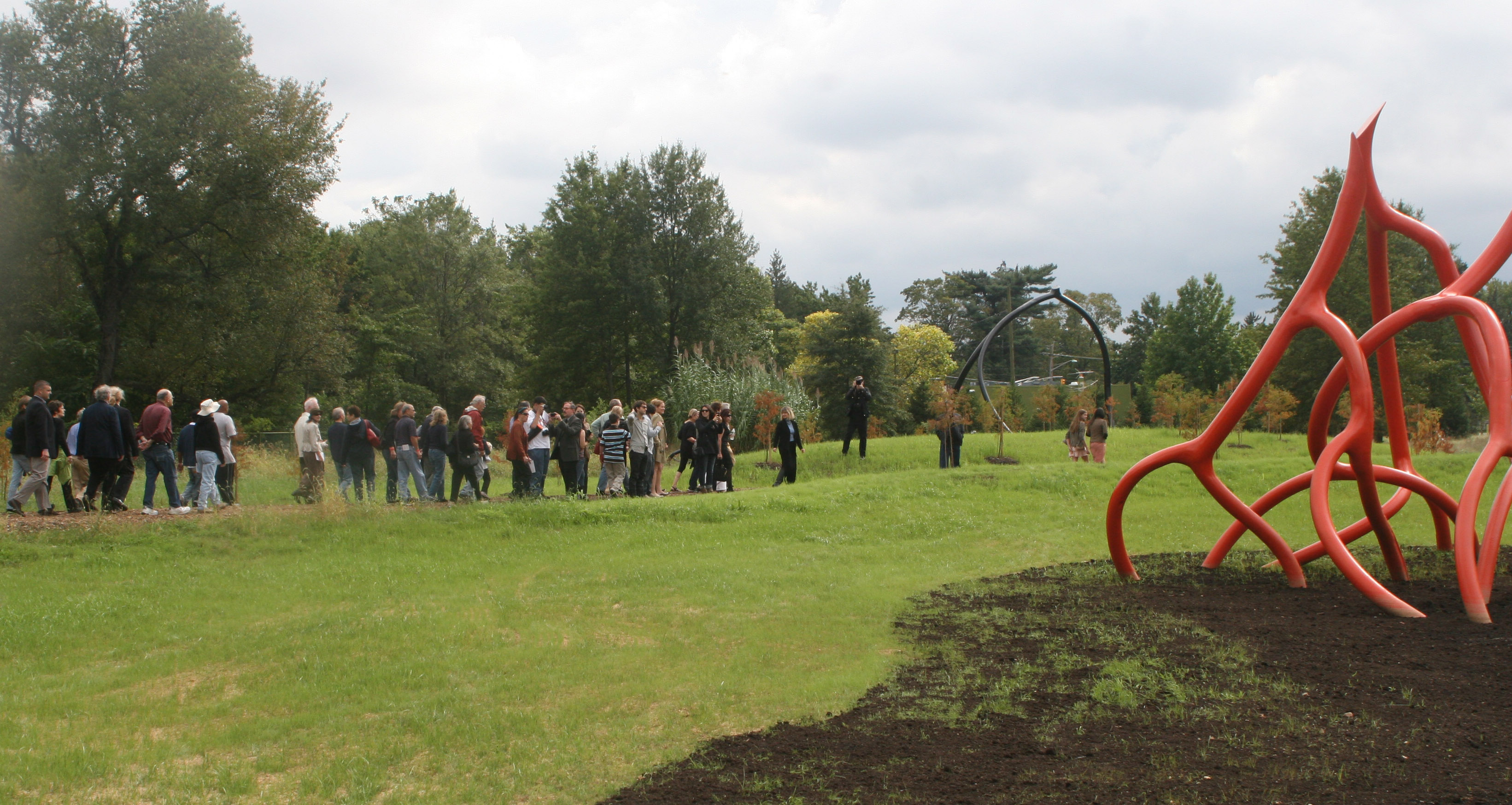
Aerial Roots

The Wildflower Meadow @ Grounds for Sculpture w/Tobin’s Aerial Roots

Visitors descend upon the newly-opened meadow. Aerial Roots will be in residence for about a year. By spring of 2012, the wildflower meadow should be well-established; the plan was to provide a native ecology setting (for central NJ near the Delaware River) in which sculptural works could be displayed. As the smaller trees mature, they will screen some of the sculptures, lending the possibility of surprise as the visitor walks the paths. Right now, the meadow is more of a flat setting for the steel roots–we can see everything from the rise as we enter the park. In time, revelations may be part of the experience. Visit the mature areas of GfS to get some idea of how the meadow may evolve naturally around the artwork.

Surprise is, for me, one of the hallmarks of wonder, awe, and art. I like to be surprised when I view or read or listen to works of art. Surprise leads, when the work is good, to revelation and reflection. It is not the sum of the aesthetic experience, but it seems to me a necessary component.

Syntax

“Syntax” by Steve Tobin. Copper, bronze. 

Syntax:
1a: the way in which linguistic elements (as words) are put together to form constituents (as phrases or clauses)

1b: the part of grammar dealing with this

2: a connected or orderly system : harmonious arrangement of parts or elements [i.e. the syntax of classical architecture].

[Thank you Merriam Webster.]

This is one of my favorite sculptures. A harmonious arrangement of parts or elements. Say, perhaps, letters of the alphabet which permit us to code abstract concepts and concrete objects into recognizable patterns, enabling us to share information of many kinds. “Syntax” is constructed of hundreds of cast-bronze letters, joined together in such a way that the overall form is unified and calm while the letters themselves make a chaos (the letters do not join into recognizable words).

Steve says that this piece encompasses all the things human beings who use speech could express in words. Well, maybe most things. And using Romanized alphabets. No Cyrillic letters in here, or ideograms, so far as I can tell…but the potential exists in this sculpture. I like the central hole: it suggests depth, or the kind of gravity that black holes supposedly possess, pulling everything into themselves that passes the liminal boundary–all the things unsaid.

Lately, I’ve been working with my students to help them see the connections between rhetoric and grammar, the logic of these linguistic elements, grammar’s many constituents, which my students tend to see as an unruly rabble or a horde that demands strict rules in a language that no one understands. After a day of words words words, and no time for poetry, I’d like to sit next to this sculpture for 15 minutes and breathe…in silence.