Feeder streams

A friend and I had a conversation about storytelling and human connectedness, relatives and family myths. We recognize that with age and relationships come references and allusions–some that operate only within the family system, others that interconnect with the wider social world. The televised funerals of some celebrated US citizens (Aretha Franklin, John McCain) offer excellent examples of how various eulogists–family, colleagues, close friends–endeavor to extend their feelings about the person to others. The best eulogies tell stories. It’s how human beings learn about one another, how we connect, bond, and cohere. The process reminds me of feeder streams that follow gravity and the earth’s geological patterns to wend their ways to join a river.

A river enlivened my childhood. Several rivers, in fact–the Hudson, the Delaware–but the one that comes to me at this moment is the Eel River in Indiana, pictured in my recent post here. By coincidence, just this week Streetlight, an online literary review, published my poem “Eel River Meditation.” In less cheerful news, someone whose presence I associate with South Whitley, IN has entered hospice care. These associations summon memories that carry me into that realm of family tales, rituals, jokes, sorrows, generational mythology.

My grandmother lived beside the Eel. A self-taught artist, she painted the bridge over the river many times, in all seasons. It must have steadied her sense of being in the world, of being in place; certainly, her paintings evoke that place, a small Indiana town, in those of us who knew and loved her.

And what could be more metaphorical than a bridge? Than a river? Than the changing seasons?

Locally, this rainy summer in my valley region, the feeder streams are full to overflowing and rushing to the Lehigh River, flooding the low-lying marshy areas, stranding the occasional cow or motorist. The fall semester has begun, and the garden’s mostly abandoned to the aforementioned weeds. My mind and heart are full, too. Maybe there will be poetry.
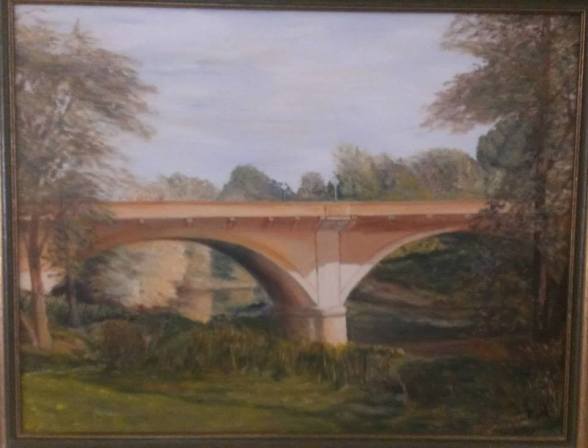
Eel River Bridge Edna Michael

South Whitley’s Eel River bridge, early summer. Edna Michael


Connections


4446_1159463871068_1826910_n

August has arrived and a few of our incoming freshmen are on campus already, as well as students on various fall sports teams who need to get a jump on the competition season. It was quite awhile ago that I was a teenage person entering my first year at college, but each year our students arrive with the same anticipation and excitement I felt. They’re ready to exercise a little responsibility, a little freedom, and to make the kinds of connections–personal, emotional, and intellectual–that will affect the rest of their lives one way or another.

~

In the 1970s, science historian and television broadcaster James Burke created and hosted a show called Connections. I was a fan of the series because I loved the surprising ways discoveries, events in history, people, and accident led to innovations and the criss-crossing of continents and ideas. The interdisciplinary aspect of human culture, of science and the arts, fascinated me as a teen. Those networked ideas have shown up many times through my life.

Connections: The photo above was taken by my fellow student Steve Lohman when we were freshmen. Steve later attended Pratt School of Art.  We lost touch for a long time, and–I have forgotten how–I found his metalwork while I was looking for cover art for my book of poems The Capable Heart.


running_horse

Running Horse by Steve Lohman

Connections: I liked Steve’s wireworks, but I remembered him as a photographer. Granted, what a person pursues at age 17 or 18 is easily liable to change–but I was curious about how he started doing sculpture. When he mentioned he’d attended Pratt, I asked if he had ever met Toshio Odate, who taught there for years. “One of my favorite teachers!” said Steve. “I loved his class.”

Connections: My spouse took a job writing for a woodworking magazine, where he met Toshio, who wrote about Japanese tools and woodworking techniques. Meanwhile, Toshio was creating his own works of art at his home as well as mentoring many students. He’s now a long-time friend of ours. (Photo of Odate’s “Pride of New England,” below, by Laure Oleander).

toshio-pride copy

Connections: Neural networks, the embodied mind, the ways writing assists in psychological healing, the twists in a good novel’s plot, the turn in a poem, metaphor, surprise. The unexpected thrills us–unexpected connections fill us with curiosity and a kind of joy, as does the closure.

~

Connections: The commercial creation Thinkhub, invented for teaching, offers yet another example of connections. A cultural thinkhub project based in Toledo, midstory.org has produced my poem “River by River” as a soundscape: click here.

The project researchers found my poem in the anthology I Have My Own Song for It: Modern Poems of Ohio. Look around, folks–connections are everywhere, and we learn from them.


Seemingly small stuff

Things to view, things to think about.

Sub Rosa’s post on floral aesthetica here.

IMG_4663

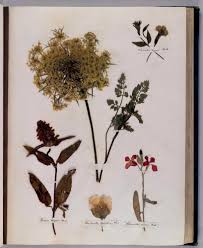
Emily Dickinson’s herbarium, thanks to Harvard (it takes a few seconds to load) here.

qalace ed

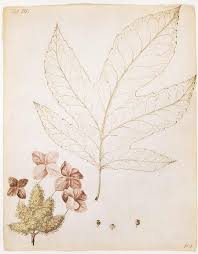
William Bartram‘s 18th-century drawings of American flora.

bartramx

~

Lovely words from Lesley Wheeler, and so true for me, too: “…reading and writing puts me in an honest place. Plus, while poems contain struggle of all kinds, they also constitute separate worlds it can be a great relief to enter, because good poems are not unjust or disruptive of bodily integrity.”

Conditioning

In regards to my last post: I’ve conferred with some people who knew Jack Fisher, and I may have mis-remembered parts of the story. Although those who knew him agree it sounds like something he would do, no one else can place the painting that I recall. His daughter says it’s possible I saw a sketch or preliminary painting that Jack never completed. (She definitely recalls how much he abhorred the water tower!) If so, perhaps his talking about the possibilities of the composition made an impact on me, even if the work itself was a watercolor sketch that never made it to canvas. Entirely possible.

The point of my post remains the same, however–that “ugly” things can be understood in ways that may offer new perspectives on what we consider beautiful.

I guess what I am trying to get to qualifies as a kind of conditioning. That’s now a therapeutic approach to teaching people how to overcome, say, a phobia of airplanes or elevators. You put your toe in the water, so to speak, or learn about the thing that causes fear. And knowledge can overcome fear. Not always, but often.

Inadvertently, I discovered conditioning on my own, when I was about twelve. I decided to study some things I was afraid of–spiders, bees, darkness–and managed to unlearn the fear. It does not work with everything: I’m still acrophobic.

famous photo construction workers

‘Lunchtime Atop A Skyscraper’ Charles Ebbets, 1932

My biggest fear was one most human beings acknowledge–the fear of death. From the time I was quite small, I worried and feared and had trouble getting to sleep because my mind raced around the Big Unknown of what it would be like to die. Many years into my adult life, I decided to explore that fear through my usual method: self-education. I read novels and medical texts and philosophy and religious works in the process. Finally, after visiting an ICU many times during the serious illness of a best-beloved, I decided to sign up as a hospice volunteer.

It’s one way to face death–one sees a great deal of it in hospice care. But the education I received from other caregivers, from the program instructors, and from the patients and their families, has proven immensely valuable to me. Am I afraid of death? Well, sure; but fear of death (thanatophobia) no longer keeps me up nights. I possess a set of skills that helps me recognize how individual each death is–just as each life is. More important still? I treasure and value the small stuff more and am less anxious about the Big Unknown. It’s going to happen, so why agonize over it? This is conditioning. For me, anyway.

Conditioning does not have the same meaning as habituation, because conditioning requires learning and is more “mindful” than habituation. Habituation occurs when we just get accustomed to something and carry on; perhaps we repress our emotions or our values in order to do that carrying on. People can habituate to war, poverty, all kinds of pain, and can make not caring into a habit. We are amazing in our capacity to carry on, but it isn’t necessarily healthy. Getting into the habit of warfare, hatred, ignorance, hiding our feelings, or other hurtful behaviors is often easier than getting into more helpful habits like daily walks. I do not know why that is.

I am, however, endeavoring to condition myself to stay awake to new perspectives, to stay inquisitive, to plumb the world to find, if not beauty, at least understanding and compassion and gratitude. Maybe one day I will even manage to get that perspective from somewhere very, very high up…    [yikes!]


Aesthetic “therapy”

I have been musing on Rebecca Solnit’s text in which she writes about the Romantics’ “new” appreciation of Nature. I was particularly struck by her research about how in Europe, and among the Eurocentric American colonizers, pre-Romantic era society considered mountains not only dangerous but also “ugly” (in Wanderlust: A History of Walking). Aesthetics began to change in the late 18th and the 19th centuries. Walking the natural world for something other than pure transportation from place to place altered our social ideas about what’s “beautiful.”

~

“The first question I ask myself when something doesn’t seem to be beautiful is why do I think it’s not beautiful. And very shortly you discover that there is no reason.”  —John Cage


~

This train of thought reminded me of Jack Fisher’s water tower. Jack was a friend and extended-family member who who lived in Bucks County, Pennsylvania from the 1940s until his death in 1999. He was an architect, engineer, teacher, builder of many things, and an artist.

Often when we were visiting, Jack would show us a painting he was working on. On this occasion, he told us how annoyed he had felt at a new condo development; the big, aqua-colored water tower rising from the housing campus especially irked him. “It’s so ugly!” he said. “So ugly, and I was feeling so mad, I decided to do a landscape painting of the damned thing. And here’s what’s funny–I kind of like the composition here, and the colors. What do you think?” He was right. It may have been an ugly water tower, but it was a lovely painting.

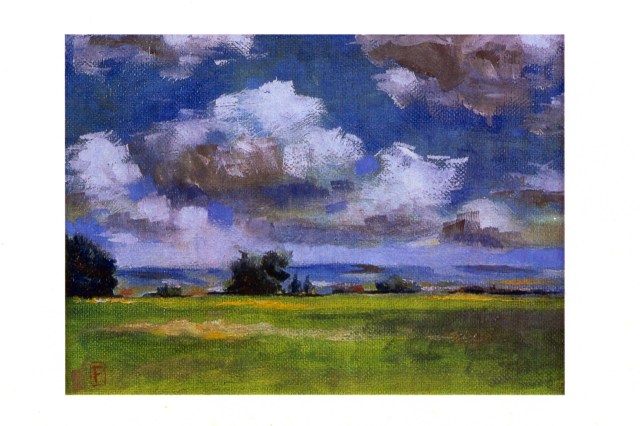
Unfortunately, I do not have an image of that painting except in my memory; here, however, is a painting of Jack’s that depicts the fields in Bucks County, PA, which he considered beautiful.

jackpainting004

Suber’s Field with Clouds, Jack Fisher, oil, 1998

Imagine a water tower here, and a sea of peak-roofed condominiums. And a balanced composition, and a deft use of colors.

~

Looking closely enough at something to find that you no longer see it as ugly requires an almost meditative change in perspective. It’s been an approach useful to me as a poetry prompt and as a means of more closely appreciating the world and everything in it. I don’t mean that I identify with the 19th-c Romantics, though I eagerly trod where Wordsworth trod when I visited the Lakes District a few years back; I don’t. My view of nature is really with a small ‘n’ and is pragmatic and scientific, among other things.

But: John Cage’s question to himself is a reminder to be compassionate, to observe with openness, information, education, perspective, and loving-kindness…while walking through the world.


Haiku, moon, peony

During busy times, we may need a few moments of solitary reflection.

~

381-1233891708GdW7.jpg

Full moon moonlight
Sony Cyber-shot DSC-V1
10/800s, f 2.8, ISO 100, 7 mm

253142_2101392498695_2412222_n


~
flower moon
fireflies enlighten
the pear tree
~

I’m currently reading David Bayles’ and Ted Orland’s encouraging little book, Art & Fear. Nice reading to tuck around the edges of a few full weeks.


L’enigma

“What is especially needed is great sensitivity: to look upon everything in the world as enigma….To live in the world as in an immense museum of strange things.”

This quote is attributed to Giorgio de Chirico, favorite artist of my poetry mentor & best pal, the late David Dunn. I like the way this idea is phrased (it may be the translator, it may be de Chirico): to live as in a museum; for a museum’s purpose–behind its collection, curation, and presentation–is simply to offer up items for the community to observe.

Paolo Baldacci makes an argument for de Chirico as “the first conceptual artist” that I find intriguing if ultimately unconvincing. There is merit, however, in considering the artist’s “surrealist era” paintings as conceptual in the sense that experiencing the work unsettles the viewer, distorts her sense of the real and requires her to enter the world of the painting with its enigmatic strangeness. And to observe without knowing, exactly, what it is she can see.

Artist Deborah Barlow, on her blog Slow Muse, has some words worth reading on the subject of “not knowing” that visitors to museums and galleries, and those who can view the world as an immense museum of strange things, may recognize. Barlow suggests that there may be an “essential incomprehensibility” in the acts of art-making and path-making as the human being moves from the known to the not-known. The enigma, as de Chirico terms it. The ambiguous and uncertain, the experiment, the unanswered question.

David Dunn often wrote letters to me in which he expressed his occasional discomfort with words, with sentences and language; he wished he could paint or play a musical instrument–felt that jazz might have enabled him to enter the enigma more fearlessly, as his jazz heroes did when they jammed and improvised.

WEB_sized_De_Chirico_-_LEnigma_dell_Ora_1910_HR-p

“L’enigma della Oro” (1910)

We wrote about writing, often. Poetry–and the problem of saying the unsayable. Lately, I feel almost ready to retrieve his letters from the box where I’ve kept them for 20 years. My personal museum, those old letters. My immense museum, this strange, strange world.

A poem that offers entrance into a potentially uncomfortable world–by Luisa Igloria on Dave Bonta’s via negativa site: click here.


Poetry & paradox

~
“Language is a profoundly mysterious technology, so constitutive of the human mind that we can only get glimpses, from inside the fishbowl of consciousness, of how it works.”
sea inside Charnine

 The Sea Inside. Charnine.com features information on surrealist artist Charnine and Surrealism – copyright © 1994 – 2011 Samy Charnine – All rights reserved

~
How do we get from language to poetry? However we do that, consciously or not, it must be as fluid and natural as it is damned difficult! I sometimes wonder whether paradox may be the basis of art. At least, if there exists a “something” that inspires me to compose a poem, paradox–and the way it requires effort to explore contradictions and ambiguities–could stand in as my motivating flame.
~

Paradox, randomness, juxtapositions and contradictions evoke imagery, dream, the realms beyond the rational consciousness we humans claim to possess. Poet and fellow poetry blogger Susan Rich recently posted about the surrealist painter Remedios Varo, an artist whose name and art I had never before encountered; and I felt an urgent pull to introduce her work to my friend David Dunn–he loved surrealism and appreciated it more than I ever have, and such paintings (particularly early de Chirico) exerted a large influence on his poems.

David, however, died in 1999. I share my memory of him here, by writing it on a blog, the same as I share the names of Varo and de Chirico and of the many poets and philosophers I have mentioned during my years of posting to this forum. It’s a form of immortality, if only a temporary immortality (another paradox…)
~
Here is Menand again, who wrote poetry in his youth but moved into journalism and critical reviews in prose later on: “… I got the same painful pleasure out of writing prose that I did out of writing poetry—the pleasure of trying to put the right words in the right order.” Painful pleasure. That mysterious technology, language, rises to the occasion of inherent contradiction.


“And I took away from my experience with poetry something else. I understood that the reason people write poems is the reason people write. They have something to say.”
~
Do you know what you have to say before you write a poem? Or does what you have to say appear in the process of writing? Or after the poem seems complete? Or once someone else has read it and decided what it is you had to say?

Fully human

A student who grew up in Viet Nam and arrived in the USA just two years ago scheduled an appointment with me for assistance in revising her final paper for Philosophy.

My job is to help her with her articles, subject-verb agreement, verb tense, and plural forms and uses, and when to use a capital letter for proper nouns. I also assist students like her with claims, thesis statements, and rhetorical structure–but I am not a “content tutor.” Of course, I often understand the content and find it interesting to observe how young people interpret, say, literature or philosophy.

In this case, Western philosophy, in English, as interpreted by a person raised in a culture quite different from the Western university system norm.

Philosophy 109 challenges many native-born and US-educated freshman students; taking this course as an English-learner with very little “Western” experience must be ridiculously difficult. So I first assessed how the course had been going for her, and she said, “So-so.” What had been most difficult? Note-taking, she said. With the texts she could take her time, translate, and eventually tease out the ideas; but class lectures were really hard. In addition, she struggled with the concept of opposition and rebuttal as structured in the philosophical argument.


Her assigned argument for the term paper was: “The arts, sciences, and philosophy are valuable because they help us to become fully human.”

The paper began with her assertion that the arts make us more fully human because they are beautiful to behold and inspire in us joy and appreciation.

“Is the best art beautiful?” I asked. She said yes, and I asked her, “Is it only art’s beauty that makes us human and good?”

“Not only,” she said, after a moment of hesitation. “Sometimes–sad is beauty. Sad is not good, but sad also makes us human.” She hesitated again and then went on: “I think good art, and good science, has both sides. I think this but it isn’t in my paper. Should I put it in my argument?” We agreed to work on a sentence or two that might express her interpretation more completely while heeding the general conventions of Introduction to Western Philosophy.

Sometimes, syntax is content.*

Without exception (well, almost), I learn so much from student interpretations of ancient concepts. Rather than rolling my eyes and scoffing at how little they know, I’m searching their perspectives for what it is I ought to know about them and their experiences. The stance of most older authorities is that young people must integrate themselves into our norms and conventions; but we will age out of our power base, at which point we’d be better off recognizing their norms and points of view and exercising our neurons by learning how to adapt to the next set of conventions.

Philosophy and the arts will stay around. I have no doubts about that. The ways in which human beings interpret them may change; all to the good–stasis would destroy philosophy and art, thus keeping us from our potential to be fully human.

~


*[You might want to read Sister Miriam Joseph’s classic text, The Trivium, for a deeper explanation of how to approach ‘mastery’ of the liberal arts and learning.]


Transitions & ambition

letter I
have maintained this blog pretty regularly, for years now, writing about books and poems and gardens and teaching, examining the concept of consciousness and trying to plumb–from a novice’s perspective–the brain’s wiring and functions. I suppose I am seeking a kind of “interdisciplinary” approach in these posts and in life: a philosophy of values that considers the arts, aesthetics, evolution, biology, social structures, neurology, consciousness, physics, etymology, pedagogy, ecology, and compassion (have I forgotten anything?) in a distinct but expansive method of living in which I can situate myself and which might guide my behavior as I make my life-long way through the world. If, by some chance, my words influence a reader–so much the better; this is, after all, a public space (WordPress.com).

Like many people who use social media platforms for their writing, though, I have a mixed view of its suitability as a medium and of its perceived necessity for contemporary writers. My purpose, originally, was to practice writing prose and to promote the arts and the natural environment as necessary complements to and instruction for the development of empathy (compassion) and metacognition in human beings.

The blog has been reasonably suitable for practice; it gets me writing what is basically a brief essay on a more-or-less weekly basis. It has several thousand “followers,” but only a handful of readers. [I can discern this through the statistics page on WordPress, though I don’t check often.] In general, I use this platform mostly as a way of “seeing what I think,” and it serves that purpose, too.

IMG_0127

I have come to some conclusions about the problem of consciousness (and about whether it actually is a problem) through the reading and experiences of the past ten years or so. Those conclusions are, however, private ones. While the process of discovery and inquisitiveness works in a public forum, the takeaway remains, for this blogger, a thing carried within.

But.

~~

But other blogger-writers have influenced my thinking about what a public forum such as blogging or Facebook can do for the writing process. Dave Bonta and Luisa Igloria, as well as Michael Czarnecki and Lou Faber–among others–promote by example the option, and value, of publishing new or unedited, unfinished, partially-revised work. Granted, not all of them have thousands of readers who weigh in on criticism or encouragement; but the very process of making public the work-in-progress seems to me to be courageous. This may be because I am a wimp, or it may be because the social aspects of the vaunted “po-biz” have dampened my willingness to show a kind of transparency in my writing methods.

I am not on the tenure track and will not be teaching in an MFA program, however, so why would it matter?

Therefore: be prepared, oh limited but blesséd audience. I may begin to foist upon you the recent sad, sad poems I’ve been writing–in draft form. Or I may begin to reveal the poems from my seven-years’-unpublished manuscript online. Or I may, like Luisa and Michael, begin to blog “a poem a day” (unlikely, but…). It seems to me that a transition is in order here. And that stands as my writing ambition for the moment, as autumn makes its way toward the solstice and I face another stack of student essays to grade.