Fully human

A student who grew up in Viet Nam and arrived in the USA just two years ago scheduled an appointment with me for assistance in revising her final paper for Philosophy.

My job is to help her with her articles, subject-verb agreement, verb tense, and plural forms and uses, and when to use a capital letter for proper nouns. I also assist students like her with claims, thesis statements, and rhetorical structure–but I am not a “content tutor.” Of course, I often understand the content and find it interesting to observe how young people interpret, say, literature or philosophy.

In this case, Western philosophy, in English, as interpreted by a person raised in a culture quite different from the Western university system norm.

Philosophy 109 challenges many native-born and US-educated freshman students; taking this course as an English-learner with very little “Western” experience must be ridiculously difficult. So I first assessed how the course had been going for her, and she said, “So-so.” What had been most difficult? Note-taking, she said. With the texts she could take her time, translate, and eventually tease out the ideas; but class lectures were really hard. In addition, she struggled with the concept of opposition and rebuttal as structured in the philosophical argument.


Her assigned argument for the term paper was: “The arts, sciences, and philosophy are valuable because they help us to become fully human.”

The paper began with her assertion that the arts make us more fully human because they are beautiful to behold and inspire in us joy and appreciation.

“Is the best art beautiful?” I asked. She said yes, and I asked her, “Is it only art’s beauty that makes us human and good?”

“Not only,” she said, after a moment of hesitation. “Sometimes–sad is beauty. Sad is not good, but sad also makes us human.” She hesitated again and then went on: “I think good art, and good science, has both sides. I think this but it isn’t in my paper. Should I put it in my argument?” We agreed to work on a sentence or two that might express her interpretation more completely while heeding the general conventions of Introduction to Western Philosophy.

Sometimes, syntax is content.*

Without exception (well, almost), I learn so much from student interpretations of ancient concepts. Rather than rolling my eyes and scoffing at how little they know, I’m searching their perspectives for what it is I ought to know about them and their experiences. The stance of most older authorities is that young people must integrate themselves into our norms and conventions; but we will age out of our power base, at which point we’d be better off recognizing their norms and points of view and exercising our neurons by learning how to adapt to the next set of conventions.

Philosophy and the arts will stay around. I have no doubts about that. The ways in which human beings interpret them may change; all to the good–stasis would destroy philosophy and art, thus keeping us from our potential to be fully human.

~


*[You might want to read Sister Miriam Joseph’s classic text, The Trivium, for a deeper explanation of how to approach ‘mastery’ of the liberal arts and learning.]



Transitions & ambition

letter I
have maintained this blog pretty regularly, for years now, writing about books and poems and gardens and teaching, examining the concept of consciousness and trying to plumb–from a novice’s perspective–the brain’s wiring and functions. I suppose I am seeking a kind of “interdisciplinary” approach in these posts and in life: a philosophy of values that considers the arts, aesthetics, evolution, biology, social structures, neurology, consciousness, physics, etymology, pedagogy, ecology, and compassion (have I forgotten anything?) in a distinct but expansive method of living in which I can situate myself and which might guide my behavior as I make my life-long way through the world. If, by some chance, my words influence a reader–so much the better; this is, after all, a public space (WordPress.com).

Like many people who use social media platforms for their writing, though, I have a mixed view of its suitability as a medium and of its perceived necessity for contemporary writers. My purpose, originally, was to practice writing prose and to promote the arts and the natural environment as necessary complements to and instruction for the development of empathy (compassion) and metacognition in human beings.

The blog has been reasonably suitable for practice; it gets me writing what is basically a brief essay on a more-or-less weekly basis. It has several thousand “followers,” but only a handful of readers. [I can discern this through the statistics page on WordPress, though I don’t check often.] In general, I use this platform mostly as a way of “seeing what I think,” and it serves that purpose, too.

IMG_0127

I have come to some conclusions about the problem of consciousness (and about whether it actually is a problem) through the reading and experiences of the past ten years or so. Those conclusions are, however, private ones. While the process of discovery and inquisitiveness works in a public forum, the takeaway remains, for this blogger, a thing carried within.

But.

~~

But other blogger-writers have influenced my thinking about what a public forum such as blogging or Facebook can do for the writing process. Dave Bonta and Luisa Igloria, as well as Michael Czarnecki and Lou Faber–among others–promote by example the option, and value, of publishing new or unedited, unfinished, partially-revised work. Granted, not all of them have thousands of readers who weigh in on criticism or encouragement; but the very process of making public the work-in-progress seems to me to be courageous. This may be because I am a wimp, or it may be because the social aspects of the vaunted “po-biz” have dampened my willingness to show a kind of transparency in my writing methods.

I am not on the tenure track and will not be teaching in an MFA program, however, so why would it matter?

Therefore: be prepared, oh limited but blesséd audience. I may begin to foist upon you the recent sad, sad poems I’ve been writing–in draft form. Or I may begin to reveal the poems from my seven-years’-unpublished manuscript online. Or I may, like Luisa and Michael, begin to blog “a poem a day” (unlikely, but…). It seems to me that a transition is in order here. And that stands as my writing ambition for the moment, as autumn makes its way toward the solstice and I face another stack of student essays to grade.


Backstory, continued

What brought the idea of backstory to mind was a poem of mine that recently appeared in Peacock Journal’s  print anthology. The poem appeared last year in the journal’s online site. (See: “Imagined Painting of Mary Magdalene Bathing.”)

A friend read the piece and responded to the poem by saying, “This is a beautiful poem. It’s so visual–also, different the second time you read it. And I know how interested you’ve always been in saints and iconography and art, but where did you come up with the idea of imagined paintings? What’s that about?”

This is the best kind of question, as far as I’m concerned. It is a question about ideas, not inspiration or meaning or even craft–though I love questions about craft. It does beg the writer to reveal, however, a bit of the story-behind-the-story/poem/narrative, etc.

“Backstory” may seem self-explanatory. It’s a term used more frequently in drama, particularly screenwriting. Poetry critics are less inclined to employ the concept because–see last post–it is too easy to fall into explaining the poem, which is generally considered a no-no. My friend, however, is a reader and not a poetry critic. I felt free, therefore, to address the question on a personal level.

As my good friend knows, I have been intrigued since adolescence by the art and iconography, the symbolism and the stories of the saints, despite my Protestant upbringing. I love art, aesthetics, and the divinely natural (empirical, phenomenal) World and feel an ambiguous but compelling relationship with myth, religion, history and a culture I cannot escape. And I have imagination.

I began writing about a saints in less-than saintly pursuits. The idea interested me. Surely the saints could be imagined as real human beings, not only as intercessionaries between the human realm and Heaven. I wrote about St. Sebastian purchasing a tunic, Saint Agnes braiding her mother’s hair, and St. Anthony fetching a pail of water. Saints as human beings (rather than as symbols, icons, and religious items) led me to the depictions of saints in art as other-worldly, pure, suffering, or in all ways saintly; and I entertained thoughts of paintings I had never seen but would like to see–theoretically-possible paintings. In the case of St. Mary Magdalene bathing–would Da Vinci have painted it? Rubens? I can only imagine. The poems are a kind of ekphrasis.

I wanted to be a painter when I was a child. This imagining may be as close as I ever get to realizing my youthful ideals.

~

There is not much more backstory than that. None of it leads to meaning or interpretation, although the story above may cement some allusion or confirm referents in the reader’s mind. I hope, however, that the backstory here might interest one or two readers enough that they pick up a book on Renaissance or medieval art, on hagiography or history. Or perhaps someone will go to Amazon.com and purchase the anthology at the link above.

Thank you, friends in literature and imagination.


Far afield

My desire has been to wander, but my inclination does tend toward staying at home. One reaches a point in one’s life, however, at which wandering will shortly become more challenging than it was in youth. Also, it gets far too easy to stay comfortably within one’s zone of familiarity, which limits transitions and other difficult things.

Recently, I went far away, found myself (among other interesting places) in a field and happily fell into familiar behaviors I follow at home. In this case, scoping out the local flora and minor fauna in the hills in July.

IMG_4797

We were touring a small region of a small but extremely varied country: Portugal. The field featured small lizards that were so quick I couldn’t photograph them; dozens of types of wildflowers and grasses and their assorted tiny pollinators; robins, black redstarts, kestrels, and other birds I couldn’t identify. I am pretty sure we saw a hoopoe, which for me is exciting, though I expect it is not uncommon in Portugal.

As a humanities geek who loves Medieval and Renaissance art and architecture, I love the old cities; and the sea’s appeal abides, but the mountain regions appeal to the introverted gardener and naturalist in me. I was pleased with the quiet, with the pure air and blue sky, the twisting roads, the small farms. Most of all I was pleased to find so many plants and pollinating creatures in the field next to where we stayed for two nights, not far from the Peneda-Gerês National Park.

Some of these flower photos feature at least one bee or wasp or beetle-y thing. Below, a common sight on the mountains: heather, flourishing as well as it does in the British moors. Not much rain, but many misty mornings, even in July.

IMG_4702

This region is wind farm country. There are large, electricity-generating windmills atop much of the range, and quite a few of the many small rivers are dammed to create electric power and places to fish and swim. There’s certainly very little air pollution up in the hills…I have visited few places so pristine.

More little critters among the field flowers. Easy to overlook, despite how vivid these photos may appear.

IMG_4706

Nice to dwell, if only for awhile, in a place that offers a beautiful change of perspective.

Beautiful brain

While waiting for the snow to evaporate and melt, the gardener experiences agitation; the days are longer–it must be time to plant seeds…but the soil is too wet and too cold.

Fortunately, there are always books! I have read Daniel Dennett on religion, George Lakoff on the embodied basis for philosophy, and am plowing rapidly through Ruth Whippman’s (acerbic and very funny) America the Anxious.  Also I am slowly savoring an anthology of Jewish women’s poems, The Dybbuk of Delight, that I randomly discovered in the library.

beautifulbrainbook04-1080x644

⇑ But here’s a book I want to own, when I can justify more book purchases: Beautiful Brain: the Drawings of Santiago Ramon y Cajal, because Art! because Neuroscience! because Beauty! The blog Hyperallergic says the drawings are going to be touring museums (see The Dynamic Brain Drawings of the Father of Neuroscience), which might also become a must-do for me when the exhibit travels to New York City next January.

What Cajal was doing back at the turn of the last century still inspires artists, not just medical scientists, today (see my post on Greg Dunn’s neuro-artworks). These compellingly beautiful and quite accurate drawings may also inspire poets and armchair philosophers who have lately spent a great deal of time pondering the resilience of the brain and the challenges that rupture a sense of self when cognition is interrupted.

beautifulbrain01-1080x1373

~

Credit goes to Abrams Books for these graphics and for the decision to publish this beautiful text.


Spiritual quantum fields?


Herewith, an intriguing paragraph about physics, biology (the brain), and consciousness:

Wave-particle duality, a fundamental concept of quantum mechanics, proposes that elementary particles, such as photons and electrons, possess the properties of both particles and waves. These physicists claim that they can possibly extend this theory to the soul-body dichotomy. If there is a quantum code for all things, living and dead, then there is an existence after death (speaking in purely physical terms). Dr. Hans-Peter Dürr, former head of the Max Planck Institute for Physics in Munich, posits that, just as a particle “writes” all of its information on its wave function, the brain is the tangible “floppy disk” on which we save our data, and this data is then “uploaded” into the spiritual quantum field. Continuing with this analogy, when we die the body, or the physical disk, is gone, but our consciousness, or the data on the computer, lives on.

This comes from a brief article by Janey Tracey on Outerblogs. I spent a few minutes trying to find more on the physicists she quotes, among them Christian Hellwig, also of Max Planck Institute, and Robert Jahn of Princeton. But I have been too busy to follow up by reading papers and books–between semester mid-term and concerns about our Resident Nonagenarian, who is at present “declining” toward death, things have been…challenging. We are experiencing with our best-beloved the waiting period as the corporeal body shuts down organ by organ, bit by bit, consciousness becoming semi-conscious, then intermittent, and unresponsive, as the mind enters that realm none of us can understand.

Life closes in many ways–swiftly, at times, but more commonly in increments. This death is not the one our best-beloved would have chosen (in one of her recent moments of clarity: “This isn’t what I wanted,” she said). Alas. The slow, to all appearances agonizing, shutting-down toward death probably rates low on most people’s desires list.

The Rolling Stones warned us you can’t always get what you want [skip the ad, listen to the rock n roll]. I suppose that song has already been uploaded onto my spiritual quantum field. Not to mention the spiritual quantum fields of millions of humans. If Dr. Dürr’s speculations are correct, that may mean Mick Jagger, Keith Richards, et al are among the immortals already. And while I am mentioning this possibility with a sense of humor, I do ponder the interesting concept of a quantum code that encompasses human memory-processing, experience, and mind. It seems to be distinctly likely that consciousness is a tangled hierarchy.

Tangled hierarchy as in strange loop, or paradox, explained in Goedel’s Incompleteness Theorems. Douglas Hofstadter, trying to get his mind around the problem of consciousness, suggests that such a “flipping around of causality” appears to happen in minds possessing self-consciousness. The mind perceives itself as the cause of feelings, thoughts, etc. Our 20th-century scientific models posited that feelings and desires are caused solely by the interactions of neurons.

Though maybe quantum theory and biophysics and 21st-century neurological psychology studies will indicate we are still pretty far from the Whole Story.

Meanwhile, one story of one person draws nearer the close. No–that is not the case. The body will die. Her story–her many stories, told from many perspectives, her paradoxes, her own strange loopiness–91 years has only been the beginning.

300px-magrittepipe1928lacomuseumart

Rene Magritte “The Treachery of Images” 1928. Los Angeles County Museum of Art


Moment for beauty

Bill Lantry over at Peacock Journal has been endeavoring to continue our appreciation for the beautiful. I’m pleased that the editors chose three of my poems for the journal, which is a rotating online site, well-archived, and quite lovely.

dirk-van-noyhuys-scaled

Dirk Van Nouhuys–photo

Here are the poems:

Peacock Journal–Ann E. Michael poems

Please explore the site further. Yours, in beauty.

Words others have written

I’m still feeling a bit alexithymic. The epilogue of Canetti’s Crowds and Power seems so prescient to me,* though that may be because of the cognitive state I am in…trying to decide whether or not to dissociate myself somehow from society at a time when that approach seems appealing but irresponsible. Thoughts about consciousness, what it is, and whether it matters. Thoughts about the value (and what do we mean by value?) of poetry and the arts.

~

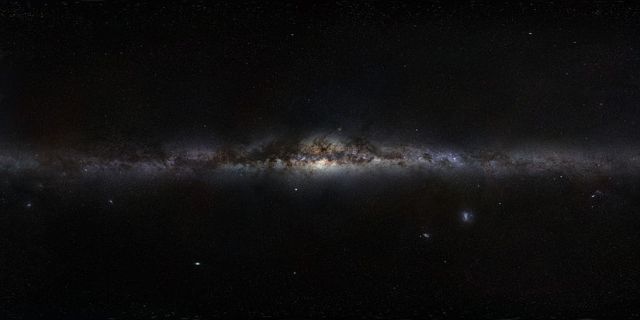
My sister’s family, and my husband, were in New York City during the 2003 blackout; my husband was at home on September 11, 2001, but my sister and her family–who are long-time Manhattan residents–went through that experience. Some thoughts from Rebecca Solnit (see link below for a lengthier essay from which these words were excerpted).825px-eso_-_the_milky_way_panorama_by

Rebecca Solnit:

On the warm night of August 15, 2003, the Milky Way could be seen in New York City, a heavenly realm long lost to view until the blackout that hit the northeast late that afternoon. You can think of the current social order as something akin to this artificial light: another kind of power that fails in disaster. In its place appears a reversion to improvised, collaborative, cooperative and local society. However beautiful the stars of a suddenly visible night sky, few nowadays could find their way by them, but the constellations of solidarity, altruism and improvisation are within most of us and reappear at these times. People know what to do in a disaster. The loss of power, the disaster in the modern sense, is an affliction, but the reappearance of these old heavens is its opposite. This is the paradise entered through hell.

http://lithub.com/rebecca-solnit-how-to-survive-a-disaster/#

~night

*I may get to this in a future post.

Museum musing

On a drizzly, quite autumnal day, I returned to one of my favorite places, the Philadelphia Museum of Art.

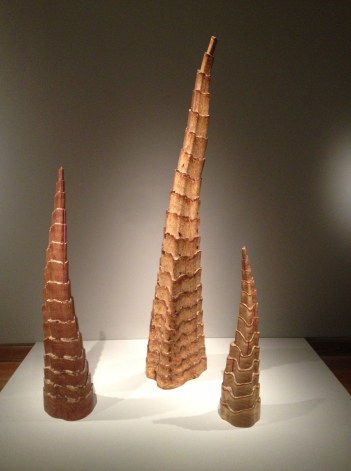
Our main purpose this trip was to visit the American Craft galleries, where wood-turner and artist David Ellsworth’s work, including some collaborations with his wife, glass-bead artist Wendy Ellsworth, currently resides for a one-year exhibit. It’s not every day that I can enter a world-class museum and say, “I am friends with the artist who created this marvelous object!” Kudos to the Ellsworths and to the museum for recognizing the importance of David’s astonishing work.

photo-3

Crafted from a dense burl of wood, precisely bandsawn, these sculptures from Ellsworth’s “Line Ascending” series range from 2 to 5 feet in height and conjure possibilities from dinosaur horns to mountains to minarets.

I had not had a chance on previous visits to walk through the Anne d’Harnoncourt Sculpture Garden at the museum, so despite the drizzle, we followed the paths through the 1-acre urban park. The hardscaping is very nice, though by now a bit cliched, since it seems every city garden in the US uses New York’s (admittedly amazing) High Line as its model. The Anne d’Harnoncourt garden likewise utilizes native plants in the garden areas–a trend of which I approve. The views of Philadelphia, its fountains and the river, are nicely framed, and the park is laid out well for “rooms” to contain or display large sculpture. I am sorry to report that few of the sculptures resident at present are appealing, though. My spouse remarked that one of the Sol Lewitt pieces “looks like a barbecue grill platform.” In another setting, that might not have been so obvious (or so funny). Nonetheless, it was pleasant to wander the sculpture garden paths and muse on things aesthetic instead of thinking about the large stack of student essays awaiting my attention.

Evaluating freshman composition papers requires a different aesthetic altogether.


Surely compelled

Ann Lauterbach from her book The Night Sky: Writings on the Poetic Experience

We make music, painting, sculpture, films, novels in order to mediate our mortal visiting rights: a specifically human wish to intercede, to punctuate the ongoingness of time and the seemingly random distributions of nature. This punctuation is called history or, more precisely, culture, or, more precisely still, history of culture…

The phrase “to mediate our mortal visiting rights” feels particularly resonant these days, as some of my elderly best-beloveds appear to be navigating that region–mediating it–at present; [to mediate: “divide in two equal parts,” probably a back-formation from mediation or mediator, or else from Latin mediatus, past participle of mediare “to halve,” later, “be in the middle,” from Latin medius “middle”).  –thank you Online Etymology Dictionary]. The two halves, between one world of what we call the living and another which is the end of life, there is really more of a continuum, however. The “gray area” can be quite enriching and lively. Or not. These are ways we create, or punctuate, our personal histories: the year grandmother broke her hip, the year Susan entered school, the year the Twin Towers were destroyed. These, among other “random distributions of nature.”

I think it is true that the arts help us with the wish to intercede somehow, and also–a different sort of wish, it seems to me–the wish to mediate. Lauterbach seems to conflate these wishes. I see her point, but I am not sure I agree wholly.

~~~

Intercession. Isn’t that also a form of prayer?

[“intercessory prayer, a pleading on behalf of oneself or another,” from Latin intercessionem (nominative intercessio) “a going between, coming between, mediation,” noun of action from past participle stem of intercedere “intervene, come between, be between” (in Medieval Latin “to interpose on someone’s behalf;”]

~~~

…the way words make sentences and sentences paragraphs is also a kind of constellating, where imagined structures are drawn from an apparently infinite fund: words, stars….these acts of narrative and imagistic invention were surely compelled by the inexhaustible human desire to transfigure the incomprehensible into intelligible form.

Lovely–and here, I agree completely: “surely compelled.”

~~~

Writing for me is associative, meditative, and digressive.  ~ Ann Lauterbach

images                                        pompeiian woman-writer


Thanks to art critic and blogger Sigrun of sub rosa for alerting me to the existence of this book.