Anthology

While I am slowly drafting my next few blog posts, here is a promotion for a lovely anthology of poems about birds (yes, one of my poems is represented here–but the collection of 104 poems by various authors has been splendidly curated and edited by Eric Rounds and Bart White).

Shift

This past weekend, I decided it was time to submit to some changes in the way I have been submitting.

Submitting manuscripts, that is.

I have sent out a full-length collection of poetry, my second manuscript of over 60 poems, for three or four years now and the time has come to re-assess. On the spur of the moment Saturday I sent out a chapbook-length collection of poems in a completely different vein, on another topic.

Sometimes, a writer just needs to shake things up, shift direction–whether she wants to or not. It is far too easy to get comfortable in a routine (in this case, easy to send the same manuscript file through various online submission portals, at regular intervals depending upon motivation and spare time). Submittable has become the most common software portal for submissions in the poetry world; but I recall vividly the days when I had to print everything out and photocopy the manuscript, then send it by postal mail to each prospective publisher.

So everything shifts, and we adjust.

Alas, The Red Queen Hypothesis and other poems has had no takers. Maybe I need to tear the manuscript apart, rearrange and update it. Maybe the poems just are not as strong as I thought they were, even though more than half of them have been published individually; maybe there is simply no audience for that particular collection of poetry.

I do not consider this giving up on the collection or on the poems in it. I merely aim to make transition, to move along to something a little different for awhile. Wake myself up to the work I have been composing more recently, concentrate on those pieces instead.

Submit to change, and make the best of that change, and allow the change to change the writer. I think I learned that in my MFA program at Goddard.  🙂

grassesA

Poetry reading

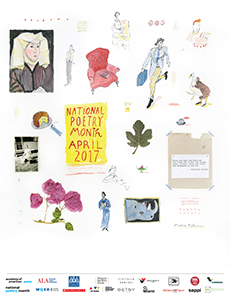
One week from today, I will be reading in Easton, PA with a few talented, feminist writers hosted by my colleague Marlana Eck. I have not given a reading in awhile, and this should be fun.

Here’s the poster:

~

with-lipstick

~

Face to face

alice-heart1 copy

The physical, corporal power of poetry; the need for language and expression to originate in the body–these are concepts that resonate with me as a poet and that make poetry such a difficult art. For how can one be in the body through words? Words remove the physical language of the body which is so important a component of communication. That is why tweets and social media posts and email often work to the detriment of genuine understanding.

What follows are three rather diverse chunks of thinking concerning the corporal and the intellectual.

Ren Powell writes in her blog:

And it made me more certain than ever that the separation of the corporal and the intellect is truly the root of every evil. It’s why all the studies show that getting people to talk face-to-face, breaks down bigotry in a way nothing else ever will. A linguistically relayed concept has to be replaced by a body that we experience in the sensual world.

It brings me to Orr’s phrase to describe poetry: “the eros of language”. I think poetry is necessary because it bridges the gap between the corporal and the intellectual in a way no other writing can. Why we say novels that tell the truth are “poetic”. When we speak poetry, sing it, it becomes corporal. It’s funny that when we sing the word “love”, we are not supposed to sing “luhv”, with its stingy and clenched vowel, but we’re supposed to open the mouth, sing “lahv”- with a wide-open palate. Because it hits us in the gut with its beauty then. Openness.

And counter-wise (which should be a word),  we can infect our minds with the routine that reinforces ugliness: I believe writing or drawing words and images of hate can infect the body.

~~

Reading Ren Powell’s words, I thought immediately of two poems of Gregory Orr‘s, from his book Concerning the Book that Is the Body of the Beloved. Here they are:

How small the eyes of hate.
I’m not making this up
Or being metaphorical.
A man held a gun against
My head and I saw how
Small his eyes were
With what they refused
To take in of the world.
This happened beside
A small highway
In Alabama in 1965.
What history called
The Civil Rights
Movement; what I call
The tiny eyes of hate.

~

How large the eyes of love.
How the pupils dilate
With desire (I’m not
Making this up: science
Has proved it’s true).

Those eyes wide
And glistening: gates
Thrown open. What’s
Inside, free to flow
Out as feeling,
And the whole world
And the Beloved
Welcome to enter.

~~

I just saw the movie “The Arrival,” a science-fiction film based on Ted Chiang’s short story “The Story of Your Life.” Any movie whose main character has a PhD in Linguistics sounds intriguing to me. The narrative uses the Sapir-Whorf hypothesis as a kind of plot point: the theory that language molds culture. An underlying possibility in the movie is that perhaps it is language that gives us consciousness, transforms us into sentience, and–possibly–has the capacity to unite and heal us.

But it needs to be face-to-face, as in the movie, wherein Amy Adams encounters aliens in person, insisting that in order to interpret any new language she must experience the process of “speaking” personally, to judge body language, movements–not just sounds or written “text.” How we communicate teaches us who we are. In order to understand one another truly, we need authentic encounters, not slogans.

We need to bid each stranger as Beloved, “Welcome to enter.”


905668_10209085939849941_7289218723455836950_o

Struggling with words

Some of the students I tutor in writing are English learners–advanced English learners, but still on the learning curve. They began speaking and writing English at age 10 or 14 or 16, or perhaps earlier, but in a family whose English defaulted to a “home” language. They often have vocabularies that far exceed my US-born students in scope, but they lack awareness of idiomatic preposition use or skills in standard English syntax.

My background is not in “ESL,” “ELL,” or the instruction of multi-lingual students. I have precious little training in that area, and no experience in translation. I do not even have fluency in any language other than my own; as a result, I have great respect for my students, who often are conversant in two, three, sometimes four languages or dialects. In truth, their language skills far outstrip my own. Yet they arrive at my door seeking help in writing, trying to understand how to write clear, concise sentences in a language they find mysterious and arbitrary in its grammar, its use of punctuation, and its rules about documentation, capitalization, and articles.bkmk-violet

The majority of them are from immigrant families, and they are among my hardest-working students. They take nothing for granted. Their frustration at not getting their ideas across on paper drives them to read more, to look words up in the dictionary (something few of my English-speaking students ever bother to do), to visit the writing tutors, to ask interesting questions about why the noun-count adjective comes before the color or quality adjective and when and why to use a rather than the as a preceding article.

They are excellent critical thinkers, probably because they have to solve problems continually: translating in their heads, figuring out whether a translator app will help them or not, deciphering figures of speech and cultural allusions, and navigating how to get around in the world outside their home base and home language.

Some of them have had to learn to handle stereotyping, ostracizing, bullying, and worse.

I admire their resilience and their youthful enthusiasm, and I recognize their dismay when nothing they try seems to work. The only aspect of their lives I am really privileged to help them with is their writing in English as they struggle with words. The rest they do on their own.

~

So here’s a story.

A student who has lived in the US for four years and who speaks one of the Asian languages regularly meets with me to go over her mathematics essays (these are basically chapter summaries with reflections). Her papers are usually well-structured and demonstrate considerable understanding of some complicated readings, but she does wrestle with article use and past-participle verb use in the various conditional tenses. Every once in awhile, though, she composes a sentence that completely throws me.

In a recent paper, her concluding paragraph contained the phrase “is not anhydrous warehouse confusion.”

[WTF?!] I had to wrap my brain around the possibilities of that one…so she pulled out her cell phone translator and we played around with it a bit: “without water,” a scientific term; I knew that had to mean “dry,” but why hadn’t she come up with the word “dry”? She knows that word. And “warehouse”? “Like store,” she said. [Storage? Dry storage? Confusion?]

After some laughter and some consternation, we realized that she was using a metaphor that means, essentially, dry facts. She wanted to write that mathematics is not just a set of confusing dry facts, as many people think it is. And we discovered that the metaphor in her language was not that different from the metaphor in English. But Google Translate doesn’t realize that!

~

I got home and said to myself: somehow I have to write a poem that contains the phrase anhydrous warehouse😀

~

Translation software, AutoCorrect and GrammarCheck are algorithms. They may be full of information, but they are not smart and they are not human beings. The genuine problem-solver, the best puzzler-outer, is the messy ol’ brain itself: human consciousness.brain


Words others have written

I’m still feeling a bit alexithymic. The epilogue of Canetti’s Crowds and Power seems so prescient to me,* though that may be because of the cognitive state I am in…trying to decide whether or not to dissociate myself somehow from society at a time when that approach seems appealing but irresponsible. Thoughts about consciousness, what it is, and whether it matters. Thoughts about the value (and what do we mean by value?) of poetry and the arts.

~

My sister’s family, and my husband, were in New York City during the 2003 blackout; my husband was at home on September 11, 2001, but my sister and her family–who are long-time Manhattan residents–went through that experience. Some thoughts from Rebecca Solnit (see link below for a lengthier essay from which these words were excerpted).825px-eso_-_the_milky_way_panorama_by

Rebecca Solnit:

On the warm night of August 15, 2003, the Milky Way could be seen in New York City, a heavenly realm long lost to view until the blackout that hit the northeast late that afternoon. You can think of the current social order as something akin to this artificial light: another kind of power that fails in disaster. In its place appears a reversion to improvised, collaborative, cooperative and local society. However beautiful the stars of a suddenly visible night sky, few nowadays could find their way by them, but the constellations of solidarity, altruism and improvisation are within most of us and reappear at these times. People know what to do in a disaster. The loss of power, the disaster in the modern sense, is an affliction, but the reappearance of these old heavens is its opposite. This is the paradise entered through hell.

http://lithub.com/rebecca-solnit-how-to-survive-a-disaster/#

~night

*I may get to this in a future post.

Writers. Groups.

Untitled-writerCreative writers, who are often solitary creatures given the kind of work we do, nonetheless must communicate with the wider world: that is, after all, the purpose of poetry. It is a form of artistic communication using words as medium. I do not know much about the (possibly long?) history of writers offering feedback, critique, encouragement or collaboration with one another aside from the more well-known spats and criticisms of Some Famous Authors. I do know that during the 20th century, evolving from artistic and literary salons of the 1800s, there arose the idea of writers’ groups and writers’ retreats, seminars, getaways, workshops…culminating in the MFA program, I suppose. Despite the popularity of the concept, I have had people ask me about writers’ groups and whether or not I recommend joining one.

First, I think we must ask: What is the purpose of a writers’ group? What do writers gain by meeting regularly and discussing their work, sharing their drafts, listening to feedback, and offering one another advice on publishing or goals or career moves? Is the writing group a place for jealousies and competition, or an environment of encouragement and networking? A bit of both? Is it good for friendships? Is it useful?

Then, we can ask: For how long can one expect a writers’ group to run? Months? Years? Decades? And how committed to the group is it necessary for members to be; and what number of members works best? How does it work, assuming that it does benefit the members? What happens if someone gets hurt, or angry, at the group or at a member in the group?

And where do we put the apostrophe? Writers’ group, or writer’s group? Or do we ignore the apostrophe? (Sorry. Had to make a punctuation observation.)

Full disclosure: I have been a member of writers’ groups for most of my writing life. I joined my first group in 1980 in Brooklyn, NY. I joined a loose coalition of poets when I moved to Philadelphia and some of us met for critique, though mostly we participated in readings. When I moved to my current region, I was invited to a feminist writers group; my spouse and I purchased our first house from one of the member poets! After that, I was invited to two other groups. One of the groups “clicked” for me. I have met with this core group of poets and writers for nearly 25 years now, and the experience has changed me.

The artistic question here is: Has the experienced changed my work for the better?

The personal question is: Have I benefited from the experience?

bookmkheartleaf

Redbud leaf in fall

I could perhaps write a book on these questions, but I am far too lazy. As to whether my work is better because of the discussion and critique, I’m pretty sure the answer is yes. Even though my colleagues are not famous writers, they are excellent and thoughtful readers–and that is what one most requires from this sort of group. If you want to improve your writing, you must have readers who can tell you whether or not they “get” your work.

Or make you reflect carefully upon why it is they don’t.

Have I benefited personally? That one is an easy and certain yes. I have a community, a very small community, devoted to creative writing and willing to read and think about that sort of work. I have learned–from their writing itself and from our discussions surrounding ideas pertinent to the process of writing and revision–much about their daily lives, backgrounds and fears and hopes, their cultures and their passions, their careers, their health, their homes (in which we meet). We have shared recommendations on which books to read, which poets to learn more about. Often, we disagree. Without conflicting opinions, no forward momentum. We are passionate, we are gentle, we are probing. Sometimes we probe too deeply. We learn to back off when necessary. We also embrace.

During 25 years, there have been serious losses, real tragedies, that our members have lived through, written about, survived. Such strength. Such humility. Such proof of the ways art can help people to express to others that in their grief they are not alone. That in their love and in their confusion they are not alone. That others feel the weird varieties of joy, the ambiguous sensations, the coincidences, the empty hours, the gladness in small things that human beings experience.

And also…might you consider a different line break here? It might heighten the punch of that phrase, and function as stronger alliteration in the following line.

Just a suggestion.  😉


Words for pain

On Wednesday, I spent a long time in conversation with an anxious dear one who was despondent over US election results. I am not the only person who engaged in such dialogues that day, but what stays with me is the way I described the conversation later–to another friend. The phrase I used was “talking her down off a ledge.” It was, thankfully, just a harmless metaphor, an exaggeration (she was not suicidal, merely distressed). Nonetheless, having recently considered the ways we express pain linguistically and how hard it is to express pain of any kind in a manner that conveys anything to other people [see blog on Scarry], I stopped to think about the figure of speech I had employed.

Emotional pain hurts, after all, as much as physical pain. What else might I have said?

I could have said, “I spent 20 minutes calming her down.” Not as vivid, but less violent. Yet isn’t that what poets and writers want–vividness? Some sort of language that elicits visceral response…and the metaphors or war, violence, and harm are the default phrases and symbols to which we turn.spinal-cord-injury-pain

We learn these word-images when we are very young, often before we understand the violent origin of the metaphor. So I wonder whether the connection is as clear as some theorists suspect. But there’s no denying that pain = harming imagery, because pain is harm. Stabbing, throbbing, pounding. That’s pain. Emotionally, too: we feel wounded, we feel broken, damaged, hurt. Anxiety feels painful; stress feels painful– “The stress is killing me!” Pretty clear connections there.

I have been challenging myself to write poems about pain (physical, existential, mental, emotional) and to discover whether I can make the sense of pain come through in words as something other than self- or other-harm; whether I can use non-violent images to convey pain, and to reframe it in the body and in the consciousness.

So far?

Not a lot of success, but some interesting drafts that sound slightly surreal or hallucinatory. There is a bonus here, though, in that I have created a difficult writing prompt and, at the same time, given myself some insights into the connections between mind and body (Descartes, you old rascal) and language.


Writing From Need

This blog is one posted recently by Ren Powell, and it’s wonderful; a response to–an imagined reader (although a real person)–and some speculation about the various “powers” of writing, as therapy, as personal expression, as communication, as task and craft. We writers have so many questions about the work we do. Process? Challenge? Inspiration? Desperation? Trust?

This epistolary essay begins in neediness and ends in inquiry. Worth a read.

~


I believe there’s a primal, unconscious fear of people whose emotional needs are obvious. There’s the mistrust: if no one else has been there for that person, there must be something wr…

Source: Writing From Need

Transcendence & education

I am in the thick of midterm madness and have temporarily abandoned my post as speculative philosophical muser, gardening enthusiast and poet.

However, I maintain my efforts to stay in mindfulness whenever I can. In the car, on my way to work. In the phlebotomist’s chair, waiting for a blood test. At a staff meeting, or with a student–trying to be aware of what I say, and who the person in front of me is, rather than zone out and get anxious about the next thing I have to accomplish before bedtime. The practice, however badly I manage it, rewards me with moments of clarity and observation that help get me through a day and complement the practice of writing poetry.

waterfall

Mindfulness does not come naturally to me; I am a daydreamer by temperament, a tuner-outer. It is far too easy for me to get carried out of the now by thoughts of “what if” or “what’s next,” and if I function in that way, I am not living my life in the present moment. Poets may start out as daydreamers, but if imagining never turns to the practice of writing and revising and reading the work–the daydreamer stays a dreamer, and does not mature into poetry-writing.

~

Among many other things, I am a teacher. I tell my students that English and Philosophy are “friends,” that they share many concepts, and that philosophy and English classes should educate people about The Big Picture. About life. I did not come to mindfulness or a consciousness of the value of the present moment in church or in school or on my own, though. People taught me. I came upon these concepts through philosophy–first, Western philosophy and later, Eastern philosophy.

Here are professors John Kaag and Clancy Martin presenting some of philosophy’s timeless questions (under the lens of Faust, for starters):

Faust knows everything worth knowing. And still, after all his careful bookwork, he arrives at the unsettling realization that none of it has really mattered. His scholarship has done pitifully little to unlock the mystery of human life.

Are we and our students in that same situation? Are we teaching them everything without teaching them anything regarding the big questions that matter most? Is there a curriculum that addresses why we are here? And why we live only to suffer and die?

Good questions.

In their article, Kaag and Martin take the question of life in the present, with its present meaning–if there is one–and propose an even deeper inquiry, one that I sometimes discuss with my colleagues in The Morbid Book Group. The authors write that

[w]hen dying finally delivers us to our inevitable end, we would like to think that we’ve endured this arduous trial for a reason. But that reason cannot, unfortunately, be articulated by many of the academic disciplines that have gained ascendance in our modern colleges. Why not? Why shouldn’t an undergraduate education prepare students not only for a rich life but for a meaningful death?

Then they compose a nice thumbnail sketch outlining some major definitions and explorations in Western thought and then suggest that higher education’s typical intellectual approach to The Big Questions has, to our students’ loss, lacked fullness of the lived experience as a part of its inquiries.

The need to have authentically lived and also to know what to do about dying are knotted together in a way that none of our usual intellectual approaches can adequately untangle. It is related to the strange way that experience is both wholly one’s own and never fully in one’s possession. Experience is, by its very nature, transcendent — it points beyond itself, and it is had and undergone with others.

The authors write, “Who needs transcendence? We suspect that human beings do.” I am certainly in agreement there; exactly how to convey transcendence to students is probably beyond the scope of most college professors, but we can encourage them toward inquisitiveness. We can be mindful about where they are now, and where we are now:

The meaning of life and death is not something we will ever know. They are rather places we are willing or unwilling to go. To feel them, moment by moment, to the end, authentically, thoughtfully, passionately — that is an answer in itself. And for us as educators, to show our students the importance of trying to go to those places — that may be one of the best things we can teach them.

What are we teaching our students about experience and the fullness of the present moment?

“…he not busy being born is busy dying” (“It’s Alright, Ma” Bob Dylan).

~

And even those being born are already dying. What have we got but the moment? I try to be mindful of that.

~

Read the article here.