Imaginary travels

We recently entered a lovely, small, independent bookshop with our youngest niece (13) and nephew (10), both of whom enjoy reading books. The bookseller had taken wise advantage of the release of Christopher Nolan’s movie “The Odyssey” and, in the poetry section, featured a whole shelf of versions of the Illiad and the Odyssey: different formats, translators, paperback, hardback, illustrated, limited-edition–quite a range! Our nephew’s at the age where paintball and nerf-gun battles, fantasy graphic novels, swords, guns, and fireworks interest him. He’s heard about The Odyssey and was curious about it. “Is that the one where all the gods get together and make more gods?” he asked. *

“No, it’s the one about the man who leaves on a ship at the end of a long war and can’t get home because the gods keep intervening and sometimes he makes questionable decisions,” I said. “It’s the one with the Cyclops.” He knew a little about the Cyclops. He wondered if it was too advanced reading for him. But he has been reading the Harry Potter books on his own, so he is used to unusual names and words for things and persistent enough to keep on with a long book. I said he could probably get through it, though he might need a dictionary sometimes. We chatted a bit there in the store, with me telling him about how old the poem is (and it is a poem, I said, though some translations are written in prose) and how it was told out loud for many years but written down into books (and you know, of course, what books were like back then? “On, like, scrolls, right?”). Twenty-four books!

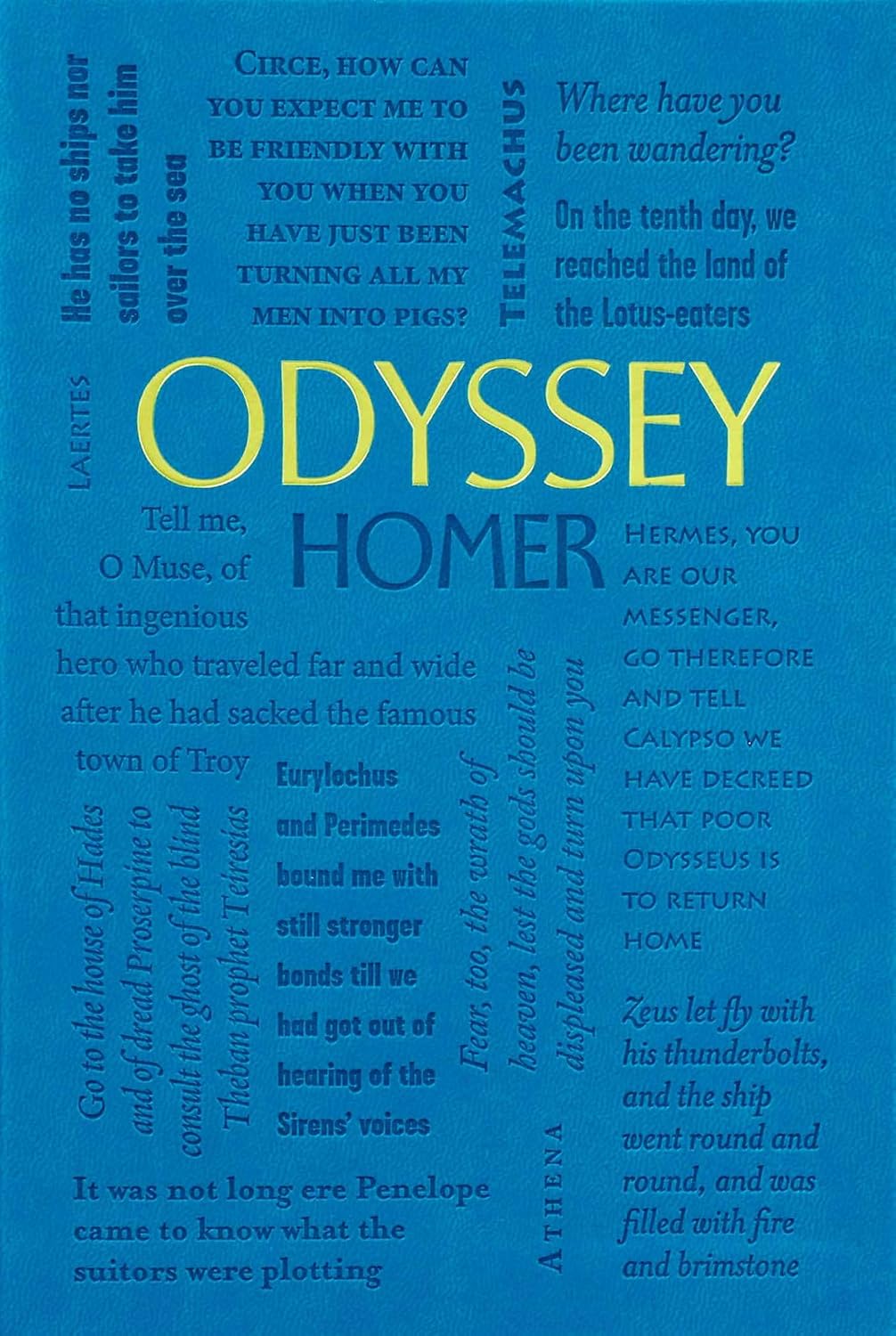
We looked at the various books…some in prose, some in poetry, some in prose but broken up into lines like poetry for academic reasons, some with footnotes. The proprietor was eavesdropping, amused, I think; he leaned over to show us a copy that had Greek on one page with the English verso, so that my nephew could see what the Greek looked like. He thought it was pretty cool. He chose a modestly-priced copy in flex-cover (see above left) because he liked reading the excerpts on the cover and because this one–the Butler translation from 1900–was written in prose. He thought he would find that more familiar, like reading a novel or a history. I said it might seem a little old-fashioned in style, but he’d probably be fine with it. “Old-fashioned like Shakespeare, or old-fashioned like ‘The Turn of the Screw’?” he asked. Precocious little fellow, no? More like Henry James than Shakespeare, I assured him. So he went home with a new book thousands of years old.

* If you happen to know which book is about the gods getting together to make more gods, let me know! 😄

~

The journeying trope is so ancient and always seems relevant. It must be we are nomads right through our genetic inheritance to the earliest human days. That reminds me of this poem, which is imagined but foretells a trip my siblings and I have a duty to make, probably in the coming spring. Now that both of our parents have died, we’ve promised to make this final journey with them.

~~~
Driving to Northeastern Indiana with Our Parents’ Ashes

I’m lazy, worn flat by August’s heat haze
with a feeling of impending grief, unable to sleep,
and I find myself imagining a last road trip
with my sister and brother, carrying our parents’ ashes
to a Midwestern graveyard.
My sister will compulsively update
our calculated arrival time and our brother,
who appreciates geography, will remind us
how many rivers we’re crossing, how many wetlands lost.
There will be a few remaining barns painted
with Mail Pouch Tobacco logos, but will we pass
Sinclair stations, cows pastured beside the highway?
More likely the rabble of off-ramps with their
abundant franchises, gasoline $3.29 a gallon.
It’s easy to imagine us driving I76 west,
Sheetz, Stuckey’s, McDonald’s, as we pass Akron,
Lima, Van Wert, our parents nestled together
in boxes beside the luggage.
I think of them shifting quietly there.
They’ve only briefly been apart, and it is time now
to intermingle them again, at their request,
which is why the three of us, in my imagination,
traverse the backroads of our shared childhood,
cross the new bridge and pass our grandmother’s
old house on the riverbank.
We’ll head for the municipal cemetery,
singing “She’ll Be Comin’ Round the Mountain”
at the tops of our lungs, as the five of us
used to do, laughing until we cry.


~

photo by Joshua Buckmaster

Crickets

Colloquial speech fascinates me, particularly as its particularity evolves and morphs over time and through culture. Phrases, allusions, slang, cultural references…no wonder that one of my favorite screwball comedies of all time is the Barbara Stanwyck/Gary Cooper film Ball of Fire. (Check it out!)

Recently, my sister complained that she sends out brief, concise emails to coworkers and people who report to her–emails that require acknowledgement or response; “and what do I get?” she shrugged in exasperation, “Crickets!” I know the feeling. Try sending emails to dozens of first-year college students…see how well the average 18-year-old answers them.

Online at YourDictionary.com, I found the most concise definition of crickets:

(US slang, humorous or derisive) Absolute silence; no communication. Derived from the cinematic metaphor of chirping crickets at night, signaling (otherwise) complete quiet. May be used alone or in metaphorically descriptive phrases.

I love that this definition suggests the term derives from movies! I love that it’s a metaphor! And, of course, I love that crickets make sounds–so in actuality the analogy stems not from absolute silence but from the absence of, I suppose, a human-language response.

This time of year at my meadow, the crickets still thrive and make noise even as the cooler nights begin to slow their calls. I hear the order Oecanthinae (tree crickets) from on high in the tree canopy and the order Gryllus (field crickets)–slightly lower in pitch–creak-cricking amid the goldenrod and sedge.

Then I stop and consider all the thrumming, crashing, screaming, irritating, beeping, blasting, babbling noise humans make in the world. Even when we feel joyful, words and enough noise to make the head spin. A great din?

I think I choose crickets, for now.

Face to face

alice-heart1 copy

The physical, corporal power of poetry; the need for language and expression to originate in the body–these are concepts that resonate with me as a poet and that make poetry such a difficult art. For how can one be in the body through words? Words remove the physical language of the body which is so important a component of communication. That is why tweets and social media posts and email often work to the detriment of genuine understanding.

What follows are three rather diverse chunks of thinking concerning the corporal and the intellectual.

Ren Powell writes in her blog:

And it made me more certain than ever that the separation of the corporal and the intellect is truly the root of every evil. It’s why all the studies show that getting people to talk face-to-face, breaks down bigotry in a way nothing else ever will. A linguistically relayed concept has to be replaced by a body that we experience in the sensual world.

It brings me to Orr’s phrase to describe poetry: “the eros of language”. I think poetry is necessary because it bridges the gap between the corporal and the intellectual in a way no other writing can. Why we say novels that tell the truth are “poetic”. When we speak poetry, sing it, it becomes corporal. It’s funny that when we sing the word “love”, we are not supposed to sing “luhv”, with its stingy and clenched vowel, but we’re supposed to open the mouth, sing “lahv”- with a wide-open palate. Because it hits us in the gut with its beauty then. Openness.

And counter-wise (which should be a word),  we can infect our minds with the routine that reinforces ugliness: I believe writing or drawing words and images of hate can infect the body.

~~

Reading Ren Powell’s words, I thought immediately of two poems of Gregory Orr‘s, from his book Concerning the Book that Is the Body of the Beloved. Here they are:

How small the eyes of hate.
I’m not making this up
Or being metaphorical.
A man held a gun against
My head and I saw how
Small his eyes were
With what they refused
To take in of the world.
This happened beside
A small highway
In Alabama in 1965.
What history called
The Civil Rights
Movement; what I call
The tiny eyes of hate.

~

How large the eyes of love.
How the pupils dilate
With desire (I’m not
Making this up: science
Has proved it’s true).

Those eyes wide
And glistening: gates
Thrown open. What’s
Inside, free to flow
Out as feeling,
And the whole world
And the Beloved
Welcome to enter.

~~

I just saw the movie “The Arrival,” a science-fiction film based on Ted Chiang’s short story “The Story of Your Life.” Any movie whose main character has a PhD in Linguistics sounds intriguing to me. The narrative uses the Sapir-Whorf hypothesis as a kind of plot point: the theory that language molds culture. An underlying possibility in the movie is that perhaps it is language that gives us consciousness, transforms us into sentience, and–possibly–has the capacity to unite and heal us.

But it needs to be face-to-face, as in the movie, wherein Amy Adams encounters aliens in person, insisting that in order to interpret any new language she must experience the process of “speaking” personally, to judge body language, movements–not just sounds or written “text.” How we communicate teaches us who we are. In order to understand one another truly, we need authentic encounters, not slogans.

We need to bid each stranger as Beloved, “Welcome to enter.”


905668_10209085939849941_7289218723455836950_o