Hunger for words, words for hunger

When I was very young, our church became involved in the War on Poverty outlined by the Johnson administration (1964). My father attended events and marches to raise awareness about the fact that many people in this wealthy nation, the USA, were struggling–even starving. It seemed, probably idealistically, that a country as prosperous as the US was in ’64 would find a way to insure that all its citizens could have enough to eat and a roof over their heads. (This was Johnson’s “Great Society”)

A memory:

My sister, my mother, and I are seated at the table in our little apartment kitchen in Yonkers, NY. My father is away on pastoral business, but the previous evening, he’d told us that we were going to fast the next day in solidarity with poor people who never had enough food to eat. The reason for fasting was to let us feel how they must feel.

My little sister thought that was unfair. She was, in her defense, only four years old.

Of course it was unfair. That was the point. Why should some people have plenty of food while others went hungry? That is unfair. (This logic she understood, though I don’t think either of us made more of the connection at that time.)

“You kids won’t fast the whole day,” my folks said–just suppertime.

Now it is suppertime. We are at the table, and the table is bare. We each have a glass of water, not milk. And we are hungry. Our mother has fasted the whole day. Isn’t she hungry? Yes, she says. She’s hungry. It isn’t a good feeling, and we whine awhile, hungry and in addition, bored.

“Okay,” she says, “you can each have a piece of bread. One piece.”

It is something, but it doesn’t fill the stomach.

bread

bread

Another memory:

I’m in my thirties, with young children of my own now, and talking with my mother about her past–a past she has kept from us, and from herself, and is slowly learning to accept. A past that included growing up during the Depression with five siblings. How her father refused, out of pride, any kind of government relief. How hard her mother worked to keep the family from going hungry.

I think, then, that my mother knows what it means to be hungry.

~~

Many decades later, the term for hunger has become, in legislature and grant proposals, “food insecurity.” The jargon, the euphemism, distances us from the facts. People without enough good nutritious food are not insecure. They hunger.

I don’t want words to operate that way, moving the reader away from understanding. I want words to bring us close, to open up the mundane and horrible real and the fervently imagined possible. Language that sears and mends, the interpretation of which also can sear and mend, words that do not act as misprision but as multi-faceted revelation. Those are the words for which I am hungry.

Something that fills the stomach: embodied, flavorful, wonderful words. That’s one of the reasons I love poetry so much, that hunger for the non-distancing. The relationship that brings us truth. The truth that is often unspeakable.

Poems can take us there:

One Kind of Hunger

The Seneca carry stories in satchels.
They are made of  pounded corn and a grandmother’s throat.

The right boy will approach the dampness of a forest with a sling, a modest twining

wreath for the bodies of  birds. A liquid eye.

When ruffed from leaves, the breath of  flight is dissolute.
What else, the moment of  weightlessness before a great plunge?
In a lost place, a stone will find the boy.
Give me your birds, she will say, and I will tell you a story.
A stone, too, admits hunger.
The boy is willing. Loses all his beaks.
What necklace will his grandmother make now.
The sun has given the stone a mouth. With it, she sings of what has been lost.
She sings and sings and sings.
The boy listens, forgets, remembers. Becomes distracted.
The necklace will be heavy, impossible to wear.
~

Lehua M. Taitano

Backstory, continued

What brought the idea of backstory to mind was a poem of mine that recently appeared in Peacock Journal’s  print anthology. The poem appeared last year in the journal’s online site. (See: “Imagined Painting of Mary Magdalene Bathing.”)

A friend read the piece and responded to the poem by saying, “This is a beautiful poem. It’s so visual–also, different the second time you read it. And I know how interested you’ve always been in saints and iconography and art, but where did you come up with the idea of imagined paintings? What’s that about?”

This is the best kind of question, as far as I’m concerned. It is a question about ideas, not inspiration or meaning or even craft–though I love questions about craft. It does beg the writer to reveal, however, a bit of the story-behind-the-story/poem/narrative, etc.

“Backstory” may seem self-explanatory. It’s a term used more frequently in drama, particularly screenwriting. Poetry critics are less inclined to employ the concept because–see last post–it is too easy to fall into explaining the poem, which is generally considered a no-no. My friend, however, is a reader and not a poetry critic. I felt free, therefore, to address the question on a personal level.

As my good friend knows, I have been intrigued since adolescence by the art and iconography, the symbolism and the stories of the saints, despite my Protestant upbringing. I love art, aesthetics, and the divinely natural (empirical, phenomenal) World and feel an ambiguous but compelling relationship with myth, religion, history and a culture I cannot escape. And I have imagination.

I began writing about a saints in less-than saintly pursuits. The idea interested me. Surely the saints could be imagined as real human beings, not only as intercessionaries between the human realm and Heaven. I wrote about St. Sebastian purchasing a tunic, Saint Agnes braiding her mother’s hair, and St. Anthony fetching a pail of water. Saints as human beings (rather than as symbols, icons, and religious items) led me to the depictions of saints in art as other-worldly, pure, suffering, or in all ways saintly; and I entertained thoughts of paintings I had never seen but would like to see–theoretically-possible paintings. In the case of St. Mary Magdalene bathing–would Da Vinci have painted it? Rubens? I can only imagine. The poems are a kind of ekphrasis.

I wanted to be a painter when I was a child. This imagining may be as close as I ever get to realizing my youthful ideals.

~

There is not much more backstory than that. None of it leads to meaning or interpretation, although the story above may cement some allusion or confirm referents in the reader’s mind. I hope, however, that the backstory here might interest one or two readers enough that they pick up a book on Renaissance or medieval art, on hagiography or history. Or perhaps someone will go to Amazon.com and purchase the anthology at the link above.

Thank you, friends in literature and imagination.


Poetry & backstory

My primary interests on this site are consciousness, nature, philosophy, the arts, and poetry in particular. Recently, poetry has been taking a backseat to other concerns; but poetry has a way of constantly asserting itself into my consciousness–of whatever that may consist (see previous posts for wrestling with that concept).

I have been reading poetry but not writing about it much and not composing at a productive clip, though I am not feeling “writer’s block.” I have, instead, allowed other events in my life to take over space formerly reserved for writing poems. This is neither bad nor good–it is just the state of affairs at present. Recently, a discussion with a friend brought up an aspect of poetry-writing that I have not spent much time thinking about; and the reason I haven’t is probably because I was warned away from the practice long ago when I first began to write verse.

The practice is “explaining the poem.” Of course, in theory the poem should do its own explaining, and if it requires too much prose telling, then it ought to be fiction or memoir or history or something other than a poem. That’s what my mentors and teachers imparted to me about poetry (all hail received wisdom!), and I do not disagree with this tenet–but having taught classes that introduce people to poetry, let me add a few cautions and qualifiers.

See, there’s explaining, and there’s explaining. One version of explaining the poem is to tell what inspired you, how you started to write it, what you were aiming for in terms of purpose, what you intended to “do” in the poem, and what each of the references means as relates to your life, the nation, culture, religion, or a love affair. If that is what the poet does before reading the poem aloud or presenting it upon the page, then the poet is doing all of the poem’s work for it. Too much information.

If the audience does not understand or appreciate the poem without this sort of explanation, then you have either a failed poem or a failed audience.

Then there are forms of interpretation and analysis by critics, reviewers, or fans; these texts or discussions can be immensely interesting and fruitful but do not involve the poet him or herself, so they do not really qualify as “explanations.” This process is what we try to teach students to do in university literary analysis coursework. Sometimes we encounter lackluster or lazy audiences in the classroom: people who want the professor or the textbook to do all the work of understanding poems for them. Poems are complex, like polymer molecules or neurological wiring. Not easy to explain.

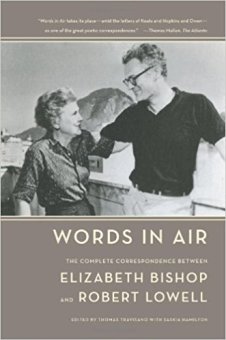
But there are explanations of a kind that can be valuable, even if they are fabishop lowell ltrsr from necessary when one encounters a really terrific poem. There are reasons to learn the backstory of a poem, if such a thing exists for that particular poem (not all poems have one). Anyway, it may be worth asking the poet about it, if she is still living and can answer or if the answer may be deduced from archival materials. We have learned the backstories of a few Elizabeth Bishop poems, just taking one well-known poet as an example (see Words in Air); the stories–in this case, letters–do not necessarily help readers interpret a poem or even understand it any better, but the stories remind us that the poem was initially embodied in the brain of another human being who was undergoing and observing experiences–or leaping into realms of imagination.

More about why that’s a good thing, and more about the embodiment of the human brain, in later posts.


Writing assignment

I’m beginning to gear up for the fall semester. As usual, I spend a couple of weeks revising last year’s curriculum, on which I have noted what worked/what didn’t work, what needs to be reinforced, what has changed in the incoming skill sets of students born in [yikes!] 1999, what’s changed in the fields of documentation and information retrieval and research during the past year [lots!].

In the process, I entertained the idea of a writing assignment for the people in our U.S. legislative bodies. The more I thought about it, the more fun I had with it. Then, I changed it from a joke assignment–because really, our nation’s government is a serious thing; too many jokes and parodies end up contributing to the problem.USConstitution

Honestly, I think this would be a valuable experience for our representatives and something few of them have done since their college years. I, for one, would like to read the essays my representatives would write.

I’m also thinking that this would be a good project for my student writers–to have each of them compose a writing assignment for legislators–or for the audience of their choice. It feels a little empowering to say, “Here are your requirements; write something for me to read.”

So here it is.

~

Assignment for members of the House of Representatives and the Senate, to be completed during recess and returned for evaluation at the conclusion thereof.

The text: Team of Rivals—The Political Genius of Abraham Lincoln, by Doris Kearns Goodwin.

Preparation: Read Goodwin’s book carefully, taking notes as you read. Especially, annotate sections of the text that feel particularly relevant to you or to contemporary issues in government. Also note themes, such as loyalty (to whom or to what?), relationships (personal and political), conflicting interests (there’s a war going on, but also more than that), compromises, responsibility (to constituents, to party, to nation, to family, to self) and status in its many forms.

The assignment prompt: Write a reflective response argument to Goodwin’s text, demonstrating that you understand her book’s purpose and showing how you might implement something among Lincoln’s strategies to change the paradigms currently operating in the legislative branch of government; offer evidence of why this strategy would be effective and what steps could be taken to create a political environment more receptive to a cohesive government even given considerable disagreement among parties. Close with a paragraph reflecting on your own political challenges and how these parallel or differ from the conflicts in Lincoln’s 38th Congress and in his cabinet.

Secondary sources may be used but are limited to: The Constitution of the United States; The Declaration of Independence; and Supreme Court justice opinions, historical or contemporary. No other source material permitted.

Page count: between 10 and 15 pages, exclusive of works cited or footnotes.


Evaluation: Each essay will be number-coded and read blind by another member of the legislature (House by other House representatives, Senate by other Senators). Each reader will write a two-paragraph response to the essay and give it a grade of 1-5 (5 being the best) based upon argument, evidence, clarity of writing and of ideas, proof that the writer understood the text material, and ability to stay on the essay prompt. Ideological off-topic “responses” and plagiarism receive a grade of 0.

Essays that demonstrate exemplary thinking and reflect an ability to apply skills learned from the readings, those that receive a grade of 5, will be circulated to members of both houses of government and to the presidential cabinet, of whomever that may consist at any given time. At this time, the authors’ names will be revealed.

After the evaluations have been completed, all essays will be filed online as .pdfs for constituents–and all citizens–to download and examine.

Living U.S. Presidents, past and current, and presidential cabinet members, should consider participating in this essay-writing project and making their work public to ensure a level of open, diplomatic discourse in the public arena.

~

Well, I can dream. Can’t I?


Muses & musings

Muse, verb–from Merriam Webster online

intransitive verb
1:  to become absorbed in thought; especially :  to think about something carefully and thoroughly

2:  archaic :  wonder, marvel

transitive verb
:  to think or say (something) in a thoughtful way

lesssaturated.jpg

Muse, noun–from American Heritage Dictionary online

1. Greek Mythology Any of the nine daughters of Mnemosyne and Zeus, each of whom presided over a different art or science.

2. muse 

a. A guiding spirit.

b. A source of inspiration: the lover who was the painter’s muse.
3. muse Archaic A poet.

[Middle English, from Old French, from Latin Mūsa, from Greek Mousa; see men-1 in the Appendix of Indo-European roots.] (It’s worth going to this link to the Appendix if you are a word geek.)
 ~

Musing, on a hot summer day, evokes Whitman’s lines:

I loaf and invite my soul,
I lean and loaf at my ease observing a spear of summer grass.

I observe a spear of summer grass, a meadow of milkweed, a small bee but a loud one buzzing about the hole where last year the grass wasp nested. Because it is a national holiday, the road construction crew next door has been absent, allowing me to hear the bees and the wind chimes and the bluejays screaming at the redtail hawks.

My poetry Muse, assuming I have one, has also taken a vacation.

In the meantime, there is summer novel-reading to do (Elena Ferrante‘s Neapolitan quartet, Margaret Atwood’s Hag-seed, and others). I do have my day job, but I have scheduled a travel vacation and am musing on what to pack, wondering what it will be like to be in a new place…wondering if my Muse will follow me as inspiration or will guide me in some new direction. Even at my age.

It’s always possible.

~

Invoking Whitman again:

There was never any more inception than there is now,
Nor any more youth or age than there is now,
And will never be any more perfection than there is now,
Nor any more heaven or hell than there is now.

You will find me outside, in the shade, musing on perfection.

seedfluff


Biodiversity, biodestruction

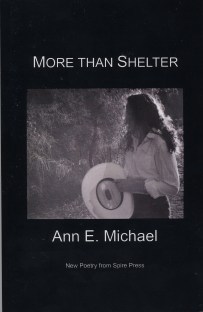
As the poems in my first collection, More Than Shelter, convey, I experienced mixed emotions about building a house and residing as human animals on a field that was in the process of reverting to wildness. It is a terrific privilege to “own” several acres of property and to dwell and raise food and children here. We have, after nearly 20 years, settled many of our challenges with the environment and its flora and fauna; and often, our lesson has been to let the environment be itself.MTS002

That means our “lawn” has largely reverted to clover and to grasses that can compete with weed seeds. That means we have meadows fore and aft and shrubby, scrubby hedgerows of mixed brush along a thin row of trees and rocks. It means we cannot entirely rid the area of invasive, non-native plants or the insects that come with them. And if a season passes without regular, careful maintenance–the environment will creep in on our living spaces very quickly.

On the other hand, a commitment to use no chemicals–or as few as possible (some exterior house maintenance requires paints and finishes that just are not environmentally-neutral) has meant that the property has good biodiversity for its size. So many kinds of avian life: scrub-loving little brown jobs, woods-dwelling owls and thrushes, turkeys, four varieties of woodpeckers, brightly-plumaged orioles, cardinals, jays, bluebirds, tree swallows, and goldfinches. Also the transient hawks, buzzards, and herons, and the grass-dwellers such as killdeer–to name a few. We are host to winterberry, serviceberry, dogwood, elderberry, nannyberry, mulberry, cherry, and wild grapes, so the wild fruit-eaters adore the place. Foxes, deer, groundhogs, raccoons, squirrels, chipmunks, skunks, opossums, even coyotes and possibly a black bear graze here.

They do not always stick to the margins and the flora. Sometimes they get into the trash cans or the compost heap (I once disturbed a deliriously happy raccoon sucking on a mango pit). Owls and foxes feasted on the guinea hens that refused to go back into the chicken run at night.

This description has not even gotten as far as the insect life, which is lively indeed–nor to the little bats, nor the oak trees’ flying squirrels.

~

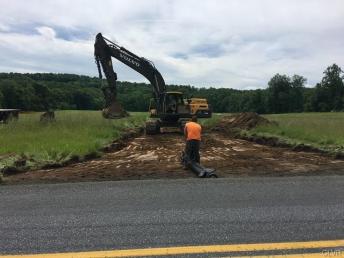
For the last decade, we have been among several neighbors who worked to slow the development of about 60 acres that lies immediately east of us and extends up the last low rise of the Appalachian foothills (Blue Mountain/Great Valley section). We have had some success in limiting the development: there are now 40 acres of preserved land on the north side of the slope, and the “estates” will consist of 13 township-approved house lots instead of the initially-proposed 52.brunner

But the site preparation process has begun in earnest this summer, and each morning–an hour or so after the birds start their chorus–the bulldozers and front-end loaders rev up and begin the crash-&-bang, the delivery of large culverts made of concrete, the dump trucks with their loads of gravel, the engineered changing of swale and drainage.

We were guilty of such disruption ourselves 20 years ago, when we installed the house we love on the land we think of as our own. I try not to mourn the loss of the field next door; it was never ours to begin with, and in so many ways, neither is the property on which our house sits.

The land belongs to no one. It is earth’s. If it belongs to anything it is to the generations of dragonflies, lightning bugs, red-tail hawks, barred owls, and rotund skunks, all of which preceded our appearance here by centuries.


Love & reflection

alice-heart1 copy

We express love because the gratification of love is enormous, and we continue to express love and to act protectively because the loss of love is traumatic. If we did not experience pain on the demise of those we love, if we had the pleasure of love but felt nothing when the object of our love is destroyed, we would be considerably less protective than we are.

It may also be that the very structure if consciousness opens the pathway to depression…To give up the essential conflict between what we feel like doing and what we do, to end the dark moods that reflect that conflict and its difficulties–this is to give up what it is to be human, of what is good in being human.

–Andrew Solomon, The Noonday Demon: An Atlas of Depression.

Reflection is a sign of consciousness, the ability to take in information and observe how it feels to be oneself in the face of that information, and to assess the impact of behaviors and actions and catastrophes and deaths. Socrates, the irritating questioner, required of human beings that capacity of reflectiveness. Solomon suggests this reflective ability is natural to people who undergo a depressive episode: “The unexamined life is unavailable to the depressed.” (italics mine)

Yet it is also this reflective consciousness which permits recovery among those who’ve been in the abyss, and sometimes a kind of bounce into remission/relief. Solomon adds that “[p]eople who have been through a depression and stabilized often have a heightened awareness of the joyfulness of everyday existence. They have a capacity for a kind of ready ecstasy and for an intense appreciation of all that is good in their life.”

That sense of “ready ecstasy” often acts as the impetus for poetry, in my experience. I am not sure that joyful awareness was worth the pain and despair–couldn’t I have just achieved heightened awareness through, say, meditation, song, or religion? Nonetheless, if I can craft a relationship with depression that is not a destabilizing battle, that’s enough for me. The recognition of joy and the critical thinking that reflection deepens in my consciousness keep me striving.

Yesterday morning, early, in the long grass, the three-legged doe gave birth to a fawn. I watched as they emerged from the meadow and headed for the woodlot together, mama still licking the little one.

Earth delivers ecstasies readily, if only we will observe.

ann e michael

Depression & friendship

When I mentioned to an acquaintance that I am reading Andrew Solomon’s The Noonday Demon: An Atlas of Depression, the look on her face pretty much summed up how most people feel about the topic–why would I want to read about something so upsetting?

A few sections of Solomon’s book are hard to read but, surprisingly, some of it is laugh-out-loud funny. Humor definitely acts as a leveler for the challenges life brings us; Solomon admits to “being afraid of a lamb chop” and other anecdotes that are not merely self-deprecating–they are somehow universal, at least they are if you are a person who has had a relationship with the Noonday Demon. His descriptions of how his friends bore with him and supported him through his deepest katabasis are hilarious, humiliating, sad, and unbelievably moving.

Simultaneously, I’m reading The Five Invitations: Discovering What Death Can Teach Us about Living Fully, by Frank Ostaseski. Obviously, that text is on the reading list of “the morbid book group.” The approach is mostly Buddhist, but Ostaseski does a good job of gently suggesting that bringing more moment-by-moment, alert compassion into our lives daily can ease many of the burdens of human suffering by making us aware that all of us suffer and that suffering, shared, becomes less of a weight or stressor in our lives.

Friendship keeps us sane. It does so partly through that sense of community in which many hands make light work. And it brings us back to sanity, sometimes (not always–there is no “always” in the human sphere). For many persons, relatives are friends. Other people have no friendships within their families but have friend-relationships that act as similar, or even more powerful, support. The luckiest people have both.

I am one of the lucky ones. Today, while thinking about consciousness and suffering and depression in the human condition, I want to acknowledge the loving, sane difference a friend made in my life: David Dunn, poet, jazz aficionado, baseball fan, Trekkie, fellow laborer in the mines of the abyss, 1955-1999.

Reading these books while navigating the recent loss of an elderly long-time friend has unleashed a reflective current that, while a bit sorrowful, does not feel like depression. There’s gratitude in this rivulet, happy memories and rueful ones–more like inspiration than desperation. That may be because the friendships are still supportive. Relationships don’t die when the friends die; a powerful relationship lasts far longer.

Depressed people feel unlovable and, unable to accept the clear evidence that they are indeed loved and valued, manage to behave in ways that make themselves and others miserable. They don’t mean to hurt others; in their pain, they think that they deserve to be abandoned and their crazy words and actions create a self-fulfilling prophecy of isolation. It takes a surprising amount of strength to be a person who undergoes depressive episodes (they are so exhausting, physically and mentally–see Solomon’s book). And it takes incredible strength to love and stand with a deeply depressed person.

David Dunn, who experienced depressions far more debilitating than my own, acted as my tether when I started to drift too far. In my younger days, that drifting often led me toward Charybdis. In turn, I helped David when he was low; we shared poems of others and poems of our own, shared books, fears, and insomnia tales. We held one another upright in the throes of some pretty miserable days.

I miss him. Though I am much, much better now, I do not think I could have survived those years unscathed without his quiet acknowledgment of my pain and the presence of his friendship. The idea that we can accept what life brings us without bitterness or anger or blame, yet without resignation or helplessness, seems a tough task for the people in my culture. David Dunn could not always attain that balance for himself, but his acceptance of me taught me more than I ever realized at the time.

swan king001 copy

~

“There is something brazen about depression. Most demons–those forms of anguish–rely on the cover of night. To see them clearly is to defeat them. Depression stands in the full glare of the sun. You can know all the why and wherefore and suffer just as much as if you were shrouded in ignorance. There is almost no other mental state of which the same can be said.” ~Andrew Solomon


Depression narratives

I have been an avid and interested reader of books, usually memoirs, describing the authors’ experiences with depression, unmanageable grief, or depressive episodes. There are a number of reasons for my interest, one being that I have an interior depression narrative of my own and the other because of my passion for delving into concepts of consciousness. Consciousness and depression must be intimately linked, of course; a person cannot feel depressed if he or she lacks a reflective sense of self or Mind. Sorrow differs, but some grief is so deep that depression enters in and squeezes the soul dry. Each narrative contains parallels to other narratives, and yet each is as unique as the author. We are “storytelling animals,” and the impetus to tell the story of depression may be to help others or to assist in re-knitting the disjunctions depression creates in consciousness.

For example: This Close to Happy, Darkness Visible, An Unquiet Mind, H is for Hawk, Hyperbole and a Half, The Year of Magical Thinking, The Solace of Open Spaces…even in the relatively brief Chapter 75 of Bruce Springsteen’s memoir Born to Run–there are dozens of such memoirs on my bookshelves, and this list does not even mention the books by poets, psychologists, and philosophers who have explored the human challenges of depression. [I have not yet read Andrew Solomon’s Noonday Demon; but it is on my list.]

Porcelain doll, “Rain,” by Alexandra Koukinova of “Alexandra” Company.

Because I am a writer, these narratives, and the lyric inventions crafted by poets, teach me much about how to explain the un-nameable, to describe–in words–the kind of numb grip that a depressive crash or a monumental grief exerts on a person’s sense of self, or even of language (which fails); the way depression shrinks into nothingness a person’s feeling of shared community/communion/communication with others, even with beloved others. There’s a story there, the story of how the story itself gets subsumed by stasis.

In these cases, metaphor: the person is the story; the story loses its narrative, tapers off, stands still. No longer interesting, expressive, alive.

Unfortunately, I know that feeling. I know how it arrests creativity and savages my ability to write.

~

Why do we “get” depressed? What does depression do to the brain? Does the brain itself cause depression? Despite the insights medical researchers have gleaned about neurological networks, cells, synapses, the anatomy of the organ we call “the brain,” there are no answers to these questions; the former can be tracked through scans to some extent, but there is seldom a “before” MRI or PET scan with which to compare “normal” and “depressed” in a unique individual. A New York Times Health & Science article from 2005 puts things pretty succinctly:

” ‘I think that, with some notable exceptions, the community of scientists was excessively optimistic about how quickly imaging would have an impact on psychiatry,’ said Dr. Steven Hyman, a professor of neurobiology at Harvard and the former director of the National Institute of Mental Health. ‘In their enthusiasm, people forgot that the human brain is the most complex object in the history of human inquiry, and it’s not at all easy to see what’s going wrong.’

For one thing, brains are as variable as personalities.”

brainOne of the problems is determining causation: which was first, the disease or a perceived (and possibly inaccurate) difference in brain structure or function? Is it chemical or hereditary, or is it traumatically-induced? Or are we not really seeing a difference in brain structure? Why do medications work for some people but not others? And why and how do medications work, exactly? Twelve years after Carey’s NYT article, psycho-neuro-biologist folks still do not know any definitive facts, though there is slow movement toward progress. [For a quite up-to-date and thorough but readable article about the complexities involved in depression, I recommend Harvard Health Publication’s online pamphlet “What Causes Depression?”]

~

From the standpoint of a person who has had a lifelong relationship with depression, I’m not sure I need a cure at this point. My depression narrative includes taking a pill that seems to help considerably; but that has not been the magic bullet that alleviated a chronic, possibly chemical, condition. What has balanced my conscious mind with my chemistry is at least as likely to be related to support, friendship, talk therapy, cognitive behavioral changes, personal motivation, love, reflection, experience, information, aging, writing, spiritual study, Zen, nature, environment, valuable work, art, and tai chi.

The Nautilus article (cited below–do consider reading it) suggests there may be an “up” side to depression:

In a study of 61 depressed subjects, 4 out of 5 reported at least one upside to their rumination, including self-insight, problem solving, and the prevention of future mistakes.

“It may be best to let depression work its miserable magic, under protective supervision.”

“Most episodes of depression end on their own—something known as spontaneous remission…” says Steven Hollon, a professor of psychology at Vanderbilt University.

The Nautilus article cites several researchers who use the evolutionary model of fitness and bargaining, concepts that Marjorie Grene might caution us away from relying too heavily upon. Drake Baer of The Science of Us, whose article was certainly titled by editors, not scientists, writes “that, in some circumstances, depression may be, in the arc of a life, yielding of insights and personal meaning. All of this is in no way meant to minimize the suffering that depression can cause — but to suggest the uses that it may serve.”

Baer’s article dwells upon the idea that there are structural and cultural concepts at work in the identification of, experience of, and healing of depression; that the “illness” or disease resides in the subjective, non-empirical, non-testable world of human consciousness (interiority). I’m on board with that suggestion. Baer closes by relating depression to katabasis, an ancient Greek word that refers to the inexorable downhill slide, the descent into the underworld, the sinking down into darkness.

Baer writes that “Katabasis leads to catharsis; not coincidentally, there’s a shared theme in the personal narratives of people who reach midlife with a sense of well-being and generativity toward others: redemption.”

My personal depression narrative, just past mid-life (by some reckoning), suggests redemption. Which is to say there’s hope.

~

2011A-rainbow.jpg

Totally cheesy rainbow photo.

See also: http://psycnet.apa.org/journals/rev/116/3/620/

http://nautil.us/issue/45/power/does-depression-have-an-evolutionary-purpose

http://nymag.com/scienceofus/2017/02/a-new-way-to-understand-and-treat-depression.html

Please, if you or someone you know and care about has challenges with depression, read the Harvard article linked in the text at very least; and check out the other links as well. This is as close as I ever get to a public service announcement, but the urgency is explicit.

Science & philosophy

The small, religiously-affiliated university at which I work graduates, percentage-wise, a large number of baccalaureates in the sciences although it offers a liberal arts-based core curriculum. How does that affect what coursework students must do? For starters, two Theology courses and one Philosophy course are required for graduation.

Three critical-thinking method, scholarly courses ought not to be more than a student in the sciences–or any other discipline–can handle; but I hear a bit of resentment among the undergrads. They question the necessity of abstract ethics classwork, wondering how such material will be applicable to a fast-paced, technologically-advanced, science-oriented career or life. Philosophy doesn’t seem to be a skill set to them.

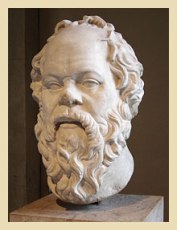
SocratesWhile I fundamentally disagree, I take their point. With so much new information coming at them, info-savvy young people might well feel skeptical about what they can gain from reading texts by Plato, Aristotle, Augustine, or Aquinas.
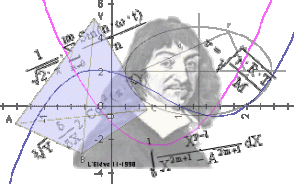
Philosophy has been around for millennia, though; empirical science as we know it–with electron microscopes, satellite-mounted telescopes, petri dishes and x-rays–is brand-spanking new by comparison. The techniques we use today seem concrete and tool-like rather than theoretical; yet as every real scientist knows, the only way developments occur is through hypothesis–theory–claim–assertion–question–pushing the envelope of the known.

Which is what philosophers have been doing for thousands of years.

The budding scientists and medical-studies researchers I encounter seldom realize that without philosophy, science would not exist. Philosophers asked the “why” questions, came up with theories and categories, tried to see into a future that might someday have the technology to confirm or refute the theories they came to solely through human observation and deduction. Problem-solving skills. They were the scientists of their day, and the methods of thinking they came up with are those that contemporary scientists in all disciplines continue to employ.

http://www.isys.ucl.ac.be/descartes/images/Descartes.gif Descartes

Descartes, 1640s

A wonderful book on the way philosophy developed into biology (to take just one of the scientific disciplines) is Marjorie Grene and David Depew’s The Philosophy of Biology: An Episodic History.

The authors–a philosophy professor and a rhetoric professor–provide a history lesson in science, taking us by steps and by leaps into the development of a scientific (empirical) skill set as derived from insightful cognitive understandings of those Dead White Guys on whose thinking Western philosophy is based.

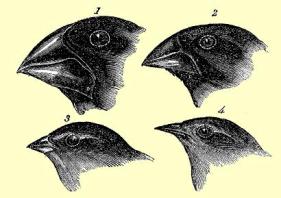
finch beaks

Darwin’s finches, 1840s

Now, I am not an advocate for a strict return to the Western Civ canon; I think university education should diversify into exploring (and questioning) other modes of cognition, culture, and philosophical approaches. Yet it seems to me imperative that students continue to study, and learn to value, the history of human thought. You can be a nurse without a thorough background in Aristotle’s categorical concepts; you can learn the drill about washing hands, donning gloves, and inserting catheters–all practical, concrete skills. You can understand the rationale for all of those skills; that’s true, and practical.

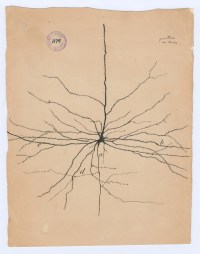
beautifulbrain01-1080x1373

Cajal’s drawing of a pyramidal neural cell, 1913

Nurses today, however, should have the thinking skills to solve unexpected problems rapidly and rationally, which is how things play out “in real life,” to deduce that something’s going wrong even when the readouts look stable, to recognize that the hurried intern added an extra zero to the number of milligrams of medicine prescribed. They need enough background in the history of medical care-giving to question a doctor or administrator when the ethics of a patient’s care seem to be at risk. These problem-solving skills are not only crucial, they are philosophically-based.

~


I will dismount from my high horse now. With all the disorienting information being bombarded at me these days, I need a poem to reorient myself. Here’s one by Mary Oliver.

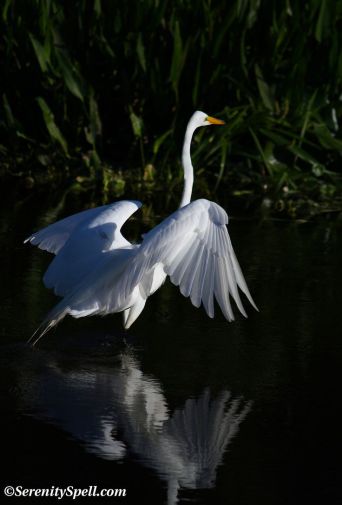
Snowy Egret (by Mary Oliver)

A late summer night and the snowy egret
has come again to the shallows in front of my house

as he has for forty years.
Don’t think he is a casual part of my life,

that white stroke in the dark.

==

We shake with joy, we shake with grief.
What a time they have, these two
housed as they are in the same body.