What is American?

I have been setting up new training for the students I hire as writing tutors. My tutors are terrific students who understand coaching, modeling academic writing behaviors, and conventional essay structure better, often, than correct use of commas. Anyone can eventually figure out commas, though–that’s not the best use of a student’s time in a tutoring session. Writing tutoring works best when the tutor and student engage in understanding the assignment and the reading and then, mutually, figure out the most appropriate means of expressing the student’s stance and response. Only the final draft needs a bit of window-dressing for academic correctness, though that certainly is important…more important to some instructors than it is to others, and more important to some students than it is to others!

What I’ve lately come to recognize is that my tutors need a little more guidance in how to assist non-native-English-speakers. The need is not merely pedagogical–such as how to coach someone in the correct use of articles or of adjective-noun word order or verb agreement. The need is also cultural: my tutors should possess an awareness of cultural and ethnic variations in background that make content-reading, prompt-interpretation, and the structure of essay-writing far more complex than they may realize.

The college at which I work is small, religious-based, suburban, regional, and only recently multi-ethnic. My tutors tend to be from fairly privileged high schools and are, after all, quite young (undergraduate sophomores, juniors, and seniors, the oldest among them is only 22). I’m continually impressed by their willingness to expand their horizons–many of them have taken semesters or mission trips abroad, for example. Several of them have asked me for advice on how to conduct tutoring sessions with “ESL” students. Hence, some training is in order.

~

I encounter this new generation of students in my office, as well; and recently, one of them asked me what she could do to “become American more quickly.” She has been in the US for two years, and she does not know what to read or what to watch to guide her more rapidly into American culture other than self-help books, popular TV, and internet sites, which she finds unfathomable and uninteresting: Everyone speaks too quickly. She misses all the allusions. The material seems shallow and risqué.

Reasonable conclusions on her part. She is bright and observant.

My feeling is that cultural appropriation is American culture, and vice versa, but that notion is a bit theoretical for the writing center. One has to start somewhere, so what path can I show her? She is so eager, yearning written all over her face and her posture–and so full of questions that in her naivete she believes I can answer.

My tutors and I need to recognize ourselves as cultural informants§, and to proceed to assist students to write as clearly in US/American-English as possible while respecting the diverse knowledge and cultural differences we are liable to encounter more frequently as our institution becomes more open and diverse–a welcome diversity that will change and enhance the college mission.

My tutee’s earnest question has primed my thinking–what is “American”? Every time we converse with a student, we are inadvertently cultural ambassadors; we represent the culture that we unwittingly just are. So now, as we help at the sentence level, we ought also to think about who it is we are and what we can do to help newcomers to acclimate.

How? I believe the students we tutor will offer the best and brightest assistance in that direction.

~

§ See Staben & Nordhaus, “Looking at the Whole Text”

Untranslatable

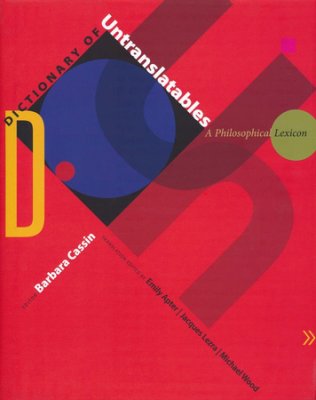
Speaking of difficult books…and I know I told myself to read more poetry (and I am, really, most recently Michael Burkard’s Fictions from the Self)…I am entranced and overawed by Barbara Cassin’s amazing Dictionary of Untranslatables: A Philosophical Lexicon. Here’s a thorough and intelligent review by Michael Kinnucan, going into more depth than I have time to post on this blog. What I want to mention about the text is its beauty and its acknowledgment of ambiguity, a quality that translates (ha!) into every aspect of human existence: our ambiguous relationships with our environments, with other humans, with our foods and our governments, our psyches, our cosmos.

138701

We cannot write about the act of translation without encountering ambiguity. We cannot really address philosophy without acknowledging that differing perspectives [context, culture, era, psychology, and of course, language] pose serious complications to understanding across languages and cultures. And even within a culture! For jargon and specialized terms can make understanding by even the most educated layman very, very difficult indeed.

While Cassin’s tome–and it is a collaborative work, with many brilliant people as contributors–presents itself as a philosophical lexicon, the connections with other disciplines (psychoanalysis, for example, with Freud’s famous coinages, and certainly poetry) are unavoidable. It may be challenging to translate the German Schicksal, a Kantian form of the idea we call in English fate, but in such cases the reader is generally going to be familiar with Kant and perhaps aware that the subtle connotations may vary. Take the word sign, however, and each reader–even those who have linguistics or anthropology or philosophy as a background–brings his or her own connotations to the definition and to the problem of translating what any individual author means by the use of the word.

Maybe this doesn’t sound fascinating to you. I relish it! And who knew (I sure didn’t) that even the word reality is a neologism, “coined by Duns Scotus” in the 13th century?

At 1200 pages of small type, this text is a tool, not a beach read. What a find, though. I have no doubt I will be referring to it for years to come, and that it will keep me wallowing in marvelous ambiguities.


A whilom history major

In an effort to get myself to sleep during a recent spate of insomnia and to enrich my understanding of ancient Roman history after reading Beard’s SPQR earlier this year, I have been reading a 1904 anthology of historians writing on various topics pertaining to the early Roman republic. History writing has changed a great deal in the past century; perhaps the historians of yesteryear were entertaining and concise by the standards of the time, but perhaps there is a reason history has a reputation for being dry. It is an undeserved reputation, in my opinion, yet I admit to finding a few of these fin de siècle commentaries soporific.

These historians toss names around as though we readers could be expected to know one 3rd-century BC general from another and assume we are already well-versed in the Punic Wars. Admittedly, it is likely the average educated reader in 1904 had more Western Civ background than the educated reader has today. I have heard of the Punic Wars, but I was rather hoping the historians could frame them for me in a way a modern reader might understand. So far, no luck with this anthology.

Perhaps that is not possible anyway–a modern reader really cannot fathom what life was like so long ago, or what constituted “civilization;” although current re-creation attempts offer a sort of immersion, no one can know how accurate they are (see: experimental archaeology). Contemporary historians, however, seem more willing to do a bit of cultural speculation, relying on archeology and artifacts as much as–or more than–upon the ancient texts listing wars, generals, leaders and enemies. One reason I decided not to pursue a history major in college long ago is that the discipline required so much task-reading of names, dates, and places before the student could move into the interesting materials of everyday life, food, culture, livelihoods, skills, crafts, religion, the arts…the kinds of things that interest me. I lacked discipline.

~

But words interest me. Another reason the 1904 book is so helpful at bedtime is the general pacing of the prose, but the word choices are fascinating. I do not just refer here to archaic history jargon but to vocabulary in general. It’s what one of my colleagues among the English instructors terms “ornamental.” Ornamental prose has its place, and there are times I relish its languid character, but it tends to drag for the reader more accustomed to contemporary American-English conciseness. So I get sleepy.

There are charming rewards to this stuff. Last week, the word whilom kept me from slumber. I had to find out what it meant before going to sleep and was about to throw off the blankets and get my dictionary. My kind spouse had the smartphone on the bedstand, however, and dictionary.com identified it as “archaic; erstwhile.” Here’s a little bio of the word from worldwidewords. Reading a compendium such as this one offers me insights not only into ancient Rome but into the world of scholars of 100 years ago–quite a different culture from today.

~

Ann E. Michael is a whilom history student and umquhile psychology major who turned to philosophy and English and then earned a graduate degree in Creative Writing. She recommends The Historians’ History of the World Volume 5 (ed. Henry Smith Williams) as both educational and snooze-inducing.     🙂

Face to face

alice-heart1 copy

The physical, corporal power of poetry; the need for language and expression to originate in the body–these are concepts that resonate with me as a poet and that make poetry such a difficult art. For how can one be in the body through words? Words remove the physical language of the body which is so important a component of communication. That is why tweets and social media posts and email often work to the detriment of genuine understanding.

What follows are three rather diverse chunks of thinking concerning the corporal and the intellectual.

Ren Powell writes in her blog:

And it made me more certain than ever that the separation of the corporal and the intellect is truly the root of every evil. It’s why all the studies show that getting people to talk face-to-face, breaks down bigotry in a way nothing else ever will. A linguistically relayed concept has to be replaced by a body that we experience in the sensual world.

It brings me to Orr’s phrase to describe poetry: “the eros of language”. I think poetry is necessary because it bridges the gap between the corporal and the intellectual in a way no other writing can. Why we say novels that tell the truth are “poetic”. When we speak poetry, sing it, it becomes corporal. It’s funny that when we sing the word “love”, we are not supposed to sing “luhv”, with its stingy and clenched vowel, but we’re supposed to open the mouth, sing “lahv”- with a wide-open palate. Because it hits us in the gut with its beauty then. Openness.

And counter-wise (which should be a word),  we can infect our minds with the routine that reinforces ugliness: I believe writing or drawing words and images of hate can infect the body.

~~

Reading Ren Powell’s words, I thought immediately of two poems of Gregory Orr‘s, from his book Concerning the Book that Is the Body of the Beloved. Here they are:

How small the eyes of hate.
I’m not making this up
Or being metaphorical.
A man held a gun against
My head and I saw how
Small his eyes were
With what they refused
To take in of the world.
This happened beside
A small highway
In Alabama in 1965.
What history called
The Civil Rights
Movement; what I call
The tiny eyes of hate.

~

How large the eyes of love.
How the pupils dilate
With desire (I’m not
Making this up: science
Has proved it’s true).

Those eyes wide
And glistening: gates
Thrown open. What’s
Inside, free to flow
Out as feeling,
And the whole world
And the Beloved
Welcome to enter.

~~

I just saw the movie “The Arrival,” a science-fiction film based on Ted Chiang’s short story “The Story of Your Life.” Any movie whose main character has a PhD in Linguistics sounds intriguing to me. The narrative uses the Sapir-Whorf hypothesis as a kind of plot point: the theory that language molds culture. An underlying possibility in the movie is that perhaps it is language that gives us consciousness, transforms us into sentience, and–possibly–has the capacity to unite and heal us.

But it needs to be face-to-face, as in the movie, wherein Amy Adams encounters aliens in person, insisting that in order to interpret any new language she must experience the process of “speaking” personally, to judge body language, movements–not just sounds or written “text.” How we communicate teaches us who we are. In order to understand one another truly, we need authentic encounters, not slogans.

We need to bid each stranger as Beloved, “Welcome to enter.”


905668_10209085939849941_7289218723455836950_o

Struggling with words

Some of the students I tutor in writing are English learners–advanced English learners, but still on the learning curve. They began speaking and writing English at age 10 or 14 or 16, or perhaps earlier, but in a family whose English defaulted to a “home” language. They often have vocabularies that far exceed my US-born students in scope, but they lack awareness of idiomatic preposition use or skills in standard English syntax.

My background is not in “ESL,” “ELL,” or the instruction of multi-lingual students. I have precious little training in that area, and no experience in translation. I do not even have fluency in any language other than my own; as a result, I have great respect for my students, who often are conversant in two, three, sometimes four languages or dialects. In truth, their language skills far outstrip my own. Yet they arrive at my door seeking help in writing, trying to understand how to write clear, concise sentences in a language they find mysterious and arbitrary in its grammar, its use of punctuation, and its rules about documentation, capitalization, and articles.bkmk-violet

The majority of them are from immigrant families, and they are among my hardest-working students. They take nothing for granted. Their frustration at not getting their ideas across on paper drives them to read more, to look words up in the dictionary (something few of my English-speaking students ever bother to do), to visit the writing tutors, to ask interesting questions about why the noun-count adjective comes before the color or quality adjective and when and why to use a rather than the as a preceding article.

They are excellent critical thinkers, probably because they have to solve problems continually: translating in their heads, figuring out whether a translator app will help them or not, deciphering figures of speech and cultural allusions, and navigating how to get around in the world outside their home base and home language.

Some of them have had to learn to handle stereotyping, ostracizing, bullying, and worse.

I admire their resilience and their youthful enthusiasm, and I recognize their dismay when nothing they try seems to work. The only aspect of their lives I am really privileged to help them with is their writing in English as they struggle with words. The rest they do on their own.

~

So here’s a story.

A student who has lived in the US for four years and who speaks one of the Asian languages regularly meets with me to go over her mathematics essays (these are basically chapter summaries with reflections). Her papers are usually well-structured and demonstrate considerable understanding of some complicated readings, but she does wrestle with article use and past-participle verb use in the various conditional tenses. Every once in awhile, though, she composes a sentence that completely throws me.

In a recent paper, her concluding paragraph contained the phrase “is not anhydrous warehouse confusion.”

[WTF?!] I had to wrap my brain around the possibilities of that one…so she pulled out her cell phone translator and we played around with it a bit: “without water,” a scientific term; I knew that had to mean “dry,” but why hadn’t she come up with the word “dry”? She knows that word. And “warehouse”? “Like store,” she said. [Storage? Dry storage? Confusion?]

After some laughter and some consternation, we realized that she was using a metaphor that means, essentially, dry facts. She wanted to write that mathematics is not just a set of confusing dry facts, as many people think it is. And we discovered that the metaphor in her language was not that different from the metaphor in English. But Google Translate doesn’t realize that!

~

I got home and said to myself: somehow I have to write a poem that contains the phrase anhydrous warehouse😀

~

Translation software, AutoCorrect and GrammarCheck are algorithms. They may be full of information, but they are not smart and they are not human beings. The genuine problem-solver, the best puzzler-outer, is the messy ol’ brain itself: human consciousness.brain


Words others have written

I’m still feeling a bit alexithymic. The epilogue of Canetti’s Crowds and Power seems so prescient to me,* though that may be because of the cognitive state I am in…trying to decide whether or not to dissociate myself somehow from society at a time when that approach seems appealing but irresponsible. Thoughts about consciousness, what it is, and whether it matters. Thoughts about the value (and what do we mean by value?) of poetry and the arts.

~

My sister’s family, and my husband, were in New York City during the 2003 blackout; my husband was at home on September 11, 2001, but my sister and her family–who are long-time Manhattan residents–went through that experience. Some thoughts from Rebecca Solnit (see link below for a lengthier essay from which these words were excerpted).825px-eso_-_the_milky_way_panorama_by

Rebecca Solnit:

On the warm night of August 15, 2003, the Milky Way could be seen in New York City, a heavenly realm long lost to view until the blackout that hit the northeast late that afternoon. You can think of the current social order as something akin to this artificial light: another kind of power that fails in disaster. In its place appears a reversion to improvised, collaborative, cooperative and local society. However beautiful the stars of a suddenly visible night sky, few nowadays could find their way by them, but the constellations of solidarity, altruism and improvisation are within most of us and reappear at these times. People know what to do in a disaster. The loss of power, the disaster in the modern sense, is an affliction, but the reappearance of these old heavens is its opposite. This is the paradise entered through hell.

http://lithub.com/rebecca-solnit-how-to-survive-a-disaster/#

~night

*I may get to this in a future post.

The business of judgment

“Let us start with…the pleasure of pronouncing an unfavourable verdict. ‘A bad book,’ someone says….and he appears to be saying something objective. His face, however, betrays his enjoyment of his words…We constantly catch friends, strangers, or ourselves at this business of judgement, and the pleasure of an unfavourable verdict is always unmistakable.

“It is a cruel pleasure…there is no mercy in it and no caution and it accords best with its real nature when it is reached without reflection. The passion it conceals is betrayed by its speed. It is quick, unconditional judgements which excite the pleasure visible in the face of their author.

Gavel Clipart 31006.jpg“…It consists in relegating something to an inferior group while presupposing a higher group to which we ourselves belong. We exalt ourselves by abasing others. The existence of two opposing kinds, different in value, is assumed to be natural and inevitable. Whatever the good is, it is there to be contrasted with the bad. We ourselves decide what belongs to each.

“For it is only in appearance that a judge stands between the two camps, on the borderline between good from evil…he invariably reckons himself among the good…the things he judges are quite definite and factual; his vast knowledge of good and bad derives from long practical experience. But judgement is also usurped by those who are not judges, whom no-one has appointed, and no-one in his senses would appoint to such an office. No special knowledge is thought necessary…

“At the root of this process lies the urge to form hostile packs, which, in the end, leads inevitably to actual war packs…It depends entirely upon circumstances whether one or the other of these groups engenders enough inner heat to become a pack and attack the opposing group…”

From Elias Canetti Crowds and Power (1960 Masse & Macht; 1962 English tr. Carol Stewart)

Words for pain

On Wednesday, I spent a long time in conversation with an anxious dear one who was despondent over US election results. I am not the only person who engaged in such dialogues that day, but what stays with me is the way I described the conversation later–to another friend. The phrase I used was “talking her down off a ledge.” It was, thankfully, just a harmless metaphor, an exaggeration (she was not suicidal, merely distressed). Nonetheless, having recently considered the ways we express pain linguistically and how hard it is to express pain of any kind in a manner that conveys anything to other people [see blog on Scarry], I stopped to think about the figure of speech I had employed.

Emotional pain hurts, after all, as much as physical pain. What else might I have said?

I could have said, “I spent 20 minutes calming her down.” Not as vivid, but less violent. Yet isn’t that what poets and writers want–vividness? Some sort of language that elicits visceral response…and the metaphors or war, violence, and harm are the default phrases and symbols to which we turn.spinal-cord-injury-pain

We learn these word-images when we are very young, often before we understand the violent origin of the metaphor. So I wonder whether the connection is as clear as some theorists suspect. But there’s no denying that pain = harming imagery, because pain is harm. Stabbing, throbbing, pounding. That’s pain. Emotionally, too: we feel wounded, we feel broken, damaged, hurt. Anxiety feels painful; stress feels painful– “The stress is killing me!” Pretty clear connections there.

I have been challenging myself to write poems about pain (physical, existential, mental, emotional) and to discover whether I can make the sense of pain come through in words as something other than self- or other-harm; whether I can use non-violent images to convey pain, and to reframe it in the body and in the consciousness.

So far?

Not a lot of success, but some interesting drafts that sound slightly surreal or hallucinatory. There is a bonus here, though, in that I have created a difficult writing prompt and, at the same time, given myself some insights into the connections between mind and body (Descartes, you old rascal) and language.


Language & violence

“To have great pain is to have certainty; to hear that another person has pain is to have doubt.” Elaine Scarry

~

I have finally finished reading Elaine Scarry‘s difficult book The Body in Pain. The subtitle is “The Making and Unmaking of the World,” which offers some idea of how large a topic is under consideration in her text. She examines torture, war, sports as metaphor for war, the creation of god(s), the interiority of and thus the difficulty of assessing pain, the Marxist and Judeo-Christian structures of imagining the world (“making” through art, government, the creation of objects, religions, and concepts), to name a few of her subjects. She considers the utter “unmaking” of torture and war as world-destroying and, ultimately, word-destroying; when the human is in deep pain, the utterances are essentially word-less–moans, grunts, screams–and the experience remains internal and unique to each individual:

“Whatever pain achieves, it achieves in part through its unsharability, and it ensures this unsharability through its resistance to language. ‘English,’ writes Virginia Woolf, ‘which can express the thoughts of Hamlet and the tragedy of Lear has no words for the shiver or the headache.’ … Physical pain does not simply resist language but actively destroys it.”

I love her theories (are they theories? explorations?) of imagination/imagining and creation/creativity. She develops this set of concepts in the transitional chapter “Pain and Imagining,” then applies her ideas to huge social constructs, not just to objects or individuals. I found it difficult to get my mind around the philosophical aspects of her argument–the denseness of her prose can  be tough, though never impenetrable. pain

What sprang to mind for me, among many other thoughts to mull over, is the pang I feel about recognizing that tools that change or make can also, almost always, be weapons as well. The hand or the fist. The sculptor’s knife or the assassin’s dirk. The stone that grinds corn or the projectile hurled at the opponent. The words that comfort, the words that wound. For a writer–a poet (“maker”)–that awareness hovers, always, in the background.

~

Also, Scarry’s book made me mindful of how pain and sorrow employ the language of war and torture. This is irrefutable, and it saddens me. I wonder: is there any way around that fact?

If I could rephrase my pain into words that were not violence-based, could I re-frame my pain? Certainly language has a relationship with consciousness; could there be a placebo effect on my interior sensations if I were to re-name my “pain sensations” as something other than burning, stabbing, numbing, sharp?

Could I unmake the world of pain through a mindful habit of personal language?

[Note: this speculation is not where Scarry goes in her text; it’s just a thought experiment that I have considered based upon some of her observations.]


Alexithymia

Alexythymia–a term used in psychology and psychiatry. Dictionary.com defines it: “difficulty in experiencing, expressing, and describing emotional responses. … Inability to describe emotions in a verbal manner.

It means having no words to describe or express feelings.

Or, experiencing feelings and having no verbal expressive methods to convey the feelings.

As to this 2016 US presidential campaign cycle, I am experiencing alexithymia. My feelings are just not something I can find words to explain. I will therefore rely on logic as much as I possibly can, but I admit that this year my vote is entirely based upon gut feelings that I cannot adequately organize into good prose.

It’s nice to know there’s a word for it.