Generosity

It is a well-documented fact that writers can be dismissive, hypercritical, and downright insulting when it comes to the work of their peers and predecessors. Juvenal, Samuel Johnson, Oscar Wilde, Dorothy Sayers and her nemesis Edmund Wilson, Dorothy Parker, John Logan…the list is long and spans centuries. Some of the critiques are valid, in their way; many are wickedly funny, which doesn’t remedy the unkindness of the barbs. Most writers who have been writing and presenting or publishing their work for awhile will have encountered some less-than-generous “feedback” from other writers. Given human nature, such responses are probably inevitable.

In the mediated circle of the voluntary critique group such as may be found among MFA programs or community writers’ groups, the group or mentor often establishes protocols for sharing work–methods of responding to creative efforts that avoid too-harsh criticism, ad hominem attacks, or dismissive/discouraging comments. Once your writing is out in the world in whatever public form (print, slam performance, live reading, video, online, etc), however, the best advice is sometimes “don’t read the comments.”

Many agendas may drive the urge to bash particular writers or their works, among these envy, attention, pride, status, self-preservation, righteous indignation, or a sense that one needs to scramble to make space for oneself in an already small environment (“the literary world”). Even, dare I say, ignorance. I could speculate on reasons for unkindness until the proverbial cows come dawdling home, but I suppose it can be attributed to a kind of social Darwinism. People can be mean-spirited when threatened. Though exactly how the writing of poetry poses a threat to other poets remains a mystery to me.

Maybe I am a Pollyanna (entirely possible), but although I can recall some incidents and critiques that have stung me, there have been far more instances of generosity from fellow writers. While contemplating writing this post I sat back and decided to count how many fellow writers have extended courtesy, respect, useful advice, helpful criticism, networking and publication leads, encouragement, and the sense that I’ve “been seen”–acknowledgment as a writer–and I found the list was long. I considered listing names, but there are so many…and I was afraid I’d inadvertently overlook someone. I consider this an excellent “problem” to have.

Granted, some stings have been…memorable. However, I’ve been writing and publishing poetry and related prose since the early 1980s, so there have been many years during which I’ve had the joy of connecting with other writers in generous ways. Writing is both a large community and a small one, depending upon where I am in my own life: local at times, semi-isolated other times, and then–thanks to social media platforms, with which I have love/hate relationships–national and international!

As I get ready to pull back a bit from my work in the realm of higher education, I hope that the lessons I have learned about being generous to my students, gently encouraging while pointing out areas to keep working on, will stay with me. My feeling about poetry is that there’s certainly room for more of it in a world which can be harsh, and that acknowledging other humans’ urge to express their awe, fear, grief, passion, love, anger, and perspective won’t actually harm many of us.

Thus, to all of the fellow writers and artists living and dead who have been generous to me: Bounteous gratitude. I’ll keep trying to pay it forward.

Artistry, art

Wednesday evening I participated in a lovely (if under-attended) event at a local listening room, Godfrey Daniels Coffeehouse. The venue’s been in existence nearly half a century and hosts many a folk, blues, and folk-rock band/singer-songwriter, as well as the occasional puppet show, jam, open mike, children’s event, and poetry reading. Quite a storied place. Dave Fry, one of the co-founders, offers a monthly “Dave’s Night Out” during which he invites songsters, singers, lyricists, musicians, and poets to take the small stage and present their work as well as discuss their working process–with Dave himself and with the audience. It’s a wonderful opportunity to exchange creative and artistic ideas in public. The poets were me, Danielle Notaro, and Cleveland Wall. Dave’s take on the evening is here.

On the way home, my beloved and I had a discussion about artistry and “being an artist.” As he is from an artisan/craftsman background, he does not think of himself as an artist. The term seems a bit “elevated” to him. And while he is a creative problem solver–crucial to being an artist–I see why he does not consider himself an artist.

Some of that thinking is simply semantic, however, a perception based on someone else’s definition of an artist. Beloved asked me, “Do dancers or musicians consider themselves artists? Do you consider yourself an artist?” Good question, and the answer’s probably individual (i.e., it depends).

I mean–do I consider myself a poet? A writer? Let alone an artist. I immediately thought of a Substack post by my friend, journalist (journalists are writers!) Peter Moore, in which he publishes an excerpt from his post-college diary. Brave man.

“On the ferry from France to Folkestone I floated on a rising tide of words words words: “I must enter into the intense feeling I had while riding the Tube this morning,” I wrote, “that I honestly feel like a writer, that it was just a matter of time and effort before I am recognized as one. I hope and trust that this is prophetic.”

https://petermoore.substack.com/p/r2e-excerpt-46-the-rising-tide-of

Yeah, I remember feeling those particular 22-year-old feels and the questioning that accompanies them. I am certain that similar enquiries appear in my old journals, though I may have been more cynical and less trusting than Peter was. He closes this post by saying: “Meanwhile, all those blank pages were screaming at me. Fill them with what, aside from intense living?

“Pretensions to artistry!”

~

Which is not to say that poets and writers and dancers and songwriters are not artists. It’s just that some of these folks think of themselves as artists, and others think of themselves as artisans, or craftspeople, or creative innovators, or…name it what you will. Poetry is a form of creative expression, and if you (dear reader) categorize that as art, then it is. If my poet colleagues think of themselves as artists, I respect that and will not argue. Perspectives, right? Not the same as pretensions, although I will admit that in my opinion, there are some people who write poems, and other things, a bit pretentiously. I have been guilty of the same, especially when I was young and getting the practice underway. Pretentiousness may even be a kind of motivation. We learn humility as we practice our missteps.

Contemporary Western society casts a great deal of gravitas and status on the word “artist.” So to answer my spouse, I replied that well…I do consider myself a writer and a poet, but I seldom think of myself as an artist. However, if you think poets are artists, I am an artist. Because I do indeed think of myself as a poet. I cannot get away from that urgent need to observe, imagine, interpret, restate, turn into metaphor, reflect, create into form, and otherwise do the making (Poiesis) of word play.

Information from poems

I tried to attend a poetry event on Saturday afternoon, but the weather was against me.

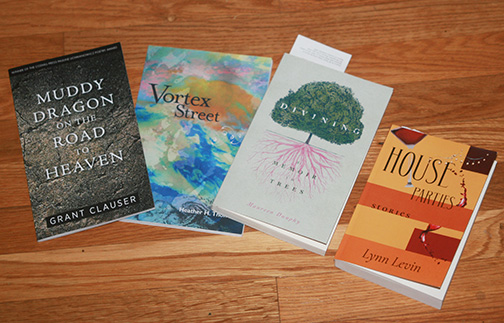
The rain came accompanied by lightning strikes, high winds, falling branches, flash-flooded roads, sleet, and a little hail, all in the space of two and a half hours. I left home only to turn around after three miles. The highway was blocked with traffic piled up due to various “storm-related events” (said the weather sites). Actually, I was grateful for the storm, since our region has been unusually dry and even warm for April–my trees, shrubs, meadow, and perennials needed rain. And upon my return, I got back to reading books of poetry. This past week these included collections by Marilyn Chin, Elizabeth Metzger, Grant Clauser, Jennifer Franklin, and Natalie Diaz. Some wonderful work there.

Through these books of poems, I also gleaned lots of interesting information. That’s something many people who claim not to like poetry don’t understand: you can learn about so many things through poetry! Poems contain fascinating facts, intriguing perspectives, tons of social and cultural observations, vocabulary and terms I would not have known about otherwise…poems have been the impetus for me to learn more about astronomy, theology, historical events and people, the geography and topography of the earth and its oceans, the life cycles of insects and plants, how metal shops operate, how to catch fish or tie a fly, what it is like to “live with a disability,” how the process of dying has differed from era to era and place to place, what it is like to reside in a war zone, the traditions of people whose backgrounds differ from my own, and other so-called “non-fictional” information.

Facts, in other words. Poems may inhere in the emotional or intellectual realm in many ways, but they also can–and often do–inform. They contain facts as well as multitudes. If people did not get so hung up on trying to decode a secret meaning behind everything they encounter that appears to be a poem, they might be surprised at how much they could learn from such (usually) brief texts. Yes, it might help to look up a word or a reference or two. That can get a reader started on a whole trail of interesting and valuable knowledge, widening the worldview, changing the perspective.

It may even lead a person to recognize that facts can change depending on point of view. Contemporary science acknowledges this, but most human beings haven’t accepted it yet. Anyway, this points to one reason poetry has often been considered unconventional, subversive, even dangerous or radical: Poems can challenge the status quo of what is accepted, received, unquestioned in society’s knowledge base. Terrifying the authorities by means of information.

Go for it. Read a book of poems.

~

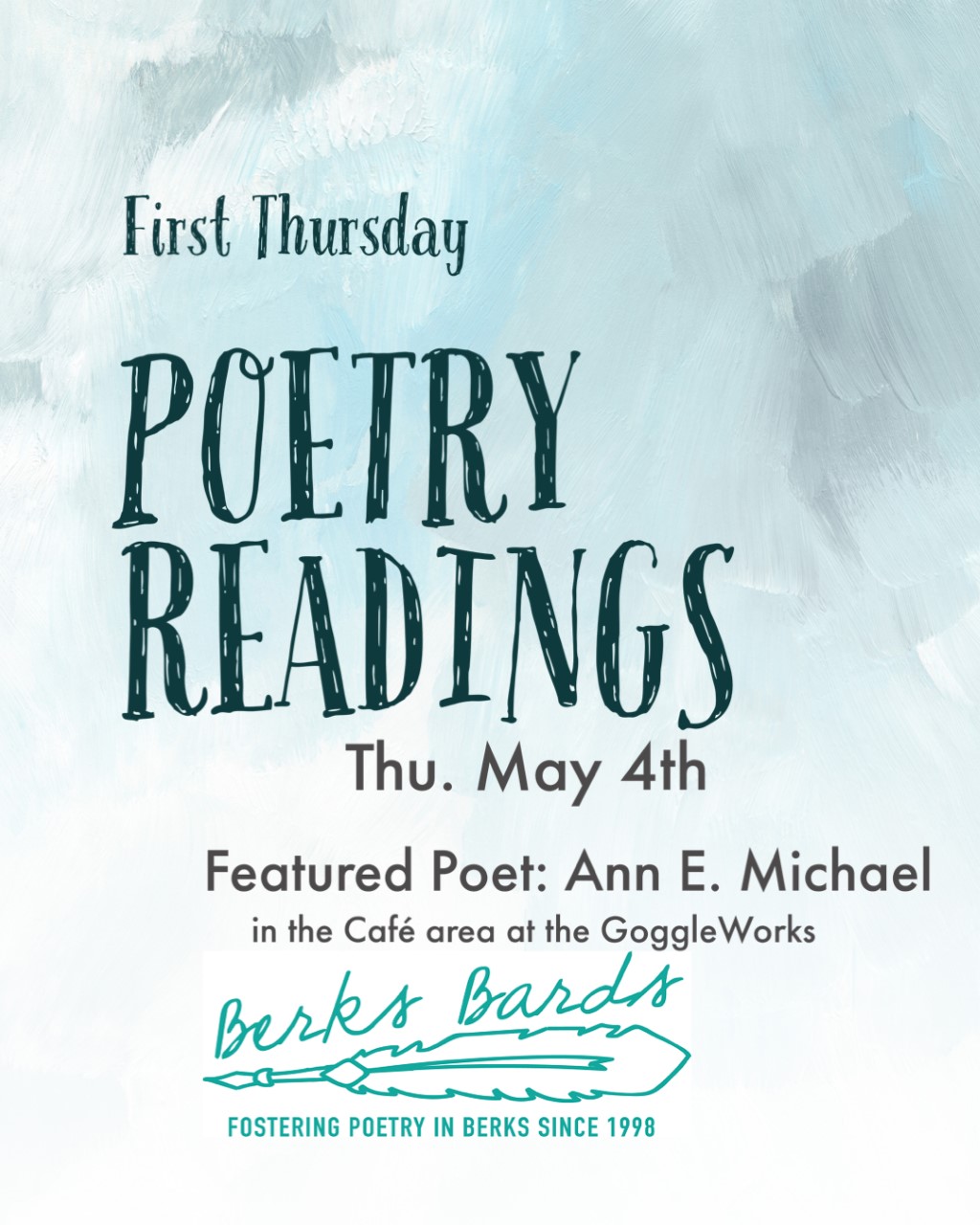
Coming up in May, I’ll be featured once again at GoggleWorks in Reading PA, 6 pm on May 4th…it has been awhile since I was there (2012), and I look forward to it!

Bookish decisions

In the past two weeks, I’ve read two contemporary poetry collections that I didn’t, er…love…or perhaps what I mean is I did not respond to them the way I enjoy responding to poems (and no, I will not be naming titles, though I will be giving these books away). While that is a let-down of sorts, I also started reading naturalist Marcia Bonta‘s Appalachian Autumn–which I do love. The book takes an environmental-diary approach that I have enjoyed in other naturalist writers’ work and which, no doubt, I relate to partly because I am also a near-daily diarist of my own backyard; Bonta has much to teach me, because she has a naturalist’s education and long experience. This is one of four Appalachian Seasons books she’s authored, and maybe I should have started with Spring, since that equinox has just passed. I found myself interested in the story this book tells of her family’s legal struggles with local lumbermen and absentee landlords, however. It’s an experience with which, sadly, my beloveds and I are familiar.

And I also began reading a book of poetry I have found exceptionally compelling–Rebecca Elson’s A Responsibility to Awe. Perhaps more on that in a future post. So books continue to enrich my life. I hope that is always the case, but I’ve seen how changes in human neuroplasticity can affect even the most bookish among us. More reason never to take the joys of reading for granted–and to keep my library card current.

~

In future, I plan to use the library card more than the credit card when it comes to books; but I know I’m weak. Besides, many of the small or indie press poetry books I relish are not easy to find in public library collections. One of my priorities this year is to winnow the home bookshelf stacks, to keep only what I really cannot bear to part with or am sure I will read or refer to again. But how can I be sure? The book lover’s dilemma, isn’t it? Nonetheless, there are definitely texts I can part with if I just take the necessary time to go through the collection. I can donate them to a public library, and even though many of them won’t get curated onto those shelves, at least I will be supporting an institution I value. I have been referring to this process of lightening my bookshelf loads as “culling,” but that word tends to have a negative connotation. I’d like to remind myself of the positive aspects of giving some of my books away: good for me, good for other readers, good for the authors of these books whose work may be discovered by other readers. Less to pack if we ever move, less for my children to deal with when that time comes. Yeah, I’m thinking ahead.

Reading poetry

I find I’m drafting poems again, though most of them fall on the melancholy side of tonality. It’s odd because I’m not feeling exceptionally melancholy myself. Granted, the news cycle’s enough to make anyone feel a bit low; but my internal weather isn’t so bad, and the end of February has arrived with peculiar mildness this year. Last year, we were still covered in snow at Valentine’s Day. Could still happen–but the snowdrops and the crocuses are open, as are the iris reticulata.

~

Spending time reading contemporary poetry books may be a contributing factor to my flurry of new drafts. In the past two weeks or so, I’ve enjoyed perusals of books by Ocean Vuong, Lynn Levin, Jaan Kaplinski, Cleveland Wall, Kim Addonizio. I’m also reading Ian Haight’s newer (unpublished) translations of some Nansorhon poems, a process accompanied by research into the precepts of Taoism and its heavenly denizens and hierarchies. I need some context if I’m going to get as much out of her Taoist poems as I’d like. Thanks to Ian’s research and translations, I did some study of this poet and her work ten years ago; but I focused more on her family situation and constraints and did not examine the most religiously-influenced poems.

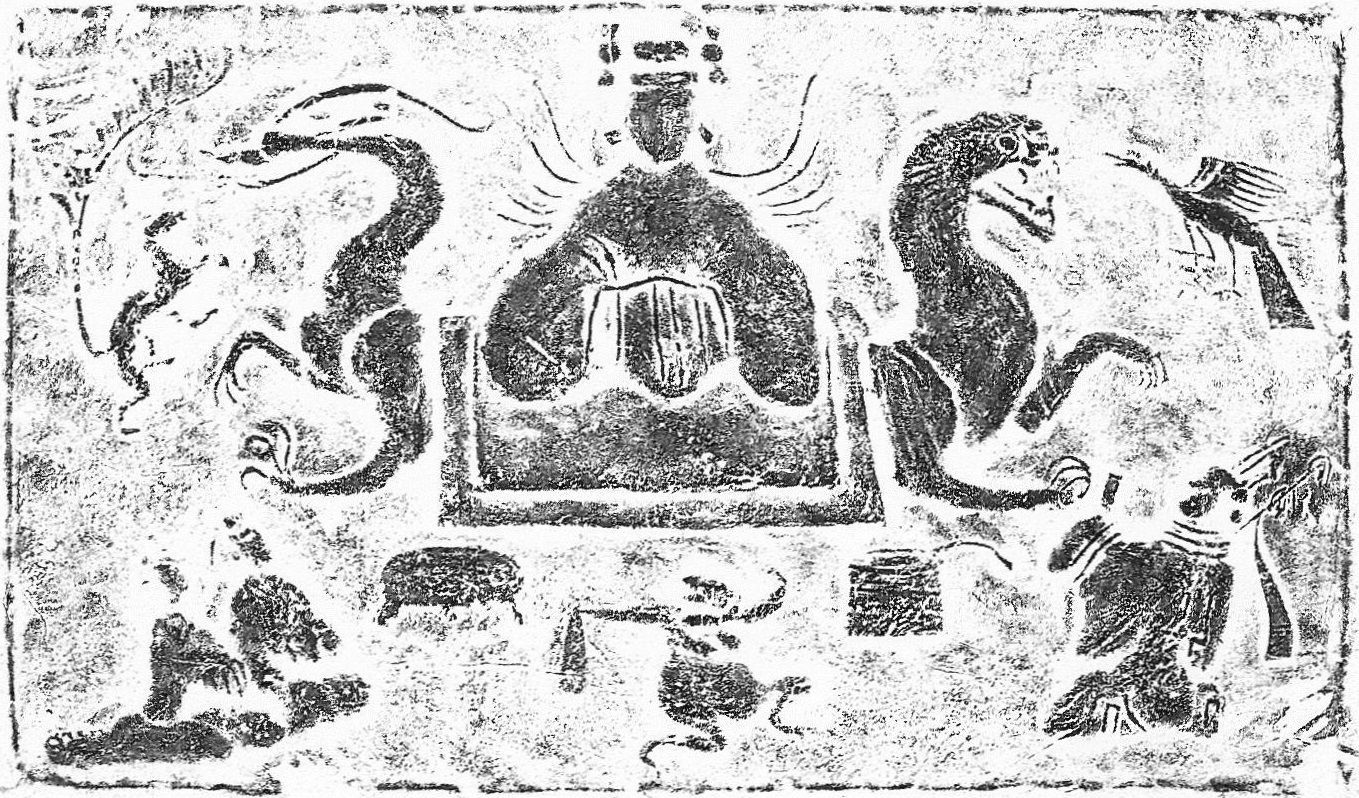
One Taoist goddess whose realms and attributes intrigue me is the Queen of the West, also called Queen Mother of the West, or Xiwangmu 西王母. She’s the mythical source of the peach of immortality and was likely important to Nansorhon as a powerful, much-worshiped female deity. Indeed, she’s invoked in several of the Nansorhon poems.

“Rubbing of a brick relief from the Han period, showing the Queen Mother sitting on her throne. To her right hand, a nine-tailed fox (jiuwei hu 九尾狐) and a dragon are facing each other, and to her left, a three-legged crow (sanzu wu 三足烏) and a tiger are facing each other. Just in front of the Queen Mother, a toad is dancing.” See http://www.chinaknowledge.de/Literature/Religion/personsxiwangmu.html (caption text by Ulrich Theobald, 2010).

~

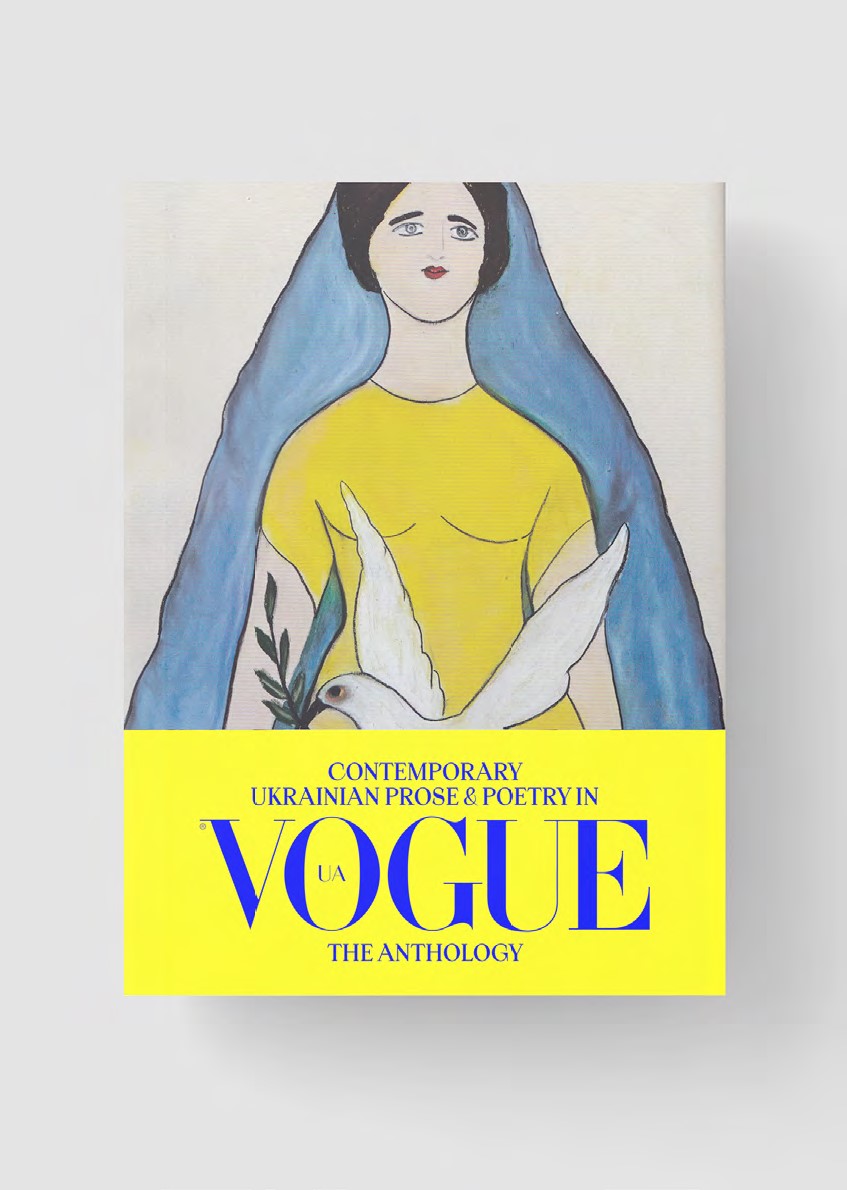
Other translations I’m reading are from Ukrainian. One of my husband’s colleagues is working in exile on Vogue Ukraine, and the magazine plans to publish a print anthology of contemporary Ukrainian writers–as early as next month!–marking the one-year anniversary of the start of the Russian hostilities aimed at Kyiv. She sent me a few selections of the poems and prose that will appear in the book, and I’m impressed by the writing and the breadth and depth of the literature. And also heartbroken.

Vogue UA had been planning its 10-year anniversary celebration when Russia invaded. The magazine rapidly pivoted to online-only, and its editorial team decided to publish a commemorative print book titled, rather significantly, 9 1/2 Years of Vogue Ukraine (and if you are curious, you can purchase it here). Yes, it’s a high-end fashion magazine–not my usual jam. Proceeds support various Ukrainian cultural organizations (museums, libraries) and female veterans.

The forthcoming book, featuring contemporary Ukrainian prose and poetry, will appear on the Vogue UA site in March or April. I’ll keep my readers apprised…from what I have seen so far, the anthology will be well worth reading.

Automatic writing*

A few posts back, I mentioned I would weigh in on artificial intelligence prose generators–“bots”–specifically the much-reported-upon ChatGPT. The media coverage has included everything: hand-wringing, speculations on the extinction of critical thought, predictions about the death of the high school essay or the re-institutions of oral and handwritten exams, not to mention worries about spurious content and job loss among educated citizens, as well as wild enthusiasm for automating tedious writing tasks and excitement about where tech is taking us.

It’s not as new as most people think. AI has been providing customer-service responses and generating basic summary content for news-related websites for awhile; but OpenAI’s open-source platform, which is currently free and for use by anyone (not to mention educating itself as each user inputs prompts and questions) has so rapidly gained “tech adopters” that those of us who teach writing cannot ignore it completely. And we shouldn’t ignore it, but neither should we throw our hands up in surrender and predict the end of the art of writing as we know it.

A recent New York Times article reflects the kind of discourse taking place at the institution where I work. It’s fascinating to me to see how quickly the conversations have evolved in the usually slow-moving environment of academia. I find that at my college, my years of laboring with students who lack strong backgrounds in written expression or confidence in their writing have suddenly attracted the attention of full-time faculty members–they want to know how they can tell if students are using AI assistance to write essays (when said profs have no pedagogical experience in writing) and how to change the wording of their assignments to “fool” the programmed generators, among other pressing questions. These inquiries tend to come tinged with a sense of slippery-slope fallacy: does this mean academia will go to hell in a handbasket?

I refuse to send out a firm forecast, though my intuition says no; instead, academia, and society, will change.

And despite the daily-proven, scientifically-accurate, anecdotally-obvious FACT that change is normal and indeed necessary, most people (and their societies and institutions) fear change. Hence, the media and institutional brou-ha-ha.

Let’s face it, writing can be hard. There will always be people who do not want to do the work of writing from the soul, brain, heart, emotion, experience, dread, you-name-it. Painting is hard, too. But people who don’t want to practice and experiment with visual art can use paint by numbers, clip art, or AI. There will always be a few folks who learn to play an instrument for the joy of it and for the challenge of continually learning new approaches to the process of music making; the rest of us can be audiences, if we like. People who write because they can’t not write? They won’t use bots unless they want to experiment with them: make perverse use of the programs, play with them to see what the human’s skills can do in concert with algorithms, bits, bytes, and data. I know artists who are already collaging with AI-generated art to create new, human-mediated visuals.

I recognize the fear factor here, but I don’t buy into it because I am so curious about what will happen next. I’m interested to see how changes will occur, which changes will make a difference and which ones will just vanish, and whether pedagogy will develop toward, away from, or parallel to AI developments in numerous spheres–to name just three of numerous possibilities. Change is exciting, but it’s also hard. I can’t say I am as excited about adapting my fall semester syllabus to reflect whatever the university decides to do in light of ChatGPT, but since I’ll have to adapt to a new “learning management system” anyway, I may as well accept that “a change is gonna come.”

~

*For the definition of automatic writing, Wikipedia has a fairly complete page.

Photo by Startup Stock Photos on Pexels.com

Book news!

Here’s a bit of glad tidings. My manuscript The Red Queen Hypothesis won the Prairie State Poetry Prize and will be published before the end of 2023–maybe even by the end of this summer! It’s thrilling to have won an award like this.

In fact, I should be jumping up and down with glee that RQH finally will see print, as it has taken me numerous submissions, two acceptances that did not come to fruition, and a considerable number of pauses to reassess the manuscript. But my initial feeling is more of relief than elation. Relief that now I can turn all of my focus to newer work: a manuscript nearly completed and one that I’m just starting to collate and imagine. Well–not all of my focus in those directions. There is the work of promoting the new book, work that I find difficult and challenging because it’s not really in my wheelhouse. Highland Park Poetry is a tiny independent non-profit press and doesn’t have the resources to do much promotion; Jennifer Dotson, Founder & Creative Engine behind the organization, runs several contests, produces a newsletter, and hosts a Facebook page of contributing poets. She also hosts a poetry podcast and at least one reading series…a busy person, working on a small budget. People like her and Larry Robin are the guardian angels of poetry in the USA. Many thanks, Jennifer. I’ll do what I can to promote my book.

There may be reading events in my future this year. If so, I’ll try to post them here as well as my fall-back social media framework, the wretched but still occasionally useful Facebook.

As to new work, grateful to report that it is coming along. I have a small stack of potentially interesting/workable drafts in my file. The month of January wasn’t all dearth and chill and lack of imagery or ideas. Granted, there are days and there are days. I find, though, that I am more patient with myself during low or no-motivation times than I used to be. I kind of hate to rack that up to maturity (oh ye gods! have I become “a mature woman”?)–but age might be a contributor. I feel no compelling reason to push myself past my physical and emotional limits anymore because it isn’t worth the repercussions. Given who I am and the stage of my career and life, there’s no need to prove my worth to anyone, to elevate my status as a “serious writer,” to grind the wheels of ambition to make other people take notice.

I’m an introvert. I don’t really like being noticed. But I do like it when people read what I’ve written, when what I have put into words has a chance to filter into other minds and other emotional frames. It’s entertaining and pleasant to imagine fellow human beings might sit quietly with a book (or screen) and consider, in their own minds, what I have observed or invented. If they don’t like it, that’s okay. At least they are reading. That’s valuable in itself.

Admiration

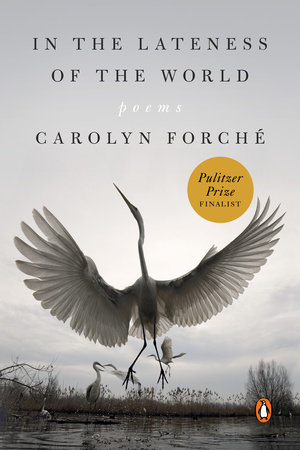
Carolyn Forché has a new collection of her own poetry, which is always cause for joy. She has compiled anthologies and written memoir and essays, but her poetry collections don’t appear frequently–five collections since 1975, averaging one poetry collection a decade. This is not a prolific output in terms of poetry collections compared with some of her peers, but her books are worth waiting for. I suspect that her poems, crafted with such memorable pacing and imagery, which unspool so purposefully–even mindfully, though that term is overused–must take time to consider, revise, or compose. I have to slow my breath just to take them in.

In the Lateness of the World lies on the book pile beside my bed at the moment, and I read about three to four poems at a time. Savoring them, thinking about their implications; despair and concern and grief, and deep love for the world we inhabit and the people who labor through the days. Forché, because of her “poetry of witness,” often gets called a political poet, mostly because she never shies away from confronting, and writing about, the injustices and damages inflicted on people and on the planet–and implicating the perpetrators. But she also avoids ideology. The perpetrators are not easily pegged in her work: all of us can be implicated, and all of us are affected, a network no single person or nation can untangle or resolve. Forché’s poems resonate with a complicated love and a recognition of how much work we must be willing to do.

~

Imagining Forché writing, I ponder my thoughts on revision and why I love doing it but simultaneously procrastinate on getting to it; good revision, in my case, requires a dedicated mindfulness and singular devotion that seems to require large blocks of time. I can compose drafts rapidly–jottings, notes, even entire pieces (unfinished but on track). Revision doesn’t work that way for me. It requires critical thinking. Analysis. Concentration. Mulling. Bouncing the work off others. Re-entering the mind of the moment. Waiting things out. Reading other poets. For example, reading the poems of a writer who seems to take her time on each piece, yet manages to keep the immediacy and gorgeous imagery in each of her poems intact.

How does a poet do that? Talent helps, but talent alone doesn’t get a writer to the fine observations and imaginative layers really good poems possess. That may require mediation, play, solitude, practice, revision, a community of writers, long gestation for some poems, mentorship, nature walks, travel… It’s likely I have not been dedicating enough mental and creative energies to my drafts. Or that I need some new methods.

My excuse is I don’t have time. But enough excuses. This is stuff I love, that I enjoy doing. Why shy from what I love?

Oh, the mundanity!

Ah, the challenges of staying organized! I spent this morning finally starting the process of reorganizing my poetry files–the paper ones, which I keep in various arrangements of document boxes, accordion file boxes, and an index card box. This is stage one of a project I have procrastinated on for far too long. The digital files will be the next step, assuming I actually complete this stage. Being something of a Luddite when it comes to digital organization methods, I have no idea how to manage that stage yet; paper documents, however, I understand.

January’s tenor usually strikes me as a bit dull, damp, chilly, dark, and generally unmotivating. My mood concurs. It’s therefore rather heartening that I find myself up to this task–and that the task itself has given me a sense of accomplishment in more ways than one. For one thing, getting around to doing what you know has to be done but have been putting off can feel surprisingly good. For another thing, the reorganized materials take up less space, which is never a bad thing.

Also, it was a boost to my writerly confidence to make an informal accounting of my published work. After 40 years of writing it feels good to know that many editors, and a few publishers, thought my poems “good enough” to print. The unpublished poems take up considerably more space, of course. And I haven’t even started to page through THAT pile yet, let alone find a method of organizing the pages. The sense of having at least begun this lengthy process cheers me in the middle of the bleak, blah, January days.

~

This cartoon by Sarah Kempa (The New Yorker, Jan 11, 2023) struck me as applying also to poets and other creative writers. I know this feeling well. Many of us benefit from the occasional boost in confidence.

And believe me, I have many thoughts about AI-generated prose and poetry; but that’s for a later post.

Solo endeavor?

It was great fun to be back in person, in Philadelphia, reading poetry aloud. Prepping for the performance made me aware, though, that I have no current obsession to mull upon; that may be why I have not been writing many poems of late. However, I recently felt inspired by Lesley Wheeler’s blog post including some prompts from poets. Prompts! Of course. Those are ways into writing when writing has not supplied the writer with her own ways into writing.

Therefore, I’ll close another year of my blog with a piece I drafted using Lesley’s conjunctions prompt. What resulted from the free-write surprised me, which is a good thing (it’s fun when I surprise myself, though this gets a bit dark toward the close–but dark contains interesting objects). And many thanks to Lesley and to the other poets whose prompts she shared. It’s likely I will keep working with them until my next poetic preoccupation.

~

So I’m tired of hearing people start their sentences with “So” on podcasts and the radio and TV, “so” a verbal tic, a word instead of “um,” which serves the same purpose but admits, more humbly, of uncertainty, which says I am pausing to gather my thoughts before speaking; whereas “So” sets up an explanation leading to opinion or argument, or so it seems to me.

So I’m sitting on my back porch even though it is late December, clouds gathering over bare trees. I hear woodpeckers deepening holes in trees, a rat-a-tat drill, and white-breasted nuthatches loud along the woodlot, and I ponder emerald ash borers and climate change and how to handle human aging in a capitalist society.

So what I wonder is “Am I afraid?” Some questions possess a looming quality, I guess this is one such. In my wicker chair, in my own backyard, no. Not afraid. The mood’s serene, no tightness in my chest no racing heart, not even facing death–as we all must do, though most of us refuse. Where are you going with this, Writer?

So all I’m saying is, I have fears about the future yes but not about dying, because dying I will face alone. Even when loved ones can be beside us, we are not an us when death comes. Each dies to their ego alone, interior to the world, most alone at death no matter who surrounds us.

So why, then, do I volunteer for hospice work, where the goal is not only to alleviate some of the pain but also to keep people from dying unaccompanied? My reasons are complicated, people are complicated. So let me just say that having been present when human beings die, that passage may not necessarily be a lonely one. But it is accomplished alone.