Mindlessly

There are some necessary but mindless tasks that I’m good at and don’t mind doing. Weeding, for example (unless it’s raining, or disgustingly hot), or cleaning a bathroom. My morning chore today entailed removing staples that fastened carpet underlayment to the floor. There are dozens of these staples stuck in the subfloor, and most of them have bits of foam-like fabric wedged in them. The edges of the room are studded with tacking strips–annoying to remove when one is not a professional. Best Beloved and I did consider hiring someone to replace the floor, but since it is a job we can do ourselves…well, we have the time and are doing it.

There’s a difference between the mindless and the tedious. I don’t care for tedium; but a task I can mindlessly manage–something physical, but not too demanding, without a lot of surprises I need to problem-solve–those projects can be almost relaxing. When weeding, my thoughts can wander. The job is so familiar and repetitive that there is no need to devote much brainpower to it. Ideas, reflections, observations, images can float aimlessly in my mind. I can think about poems while weeding. Taking a walk in a woods or quiet countryside offers me the same sort of internal/external environment.

Proofreading was like that for me, back when I was a proofreader (when there were such things as proofreaders in every newspaper, type or print shop, publishing house, ad agency, and legal department). Editing takes some thought; but the less engaged a proofreader is with the text, the better. I was employed as a proofreader when I first recognized that I was truly serious about writing poetry, and I found value in the ’empty mind’ that my workaday job fostered. There was a bonus in that sometimes I did glean new information from the materials I read.

~

Composing this post, it strikes me that “mindless” is the wrong word, or not an accurate word to convey what it’s like to feel internally occupied while the physical body’s doing something else. “Reflection” implies more stillness. Something more akin to walking meditation?

At any rate, I can hope that the weeding and staple-removing might eventually get my poetry mojo re-booted. I have to work on my next manuscript and continue to promote my latest book, too. In the meantime at least I’m accomplishing something.

~

Aloft at last

My second full-length poetry collection is finally available. Whew! It took a good bit of patience, some frustration, and considerable persistence to get here, but I believed that this was a manuscript worth plugging away on. And thank you to Highland Park Poetry and to judge Cynthia Gallaher for choosing RQH as a prizewinner.

Persistence doesn’t always pay off, but when it does, we tend to focus on how important it is to keep on keeping on. However, I’m not sure I wholly believe in the process of sticking-to-it no matter what; there are times when you do need to let go of an unattainable goal or the pursuit of a not-terrific idea, and just–well, fail. I have let go of quite a few goals, plans, and previous manuscripts when I honestly evaluated my feelings about them and their possibilities for becoming realized. It’s okay to fail. You learn more from failure than from success. I have gained quite an education that way myself.

But I wanted this book to get into print. I like the poems in it. I like the things I learned as I played with meter and form and (mostly slant) rhyme. It was fun to find a range of topics that managed, one way or another, to work together. Mostly, I wanted an audience, to find out whether readers find it thought-provoking or entertaining or interesting. Also, I was starting to sense that it was getting in the way of my next manuscript. Yes, of course I have the next manuscript…

Do I wish the book had come out four or five years ago? Yes. My first collection, Water-Rites, came out way back in 2012; RQH was supposed to have followed more rapidly on that book’s appearance. Am I glad it has appeared at last? Also yes, very glad!

I am grateful to so many people for this book. And I will be grateful to anyone who buys it, reads it, and doesn’t find it a complete waste of time. Meanwhile, I’m working on getting some readings lined up. I know I will appear at the book launch September 9, 2023 in Highland Park, IL! I’d love to read at other venues, so if you know of one let me know.

And if you have a manuscript you really believe in–keep trying.

Transitions of one kind or another

Transitions require reflection and, quite often, reorganizing–and certainly that seems the case at present. I decided back in April to take a hiatus on submitting while I wound down at my college job, also recognizing that I need to put in some work on promoting my book (the cover should appear on my next post!). Besides, before I can send out poetry again, I need to assess what I have that might actually be worth sending out. It’s possible that much of the pile of not-yet self-evaluated poetry exists in unfinished form. That means further revision. While revising is an enjoyable task for me, at this point I confess to feeling overwhelmed. The first task, then, is one of organizing…which I admit I like a lot less than revision.

It was therefore with considerable resignation I faced the drawers, folders, computer files, and index cards that more or less make up my, uh, creative output. The project is nowhere near complete, but I got some cheer by realizing that I have been writing and revising more than I thought, a little at a time. The pile of papers on the chair pictured to the right is 16 months of revisions.

I would pat myself on the back more heartily if that stack had resulted in several damned fine pieces of poetry, but at least it means I’m doing the work that writers do and that I was doing it even when feeling taxed by situations not entirely within my control. Which is also what writers do. Sometimes you need to give yourself a little boost of validation.

A bigger boost of validation for writers is the publication of a book, and that ought to keep me buoyant for awhile even if I do dislike the promotional aspect of book publication (which falls more and more on the writer these days as the book industry contracts). My publisher says the book should be available in August– “Watch this space” –as advertisers used to urge.

Meanwhile, the anthology of contemporary Ukrainian literature published by Vogue Ukraine is now in print and available; it’s full of passionate creative work and includes some internationally notable writers, the best-known of whom is Oksana Zabuzhko, who wrote a reflection about the appearance of her debut novel 25 years ago; one of the most shattering pieces is an extremely current non-fiction text by Olia Rusina written, diary-form, as the assault began on Kyiv. Info here.

Autobiographical?

Although poems can be anything–philosophies, arguments, histories, internal monologues, passions, information, invention, dreamscapes, jokes, narratives, parodies, you name it–poems sometimes parallel a writer’s individual experiences in the world in a way that would, in prose, be termed memoir. When readers think of poems that are “from the heart,” they usually mean work that authentically describes what appears to be personal acquaintance with environments and behaviors: something autobiographical, or “true.” I have tussled with this perception in some of my own work, for example, my chapbook Barefoot Girls, in which the poems describe fictional experiences that in many cases were not my own but those I heard as a teen; and yet, some of them are memoir-ish.

How to decide what categorizes memoir-ish poetry collections? On the one hand, maybe everything ever written by any poet, since connecting the personal with the so-called universal has long been considered the job of poetry. Even narrative and heroic epics, when they are lasting and successful in their aims, contain some aspects we might call personal (motives and emotional responses to a situation, for example), though the writer’s life and its events may be obscured by centuries.

But memoir is not autobiography; readers should keep that in mind. Maybe it’s Vivian Gornick who said that autobiography is what happened and memoir is how it felt–I’m sure I am misremembering, so don’t quote me on that. In a past interview in the New York Times, Sharon Olds derided her own poems as narratives–even personal narratives–but sidestepped the term autobiography; she still refers to the first-person in her own work as “the speaker.”

…even though her poems have been called
diaries, “I don’t think of it as personal,”
she said. “These are not messages in a
bottle about me,” said Ms. Olds.

“The Examined Life, Without Punctuation” by Dinitia Smith, 1999 (New York Times)

Where does that leave us as readers? I don’t know–and I think it’s okay not to know. That said, I have recently read a number of poetry collections that fall decidedly on the memoir side of the continuum and found them interesting, informative, well-written, at times beautiful and also at times hard to read (i.e., profoundly sad). If you, my reader, are intrigued by the challenge of what is or is not memoir in poetic form and are open to experiencing the circumstances and knowledge of other lives and perspectives that such work offers, here are a few books you might investigate. There are many, many more–this list is just from my more recent perusals. Not one of them is anything like the others.

Edward Hirsch, Gabriel, a poem; Jeannine Hall Gailey, Flare, Corona; Emily Rose Cole, Thunderhead; Daisy Fried, The Year the City Emptied; Sean Hanrahan, Ghost Signs; Lisa DeVuono, This Time Roots, Next Time Wings.

is or isn’t is memoir?

Lightning bugs

We didn’t call them fireflies when I was a child, though now I kind of prefer that name for the flittery flashers that decorate the summer nights. There are fewer this year, probably due to variances seasonally–that drought we’re still not completely recovered from, followed by some rain and hail, and slightly cooler June temperatures than usual thanks to the haze of smoke from wildfires to our north. Peak season for fireflies in my region has typically been right at the solstice. Looking out my window this evening, I remark on a paucity of flashes in the meadow and over the lawn. Fewer Lampyridae this June. Things can change from one year to the next.

Change equals living: no life without alterations of one kind or another. My current situation is one of those so-called Life Events: I have retired from my position at the university where I worked for about 17 years. I suppose it is A Big Deal (see how I’m capitalizing?), but I must admit that so far it doesn’t feel terribly fraught, major, or even bittersweet. It just feels appropriate. Part of the reason for that is that I’m not a person who has defined herself by her career. Thank goodness, since it was a fairly modest career. I enjoyed my work with students; and I was part of a terrific team of earnest, funny, and supportive folks. So yes, that’s something to miss. However, I have many interests beyond work at the college. Time to pursue those, methinks. Time to spend with my mother as she wanes. Time to travel with my husband and on my own and to visit our far-away offspring. Of course, there are all those things that will keep me unexpectedly busy…gardening, house maintenance, trying to get the metaphorical ducks to line up (as if they ever will). And then, poetry; I want to devote some serious brainpower to revising, reorganizing, drafting, reading, learning more about the art I love. Maybe even submitting more work, putting together another manuscript or two. Who knows what changes are ahead?

~

When I note the fewer numbers of fireflies, I do not mean there are none. It’s just that some years, by June 18th, the back of our yard simply dazzles; we don’t need fireworks! Because they pupate in dampness, such as in rotting logs or underground, and because they need moist earth in order to feed (on soft-bodied invertebrates, according to the Xerxes Society’s informative page here), a spring drought can limit their numbers. And I miss them, the way I miss the little brown bats and the green ash trees. Those types of changes may be more or less inevitable, but I can’t help thinking that such transitions feel less timely than my departure from running the university’s writing center. The ash and the bats are still around, but in vastly decreased numbers. I hope the lightning bugs bounce back.

~

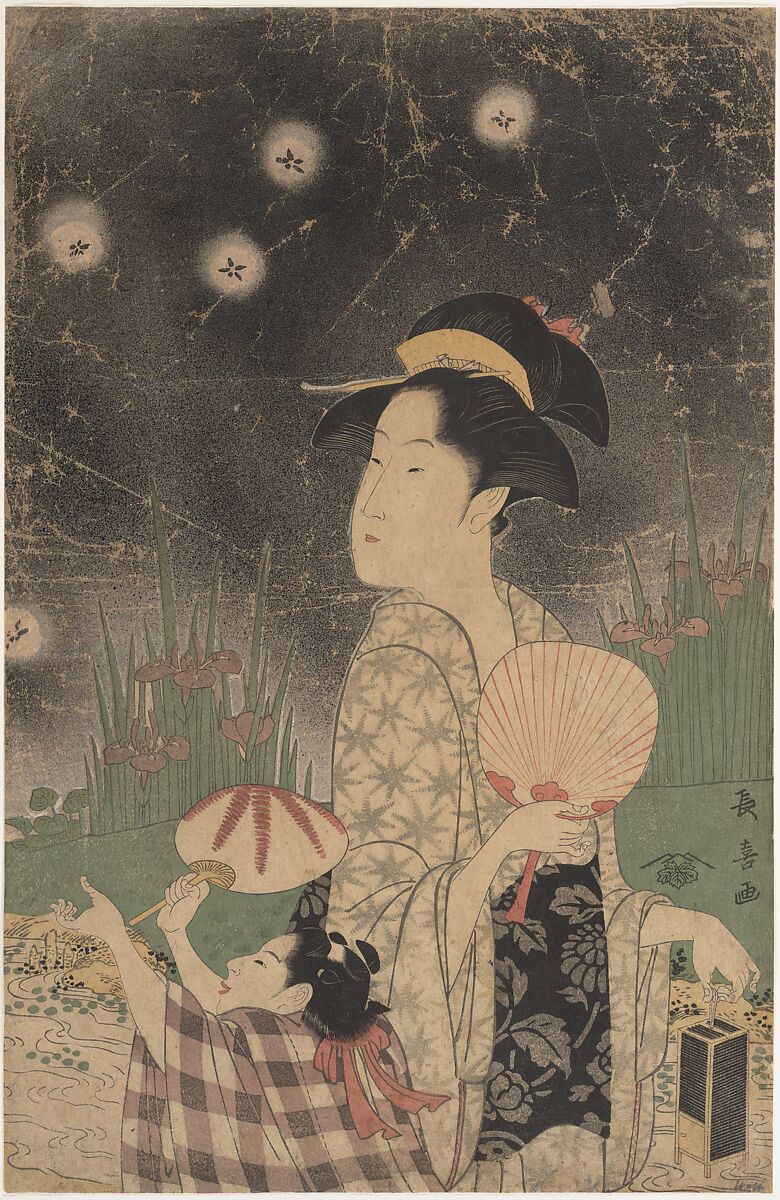
Art from the Metropolitan Museum: Eishōsai Chōki ca. 1763

Goals, sort of

Our regional drought continues. I sometimes entertain the idea that the universe is telling me I might as well consider moving to the Southwest–where my children now reside–since the Mid-Atlantic area currently has less rainfall, higher temperatures, and lower humidity than where they are. Granted, this is likely to be a temporary situation; but for the present, I get the chance to walk on crunchy grass and hard soil daily and see how I like it. And to see blue skies for days on end, and see how I like that. What next?

Speculating on “what next” comes rather naturally to me, a reflective sort of human being; but making goals and ambitions toward accomplishment–not so much. Lately, though, the years-ahead thinking has been moved the forefront of my thoughts. It’s all those dang Medicare and Social Security and AARP mailings, in part, and my peers and I heading into the so-called retirement years. Inescapable: the conversations crop up around the dinner party table, while having coffee with a pal, or on a phone call with siblings. People keep asking me what my new goals are. I suppose, having reached the age Social Security (used to) kick in, I was expected to come up with new goals? Must have missed that memo.

Goal: the word is of uncertain origin, says Etymology Online, but appears in the 14th c “with an apparent sense of ‘boundary, limit.’ Perhaps from Old English *gal ‘obstacle, barrier,’ a word implied by gælan ‘to hinder’ and also found in compounds (singal, widgal). That would make it a variant or figurative use of Middle English gale ‘a way, course’…” And there’s the further meaning of a stake that signals the end point of a game. Interesting that goal can be an obstacle, a limitation, an end-point, or a pathway.

If I think of it as a pathway, the question is, what do I want to do? After many years as an educator…do I throw all that experience away and take up something else? My guess is that I’ll find myself imparting information of some kind, one way or another, regardless of employment status. So no major change of course, just a change of scenery, situation, or audience. After all, I will still be writing.

Or are we talking aspirations? What is it I would like to plan for…self care? travel? conferences and retreats? Time to do–what, exactly, and with whom? Here there are perhaps barriers and limitations: can we ever stop worrying about how much will it cost and how much time it will take to achieve the specified goals? And obstacles–you cannot plan for them. Maybe I go blind or get cancer or get hit by a bus. Maybe the apocalypse occurs in my lifetime. That would certainly be the stake that signifies “game over!”

Then again, what if my plans are to get into the woods more, sit under trees more, take more walks, read more books, tend to plants and animals, hang out with my beloveds, write poems? Those things, I want to do in future. But it isn’t as though I am not already doing them now.

Photo by Michael Heinrich on Pexels.com

Reading friends’ books

One thing about being a writer is that, after awhile, you meet other writers one way or another: sometimes through social media, Zoom events, or in person at book signings and readings; sometimes through conferences, workshops, or various educational programs; sometimes by finding local writers groups or getting an introduction to someone through a friend. When you meet writers, you get the additional privilege of reading their work. It so happens that lately, many of my writerly friends and colleagues have published books, and I’ve been busy reading them!

First, I want to mention that whenever possible, readers should purchase literary volumes from the writers themselves or from their publishers, or–if it’s an option in your region–from an independent bookseller. I do resort to ABE and Thrift and Amazon when a book has gone out of print or when the publisher prints through Amazon, but I want to remind people that the other sources will support the writers themselves or the independent small bookshops and publishers who launch these books into the world.

Now that my virtuous aside has been accomplished, here are a few of the books-by-friends-&-colleagues I’ve been consuming lately–not all of them newly-published (it takes me awhile to get around to the reading).

~

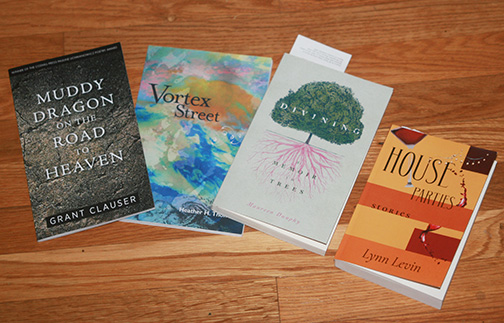
The near-abstract imagery and the concrete place-names and lyricism in Heather H. Thomas’ 2018 Vortex Street appealed to me on several levels, from the scientific (a repeating pattern of swirling vortices, see “fluid dynamics”) to the particular: my husband grew up in Reading, PA, where some of these poems are suspended in recollection. I’ve also loved reading Grant Clauser’s latest, the 2021 Codhill prize-winner Muddy Dragon on the Road to Heaven, a collection of poems that strikes me as both deeply beautiful and tenderly sad. Poet Lynn Levin has published a terrific book of short stories, House Parties, that remind me of the wry sense of humor and wide-ranging knowledge her poems have while proving she’s also a deft hand at plot and character. Maureen Dunphy’s memoir Divining, A Memoir in Trees, brought to mind parallels with Lesley Wheeler’s memoir in poems, Poetry’s Possible Worlds. In both books, the authors have chosen a locus [an American tree, a contemporary poem] and used the exploration of that “trigger” to draw out something personal. What better way to connect with readers than through something we love and value? Which brings me to a shout-out to Jane Satterfield, whose poetry collection The Badass Brontës isn’t in this photo because I’ve already lent it to someone who’s a Brontë fan.

~

In addition to the above books, I am eagerly awaiting new works from a host of other poet-friends: chapbooks by Beejay Grob (forthcoming from Moonstone Publishing) and Lisa DeVuono, poetry collections from Jerry Wemple, Jeanine Hall Gailey, and others that slip my mind at the moment. My only regret is that I have all this reading to do just as gardening season gets really underway!

Generosity

It is a well-documented fact that writers can be dismissive, hypercritical, and downright insulting when it comes to the work of their peers and predecessors. Juvenal, Samuel Johnson, Oscar Wilde, Dorothy Sayers and her nemesis Edmund Wilson, Dorothy Parker, John Logan…the list is long and spans centuries. Some of the critiques are valid, in their way; many are wickedly funny, which doesn’t remedy the unkindness of the barbs. Most writers who have been writing and presenting or publishing their work for awhile will have encountered some less-than-generous “feedback” from other writers. Given human nature, such responses are probably inevitable.

In the mediated circle of the voluntary critique group such as may be found among MFA programs or community writers’ groups, the group or mentor often establishes protocols for sharing work–methods of responding to creative efforts that avoid too-harsh criticism, ad hominem attacks, or dismissive/discouraging comments. Once your writing is out in the world in whatever public form (print, slam performance, live reading, video, online, etc), however, the best advice is sometimes “don’t read the comments.”

Many agendas may drive the urge to bash particular writers or their works, among these envy, attention, pride, status, self-preservation, righteous indignation, or a sense that one needs to scramble to make space for oneself in an already small environment (“the literary world”). Even, dare I say, ignorance. I could speculate on reasons for unkindness until the proverbial cows come dawdling home, but I suppose it can be attributed to a kind of social Darwinism. People can be mean-spirited when threatened. Though exactly how the writing of poetry poses a threat to other poets remains a mystery to me.

Maybe I am a Pollyanna (entirely possible), but although I can recall some incidents and critiques that have stung me, there have been far more instances of generosity from fellow writers. While contemplating writing this post I sat back and decided to count how many fellow writers have extended courtesy, respect, useful advice, helpful criticism, networking and publication leads, encouragement, and the sense that I’ve “been seen”–acknowledgment as a writer–and I found the list was long. I considered listing names, but there are so many…and I was afraid I’d inadvertently overlook someone. I consider this an excellent “problem” to have.

Granted, some stings have been…memorable. However, I’ve been writing and publishing poetry and related prose since the early 1980s, so there have been many years during which I’ve had the joy of connecting with other writers in generous ways. Writing is both a large community and a small one, depending upon where I am in my own life: local at times, semi-isolated other times, and then–thanks to social media platforms, with which I have love/hate relationships–national and international!

As I get ready to pull back a bit from my work in the realm of higher education, I hope that the lessons I have learned about being generous to my students, gently encouraging while pointing out areas to keep working on, will stay with me. My feeling about poetry is that there’s certainly room for more of it in a world which can be harsh, and that acknowledging other humans’ urge to express their awe, fear, grief, passion, love, anger, and perspective won’t actually harm many of us.

Thus, to all of the fellow writers and artists living and dead who have been generous to me: Bounteous gratitude. I’ll keep trying to pay it forward.

Artistry, art

Wednesday evening I participated in a lovely (if under-attended) event at a local listening room, Godfrey Daniels Coffeehouse. The venue’s been in existence nearly half a century and hosts many a folk, blues, and folk-rock band/singer-songwriter, as well as the occasional puppet show, jam, open mike, children’s event, and poetry reading. Quite a storied place. Dave Fry, one of the co-founders, offers a monthly “Dave’s Night Out” during which he invites songsters, singers, lyricists, musicians, and poets to take the small stage and present their work as well as discuss their working process–with Dave himself and with the audience. It’s a wonderful opportunity to exchange creative and artistic ideas in public. The poets were me, Danielle Notaro, and Cleveland Wall. Dave’s take on the evening is here.

On the way home, my beloved and I had a discussion about artistry and “being an artist.” As he is from an artisan/craftsman background, he does not think of himself as an artist. The term seems a bit “elevated” to him. And while he is a creative problem solver–crucial to being an artist–I see why he does not consider himself an artist.

Some of that thinking is simply semantic, however, a perception based on someone else’s definition of an artist. Beloved asked me, “Do dancers or musicians consider themselves artists? Do you consider yourself an artist?” Good question, and the answer’s probably individual (i.e., it depends).

I mean–do I consider myself a poet? A writer? Let alone an artist. I immediately thought of a Substack post by my friend, journalist (journalists are writers!) Peter Moore, in which he publishes an excerpt from his post-college diary. Brave man.

“On the ferry from France to Folkestone I floated on a rising tide of words words words: “I must enter into the intense feeling I had while riding the Tube this morning,” I wrote, “that I honestly feel like a writer, that it was just a matter of time and effort before I am recognized as one. I hope and trust that this is prophetic.”

https://petermoore.substack.com/p/r2e-excerpt-46-the-rising-tide-of

Yeah, I remember feeling those particular 22-year-old feels and the questioning that accompanies them. I am certain that similar enquiries appear in my old journals, though I may have been more cynical and less trusting than Peter was. He closes this post by saying: “Meanwhile, all those blank pages were screaming at me. Fill them with what, aside from intense living?

“Pretensions to artistry!”

~

Which is not to say that poets and writers and dancers and songwriters are not artists. It’s just that some of these folks think of themselves as artists, and others think of themselves as artisans, or craftspeople, or creative innovators, or…name it what you will. Poetry is a form of creative expression, and if you (dear reader) categorize that as art, then it is. If my poet colleagues think of themselves as artists, I respect that and will not argue. Perspectives, right? Not the same as pretensions, although I will admit that in my opinion, there are some people who write poems, and other things, a bit pretentiously. I have been guilty of the same, especially when I was young and getting the practice underway. Pretentiousness may even be a kind of motivation. We learn humility as we practice our missteps.

Contemporary Western society casts a great deal of gravitas and status on the word “artist.” So to answer my spouse, I replied that well…I do consider myself a writer and a poet, but I seldom think of myself as an artist. However, if you think poets are artists, I am an artist. Because I do indeed think of myself as a poet. I cannot get away from that urgent need to observe, imagine, interpret, restate, turn into metaphor, reflect, create into form, and otherwise do the making (Poiesis) of word play.

Information from poems

I tried to attend a poetry event on Saturday afternoon, but the weather was against me.

The rain came accompanied by lightning strikes, high winds, falling branches, flash-flooded roads, sleet, and a little hail, all in the space of two and a half hours. I left home only to turn around after three miles. The highway was blocked with traffic piled up due to various “storm-related events” (said the weather sites). Actually, I was grateful for the storm, since our region has been unusually dry and even warm for April–my trees, shrubs, meadow, and perennials needed rain. And upon my return, I got back to reading books of poetry. This past week these included collections by Marilyn Chin, Elizabeth Metzger, Grant Clauser, Jennifer Franklin, and Natalie Diaz. Some wonderful work there.

Through these books of poems, I also gleaned lots of interesting information. That’s something many people who claim not to like poetry don’t understand: you can learn about so many things through poetry! Poems contain fascinating facts, intriguing perspectives, tons of social and cultural observations, vocabulary and terms I would not have known about otherwise…poems have been the impetus for me to learn more about astronomy, theology, historical events and people, the geography and topography of the earth and its oceans, the life cycles of insects and plants, how metal shops operate, how to catch fish or tie a fly, what it is like to “live with a disability,” how the process of dying has differed from era to era and place to place, what it is like to reside in a war zone, the traditions of people whose backgrounds differ from my own, and other so-called “non-fictional” information.

Facts, in other words. Poems may inhere in the emotional or intellectual realm in many ways, but they also can–and often do–inform. They contain facts as well as multitudes. If people did not get so hung up on trying to decode a secret meaning behind everything they encounter that appears to be a poem, they might be surprised at how much they could learn from such (usually) brief texts. Yes, it might help to look up a word or a reference or two. That can get a reader started on a whole trail of interesting and valuable knowledge, widening the worldview, changing the perspective.

It may even lead a person to recognize that facts can change depending on point of view. Contemporary science acknowledges this, but most human beings haven’t accepted it yet. Anyway, this points to one reason poetry has often been considered unconventional, subversive, even dangerous or radical: Poems can challenge the status quo of what is accepted, received, unquestioned in society’s knowledge base. Terrifying the authorities by means of information.

Go for it. Read a book of poems.

~

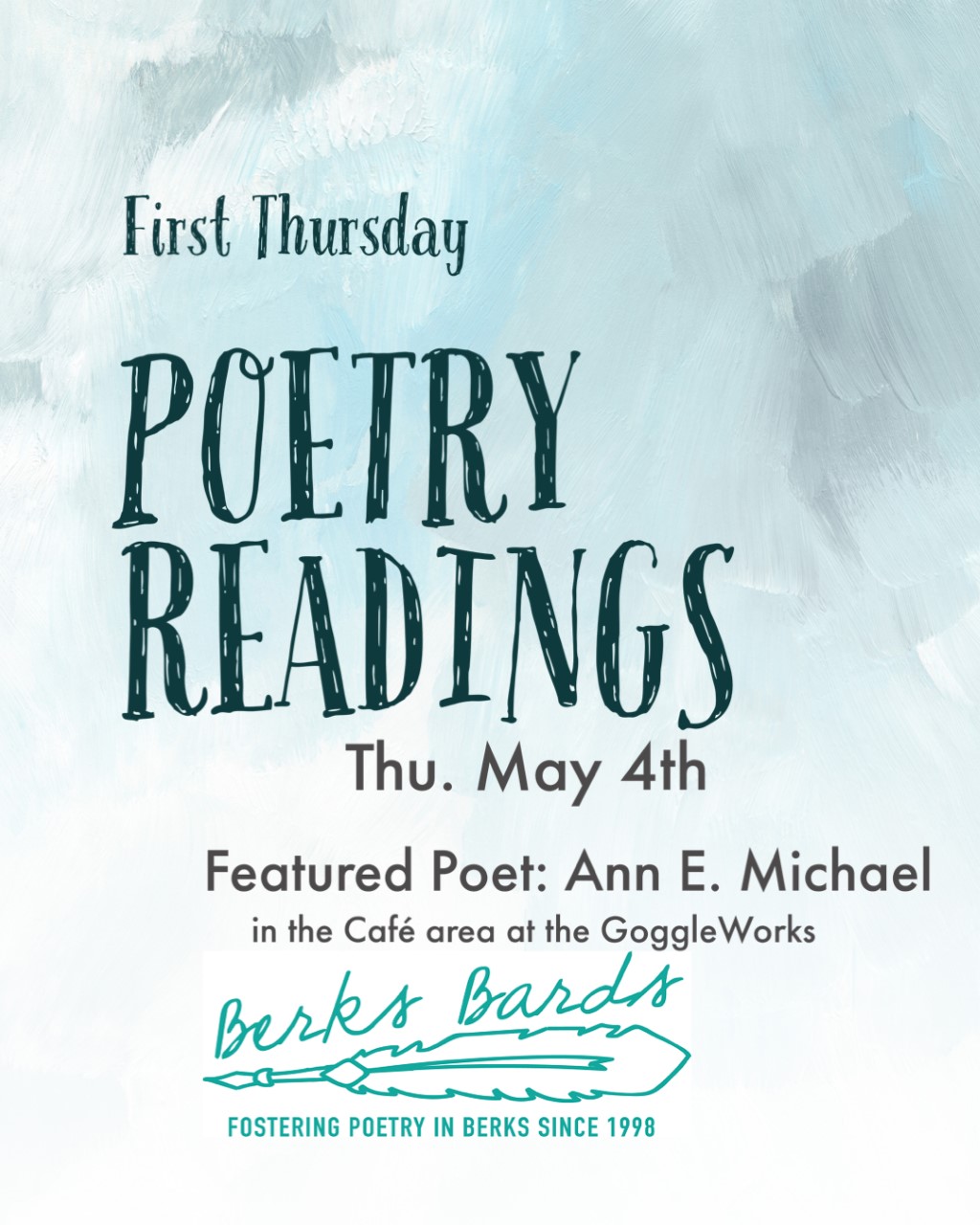
Coming up in May, I’ll be featured once again at GoggleWorks in Reading PA, 6 pm on May 4th…it has been awhile since I was there (2012), and I look forward to it!