April is National Poetry Month; but this year, I am in hibernation mode.
I’m not going to readings or writing a poem a day for 30 days, not posting much of my or other people’s poems or poetry books on social media, and not doing much poetry writing or any submitting. What’s gotten into me? Some kind of malaise? Or just a sense of being overwhelmed by, you know, life and aging and perhaps too much reflection. Plus there’s garden catch-up to tend to, since I was away for the early part of the season opener. And we’ve had a heat wave with a dry spell and lots of wind, so I’ve had to pace myself with the heavy stuff. Thankfully, Best Beloved can pitch in with much of that. Yet I am reading poetry, and if that ever stops I’ll know I’m in trouble.
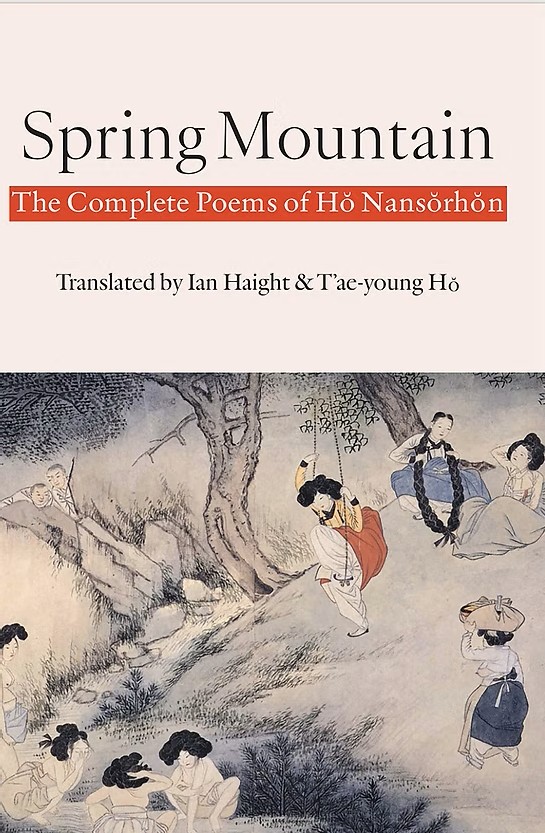
So–back from traveling westward-ho. While in Fort Collins, Colorado, some dear friends introduced me to Wolverine Publick House, Cafe, and Bookshop, where there’s a lovely poetry book room in which I found my colleague Ian Haight’s book, Spring Mountain: The Complete Poems of Nansŏrhŏn. Also lots of other fabulous poetry that I had to restrain myself from purchasing, lest I overload my carry-on luggage weight. I read many of the Nansŏrhŏn translations in earlier versions that Ian emailed to me, and it is wonderful to find the book in print (from White Pine).
While in Boulder, CO, another friend suggested Devon Price’s book Unmasking Autism, which has given me much room for reflection. For many years, I helped students write college-level papers and realized that a number of these young people had varying aspects of “autism spectrum disorder”…that I, as a writing tutor/teacher, was wholly untrained to deal with. To help them, I made it up as I went along, student by student. It turns out that most of what we know about supporting autistic people to navigate contemporary social structures has been pieced together by people making it up as they went along. It helped me that one of my dearest friends has a now-adult child with autism–I’ve known him since before his birth, and I think of him as an intriguing person who has much to offer to a society that essentially ignores or shuns people like him. He needs more support services than the students I saw at the university, but he is quite his own person, and always has been. It saddens me that people like him are not more celebrated (not merely tolerated) in our society. We would all be much richer for the experience. Devon Price makes an excellent case for how acceptance of neurodiverse people can enrich the world; however, that would mean dismantling much of the capitalist, work-ethic, individualistic social systems we have, not to mention changing how the US health insurance and health care industries operate. So–not too likely any time soon. If ever. But I believe we need more social space for people whose “peculiarities” are not harming others, even if they seem a bit “weird.”
That would be good for me, for one. Speaking as a perpetual outlier and occasionally rogue thinker, it’d be nice to feel my ideas and modes of thinking aren’t weird, just different; they can be acceptable in their own way. I do not fall under the category of adult autistic but, like most of us, I have some traits that I share with the people Price writes about. Recognizing that we share traits is a way to get to know people who seem “unlike us.” And to feel less afraid of, or uncomfortable with, having them in our lives.
~
Finally, I want to shout out to Bob Mee, whose blog I read (thanks to Dave Bonta’s Poetry Blog Digest.) Mee’s recent post questioning whether the brain, as we age, changes the way we write poetry really got me thinking. I’m getting longer in the tooth myself and, as I’ve been writing poems since I was 20, his post got me curious about my own changes in style, approach, form, content, topic, influence over the years. I will probably be mulling over this idea for some time, and it may even get me to dredge up some really old poems to see whether how I write poetry has changed. Mee says: “when I sit to write the process is different. My brain is still capable of energetic concentration but I look at some of the ‘old’ poems from twenty years ago and know I cannot write like that any more.” Hmm. I’m not sure this is as true for me as it is for him, but I think it is worth examining.


 ann e michael