Equinoctal

Torrents. We had rain in torrents, and it went on for days from February into March and then on…and on. Constant alerts on the cell phones: “Flash flooding.” Doldrums set in. In an effort to accomplish anything at all, I even started to sort through and organize my attic.

Talk about desperation!

The attic project isn’t finished–the weather turned mild and clear two days ago, so I ran to the garden to get to work out there–but it turned out to be a more rewarding task than I expected. I started by tackling the Christmas stuff, then the books (SO many books), children’s toys (the kids are in their 30s and there are no grandchildren), and moved on to paper correspondence. Letters! Postal mail. Epistles. Why I have saved so much of my correspondence from 1975 to the present, I cannot explain. Maybe that’s a thing that people who love words just naturally do, the same reason I have kept so many books. I certainly don’t need all of it; but that was part of the task, sorting what I want to keep and agreeing to recycle the rest. I also found odd ephemera, such as photocopied posters for long-ago poetry readings, broadsides of poems, xerox-zines from the early 1980s, and ancient mixtapes on cassette.

~

There’s some sorrow with this project. So many of my former correspondents have died. I find my grandmother’s looping script, my dad’s distinctive handwriting, my dear friend David Dunn’s nearly-illegible scrawl. Reminders of times past. Maybe that is why we keep ephemera: to remember what we thought, at the time, was important.

Maybe it is, maybe it isn’t, by the time we reach our later decades–if we’re fortunate enough to reach them.

I keep gardens for different reasons. Not to remember the past but to see what the present can bring.

~speaking of the present~

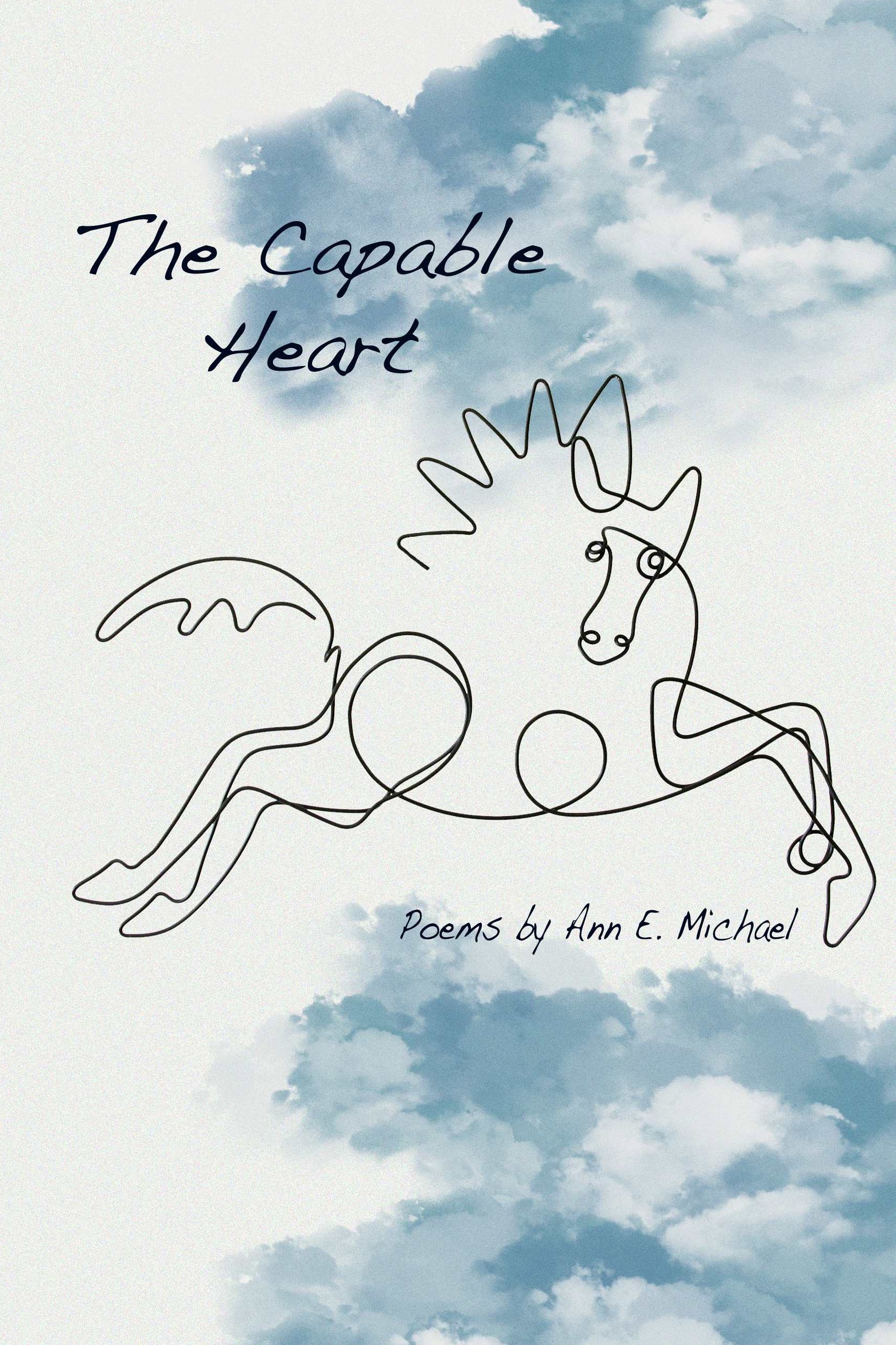
My new book can now be ordered from the publisher, if you find Amazon problematic (and there are good reasons for that). The link is here.

House concert

I can only recall ever attending one house concert. It was during my college days–1977 or ’78–and took place at a large Victorian house in Ann Arbor, MI. We sat about on chairs, sofas, stairs, and the floor to listen to blues/folk singer and guitarist extraordinaire, David Bromberg. It was a pleasant environment in which to hear the musician–an intimate and attentive audience, a sense of camaraderie and shared appreciation, and quite comfortable. But I never managed to attend another house concert…usually, such events are fairly private and by invitation (as I think that one was), so you don’t hear about them until after they’re over.

I was therefore delighted when friends suggested that they hold a “house concert” or, in this case, a house reading, so that they could share my poems with some acquaintances. A new audience! A comfortable, non-intimidating space, terrific food, and the kindness of people willing to listen to a bit of poetry…what’s not to like about that? There were over a dozen folks in our friends’ pleasant home, and at the close of an evening of wine and food and conversation, I was asked to read and talk about my poems. And promote my new book (which is now available to order on Amazon).

My gratitude overflows, Don and Jeannie. You’re the best!

An unexpected aspect of the house concert event was that it was delightful to meet the “audience” first, before the reading–a reversal of the usual order, and very helpful in getting me to feel more comfortable not just in presenting my work but in deciding which poems to read. In addition, the cozy atmosphere meant listeners felt free to ask questions and continue the conversation to include thoughts on song lyrics, “private” poetry (that people write for themselves alone), favorite poets, and the context of the work of poetry in the world.

That was such a marvelous evening. And up ahead, somewhat similar in nature: on March 27, at 7 pm, I will be joining poets Marilyn Hazelton and Susan Weaver–two members of the writing group that I’ve been part of for decades–and folk singer, radio host, teaching artist, and community arts leader Dave Fry for one of Dave’s monthly “Dave’s Night Out” events at Godfrey Daniels, a listening room in Bethlehem PA. Dave has been generous enough to have hosted me with other poets on stage at the coffeehouse before, and the experience was terrific. His guitar accompaniment enhances the sonic delights of poetry. I’m looking forward to this one. Tickets are $15, I think, and they keep Godfrey’s running as a non-profit arts venue in our region.

I’m happy to see this book in the world. Copies can also be ordered from Kelsay Books.

~

Wet lion weather

Early March, but February’s doldrums appear to be hanging on with clouds and heavy rain in our weather (though it has been fairly mild) and my mood as well. If March comes in like a lion, it is this year a very damp panthera leo. Crocuses, yes; iris reticulata, yes; winter jasmine, yes; hellbore, yes. And the robins are chirping like mad every evening as dusk arrives–and it does arrive later each day.

I should feel merrier. There are some poetry-related things coming up this month, an informal reading at our friends’ house, a bit of recognition perhaps, a visit from a beloved before the month closes, and maybe even the new book. In addition, I have managed to collect and organize the first draft of yet another collection. (Don’t hold your breath–this one will be a long time coming.) My physiology has been annoyed by the rain and humidity, however, which keeps me out of the perennial beds where the winter weeds are having a party in the chilly mud. There’ll be hell to pay for this later if I can’t get out there pretty soon. But it would not be the first time–which is why I know there will be hell to pay!

I did take advantage of the many rainy, achy days by reading an amazing novel by (Nobel Prize winner) Olga Tokarczuk, The Books of Jacob. Dare I call something a masterwork? This marvelous historical novel is over 900 pages long, beautifully rendered in English by Jennifer Croft, and based upon 18th-c Polish history and the idiosyncratic Frankist religious movement. I’ve been thinking about it for days–reflecting on words, names, letters, philosophy, and even metaphysics. Several times I found myself setting the book down in admiration, wondering how on earth Tokarczuk manages to keep the thread of her numerous narratives together so beautifully.

When a book gives me that kind of joy and evokes so much wonder, I feel that being a writer might actually be a worthwhile occupation. And if the rain keeps up, I’ll be at the library looking for her other books soon.

Process: shosin

Ah, the manuscript process! It interests me even when I’m not in the midst of putting a collection together, because it seems there is no consistently efficient way to go about it–no matter what people claim. It’s fascinating to read, in interviews, articles, and blogs, how poets decide on the poems to gather into a book; I have put together three full-length collections, and yet I can’t say that I have developed a method I can rely on. Each volume seems to have had different inceptions and different means of getting to an end.

My first approach is to choose several dozen poems, about a third of which have been published in literary journals. After that, no system: I ponder possibilities. My last two books had titles early on, which helped a little, and my chapbooks have had themes that guided me about what to include or exclude. Not so this time. The process this time reminds me of how I put together Water-Rites, which evolved from my MFA thesis in 2003. In other words, I don’t really know what I’m doing! Which feels edgy and uncomfortable, and is probably therefore a good thing. I don’t want to get too confident or at ease with writing. Creativity sometimes thrives on obstacles, or on the prompting to do more, to try new things, to solve problems.

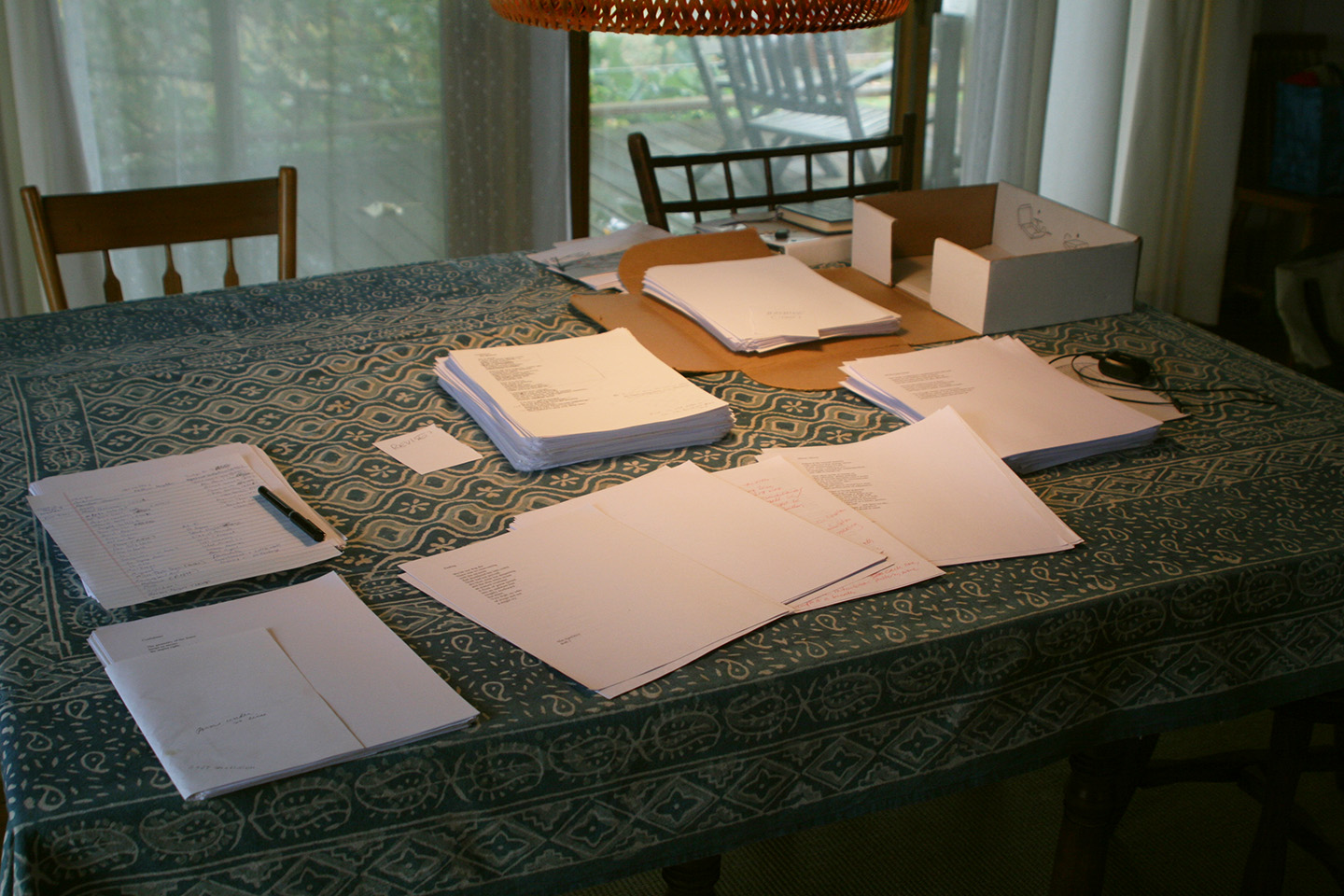
Putting Abundance/Diminishment together at the “lighthouse” in 2019

This past weekend, I started curating in earnest, laying out poems and reading them to find out whether there are resonances and “conversations” between them. One method is to try grouping the pieces by theme or style. The overall book may then be divided into sections, which is a not-common approach in contemporary poetry books. But my first attempt arrived at seven sections, which strikes me as maybe two or three too many divisions for a manuscript. Also, the sections were wildly divergent in tone and context. Some divergence keeps a book from being tonally monochrome, but I don’t want my text to throw my readers from port to starboard willy-nilly, either. As a reader, I like poetry collections that have chapters/sections. How necessary are they, though? Maybe I don’t need them.

I was thinking about Louise Glück’s book Wild Iris, which is not divided into sections and which even has many poems with the same title (seven called “Matins,” for example). But the poems appear naturally, with a sense of flow–and there are not a lot of twists from poem to poem, though there are twists within the poems.

Billy Collins’ books are not separated into sections, either. He has said he doesn’t work towards a theme or arc, just chooses poems that he thinks are good enough; and yet his latest collection, Musical Tables, is full of short poems (um, a style or theme? Possibly). I have been doing a bit of research on this through my bookshelves and online, seeking further direction. Clearly, there’s work ahead, and even though I’m in my 60s I’m still a novice when it comes to manuscript-making.

Shosin: 初心 , or “beginner’s mind,” may serve me well here. (See Suzuki’s classic book). Wish me luck? I think I’ll need it. And if you have some advice, let me know.

Waiting

Trying new things, slowly. I made a profile on Chill Subs, even though I am about to take an extended break from submitting poems to journals. The task I have recently set for myself is to curate (?) collect (?) another set of my poems to make into a new manuscript. Generally, I start with a selection of about 100 poems and winnow, revise, and substitute from that initial batch. It takes time. Eventually, though, I will get around to exploring the Chill Subs platform to see whether it makes sending out poems any easier. My guess is that it won’t help all that much, since my real problem with submitting work is a lack of motivation and uncertainty about whether a poem suits the editorial tastes of the journal–or whether the poem is even a good poem. I have trouble judging my own poems, though I feel I am fairly adept at critiquing the work other people compose. It’s that log in my own eye, perhaps (Matthew 7:3-5).

The days are lengthening, but February remains a long month, typically a time of year I feel achy and low in mood even as the woodpeckers “laugh” their noisy calls high up in the trees and sun shines brightly on the not-melting-much snow. But the snow feels right; last year we had an “open” winter, and that lack of natural snow-mulch takes a toll on the kinds of plants and animals that reside here. In another week or two, the urge to put a few seeds in seed trays will likely take hold of me. For now, however, the seeds stay nestled in their unopened packets under the desk in my kitchen.

Waiting.

This superbly handsome pileated woodpecker photo was taken by my friend Fred Zahradnik at nearby Hawk Mountain Sanctuary.

lìchūn

As is not uncommon in our region, we have a warm and sunny spate of days that evoke thoughts of spring…often thoughts that are dashed by late-arriving snow and ice storms. The days are an hour longer than they were at the December solstice, and some plants bloom or start to bloom: witch hazel, snowdrops, hellebores, skunk cabbage, winter aconite.

In the Chinese lunar-solar calendar, these weeks mark the start of spring: 立春 lìchūn. (Hence the new year commences, celebrated this year on February 10.)

I love the emergence of new growth in springtime and enjoy looking for buds and leaf-tips, but winter’s crucial to this environment. It plays its role by enforcing dormancy and restful, unperceived rejuvenation. Nonetheless, sometimes I resent the way it teases–knowing that the freezing will return and that mid-March snows are not uncommon here. That has made me think to post my poem “Spring Lies,” which appears in The Red Queen Hypothesis.
~~

Spring Lies

Sun through fog. The leaves of beech trees gleam
low under the tall expressive line of ash and poplar
whose topmost reaches, feathered by the mist,
wait budded but un-leafed. The starlings stop, are
tethered to their twigs for brief collective
breaths and urgent calls that rally all
to action once again—a whir, black-speckled sky,
the poplars barren after the birds’ brawl
moves off. An hour goes by. The meadow’s damp
expanse reveals patches and threads of green.
Here, mud seems harmless: winter has decamped.

Meanwhile, a small town near a river bank
sighs beneath a dank slide, silenced, loses
all but longitude and latitude.

People want to feel the home they choose is
safe but, at best, they stake a compromise—
fire, flood, crime rate, mud. Spring’s temperate. Spring lies.

~

Patterns

I recently finished reading Meander, Spiral, Explode: Design and Pattern in Narrative by Jane Alison, a series of essays that considers the structure of written narratives in fiction, mostly in novels. Alison’s background context is the Western-developed Aristotelian dramatic arc, that “exposition/rising action/climax/falling action/denouement” plot that generally follows chronologically. She then examines several novels, modern and contemporary ones mostly, that don’t adhere to the classic structure.

I’ve read some of the books she looks at, and have decided to put others she mentions on my to-read list, but mostly what I took away from her text is my own recognition that poets have been varying structures for a very long time. I don’t mean just the patterning difference between, say, a sonnet and a pantoum or free verse but a poem’s narrative structure, its approach to chronology, imagery, argument, world-building, and more. When I was reading, I thought of examples of poems that spiral, meander, make wavelets, are fractal in nature, or explode (to use some of Alison’s terminology).

In particular, the cellular or networked ‘form’ of storytelling seems basic to poetry–each cell a room or stanza, interlocking or sitting nearby with space around each one. The space connects as well as makes gaps, leaves room for reflection and recombined connections and new patterns; sometimes the stanzas float like little blocks on the page (or screen)…interrupting the narrative and enhancing it as well. Poetry’s narrative is often collage-like, and I notice this aspect in some newer novels as well–but I read much more poetry than fiction these days. Maybe it’s time to plunge into more novels again? At any rate, Alison’s book has made me reflect on narratives, lyrical narratives, literary structure. Maybe even the structure of a new manuscript? (I ought to get to work on that.)

If you want a taste of this book, you can read part of her opening chapter, which appeared as an essay in The Paris Review, here. I don’t teach in a classroom anymore, but if I were instructing a creative writing class I might put this book on the reading list.

Cover reveal

Earlier this week, I went to a neighboring city–Reading–to record a TV segment for the local station, BCTV, that hosts a program about poetry! The host and interviewer is poet Marilyn Klimcho of Berks Bards (a non-profit poetry group in Berks Co, PA). It was truly pleasant to read a few of my poems in a professional setting (studio), but the best part of the day was just chatting with Marilyn about poems, poets, and poetry. We began our conversation half an hour before the cameras rolled and continued it afterward, so the 25 minutes that were recorded seemed just to be part of a longer, casual discussion.

I appreciated that. I’m part of a long-running critique group, but it’s seldom that I get the opportunity to pick someone’s brain and share ideas, influences, and general enthusiasm about the art of poetry the way I did in grad school. Probably could work on getting more such discussion into my life.

The “Poets Pause” segment will air in March and then reside on YouTube, so I will post that link at some point. It was kind of Marilyn to highlight The Red Queen Hypothesis and to give me a chance to mention my next collection, forthcoming from Kelsay Books later this year. Speaking of which, I do now have a photograph of its cover:

The photo is by Don Schroder, a friend who’s got a website full of lovely images from his numerous travels to the African continent as well as good shots of festivals of many kinds and floral beauties from arboretums and gardens. Go check it out!

The cernuous tulip seems appropriate to several themes I evoke in these poems–elegies and the sense of impending losses but also appreciation of beauty and brevity and life’s many colorations. Initially, I thought that I was using fewer of the animals, plants, weather and the “nature stuff” I tend to populate my poems with, because so many of the poems in Abundance/Diminishment are for or about humans. But…nope, just took another look through the manuscript in the final approval/editing process and realized that I cannot seem to leave the planet’s environment out of my work. I probably should have been a biologist, ecologist, or a science teacher instead of an instructor of English, but oh well.

Frankly, I love the simplicity of this cover, and I’m excited to have the book in print later this year…especially since it took me a decade to get The Red Queen Hypothesis into the world.

Hominid animals

Reading Frans de Waal’s books always gets me thinking about the use of anthropomorphism/personification in poems. When I was studying and first learning about poems, the general thinking from critics seemed to be to treat anthropomorphism, and even personification, as a “no-no” in contemporary poetry. We were not to make trees or grasses or wolves “humanized”–which does make a kind of sense; instead, we were told to observe and describe what we saw with less of a reflection on whether the non-human thing bore resemblance to human things.

For example, the bee was not to love the flower or the hive, nor the ostrich to love a fellow ostrich. A willow shouldn’t sway like a dancer. It should sway like a willow in the wind. There was science behind all this, maybe Skinner’s science but still; and there is Nagel’s bat: how can a person imagine being a bat the way a bat experiences being a bat? I’m not going into reductive materialism here, don’t worry. Just trying to provide some context outside of poetry to suggest there may be forces behind the trend away from anthropomorphism, some of which are valid.

I have always been tempted to title a book The Personification of Everything.

Now science is fairly certain that emotions preceded “rational intelligence” as life evolved and that animals possess traits and behaviors that aren’t so fundamentally different from ours; we are hominid animals. I would add that, as reflective hominids who employ language for reasons beyond basic information, human beings make connections (metaphor, simile, parallelism…) and can observe the “others” in our environs as not always so unlike ourselves. Or dream of inhabiting the lives of those others, or imagine telling stories from those vastly strange (to us) points of view.

So I’m coming around to appreciating anthropomorphism and personification as dwelling in the realm of the imagination that is not the domain of philosopher or scientist. After all, writers have been taking other perspectives on stories for quite some time, especially during the past century. Ophelia’s perspective (Hamlet), Persephone’s (The Odyssey)…Kazim Ali re-writing Icarus’ story (Sky Ward, 2013). Why not, then, write poems using the perspective of the spotted lanternfly, as Robin Gow has done?

One of my favorite short stories by Ursula Le Guin, “Direction of the Road,” takes the perspective of an oak tree. It is about the relativity of time and motion, but one thing the piece brings home–without any preaching–is that human lives are comparatively brief and, dare I add, not as important in the scheme of things as we may believe. Once we can accept that possibility, maybe we can more gently embrace the world and the things of the world.

Vacuum of meaning

Seven months ago, my mother’s handwriting was decipherable–to a degree:

Her script now resembles nothing so much as asemic “cursive”:

Asemic writing is a wordless open semantic form of writing. The word asemic means “having no specific semantic content”, or “without the smallest unit of meaning”. With the non-specificity of asemic writing there comes a vacuum of meaning, which is left for the reader to fill in and interpret. Wikipedia

Her words likewise sound as though they possess no semantic content, but her body language, facial expression, and intonation when she speaks make it clear that there is a unit of meaning in whatever she tries to convey verbally. It amazes me that she doesn’t seem particularly frustrated by her aphasia. Although I can’t know what my response to aphasia would be, I doubt I would be as accepting and unflustered as my mother is.

I think of how Eloise Klein Healey wrote her book of poems Another Phase while experiencing Wernicke’s aphasia after a bout of meningitis. I gave my mom this collection a few years back; she marveled at these short poems, when she was still able to read, deeply impressed that Klein Healey persisted in using words–creating poetry, no less–despite aphasia. Eloise has regained some of her fluency, while my mother can only get worse (her aphasia is due to vascular dementia, from which there is no possible return).

Yet my mother continues to write–to take notes? jot down ideas?–it’s not possible to know, but I find her cribbed, indecipherable cursive here and there on pieces of paper on her desk, and in a notebook in her dresser drawer. It resembles asemic writing now. That habit of recording some aspect of one’s life, or of making lists…it appears that muscle memory can include the small-motor habit of handwriting. I wonder if she is making meaning in some way that I cannot possibly discern, something interior but necessary to her. As a writer, the idea appeals to me. But I also wonder what the point of writing is when there is no audience, so that the act is no longer an act of communication. Does it then become a “vacuum of meaning”?

~

In happier (meaningful?) news, January’s surprisingly full of poetry this year, and I have had time to attend, participate, listen in. Plus it finally feels wintry here. Snow’s coming down, herbal tea warms me in the afternoon, and we’ve lit the fire in our fireplace more than a few times, burning up the dead-fall ash trees that have been coming down around the property the past three or four years. I’m staying inside more than usual, “yin energy” restfulness. And withholding some lovely news for now, awaiting confirmation, enjoying the possibilities ahead.