Poetry month books & doings

~

It is, once again, April: National Poetry Month. My recent trip to the AWP bookfair has given me many poetry books to peruse at whatever pace I please, and because the weather here has been far too wet to do much in the garden, I’m using the free time to read. The outpouring of millions of peaceful protesters who oppose the current administration’s policies and who rallied on April 5 was somewhat heartening to me, but I remain skeptical and am aware that real change takes a long time. For the present, I’m bolstering my spirit through poetry.

~

I met Diane Thiel decades ago, briefly, at the West Chester Poetry Conference. She is incredibly talented, intelligent, frighteningly well-educated, and her work impressed me a lot; somehow, though, I did not get around to reading the many books she’s published since then, so her Questions from Outer Space (2022) is a delight and a revelation. Travel, literary and historical references, child-raising, teaching–the poems here cover a large range of topics. I bought her book at the Red Hen Press tables in LA. Red Hen is a terrific source for contemporary poetry books, if you’re looking…

At Saturnalia’s booth (another good small press with a large catalog), I found three of Martha Silano’s books and rejoiced. So far I have finished reading only The Little Office of the Immaculate Conception, which I love, but I can hardly wait to read her more recent books. She has a wry sense of weird, nerdy humor that’s inflected with science facts and grocery-store labels, pop culture and life in the burbs, and a healthy questioning of, well, everything.

My fellow Goddard alum and friend Lou Faber has a new book here, and it’s so wonderful to read the work of a long-time poetry colleague whom I haven’t seen in years but whose voice comes recognizably through this collection. The second half of the collection, in particular, deals with the emotionally-complex aspects of being an adoptee and this person’s efforts to untangle where (and who) he’s “from.” Contradictions abound over the years; then, DNA testing sort of, but not quite, sorts out some of the mysteries. But life–well, much of life contains mysteries and always will.

~

Meanwhile, this April I will be busy giving and attending in-person and online poetry events–even a radio spot! I’ll be reading mid-day at a local community college, participating in a No River Twice poetry event; and at some point this month, an interview about The Poetry Press Project (and my latest book) will air on WDIY 88.9FM. And a few of my poems will be appearing in print this month, the first of which is here: “Luna, Paloma.” I’ve also signed up for virtual attendance at a couple of poetry reading; and on May 4, I will be among the features for a virtual reading sponsored by One Art journal. My physical stamina isn’t what I wish it were, but thanks to technology that enables me to participate from home, I can manage to do a bit of yard work and STILL get to a poetry event.
Just reading

Sunday evening, my weeding stirred up so much dust and chaff that I needed to wear a bandanna around my nose and mouth. A continuous late-summer drought. There are still tomatoes and basil, sunflowers and zinnias, but the avian migration has been going on for some weeks and the days are getting shorter. Just after equinox, three weeks without rain; at last the sky clouds over and drops a little moisture on the parched soil. Yellow leaves sift onto the lawn. Small flocks of robins rejoice in the softer top layer of dirt, pull at grubs and worms, then fly off.

~

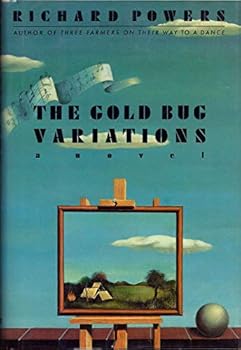
The rain’s necessary, and I’m grateful. Rainy days, however, take issue with my body–or, probably, the other way around. The need to take NSAIDs and rest offers the opportunity for just reading. This isn’t a bad thing, especially as I had Richard Powers’ novel The Gold Bug Variations to hand. It’s a tour de force of pattern, structure, code-breaking, DNA-building, relationships, love, chemistry, music, art, literature, and much more. I love the references (the narrator is a reference librarian), the minutia, history, alliteration, lists, compilations*, the whole thread of the novel’s dramatic arc, its relationship (mathematically, metaphorically, structurally) to music and the work of the gene-sequencing science. The book tells the parallel stories of couples who fall in love 25 years apart, the coincidences and randomness, the patterns that may not be patterns. I’m thoroughly wowed by an author who puts so much research into his writing and makes everything fit somehow.

Powers must have been about 33 when he completed this novel. I can’t imagine being so wise about human behavior and so informed about the sciences and music theory at that young age. Well, for one, I’m not as brilliant as he is; and two, I was raising toddlers when I was 33, which is a science unto itself and as revelatory as any book I could have been reading or writing in early mid-life.

But I digress. This book interests me on so many levels that I’ll be thinking about it for weeks. I may have to re-read it, take notes next time. I kept wanting to underline passages–it’s a library book, and marginalia is a no-no. I can imagine reading it again to the strains of the Goldberg Variations–indeed, I read a few chapters to said accompaniment this time. This is not a swift and easy read: it took me awhile to feel warmed up about the narrator, though she’s funny and smart. By the end, I loved her like a friend.

Honestly, novels seldom get me this excited or inspired. I’m glad I had a crappy day so I could justify lying around and “just reading.” As if “just reading” is not a worthwhile endeavor. The weeds can wait.

~

* re compilations: a word Powers employs often in this novel is the neologism/computer programming term “kludge.” I wasn’t familiar with it. But it’s a terrific word! https://www.etymonline.com/search?q=kludge

August

August is the month of the Sealey Challenge, which basically urges those who like/love poetry to read a book of poetry each day of the month. I haven’t given myself the challenge this year, but I am posting individual poetry books on my Instagram account daily–books from my personal library, mostly–and that means that I read a few of the poems, too. Sometimes I get carried away and re-read the entire book. [@aemichaelpoet]

This is not a bad thing.

Meanwhile, August this year behaves as it usually does, weather-wise: blisteringly hot and wiltingly humid. That would be okay except that June was so hot and dry and now an early hurricane has begun its climb up the coast; for now, we are stalled in a heat dome, and by Friday we may be inundated with rain. All of this means that my tomatoes are likely to split just as they all get plump and ripe. It also means that our annual folk life festival (Goschenhoppen) is likely to be a muddy, damp affair with fewer attendees than usual. These things happen, and they happen more frequently when the planet undergoes climate change.

~

August, as most of us learned back in grade school, is named after the emperor Augustus, whose name means “venerable, noble, majestic.” [Source: my favorite, Etymology Online]. The online source notes that “In England, the name replaced native Weodmonað ‘weed month’.” Weed month is a perfect name for August, and I think I will adopt it from now on. It certainly fits the current state of my vegetable patch as the dog days keep the outdoors too miserable for heavy labor in the dirt.

At least for me, however, the laboring can be optional as long as I don’t object too strenuously to a haggard-looking garden. The people who are truly hard workers this time of year are construction and road crews, landscaping crews, farm workers, roofers, line workers, and others who have to brave the heat and humidity to make a living. Also the janitorial staff crews at schools and dorms and other older buildings that don’t have reliable–or any–air conditioning. When we are outdoors working at the festival in August, we get a taste of how challenging it is to do physical work in the heat. This is actually an educational aspect of the festival for those who participate, especially for younger people who are new to the festival. We remind them that people worked like this all the time, in summer and during snowy winters and in the rain and without electricity…with no escaping it, since they needed to work hard just to stay alive.

Perhaps unfortunately, our forebears’ grinding efforts may have led to the idea that only hard work will save us and make us morally upright human beings. Few of the early Germanic settlers here had much time to read or compose poetry, to savor novels, to learn to play an instrument. Art was acceptable to a degree, so long as it decorated otherwise-useful objects. The poetry of the Bible was acceptable, but it wasn’t studied for its beauty. A person with my sensibilities and temperament would probably have been an outlier in Goschenhoppen’s historic community. If I’d lived to be 66 in the early 1800s, I’d be considered “an old cripple,” mostly blind and bent over with arthritis and stenosis. But maybe I’d be the kind of old woman who tells stories.

On the other hand, maybe I’d be considered a witch! I guess it depends on what sort of stories one decides to tell.

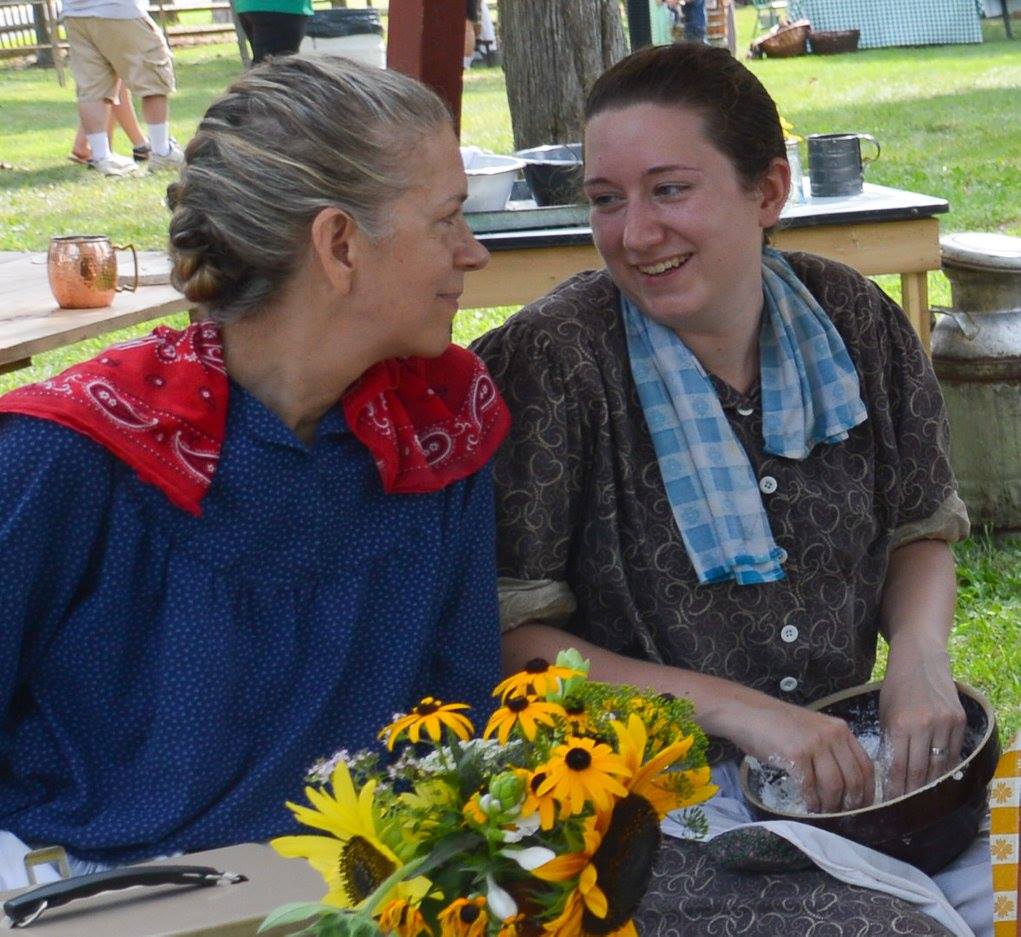
At a previous year’s festival, with my daughter. Bewitching the local kids with potato candy!

Useful avoidance

Trapped inside with the air conditioner on for over a week, I sat by my bookshelves going through the poetry books in my library. I’m re-reading, assessing which books I truly want to keep because I turn to them often or learn something each time I read them, which books I keep for sentimental reasons (maybe I know the author personally), which ones to keep because they are signed copies, which ones are long out of print and I would never be able to replace them. Some of them remind me strongly of places or eras in my life: I bought this one in a small bookshop in Grand Rapids MI, or this one at Barnes & Noble when it was just one store on a NYC street corner, or these at the storied and much-mourned Gotham Book Mart or St. Mark’s Bookshop. What are good reasons to keep books when I really have to downsize? It’s not an easy task, and the first of many in the process of getting rid of stuff so my kids won’t be stuck doing it. Besides, I enjoy re-reading these books. My children are not as enthusiastic about poetry as I am, so it makes sense that someone who loves the works on the shelves be the one who makes such decisions. It feels good to be surrounded by the words of wonderful writers when the outdoors is brutally hot and humid, and every joint in my body aches.

Surrounding myself with other people’s books also acted as one more way of avoiding my own creative work. Sometimes, though, waiting around and doing nothing on a project ends up bringing clarification or new ideas. It can prove useful. I have been stalled on my in-progress manuscript, so a month or so back I asked someone to take a look at it–and then I got caught up in doing other things. Like getting cataract surgery and having covid, and then it was gardening in full swing under sweltering weather, and then the bookshelves… I wasn’t exactly procrastinating, but neither was I actively working on, or even thinking about, the collection.

Acquired when I was much younger, and cool bookshops abounded.

And one night recently–during a much-needed rainstorm–I got a brainstorm! I realized I was trying to pack too many topics into what really should be a manuscript more closely focused on how people who love one another vary in their relationships to old age and death, and on how the contemporary social and medical aspects of the aging process pull us in uncomfortable directions, often distancing us from those relationships. So yes, there should be family poems, hospice poems, biblically-influenced poems, and dealing-with-everyday observation poems. Also some poems of hope and love, poems reminding me (and readers) of the need for compassion in all dealings. But the draft had 92 poems in it, far too many; and some were there just because I like them or they’d been published in a good journal. Which are actually not good enough reasons to include a poem in a collection, according to most of the editors I know.

I am back to thinking about the manuscript and digging up potatoes–a nice crop this year–instead of culling the poetry books because, thank goodness, the heat wave’s subsided a bit. But in the process of this non-routine summer I have allowed numerous weeds to flourish and set seed; all the more work for NEXT year’s gardening, but it’s been too hot to deal with said interlopers. I like to believe the weeds and I are reaching a sort of understanding, but it is not really a compromise. All the concessions have been on my part. [Note: weeding a personal library is less physically taxing but not really any easier.]

In residence

It’s been some time since I was away at a residency with other artists and writers. Conferences, yes, but residencies are different–more intimate in scope, less social-life activity, more one-to-one conversations, and a great many overlaps in interests, inspirations, and approaches. The intensity doesn’t feel at all like the intensity of a large conference such as AWP, where I often feel I must cram my schedule with panels, meet-ups, and attendance at presentations and where the exchanges, while often intellectual, generally require the context of careers and situational details. At a residency, we certainly don’t avoid topics like families and day jobs; but such getting-to-know-you chats are secondary to conversations about art, artists, reading, technical methods, responses to environment, discussions about intent and audience, aesthetic and artistic philosophy.

A residency also offers that key component of creativity: unstructured time (or, time one gets to structure to one’s own liking). I cannot stress enough the value of reflection, contemplation, and woolgathering; the residency I attended in Spain offered this to a degree I haven’t had in quite some time, and I relished it. I took along Olga Tokarczuk’s book Flights, perfect reading for a plane-bus-train trip, and Mark Doty’s Deep Lane, contemplative and fearless poems that urged me to spend the necessary time with my thoughts and my environment.

~

It was interesting to hear about the methods and processes of other participants who were there the week I was. While all of them write in some form, their creative work is visual: Photography, film, digital art (animation, 3D, comics), performance/performative art, painting, multimedia. At first, I felt a bit out of step since what I “produce” is…well, abstract, I guess? And the means a person uses to create poems is mostly invisible; it’s not as though you can see us at work. A person at a desk, sitting on a rock, or lying under a tree doesn’t appear to be in the process of making anything and, except when the written work appears in print/online, the “artwork” isn’t something one can show to others. As I began to converse more with the visual artists, however, once again I experienced the joy of discourse with fellow creatives, no matter their discipline. I certainly have friends who are sculptors, painters, photographers, ceramicists, dancers, musicians, actors, & craftspeople of all stripes–and I don’t feel out of step when talking with them. I suppose it is my initial hesitation around “strangers” that kicks in. Shortly into the residency, we were no longer strangers.

The word la joya is Spanish for “jewel,” and it can also refer to a geographic hollow–a bowl-like area, which is fitting since the cortijo is situated in a sort of high valley surrounded by the mountains of the Parque Nacional de Sierra Nevada. On my last day at Joya-AiR, we held an artist talk to inform one another of our creative work and processes, influences, and possible future directions we imagine our work going in. Some of the other participants will be working there for another week or two! Which would be lovely, but I could not extend my stay at this time. Nonetheless, the residency has been very useful and productive for me. I feel so grateful to the people at Joya and to my Best Beloved for encouraging me to attend.

Au revoir, institution

It was not a huge surprise–the proverbial writing has been on the metaphorical wall for some time–but the college I attended for graduate studies has announced that it is folding.

In January 2001, shortly after I won a grant in poetry from the PA Council on the Arts, I rallied myself and my work, packed a bag, and took the family car by myself to Vermont for two weeks. In a burst of confidence and enthusiasm post-grant, I’d applied to creative writing graduate programs. There were none nearby enough to commute to, and Goddard’s low-residency model seemed my only choice. Well, I could have abandoned my husband and young children and moved to another area, but that seemed untenable and unkind.

But Goddard was perfect. I met new people and made (so far) lifelong friends-in-writing and friends-in-feeling. The work challenged me; the reading was intense! When I look at the bibliography at the back of my thesis, I admit I wonder how I managed. Hard work, intellectually demanding work, constant revision. Well, I needed less sleep in those days. Many times I read and annotated while waiting for my kids while they took piano lessons or riding lessons or whatever they were doing in middle school.

Sometimes my parents or spouse spent a Saturday or Sunday with the children so Mama could study and write. It is kind of a blur, but the community of fellow students seemed so supportive at the time. It’s not that I was without supportive people in my life–but the folks at Goddard, students and faculty, deeply understood my passion for writing. I found I could spend hours talking about things that matter to writers (which is kind of everything, but also, WRITING), which wasn’t easy to do in other areas of my middle-aged, middle-class, mom-life existence.

The iconic Goddard College Clocktower

Goddard often has been termed an “experimental” college. That term covers a whole host of meanings in the world of education. No point in trying to define it, since one thing that experimental institutions tend to do is change and evolve. The program I attended in 2000-2003 differed from the programs of 1985 or 2015. Which is as it should be–education should not be a static set of activities even when some exploration of canonical texts is necessary. One reason I chose to pursue my education at experimental colleges (The New School, Thomas Jefferson College, Goddard) is that I am a slightly odd bird, an autodidact who did well enough in standard subjects but who got the most benefit from deep study of things I felt passionate about–literature, history, botany, poems, dance, philosophy, feminism, visual art. Experimental colleges offered mentors who could guide me in self-directed learning, recommend books and authors, feed my often-changing interests, offer personal, one-to-one advising and critique. I am 100% sure I would not have excelled in universities that followed more standard educational subjects and protocols, and I’m glad I received good guidance (usually) and a well-rounded, if eclectic, education.

Many of the poems in my book Water-Rites are from my time at Goddard, since Water-Rites in an earlier form was part of my graduate thesis. And a fair number of the poems in The Red Queen Hypothesis were first drafted during my years there, when I was experimenting with forms. So, having just learned for certain that Goddard will cease to function as an offbeat, transformative, self-directed institution of higher education–thus joining my undergraduate school, Thomas Jefferson College of Michigan, as defunct institutions–I will post a poem that I know for certain I drafted just before I graduated. It’s a response to the events of 9/11 and was not quite ready, nor suited, for inclusion in my first collection; it appears in The Red Queen Hypothesis and Other Poems.

~

Shreds
for Judith

We ran, leaves before a bitter wind,
& some ran headlong & some in circles,
we did not know what to do with ourselves,

& watched, pressed to our windows & could
do nothing: streets erupted with people
like clustered beetles wakened from dormancy.

We walked, in all directions but mostly north,
& we were silent and our mouths were dry.
Things like shoes and hats made us human.

We wept and it was not sufficient,
& swept, then, for months & recalled
mostly paper, the ways we occupy ourselves,
the mild wind carrying what lingered. Scraps.


(after “Exhibit 13,” Blue Man Group, 2002)


~

Abundance!

In all my born days, I’ve never had a Poetry Month start off with such an abundance of publications–and, as it will probably never happen again, I’m going to post the links here.

“Siren for Somebody Else” offers a mother’s perspective on waiting, unable to get to sleep, for a child who is out late on his own. It appears in RockPaperPoem.

“Interpreting the Conversation from Another Room” shows up in Stick Figure Poetry #13. The poem originated during the years our son lived with us and played online multiplayer games in his room, but it morphed into something a little more sinister.

“Fevered” came almost out of nowhere but resonated with some early readers who contend with mental and emotional challenges. It’s also a poem about love and compassion, I suppose. The journal Philadelphia Stories published it in the latest issue.

Gyroscope Review is a print journal that also offers a Kindle and a PDF version, the last of which is free to download, though the paper book is lovely and only $12 on Amazon. My poem “Bach and Birdsong” starts the issue off…a meditation on springtime.

Whew! This post goes with my “Gratitude” post of last week!

~ The poem below appears in my chapbook Small Things Rise & Go, FootHills Publishing:

Nap in a Treehouse

Alone in my children's treehouse,
I read 300 poems from the Chinese.

Sunlight slants over the cornfield,
flies buzz, the afternoon is warm.

This first day of autumn,
insomnia's caught up with me.

After so many sleepless nights,
I doze with Li Po and Tu Fu.
~

Legacy vs the present

For National Poetry Month, I’ll be posting a poem here every few days…something from one of my books and chapbooks.

First, though, musings on why it matters to me that my poems get collected in book form. I’ve been asked about this by a few people recently, sparked by conversations about the changing technology of “print,” and also artistic purpose, and even the concept of legacy. If I were a visual artist–say, a painter–there would be objects my hands had produced. Even a mediocre painter creates something apparently lasting or worth something. You die, and your paintings go to family members or to flea markets where people can purchase them (for the frames if nothing else…). A ceramicist may make truly useful things such as bowls and mugs; those items can last and be used, even if they end up in thrift shops or post-apocalyptic archeological digs. Maybe the painter or potter isn’t remembered, but the product endures for awhile.

But poems? So many people leave behind sheaves of unread, unpublished, perhaps private writing, much of which won’t resonate with anyone. Even if it could, the chance that anyone would care enough to sort through before burning or recycling and uncover a heretofore unknown genius is vanishingly small. I, for one, am not writing for eternity or for the future. I write for the now. The main reason I want to get books in print is that the product (a book! I love books!) matters while I’m here. After I die, no one will want my pile of drafts, old journals, revisions, false starts–not even my children. And why should they? Will future society value archives of anyone, let alone very minor poets of the early 21st c? Maybe the demise of technologically-based societies is right around the corner. All the more reason to work in and for the present moment. If I garner a few readers today, I feel blessed.

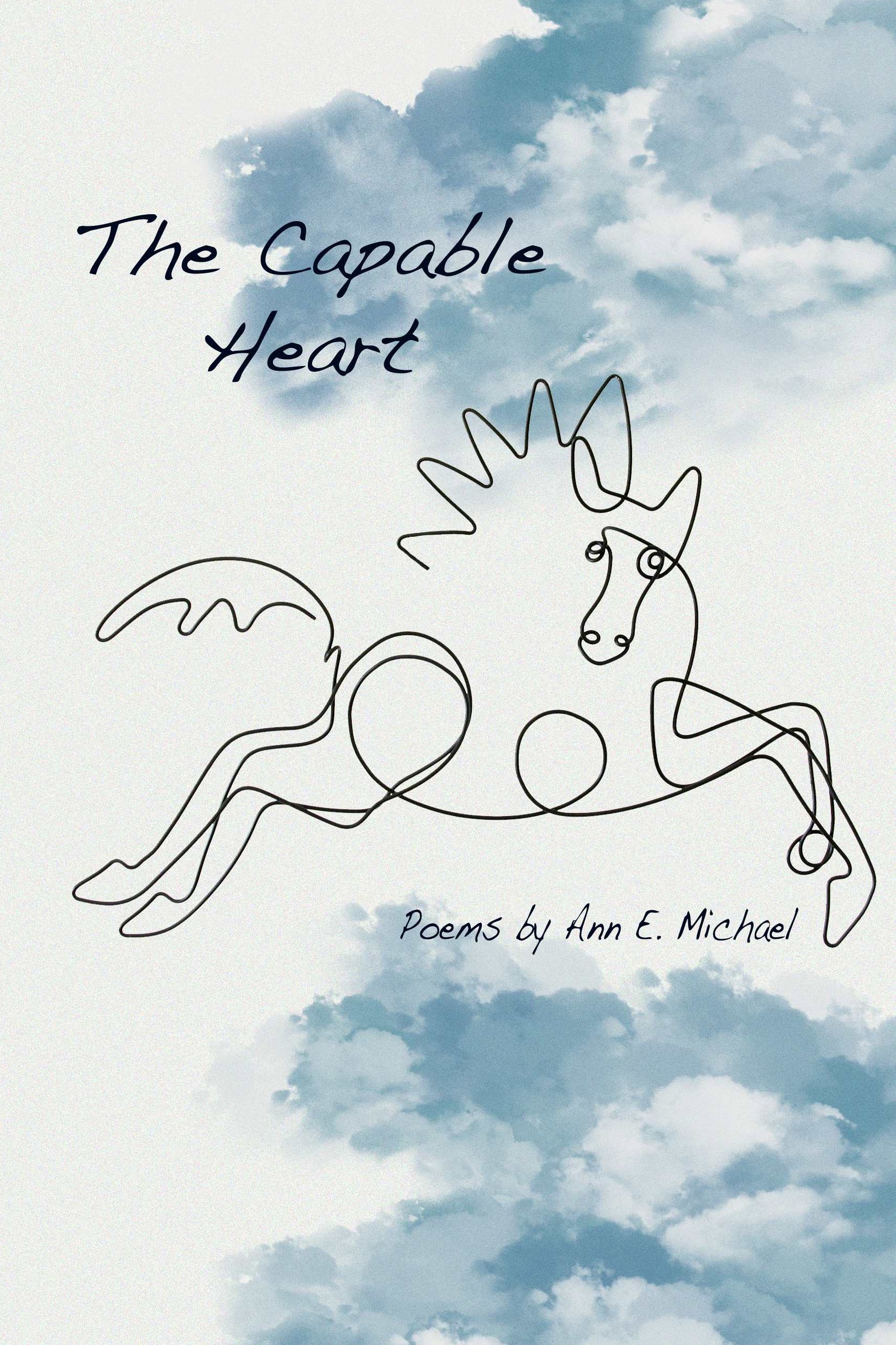
~ Today’s poem is from my 2011 FootHills Publishing chapbook The Capable Heart.

No Long Farewells

The weedy field.
On the rise beyond,
armies of brown corn,
ready to fall.
Willow looses streamers,
yellow kites
floundering in
tall grass.
I look at my hands,
fingers gold. We
walk past grapevines.

Later I think of this day
as a drafty barn,
sun on its walls,
clouds high beyond rafters:
roofless.
Nothing blocks our vision
for once. No blinders.

There is little time
for long farewells.
A light goes on.
Your bus is leaving now.
Moon follows you home.

Equinoctal

Torrents. We had rain in torrents, and it went on for days from February into March and then on…and on. Constant alerts on the cell phones: “Flash flooding.” Doldrums set in. In an effort to accomplish anything at all, I even started to sort through and organize my attic.

Talk about desperation!

The attic project isn’t finished–the weather turned mild and clear two days ago, so I ran to the garden to get to work out there–but it turned out to be a more rewarding task than I expected. I started by tackling the Christmas stuff, then the books (SO many books), children’s toys (the kids are in their 30s and there are no grandchildren), and moved on to paper correspondence. Letters! Postal mail. Epistles. Why I have saved so much of my correspondence from 1975 to the present, I cannot explain. Maybe that’s a thing that people who love words just naturally do, the same reason I have kept so many books. I certainly don’t need all of it; but that was part of the task, sorting what I want to keep and agreeing to recycle the rest. I also found odd ephemera, such as photocopied posters for long-ago poetry readings, broadsides of poems, xerox-zines from the early 1980s, and ancient mixtapes on cassette.

~

There’s some sorrow with this project. So many of my former correspondents have died. I find my grandmother’s looping script, my dad’s distinctive handwriting, my dear friend David Dunn’s nearly-illegible scrawl. Reminders of times past. Maybe that is why we keep ephemera: to remember what we thought, at the time, was important.

Maybe it is, maybe it isn’t, by the time we reach our later decades–if we’re fortunate enough to reach them.

I keep gardens for different reasons. Not to remember the past but to see what the present can bring.

~speaking of the present~

My new book can now be ordered from the publisher, if you find Amazon problematic (and there are good reasons for that). The link is here.

Process: shosin

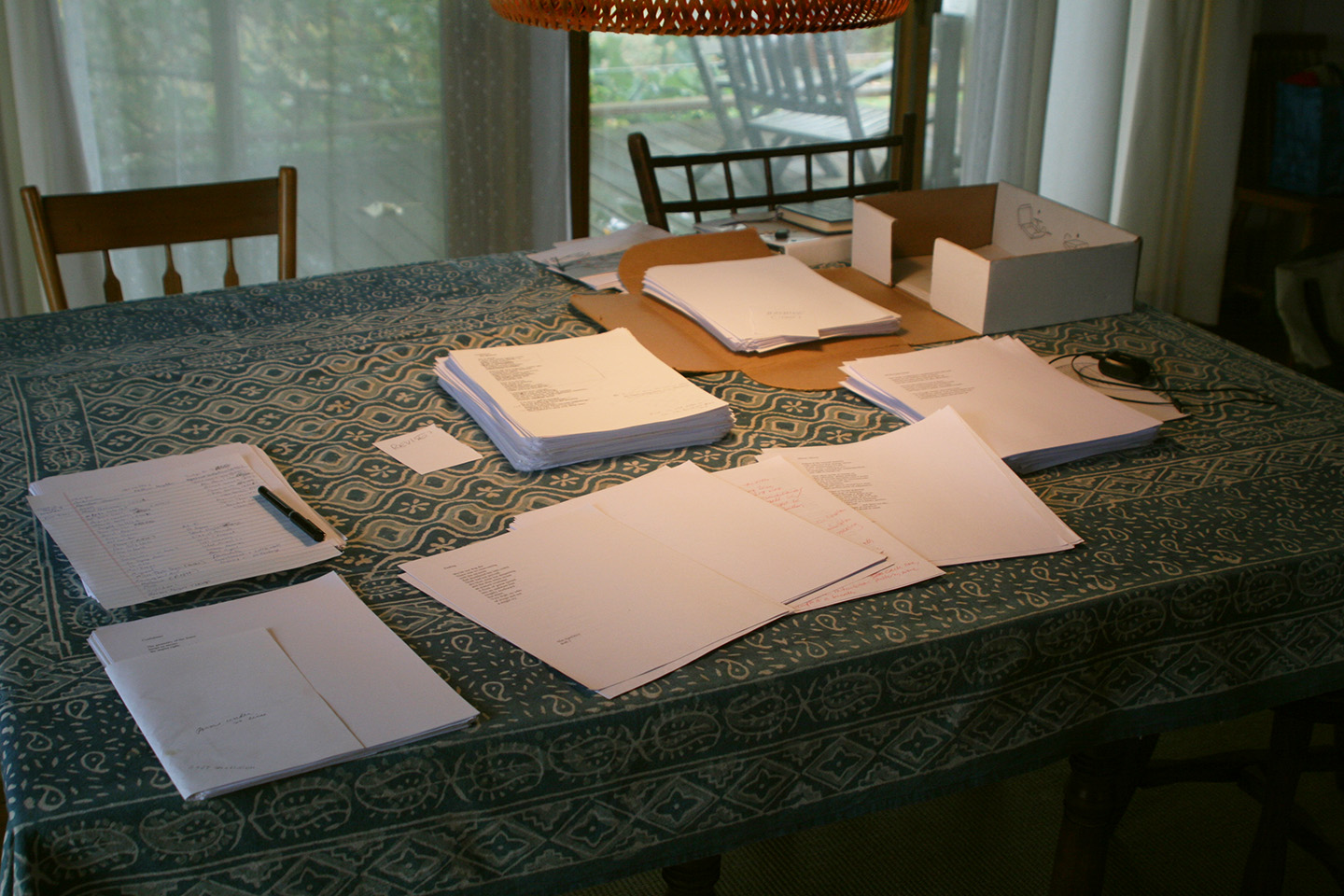
Ah, the manuscript process! It interests me even when I’m not in the midst of putting a collection together, because it seems there is no consistently efficient way to go about it–no matter what people claim. It’s fascinating to read, in interviews, articles, and blogs, how poets decide on the poems to gather into a book; I have put together three full-length collections, and yet I can’t say that I have developed a method I can rely on. Each volume seems to have had different inceptions and different means of getting to an end.

My first approach is to choose several dozen poems, about a third of which have been published in literary journals. After that, no system: I ponder possibilities. My last two books had titles early on, which helped a little, and my chapbooks have had themes that guided me about what to include or exclude. Not so this time. The process this time reminds me of how I put together Water-Rites, which evolved from my MFA thesis in 2003. In other words, I don’t really know what I’m doing! Which feels edgy and uncomfortable, and is probably therefore a good thing. I don’t want to get too confident or at ease with writing. Creativity sometimes thrives on obstacles, or on the prompting to do more, to try new things, to solve problems.

Putting Abundance/Diminishment together at the “lighthouse” in 2019

This past weekend, I started curating in earnest, laying out poems and reading them to find out whether there are resonances and “conversations” between them. One method is to try grouping the pieces by theme or style. The overall book may then be divided into sections, which is a not-common approach in contemporary poetry books. But my first attempt arrived at seven sections, which strikes me as maybe two or three too many divisions for a manuscript. Also, the sections were wildly divergent in tone and context. Some divergence keeps a book from being tonally monochrome, but I don’t want my text to throw my readers from port to starboard willy-nilly, either. As a reader, I like poetry collections that have chapters/sections. How necessary are they, though? Maybe I don’t need them.

I was thinking about Louise Glück’s book Wild Iris, which is not divided into sections and which even has many poems with the same title (seven called “Matins,” for example). But the poems appear naturally, with a sense of flow–and there are not a lot of twists from poem to poem, though there are twists within the poems.

Billy Collins’ books are not separated into sections, either. He has said he doesn’t work towards a theme or arc, just chooses poems that he thinks are good enough; and yet his latest collection, Musical Tables, is full of short poems (um, a style or theme? Possibly). I have been doing a bit of research on this through my bookshelves and online, seeking further direction. Clearly, there’s work ahead, and even though I’m in my 60s I’m still a novice when it comes to manuscript-making.

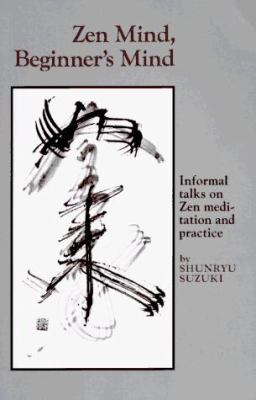
Shosin: 初心 , or “beginner’s mind,” may serve me well here. (See Suzuki’s classic book). Wish me luck? I think I’ll need it. And if you have some advice, let me know.