Face to face

alice-heart1 copy

The physical, corporal power of poetry; the need for language and expression to originate in the body–these are concepts that resonate with me as a poet and that make poetry such a difficult art. For how can one be in the body through words? Words remove the physical language of the body which is so important a component of communication. That is why tweets and social media posts and email often work to the detriment of genuine understanding.

What follows are three rather diverse chunks of thinking concerning the corporal and the intellectual.

Ren Powell writes in her blog:

And it made me more certain than ever that the separation of the corporal and the intellect is truly the root of every evil. It’s why all the studies show that getting people to talk face-to-face, breaks down bigotry in a way nothing else ever will. A linguistically relayed concept has to be replaced by a body that we experience in the sensual world.

It brings me to Orr’s phrase to describe poetry: “the eros of language”. I think poetry is necessary because it bridges the gap between the corporal and the intellectual in a way no other writing can. Why we say novels that tell the truth are “poetic”. When we speak poetry, sing it, it becomes corporal. It’s funny that when we sing the word “love”, we are not supposed to sing “luhv”, with its stingy and clenched vowel, but we’re supposed to open the mouth, sing “lahv”- with a wide-open palate. Because it hits us in the gut with its beauty then. Openness.

And counter-wise (which should be a word),  we can infect our minds with the routine that reinforces ugliness: I believe writing or drawing words and images of hate can infect the body.

~~

Reading Ren Powell’s words, I thought immediately of two poems of Gregory Orr‘s, from his book Concerning the Book that Is the Body of the Beloved. Here they are:

How small the eyes of hate.
I’m not making this up
Or being metaphorical.
A man held a gun against
My head and I saw how
Small his eyes were
With what they refused
To take in of the world.
This happened beside
A small highway
In Alabama in 1965.
What history called
The Civil Rights
Movement; what I call
The tiny eyes of hate.

~

How large the eyes of love.
How the pupils dilate
With desire (I’m not
Making this up: science
Has proved it’s true).

Those eyes wide
And glistening: gates
Thrown open. What’s
Inside, free to flow
Out as feeling,
And the whole world
And the Beloved
Welcome to enter.

~~

I just saw the movie “The Arrival,” a science-fiction film based on Ted Chiang’s short story “The Story of Your Life.” Any movie whose main character has a PhD in Linguistics sounds intriguing to me. The narrative uses the Sapir-Whorf hypothesis as a kind of plot point: the theory that language molds culture. An underlying possibility in the movie is that perhaps it is language that gives us consciousness, transforms us into sentience, and–possibly–has the capacity to unite and heal us.

But it needs to be face-to-face, as in the movie, wherein Amy Adams encounters aliens in person, insisting that in order to interpret any new language she must experience the process of “speaking” personally, to judge body language, movements–not just sounds or written “text.” How we communicate teaches us who we are. In order to understand one another truly, we need authentic encounters, not slogans.

We need to bid each stranger as Beloved, “Welcome to enter.”


905668_10209085939849941_7289218723455836950_o

Struggling with words

Some of the students I tutor in writing are English learners–advanced English learners, but still on the learning curve. They began speaking and writing English at age 10 or 14 or 16, or perhaps earlier, but in a family whose English defaulted to a “home” language. They often have vocabularies that far exceed my US-born students in scope, but they lack awareness of idiomatic preposition use or skills in standard English syntax.

My background is not in “ESL,” “ELL,” or the instruction of multi-lingual students. I have precious little training in that area, and no experience in translation. I do not even have fluency in any language other than my own; as a result, I have great respect for my students, who often are conversant in two, three, sometimes four languages or dialects. In truth, their language skills far outstrip my own. Yet they arrive at my door seeking help in writing, trying to understand how to write clear, concise sentences in a language they find mysterious and arbitrary in its grammar, its use of punctuation, and its rules about documentation, capitalization, and articles.bkmk-violet

The majority of them are from immigrant families, and they are among my hardest-working students. They take nothing for granted. Their frustration at not getting their ideas across on paper drives them to read more, to look words up in the dictionary (something few of my English-speaking students ever bother to do), to visit the writing tutors, to ask interesting questions about why the noun-count adjective comes before the color or quality adjective and when and why to use a rather than the as a preceding article.

They are excellent critical thinkers, probably because they have to solve problems continually: translating in their heads, figuring out whether a translator app will help them or not, deciphering figures of speech and cultural allusions, and navigating how to get around in the world outside their home base and home language.

Some of them have had to learn to handle stereotyping, ostracizing, bullying, and worse.

I admire their resilience and their youthful enthusiasm, and I recognize their dismay when nothing they try seems to work. The only aspect of their lives I am really privileged to help them with is their writing in English as they struggle with words. The rest they do on their own.

~

So here’s a story.

A student who has lived in the US for four years and who speaks one of the Asian languages regularly meets with me to go over her mathematics essays (these are basically chapter summaries with reflections). Her papers are usually well-structured and demonstrate considerable understanding of some complicated readings, but she does wrestle with article use and past-participle verb use in the various conditional tenses. Every once in awhile, though, she composes a sentence that completely throws me.

In a recent paper, her concluding paragraph contained the phrase “is not anhydrous warehouse confusion.”

[WTF?!] I had to wrap my brain around the possibilities of that one…so she pulled out her cell phone translator and we played around with it a bit: “without water,” a scientific term; I knew that had to mean “dry,” but why hadn’t she come up with the word “dry”? She knows that word. And “warehouse”? “Like store,” she said. [Storage? Dry storage? Confusion?]

After some laughter and some consternation, we realized that she was using a metaphor that means, essentially, dry facts. She wanted to write that mathematics is not just a set of confusing dry facts, as many people think it is. And we discovered that the metaphor in her language was not that different from the metaphor in English. But Google Translate doesn’t realize that!

~

I got home and said to myself: somehow I have to write a poem that contains the phrase anhydrous warehouse😀

~

Translation software, AutoCorrect and GrammarCheck are algorithms. They may be full of information, but they are not smart and they are not human beings. The genuine problem-solver, the best puzzler-outer, is the messy ol’ brain itself: human consciousness.brain


Words others have written

I’m still feeling a bit alexithymic. The epilogue of Canetti’s Crowds and Power seems so prescient to me,* though that may be because of the cognitive state I am in…trying to decide whether or not to dissociate myself somehow from society at a time when that approach seems appealing but irresponsible. Thoughts about consciousness, what it is, and whether it matters. Thoughts about the value (and what do we mean by value?) of poetry and the arts.

~

My sister’s family, and my husband, were in New York City during the 2003 blackout; my husband was at home on September 11, 2001, but my sister and her family–who are long-time Manhattan residents–went through that experience. Some thoughts from Rebecca Solnit (see link below for a lengthier essay from which these words were excerpted).825px-eso_-_the_milky_way_panorama_by

Rebecca Solnit:

On the warm night of August 15, 2003, the Milky Way could be seen in New York City, a heavenly realm long lost to view until the blackout that hit the northeast late that afternoon. You can think of the current social order as something akin to this artificial light: another kind of power that fails in disaster. In its place appears a reversion to improvised, collaborative, cooperative and local society. However beautiful the stars of a suddenly visible night sky, few nowadays could find their way by them, but the constellations of solidarity, altruism and improvisation are within most of us and reappear at these times. People know what to do in a disaster. The loss of power, the disaster in the modern sense, is an affliction, but the reappearance of these old heavens is its opposite. This is the paradise entered through hell.

http://lithub.com/rebecca-solnit-how-to-survive-a-disaster/#

~night

*I may get to this in a future post.

Language & violence

“To have great pain is to have certainty; to hear that another person has pain is to have doubt.” Elaine Scarry

~

I have finally finished reading Elaine Scarry‘s difficult book The Body in Pain. The subtitle is “The Making and Unmaking of the World,” which offers some idea of how large a topic is under consideration in her text. She examines torture, war, sports as metaphor for war, the creation of god(s), the interiority of and thus the difficulty of assessing pain, the Marxist and Judeo-Christian structures of imagining the world (“making” through art, government, the creation of objects, religions, and concepts), to name a few of her subjects. She considers the utter “unmaking” of torture and war as world-destroying and, ultimately, word-destroying; when the human is in deep pain, the utterances are essentially word-less–moans, grunts, screams–and the experience remains internal and unique to each individual:

“Whatever pain achieves, it achieves in part through its unsharability, and it ensures this unsharability through its resistance to language. ‘English,’ writes Virginia Woolf, ‘which can express the thoughts of Hamlet and the tragedy of Lear has no words for the shiver or the headache.’ … Physical pain does not simply resist language but actively destroys it.”

I love her theories (are they theories? explorations?) of imagination/imagining and creation/creativity. She develops this set of concepts in the transitional chapter “Pain and Imagining,” then applies her ideas to huge social constructs, not just to objects or individuals. I found it difficult to get my mind around the philosophical aspects of her argument–the denseness of her prose can  be tough, though never impenetrable. pain

What sprang to mind for me, among many other thoughts to mull over, is the pang I feel about recognizing that tools that change or make can also, almost always, be weapons as well. The hand or the fist. The sculptor’s knife or the assassin’s dirk. The stone that grinds corn or the projectile hurled at the opponent. The words that comfort, the words that wound. For a writer–a poet (“maker”)–that awareness hovers, always, in the background.

~

Also, Scarry’s book made me mindful of how pain and sorrow employ the language of war and torture. This is irrefutable, and it saddens me. I wonder: is there any way around that fact?

If I could rephrase my pain into words that were not violence-based, could I re-frame my pain? Certainly language has a relationship with consciousness; could there be a placebo effect on my interior sensations if I were to re-name my “pain sensations” as something other than burning, stabbing, numbing, sharp?

Could I unmake the world of pain through a mindful habit of personal language?

[Note: this speculation is not where Scarry goes in her text; it’s just a thought experiment that I have considered based upon some of her observations.]


Insomnia

Screech owls. Yipping foxes. Howling eastern coyotes. Tree frogs. Flying squirrels. The brown crickets, slowing their chirps as the temperature falls. Night sounds that I notice when I have episodes of insomnia.

night

eerie night

All my life, I have experienced insomnia–sometimes to a distracting degree. Now that I have a chronic condition that induces fatigue, insomnia plagues me less frequently; but something about the change of season from summer to autumn tends to arouse the sleepless demon. A colleague speculates that this seasonal insomnia occurs because for most of my life I have had to operate on the school-year’s calendar, September to June instead of January to December. Annually, this has been my transition time. I think she may be correct.

~

One of the most frustrating aspects of insomnia has been my sense that lying in bed unable to sleep is time wasted. We have only so many breaths to take in our lives. Stewing in anxiety, listening to thoughts run heedlessly through my consciousness–such fruitless minutes! I know I should be giving my body complete rest, nestling into proper circadian rhythms, instead of restlessly tossing. Or I should just get up and do something useful (but I’m too sleepy to do anything useful).

I am not a Buddhist; but learning about the practice of tonglen has provided me with a method for insomnia that does not feel wasteful. When I cannot fall asleep, or when I waken in the darkness and cannot get back to sleep again, the mindful breathing and the focus on compassion that tonglen prescribes are enormously helpful. I slow my breath and think about breath; I think about life, and about all sentient beings. In my awareness on the brink of sleep, I send compassion outward with my breaths–outward to all other beings in the cosmos. I repeat in my mind, “May they be free from suffering and the causes of suffering. May they be released from pain and the causes of pain. May they find peace. I send compassion to all sentient beings.”

The practice is akin to prayer, which I learned very young (my father is a “man of the cloth”) in church and at home. From early in my life, however, I encountered problems with prayer because I had problems with the Omnipotent Other Being to whom I was  directing my prayers. In the abbreviated tonglen practice as I practice it, I do not need to direct my thoughts to any one being but toward all beings. [I should note that in actual Buddhist practice, there is considerably more contemplative work in tonglen; a good reference is The Tibetan Book of Living and Dying by Sogyal Rinpoche.]

3792_1148123227559_731121_n

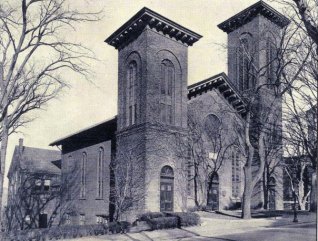
First Presbyterian Church of Yonkers NY, 1964

The benefits are several. Maybe my consciousness does not affect the consciousness of other beings, or in any way affect the suffering they experience. I certainly allow that may be the case. Nonetheless, the practice of thinking kindly toward all other beings works to make me feel happier and kinder; it reminds me of my own and others’ generous spirits. In addition, the practice soothes me both bodily and in my mind. Slow breathing is comforting and relaxing. All kinds of studies show that slow, thoughtful breaths relieve physical stress and mental stress while allowing oxygen to flow freely through the blood. All of that is helpful to the body–and the slow breaths are relaxing enough to get me back to sleep. Which is also, as studies show, quite essential for good health.

~

The night sounds and the changing seasons kindle me to write poems, as well. Sometimes those middle-of-the-night awakenings are charged with inspirations, or snippets of imagery from life or dream.The urge to write differs from the urge to share compassion, but they feel like kinfolk to me. Poetry springs, often, from the feeling of shared struggle.

~

May we make good use of insomnia. May we be free from suffering.

The Protestant in my upbringing says, Amen.


Here we are

I frequently tell my composition students to break the task of academic essay writing into steps that work for them–very Aristotelian of me. Many educated persons were “taught to think” using this method, basically by bundling concepts together into categories. I tell my students that each person may develop a different approach. Sometimes traditional categories don’t work for a particular kind of thoughtful mind.

My own, for example. I have had to study to get to the “rational,” and it intrigues me (science mind! philosophy mind!). But the mythic and the discombobulated and the circuitous: my default consciousness heads into those places when left to wander without a focused task.

A student in my class asked me why I decided to teach college. The funny thing is that it did not feel as though it were a decision on my part. It was a series of steps that seemed unrelated at the time.

One perspective–I graduated with a Philosophy and English bachelor’s degree at the moment of the worst economic period since the Great Depression (the late 1970s). I was a good speller. I got a job proofreading. From there, a series of jobs, and periods without jobs, and marriage and children and a graduate degree and wanting to do a little part time work and teaching poetry workshops in schools…

grassesA

Another perspective–I became entranced with poetry as a young adult. I read and read, and I also wrote; joined a writing critique group when David Dunn shyly invited me to the informal weekly sessions in Brooklyn. Brooklyn was not fashionable then. I had a job that paid my rent, barely. I wrote constantly, and David encouraged me to read aloud. Ariel Dawson encouraged me to submit my work to magazines. Ploddingly, and without much confidence, I followed my friends’ advice. I learned to speak in public, to groups of people who might not always be open to what I had to say. Later, I raised two children. How like teaching these things are…

I was invited to teach. I tried it. There are tasks at which I am more competent, but I get by. Some of my students thank me.

I still prefer tutoring and coaching, working one-to-one with a student, side by side in the task of urging thoughts into clarity in the form of written text. Here I am. The semester has started. Wrench those random ideas into curriculum, work on word order and concise expression. Be with the student where he or she is. Start there. Be confident. The next step will evolve.

A series of seemingly unrelated events, careers, moves, ideas, loves–those are our human foundations.

And here we are.

Untitled-writer

Complexity of perspective

A brief aside in which a contemporary philosopher admits of complexity among humans as social animals and implies (later on, more specifically illustrates) the challenges that individual consciousnesses create in resolving conflicts, or even in making individual decisions as to what is “right.” But what a thrilling capacity, if frustrating to theorists, our multiplicity is:

Human beings are subject to moral and other motivational claims of very different kinds. This is because they are complex creatures who can view the world from many different perspectives–individual, relational, impersonal, idea, etc.–and each perspective presents a different set of claims…The capacity to view the world simultaneously from the point of view of one’s relations to others, from the point of view of one’s life extended through time, from the point of view of everyone at once, and finally from the detached viewpoint often describes as sub specie aeternis is one of the marks of humanity. This complex capacity is an obstacle to simplification.

–Thos. Nagel, “The Fragmentation of Value”

Yes, an obstacle to simplification–but juicy and interesting, which clearly Nagel rather relishes. Viva complexity!

~

For a philosophical discussion particularly pertinent to the US presidential campaign this year, see his “Ruthlessness in Public Life.” Both essays are chapters in Mortal Questions (1979).


On absence

I have experienced a felt absence lately, a sense of missing.

Maybe the world is too much with me. I have responses to the Stanford rape case, responses to the Syrian refugee crisis, to the US presidential campaign, to the mass murder at a gay nightclub in Orlando; responses to some personal challenges, as well–health: my own and loved ones’, among other concerns.

Responding represents the equal and opposite reaction to any action, in a Newtonian metaphor. And what my body and my mind these days are saying to me is “step back, reflect.”

Humans love immediacy–the rapid Twitter argument, the comments on opinion posts, the punch in the gut. Animals need rapid responses in order to negotiate a world of predator and prey; humans, however, (and, more than most of us realize, many other animals) also possess the ability to reflect on what the feelings are. What they may mean. How that meaning may alter our responding mechanisms. We can–if we pause to do so–put ourselves in the place of the Other, imagine different perspectives that may color our responses.

Sometimes, we may need to absent ourselves awhile. To put some distance between our feelings and the conflicts we engage in. We need feelings and we need thoughts, we need responses and we need observation from other viewpoints.

~

It occurs to me that poetry is the conversation between the rational, languaged mind and the mind of feeling and imagery. This effort involves the same mind at work on two or more fronts, the human brain constructed as it is to handle multiple levels of feedback, feedforward, and association.

Poetry isn’t “about emotions.” It’s an art that employs language to represent the tension between the rational and the feeling, the mind’s mighty efforts to engage with the difficult and the heart-stirring.

This is how reading about neuroscience enhances my interpretation and understanding of what poets do. I read difficult books and eschew spending time on the internet. I sit on my back porch and ponder. A buzzard swings to and fro above, gliding on the updrafts. I try to heal myself. I cannot heal the world.


IMG_2288


At sundown

The disintegrating physical and mental situation of an elderly best-beloved recently has led me back (after a brief pause) to readings in neurology and consciousness. It has also led me to reflect on the tasks memory accomplishes for us and how the need to tell a story seems to reside deep in whatever “makes us human.” Many poems, perhaps most of them, are “inspired” by memories and a need to tell. So I will indulge myself by giving a narration here, and perhaps poems will follow later.

paintdaub copy

The best-beloved has been in and out of hospitals, rehabilitation centers, and so-called independent living placement and appears to have developed a very common but not-commonly-talked-about cognitive disarray, or hospital-induced delirium, that medical personnel call “sundowning” when it occurs in Alzheimer’s patients. But my patient does not have Alzheimer’s disease. Her meshing of realities must have been triggered by something else, but the possible factors are many. We may never figure out what it was that pitched her into delusion and lack of compassion, turning her into a person we barely know.

She took good care of her body. At 90, her physical self is in better shape than many people 20 years her junior. Her brain–and hence, her mind–has not stayed as healthy as the rest of her. Several small strokes deep in her brain began to alter not just her gait but her personal focus. Long years of hearing loss no doubt altered how her brain processes input. The reading I have been doing (most recently Carr’s The Shallows, Sacks’ On the Move, and Damasio’s Looking for Spinoza) indicates that the human brain is “plastic” but not necessarily “elastic.” It can modify in response to damage or training, but that does not mean it will spring back to the way it was before. In extreme old age, the process of adaptation slows. The brain becomes less resilient. For reasons no one really understands–a host of possible culprits includes hormones, glutamates, serotonin production, medicines, genetic predispositions, and environmental factors among others (a perfect storm…)–persons who have been sharp and cogent may suddenly experience delusions, often leading to paranoia, confusion, loss of affect, lack of social filters, violent and contrary behavior.

And we ask, “What happened to the soul I love?”

alice-heart1 copy

If we believe in souls, we have faith that somewhere under the changeling is the best-beloved. In flashes, she may return to us. If we believe that the brain is the person, the transition from best-beloved to aggressive complainer is harder to accept. Damasio seems to believe the brain is the person. I find it hard to agree with him fully, though I have been learning a lot about neurology in the process.

Metaphors or analogies for the situation seldom seem, to me, quite to capture the wrenching feeling I have when encountering sundowning. The idea of disintegration seems inappropriate in this case, because she recalls who we are and her mind is not collapsing so much as morphing in unaccountable ways. Threads unraveling? No, not really; the metaphor of a quilt coming undone, maybe, or an intricately-woven tapestry shredded apart–but that’s far too simplistic.

Think of the mind: it encompasses the brain with its regions for motor, somatosensory, auditory, and visual processing; the body, which takes in those physically-produced inputs; memories; thoughts; feelings, which are thoughts spurred by emotions; and a host of complex inter-relationships we cannot even begin to map. Somewhere in all of this is the person, the “self.” At least, as far as we have so far been able to speculate (though not everyone agrees; see my post on Hofstadter & Parfit. Parfit suggests personal identity is an invalid construct).

Perhaps an environmental analogy would suffice, being complex enough for comparison. She is the planet Earth, aging and adaptable, but not endlessly adaptable; her healthy balance has been thrown off by things she may not have had any control over. In whole regions, she becomes inhospitable. Poisoned. Dry. Hot. Overrun with invasives. She seems not to like us anymore, but that is not what’s going on at all. In fact, she’s dying.

Maybe that’s taking the metaphor too far. But in difficult times, one reaches far. There is hope she may recover at least some of her Self, and in the meantime, we have stories in which she plays a role. Mnemosyne–awaken in the consciousness of those who know her. Telling the stories is a step toward letting go.


Jisei

I have been re-reading a lovely anthology called Japanese Death Poems, edited by Yoel Hoffman. I purchased this book years ago when I was immersed in the study of haiku, haibun, and the early Chinese poetry forms and approaches that influenced many Japanese poets. Hoffman’s book offers excellent examples of jisei (poems composed near the moment of death) and his informational text places the poems in the context of various cultural, economic, power, and belief structures.

For a person raised in a contemporary western culture, the concept of death as a constant partner in our consciousness seems–while perhaps obvious–rather uncomfortable. We are not likely to approach our deaths with a sense of acceptance, let alone friendly understanding: “This is how it is.” But the death poems, as I read them, suggest that while death is universal, each person’s awareness of it is unique, even among people in the same culture who may hold similar beliefs.

Jisei intrigue curious folk, because death is A Big Thing to Be Curious About. Digital photographer Hank Frentz, a young artist who’s been inspired by Hoffman’s collection of jisei, has posted a series of mysterious and beautiful photos paired with the death poems, a sample of which can be viewed here. Please follow the link, as his photographs seem to me to be aesthetically and “spiritually” close to the poems he chooses, creating a kind of haiga (俳画) effect.

~~


I have also been revisiting Earl Miner’s translation of Shiki’s brief verse diary, “The Verse Record of My Peonies.” Written in 1899, when Shiki was suffering agonizing pain from spinal tuberculosis (he died in 1902 at the age of 35), the haiku and the prose of the diary recommend the reader to an understanding of physical pain, uncertainty–will I live, or die?–and humor, friendship, grieving. The diary is as layered as a peony blossom; each time I read it, I find something new to contemplate in its few pages: joy, aesthetics, nature, the human body, the solace of friendship and the isolation of illness, the nearness of death, the challenge of uncertainty, the many ways poetry can supply a place or grounding for a person struggling with ambiguities.

Two flakes fall
and the shape of the peonies
is wholly changed.

[tr. Earl Miner]


Composer Libby Larson has used Shiki’s verse diary as a text basis for a 7-minute composition for voice available here.