Source material

Creative writers are often asked where they get their ideas from. In my own case, the answer to that varies a great deal. Sometimes ideas arise from personal experience, of course, but one’s life offers only so much material if you are a relatively staid person like me. Topics for poems can arise from recent headlines or from histories, written or oral; from conversations overheard in a grocery line; from stories other people tell me; from folk tales; from science books; from dreams; from works of art, and numerous other sources. It’s this wide array of possibilities that make the concept of the creative-writing prompt so popular. A quick Google search for “creative writing prompts” offered well over 20+ pages of entries, in several languages.

Photo by Pixabay on Pexels.com

I have written pieces based upon prompts, especially when in a workshop or class, or when I feel rather tapped out of my own imaginative source material. I’m especially fond of writing that stems from viewing or experiencing a work of art–sculpture, painting, musical composition, dance, installation art (ekphrastic poems). Generally speaking, though, that’s not from whence my poems originate.

I can’t really say why I feel an urge to put down in writing specific reflections about something that’s caught my attention–or even what sort of experience evokes my response. Maybe I feel intrigued by an image, a detail, or an ambiguity–a question arises in my mind that I tussle with for awhile. Then, I may compose a draft and let it sit. Two days. Two years. Longer. Lately I’ve been revising some old poems and have realized I no longer recall what their incipience was. Which can be a good thing, because I am no longer wedded to the “reason” I wrote them and can instead consider whether they can be crafted into decent poems.

I am also working on a manuscript that I let sit for at least six years. An idea got into my mind after reading Robert Burton’s 17th-century book on depression, The Anatomy of Melancholy, quite some time ago (2017, perhaps?). I took a stab at writing what seemed to be evolving into a historical fiction story, which is not my usual approach (I have zero practice at plot and dialogue). Then, I stopped. As one does. But the topic lodged in me somewhere, I suppose, and early this year I returned to it. What if, I wondered, the draft could be restructured into a series of prose poems? There might be a sort of hybrid novella-poem in the earlier draft.

That’s more or less what I’m developing, at least for now, and we’ll see what if anything emerges. It’s keeping me interested, which I like, and the experiment feels fresh compared with “writing what I know,” or writing “how” I know. Because yes, of course we ought to write what we know; but we also know about human beings, and we have imaginations, and anything is possible.

By Robert Burton – Burton’s Anatomy of Melancholy, 1628, in the British Library, Public Domain, https://commons.wikimedia.org/w/index.php?curid=84390857

As you wish

Photo by Ahmed u061c on Pexels.com

Discouragement, a regular visitor to this writer (and many other writers), has settled into the house with me. Summer is often, for me, a time of writing less and doing outdoor and social things more; this year, though spring was lovely despite torrents of rain, summer commenced with the deaths of two long-time friends, and I haven’t been able to shake my low mood. Now the rejection slips are arriving thick and fast, and I’m questioning the value of my work in particular and of creative writing in general. Like, why bother? What am I doing this for? For whom? What’s my purpose? And under what circumstances? Why?

Brooding certainly offers no help, nor does it change “declined” to “accepted.” Creative persons often find themselves questioning their pursuits, so I have good company. (Having just about completed the last book of Remembrance of Things Past, I can report that Proust’s narrator–largely a stand-in for Proust himself–wanders in the dark through wartime Paris pondering his own decision to try being a novelist and feels discouragement and doubts aplenty.)

Somewhere on a social media platform, I encountered these words by Virginia Woolf (from “A Room of One’s Own”): “So long as you write what you wish to write, that is all that matters, and whether it matters for ages or only for hours, nobody can say.” Good perspective, that, to stop being concerned for how long your writing matters, or to whom, as long as what you write is what you wish to write. And then if you don’t submit your work for publication? Maybe that is something you can live with. Rather, something I can live with; at this point in my life, I have had hundreds of poems and essays published, six chapbooks, and three poetry collections…maybe from now on, I should write (as I always have) for myself. Even if my work is not in fashion, or considered irrelevant, or judged as potentially lasting, it is still what I wish to write, what I find necessary to express.

Though one does write to express things, and expression seeks audience. That’s a perspective for another day, perhaps. Meanwhile, back to weeding the garden and picking cucumbers, beans, tomatoes, zinnias, and sunflowers.

Blue

At one of our local used book stores,* I found a copy of William Gass’ 1976 On Being Blue: A Philosophical Inquiry. Gass writes in a style one might term prolix; but if you are like me and sometimes appreciate lists, wordplay, allusions, lengthy sentences, and fine distinctions in your sentences–as well as humor–while exploring the limits and the stretches of words and language, this book-length essay on the word/concept/color/iconography/sexual innuendo/moody attitude and conflicting meanings of the word blue might appeal. I’ve been feeling a bit on the blue side lately, hence my attraction to the book (though I do like Gass as a writer, as long as I don’t have to read too much of him at one time). And guess? It cheered me! [I will caution the reader who avoids the use of “bad language” that Gass employs such words in this essay, for purely intellectual reasons…]

Granted, my feeling blue has a different tone from other uses of the word: blue postcards, sexual meanings of blue–I’m reminded of the movie “I Am Curious (Blue)” which was considered racy and given an X rating when I was a kid, though the blue in that title referred to the Swedish flag, apparently. My blue is the blue of songs like “Baby’s in Black” or Joni Mitchell’s “Blue” album. Or just that classic music form, the blues.

And I’ll get over feeling this way. That’s what moods are: feelings that come and go, transitory. It always seems as though low moods stay around longer than neutral or cheerful ones, but many scientific studies show that it is our perception and memory of the negatives that make us think we are sadder for longer. Even Wikipedia has an entry on negativity bias, with some sources if you want to check things out yourself. As I age, I realize that bad moods and sad events and past mistakes don’t need to stick around as much as I used to think. A bit of mediation, some practice and readings in Zen and in psychology, a lengthening perspective on life’s vicissitudes, some counseling and even some medicine; whatever it is that’s brought me here, I recognize that before long the depressive hours will lift. Also I know some methods of thinking that assist me to move to more neutral ground.

I will note there are many kinds and hues of blue, enough for Gass to write 112 pages on it and for the word to appear in 85 files of my own poetry during the past 12 years–I did a quick word search just to find out. That is in the files alone, and each file contains many poems. so I can only imagine how much I have over-used the word in my writing life! Certainly, not all of those blues are sad. Many are beautiful, sunny, the blues of blueberries and balloon flowers, the New Mexico sky, mountains and oceans; teal-blues and turquoise, the bright royal blue I like to wear, the pale color of robin’s eggs.

Blue. It has always been my favorite color.

~~

*The bookstore is Apport, in Emmaus, PA. Ben has an active Instagram feed and really cool catalogues of odd books, art, and ephemera.

*The first “blue” above is an encaustic painting by Deborah Barlow; the second is at Bandolier National Monument; the third is of the Blue Ridge Mountains; the last was taken at an inlet bay, maybe in Delaware–I’ve forgotten.

Drying up

….and the drought continues into mid-November. This is a very long stretch of dry weather, and the rivers I’ve crossed recently–the Delaware, the Schuylkill, the Lehigh, the Susquehanna–are looking mighty low. Little islands are showing up in the center of the riverbeds. Tree roots visible along the banks. I found this government website that filled me in concerning the current situation. Looking at the charts, wow.

My low mood continues, for a number of reasons: the recent political news, the continuing wars, my mother’s consistent decline, the drought, my physical distance from my grown children on the other side of the continent, a friend’s death, a bunch of recent poetry rejections, the fact that I can’t go into a store without hearing Christmas music…granted, some of these reasons are not earth-shattering but the effect is, well, cumulative. Han VanderHart’s recent blog post speaks to the rejection, reminding me of things I know and should keep in mind. The challenge is just getting through and occasionally finding delights at which to marvel, for the delights surely endure. Ross Gay’s Book of Delights is my book group’s next selection, a book I’ve read before but which–at this particular moment–will probably benefit me when I re-read it.

I also feel creatively dried-up, and that’s dismaying. Reading novels (see my last post) offers peasant distraction but seldom gets me writing my own work. I’ll never be a novelist. I’ve been reading poetry, online and in books, as I always do; yet right now, the poems I have been reading, no matter how wonderful, have not inspired me to work on my own.

I’m not even revising! This is not my usual self, not my poetry “norm,” not a space in which I feel happy or well-regulated or at least inspired. Perhaps I have encountered the dreaded writer’s block. Or rather, a drought of some kind, an inner sluggishness of the imaginative flow. Despite the glorious stretch of sunny days and moonlit nights, the incessant blue sky reminiscent of those high-altitude desert environments I seem to love, despite these delights, I’m discontented.

How very human of me.

Listen, there’s a trio of redtail hawks along the woodlot. Their nasal “screeee” and their graceful swoops between the bare branches catch my attention. Sunlight on the field tells me, “You could at least get outside and take a walk.” Okay. Can do.

Poetry mentor: Chris Peditto

I moved to Philadelphia’s suburbs in 1982 because I needed a place to live, and my folks had a spare room. I was job-hunting and did not know anyone locally, so I sought out poetry events in the city–and there were more than I expected to find. Chris Peditto was one of the first people I met, and he was unfailingly generous about introducing me to reading venues and even driving me around sometimes when, as often happened in Philadelphia, public transportation did not exist between where I was and where things were happening.

Chris was natured like that, helpful in a mentoring way. He’d open up a few doors, drop the name of a literary journal I might want to look into or a poet I might want to read, and then leave the rest up to me. Sometimes, I needed a little more motivation–especially in those days, when I was pretty dragged down by depression. Chris nudged me into involvement with the Open Mouth Poetry Series of readings, which had aspects of critique, editorial decisions, publicity (for poetry events) and which eventually branched out to a xerox-zine and a paperback anthology. He liked my work and was happy to get me to rub elbows with the artistic, musical, literary folks in Center City and beyond. His encouragement meant more than I think I realized at the time.

It was Chris who introduced me to Rosemary Cappello and to too many poets, artists, and musicians to name in a blog post. Suffice it to say I remain grateful. He may not have thought of himself as a poetry mentor; but much of the confidence I now have in my ability to analyze my own work and the work of others, and much of my confidence in public performance, stems from those days in my early 20s–and he played a significant role.

But then, Chris understood poetry mentorship. He actively looked for it! I enjoyed his tales about leaving South Jersey for New York City as often as possible, even when he was only 16 or 17, and hanging about the haunts of Beat Poets until he finally managed to meet the last of the stragglers who hadn’t died or moved to California and beyond. He had some great Gregory Corso stories, Etheridge Knight stories, among others–and some rather alarming ones as well; I just loved that as a boy he had so much persistence. He emulated the Beat genre in poetry even when he didn’t completely embrace the Beat lifestyle (there may have been a bit of emulation there, as well…but Chris didn’t end up on Skid Row). I know he omitted a few incidents to keep conversations more tightly focused on writing and less on the lives of writers. To him, it is the writing that matters.

Though his prose ultimately received more notice and publication–reviews, literary analysis, short fiction, academic work on Italian-American authors, even a piece or two on pedagogy–Chris wrote poems and, more than that, loved to read poetry of practically all kinds. He was also an excellent educator and earned achievements for his work once he moved to North LA in the early 1990s. I am certain he became a mentor to many other people–not just writers. I was honored to be his friend and snail-mail correspondent for many years and felt the loss of his kind and encouraging presence keenly when he died in 2013.

~

Three mentors–none of them “famous,” all of them crucial to my development as a poet: they took my work, and my person, seriously. They listened critically and spoke to me encouragingly and listened. I think that’s what makes a person mentor material.

In later years, there have certainly been others who have been guides, coaches, teachers, mentors, friends-in-poetry…some of them better-known than Ariel, David, or Chris. But these three, all of whom are no longer walking about on the earthly plane, gave me so much more than I ever thanked them for. Which is why I’m doing so now.

Poetry mentor: david dunn

Where do I start? With a winter solstice poetry reading in Brooklyn, in a dark room on a dark night; his poem evoking a Di Chirico painting made my head explode, the work was so much more interesting than anyone else’s. But we didn’t speak that night. I met David before the equinox the following year, at a critique workshop run by the people who had set up the solstice reading: Merle Molofsky and Les von Losberg.

David didn’t have a presence; he was a presence. He read in a growl, with a slight lisp and a Brooklyn accent, and he could quiet a room. The poems were not lyrical or narrative, nor formal, nor confessional–they were jazz-like, full of strange images that sounded like surrealism and yet were not. He wrote prose poems and free verse and tiny little aphoristic pieces that sometimes made me laugh and sometimes broke my heart. He was not famous. He had not studied with well-known poets. But he had much to teach me, I thought, from the first time we sat around a table and read our work to one another.

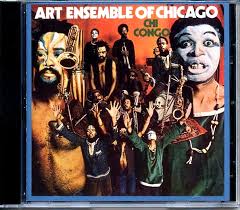
I found I listened more closely to David’s responses to my work than I did to other participants’, though as a fairly novice writer, I valued any critique. I liked that he often mentioned the work of poets he’d been reading, talked about their approaches and influences on his work. We started going to Gotham Book Mart together, searching the poetry stacks to score exciting contemporary writers and out-of-print classic collections. He told me to read Stanley Kunitz and James Lowell, Faye Kicknosway, Denise Levertov, Gerard Manley Hopkins. He had me listening to avant garde jazz, which I’d been introduced to in college thanks to a friend who was into Anthony Braxton and Dave Holland, and expanded my listening to include Don Cherry, the Chicago Art Ensemble, Albert Ayler, and many others.

His analysis of what was working in my poems, and what could work better, helped me to learn how to revise and rethink my work on my own. I gained a bit of confidence in my ability to figure out what sounded clunky, or wordy, or slightly “off.” He taught me not to be so hard on myself and to feel okay with putting a poem away for awhile–or forever–and letting the piece settle down so that, later, I could read it again and review its problematic areas less emotionally. He made me believe that my writing was worth reading, and that I was really a writer. Really. Not just faking it. In so many ways, he mentored me and my poetry. David encouraged me to submit to magazines and to let the rejections happen without feeling doubt about the value of the work. Although the value of that early work was…probably questionable, we’d look at the rejected pieces again and decide whether further revision might be needed or just a different reviewing editor!

As we got to know one another better, I learned about the challenges of his growing-up years, when he lived with his mother behind his grandmother’s millinery shop while his father was in prison for treason, in the US–following two years in a Chinese prison in Korea as a POW. Gradually, I heard about his dad’s release and inability to re-enter society, his parents’ divorce, his mom’s remarriage to a decent man who loved music but whose son, David’s step-brother, struggled with mental illness and died in a suspicious fire when David was about 20 years old. David’s outlier personality, his temper, his size–he was a large man who had been a fat boy, teased and bullied–found release and love through music, poetry, and dogs.

Also baseball, boxing, Star Trek…but we talked about those less often

posthumous poetry collection by david dunn

The other thing we conversed about frequently was frame of mind, particularly depression. Both of us were visited by depression frequently when we were in our 20s and 30s, and it was such a boon to have someone I loved and trusted who understood the “mood” and what a toll it could take on everyday life. When I married and had children, the need to feel less depressed got me to more reliable psych care–and I had better health insurance than David did. Sometimes he was chronically short of income, laid off, on unemployment, taking jobs in record stores, borrowing from his folks. He went a couple of years without health insurance or reliable health care, even though he was diabetic. So getting good therapeutic assistance for his chronic depression fell to a low priority, unfortunately. I tried to be there to listen to him, however, and he was always there to listen to me. We gave one another comfort during the doldrums, lassitude, and weird loneliness depression inflicts. And we reminded one another to write!

I miss him almost every day, though he died back in 1999. My book Water-Rites contains a section devoted to him and tries to convey the devastation I felt at losing him.

But you never really lose a mentor, right? They are always with us/in us.

Revision practice

It is National Poetry Month again, and this year, in recognition of the celebration, I have started a practice to experiment with, just out of curiosity and to give myself a nudge. Many of my poetry colleagues invest a month in writing a poem a day or reading a poetry book each week or posting a poem daily on their social media platforms. It’s important to remind ourselves why we treasure and delight in poetry.

I chose a simple project that requires frequent re-imagining/re-imaging. For my starting point, I picked a poem at random from a collection of Fernando Pessoa’s work. I copied the poem, by hand, into my journal and re-read it a few times. Then I turned the page and rewrote it, “revising” it in the way I might revise a poem of my own. My plan is to repeat this process after a day or so, each time revising from the most recent version. In a short time, the poem will have moved away from being Pessoa’s piece–perhaps bearing little to no resemblance to the original…a sort of whisper-down-the-lane approach. The intention is to consciously alter image and voice in each re-imagining of the draft, though I’m not sure how well I can hew to my intentions. We shall see.

from City Lights Books.

Why I decided on Pessoa for this project, I don’t really know; but I think there’s something perfect about using one of his pieces as springboard. Because Pessoa was kind of a springboard for himself–he created several writer-selves who wrote poems and critical prose: heteronyms, he termed them. The poem I used was “by” his persona named Ricardo Reis. Adam Kirsch wrote a good introduction to Pessoa’s peculiar obsession with being a non-person in a 2017 New Yorker article. By revising something by Pessoa in my own voice and through my own images, perhaps I nurture his pursuit of dissolving the self.

It occurs to me now that the poems of several contemporary writers may have induced me to try this writing prompt, most recently Daisy Fried in The Year the City Emptied (which I highly recommend). Her collection consists of “loose translations” of Baudelaire, reimagined in Philadelphia during the covid outbreak while her husband was dying. It’s not a cheerful read–but then, neither is Baudelaire–nevertheless, the resulting poems are powerful and vividly interesting.

So, back to my little project for April: I figure this need not be a daily practice, though I have managed to get to revision three by now–so it is moving apace. The deepest challenge is not the revision, as I enjoy revising and wish I had more time and energy for it. The challenge is just that: time and energy! As the semester sidles past mid-terms into the final stretch, I get busier at work; in addition, my chronic health conditions have moved into a frustrating flare lately, leaving me fatigued and feeling as though my brain were swaddled in cottonwool and embroidery floss. The news from Ukraine drags on sadly in the background of my day-to-day. My mother’s aphasia worsens. I am dealing by plodding away, sometimes without much brilliance, at the revision challenge. Also by watching the goldfinches as they molt into their yellow plumage… and urging my tomato seedlings to flourish in their little indoor pots.

Then I pluck daffodils and set them in vases. There’s nothing like fresh flowers on the dining table to cheer a low mood. Onward to revision four…

~

daffodil photo Ann E. Michael

Acedia

While sorting through my work, I found a poem titled “Acedia,” and I have been musing on the concept again. The poem (below) referred, when I wrote it, to a kind of numb depressive state. In contemporary English, the term means boredom, ennui, apathy–with connotations of a spiritual aspect to the torpor. PsyWeb says, “Acedia refers to a failure of will to control one’s longings or reactions to daily life, while depression is considered a medical condition or a failure of the body.”

Doing a bit of research into the etymology and history of the word took me to the Desert Fathers, Christian hermits in the early centuries of the faith. Acedia referred very specifically to a kind of spiritual laziness. Here’s a little tour of the history by Kelsey Kennedy on Atlas Obscura:

Evagrius was a member of the Desert Fathers and Mothers, a group of devout Christian monks and hermits who lived in the Egyptian desert beginning in the third century. By the time Evagrius joined their ranks in the late 300s, there were several thousand monks living in organized communities. They spent their days fasting, working, and worshiping, often in isolation. When the sun and the heat peaked, life could be quite uncomfortable. So it makes sense that Evagrius dubbed acedia the “demon of noontide,” a reference to Psalm 91. Siegfried Wenzel, in his book The Sin of Sloth: Acedia in Medieval Thought and Literature, wrote that “in the end acedia causes the monk to either give in to physical sleep, which proves unrefreshing or actually dangerous because it opens the door to many other temptations, or to leave his cell and eventually the religious life altogether.” Acedia could be resisted, but only through endurance, prayer, and sometimes even crying.

John Cassian, a student of Evagrius’s…helped spread the concept of the cardinal sins beyond the Desert Fathers. But as soon as acedia left the desert, the demon of noontide started to become a whole different animal.

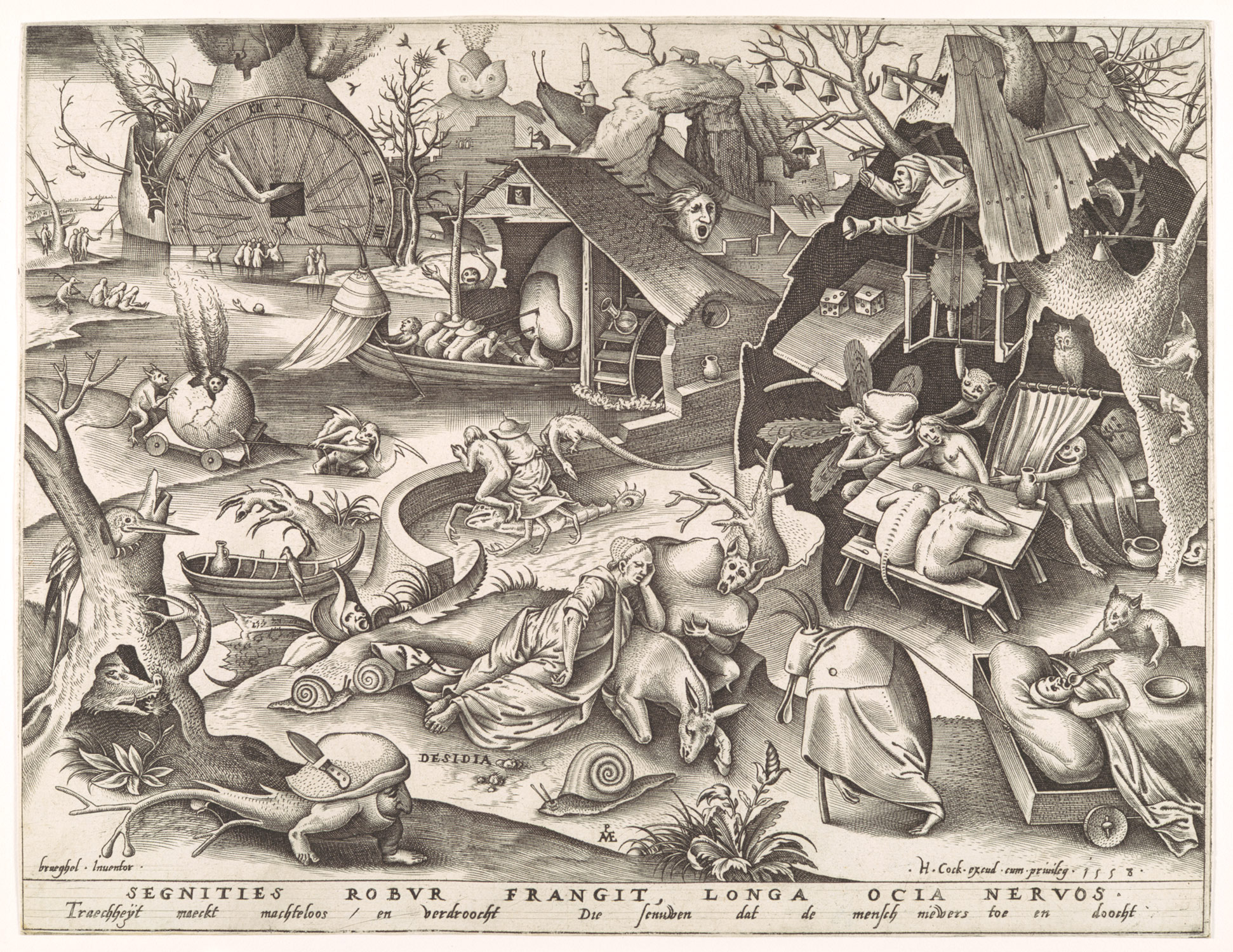
What it became was the cardinal sin of Sloth. But Despair continued to be viewed as dangerously heretical, because it led to suicidal thinking (and suicide was until recently classed as one of the mortal sins).

Thomas Merton, in his book Thoughts in Solitude, supports (without quite saying so) the Roman Catholic view that despair is a sin; but, as is usual for Merton, he frames the depression experience with compassion and offers a gentler perception of the experience. He suggests that when a person believes of him or herself “I am nothing,” there is another way of being with that thought: “I am not who I wish to be.”

This concept strikes me as so perfectly sane. When I have felt deeply depressed, the ingrained mind-numbing idea that surfaces is that I am worthless or that I am nothing. And really, what I feel is that I am not who I wish to be.

Why does the latter sentence feel less like despair? Anyway, it feels that way to me. Thank you, Thomas Merton.

Now here’s the poem in its revised-draft form, though I’m not sure it’s really finished yet.

~~

Acedia

It is what looked up at you
from the eyes of the wounded doe
what the clock said to itself
when the mainspring gave way.

It is the last few shudders
your father’s body made
when his heart wrote hopeless
on the hospital bed

the long sigh of a black dog
and your beloved’s parched skin
when she could make no more tears
and told you go now.

It is the dead nut
in the infertile basalt cave
it is all the days I tell you I can’t
but you are right

there is desire.
The numb body’s in-taken breath
yearning to stay alive:
remind me that it is desire.

~


Friendships

April: a busy time. During my busy times at work or on the home front, I often spend less time with my friends.

The best thing about that is: my friends understand. They will still be there when I crawl out from under whatever has me crushed for time, whether it’s illness, job stress, time-consuming family-related challenges, home maintenance, garden or lawn work, travel, or depression.

[insert here, me, waving to my friends!]

Social media is no substitute, although I confess to using it to keep connections with those I care about. Social media, for example, has been significant in helping me to stay in touch with poetry colleagues; but much as I admire and learn from other writers, they play different roles in my life than friends do. Also, even from the beginning of my Facebook use, I knew the platform essentially was a “me and those like me” social bubble.

The specter of “us vs. them” has raised its snarling head on social media sites ever since the early days of chat rooms. There’s a reason for that, and Natalie Angier of The New York Times reports on some recent findings in this article:


~

Meanwhile, on the “unalloyed good” side of friendship–The real friend listens, gets busy herself, drops a line now and then if I’ve been absent for awhile, and drops everything if I find myself in difficulties and ask for help.

She or he also shares my brainwaves, apparently–and not just metaphorically! The studies Angier writes about in the article below offer some really intriguing possibilities about human beings as social animals and how our brains work. PubMed.gov lists a large number of research articles that examine the topic of health, neuroscience, and sociability; the interconnectedness strikes me as relevant and fascinating.


~

Boy, do I love neuroscience! This work synthesizes physical actuality with metaphorical possibilities in ways that inspire me.

Probably, there will be poems. Meanwhile, if you want to watch some brain functions in action, some cool animations: http://www.neuroplastix.com/styled-99/therapeuticanimations.html


Love & reflection

alice-heart1 copy

We express love because the gratification of love is enormous, and we continue to express love and to act protectively because the loss of love is traumatic. If we did not experience pain on the demise of those we love, if we had the pleasure of love but felt nothing when the object of our love is destroyed, we would be considerably less protective than we are.

It may also be that the very structure if consciousness opens the pathway to depression…To give up the essential conflict between what we feel like doing and what we do, to end the dark moods that reflect that conflict and its difficulties–this is to give up what it is to be human, of what is good in being human.

–Andrew Solomon, The Noonday Demon: An Atlas of Depression.

Reflection is a sign of consciousness, the ability to take in information and observe how it feels to be oneself in the face of that information, and to assess the impact of behaviors and actions and catastrophes and deaths. Socrates, the irritating questioner, required of human beings that capacity of reflectiveness. Solomon suggests this reflective ability is natural to people who undergo a depressive episode: “The unexamined life is unavailable to the depressed.” (italics mine)

Yet it is also this reflective consciousness which permits recovery among those who’ve been in the abyss, and sometimes a kind of bounce into remission/relief. Solomon adds that “[p]eople who have been through a depression and stabilized often have a heightened awareness of the joyfulness of everyday existence. They have a capacity for a kind of ready ecstasy and for an intense appreciation of all that is good in their life.”

That sense of “ready ecstasy” often acts as the impetus for poetry, in my experience. I am not sure that joyful awareness was worth the pain and despair–couldn’t I have just achieved heightened awareness through, say, meditation, song, or religion? Nonetheless, if I can craft a relationship with depression that is not a destabilizing battle, that’s enough for me. The recognition of joy and the critical thinking that reflection deepens in my consciousness keep me striving.

Yesterday morning, early, in the long grass, the three-legged doe gave birth to a fawn. I watched as they emerged from the meadow and headed for the woodlot together, mama still licking the little one.

Earth delivers ecstasies readily, if only we will observe.

ann e michael