Systems

[I am aware that human hair isn’t good nesting material]

Late autumn reveals
oriole’s purse-like nest
constructed of my daughter’s hair.
Breeze touches
what I cannot.
(November 2010)


~

I found this tanka-like poem, written when my daughter was away at college, among some old computer-based file folders I’ve been organizing. It’s one of many old poems of mine I’ve ‘rediscovered’ in the process of trying to keep my poetry systematized. Before I left my job at the university, I imagined that I would manage to organize and update my creative work files during the first year of retirement and keep everything in reasonable order once I had established a system. As if.

It’s not as though I haven’t made progress, made some brave efforts in the direction of archive and revision, culling and filing my drafts and “finished” poems (efforts that are both electronic and paper-based). The fact remains, however, that I do not possess the kind of mind that solves the keeping-track aspects of life very systematically; and, as writing remains a significant part of my life, it suffers from the same inefficiency. I admire artistically-minded people who can keep track of their work using logistically-useful methods that work for them. I’ve read their tips, their essays, talked to them about their systems, tried emulating them. Sometimes parts of their methods are helpful to me, but I lack something. Rigor? Ambition? Energy? The desire to spend the time required?

I keep writing, but I also keep falling behind at staying organized. And then there is the issue of technology constantly updating, so that a method I used in, say, 2015 is not available anymore…unless I invent a bunch of work-arounds. (My long-standing backup method is PAPER, and I still employ it, but I hate file cabinets and folders and don’t use them.) As for spreadsheets? I avoided learning to set them up during my entire career in academia because our department had a brilliantly capable office assistant who did that stuff for us, bless her heart.

All of which means that now and then I cannot locate a draft, a poem I want to revise or to send to a friend, or consider putting into a manuscript. Frustrating. And when I bought a new laptop, I had to decide what files to move from my old desktop; how far back do I want to go? Those poems from 1987, for example–eons ago, as far as computer system lifespans. Yes, I have hard copy from dot-matrix printers. Files originally in AppleWorks and Claris, files that lived on 3.5″ floppy disks. Copies I typed out on various typewriters through the years! Although I’m complaining about it, I realize that in some ways it’s really cool that my poems have undergone so many iterations in terms of tech. It means I have been around awhile and confirms the reasons I think of myself as a writer…and not as an efficiency expert.

~

P. S. I continue to write my drafts with a pen.

Illusions, connections

Reading Proust again returned me to some of my own past reflections on memory and self, the capital-S Self. A decade or so ago I spent considerable time reading in philosophy, physics, and neuroscience in an endeavor to get a grip on human consciousness and, perhaps, behavior. I posted about some of these texts on this here blog, in between writing about poetry, the garden, and my teaching job. Recent coincidences of reading returned me to this topic, “the hard problem of consciousness,” and made me consider how our embodied selves/minds/awareness: use shortcuts to manage the overwhelming inputs of our environments; define who we are using subjective if physically-based perceptions; and fail to see the obvious because of habituation and the apparent need to confirm what we believe we know. Illusions! The Vedic concept of Māyā, Plato’s Theory of Forms…propaganda, Penn & Teller, quantum physics, complexity theory, Marcel Proust, complementarity. I have a lot on my mind.

If it IS on (or in) “my” “mind.” For there’s even some question about that, as proposed by Neil Theise in his book Notes on Complexity. Just as light can be a wave or a particle, depending upon perspective and viewer (see: complementarity), it’s possible that our minds or selves can be individual and separate but also connected and boundary-less. The subtitle of this text is what appealed to me: “A Scientific Theory of Connection, Consciousness, and Being;” so far, I’m enjoying it and finding inspiration.

It’s needed, inspiration. Despite a few plunges into new drafts (see here), I have not been writing much for at least two months, and I miss it. The ideas from physics and neuroscience that intrigue me include potential metaphors and terms such as quenched disorder, endosymbiosis theory, and holarchy. These–along with the hard problem of consciousness–all have some relationship to complexity theory, and Theise does an elegant job of writing about complicated science concepts for the non-expert.

I ran across Notes on Complexity right after finishing Sleights of Mind, a book about the neuroscience behind the sort of illusion we call entertainment magic: sleight of hand, sawing people in two, mentalist “mind-reading,” and other performances; the authors, Susana Martinez-Conde, Stephen Macknik, and Sandra Blakeslee, are trying to discover more about how brains work (or filter, and sometimes don’t work so well) by studying how we get fooled by illusionists. This is a fun book, even more fun for me because one of my Best Beloveds has long been an enthusiast of magic shows and magicians. Martinez-Conde and Macknik are neurologists, so–unlike Theise’s text–this book is very body-mechanics in its basis. Their work reminded me of how amazing the human physiological system is. And it’s entertaining.

Before these non-fiction reads, I was finishing up with Proust who, in his own creative way, was exploring the interiority of the human self and carefully observing human interactions, behaviors, assumptions, prejudices, and aesthetics. Not neuroscience, because there is no science to it, but definitely related to how our brains and bodies process experience. My sense is that poetry works that that way for me: it’s not an abstract stream of thought but something inextricable from bodily experience, maybe even, through the environment in which we exist, something deeply connected to everything, a global being-there.

The way we process experience (and is this consciousness?) is largely what leads us to the arts, to make art or to appreciate it, and to decide what feels compelling, important, beautiful. And it’s not all in our heads.

As you wish

Photo by Ahmed u061c on Pexels.com

Discouragement, a regular visitor to this writer (and many other writers), has settled into the house with me. Summer is often, for me, a time of writing less and doing outdoor and social things more; this year, though spring was lovely despite torrents of rain, summer commenced with the deaths of two long-time friends, and I haven’t been able to shake my low mood. Now the rejection slips are arriving thick and fast, and I’m questioning the value of my work in particular and of creative writing in general. Like, why bother? What am I doing this for? For whom? What’s my purpose? And under what circumstances? Why?

Brooding certainly offers no help, nor does it change “declined” to “accepted.” Creative persons often find themselves questioning their pursuits, so I have good company. (Having just about completed the last book of Remembrance of Things Past, I can report that Proust’s narrator–largely a stand-in for Proust himself–wanders in the dark through wartime Paris pondering his own decision to try being a novelist and feels discouragement and doubts aplenty.)

Somewhere on a social media platform, I encountered these words by Virginia Woolf (from “A Room of One’s Own”): “So long as you write what you wish to write, that is all that matters, and whether it matters for ages or only for hours, nobody can say.” Good perspective, that, to stop being concerned for how long your writing matters, or to whom, as long as what you write is what you wish to write. And then if you don’t submit your work for publication? Maybe that is something you can live with. Rather, something I can live with; at this point in my life, I have had hundreds of poems and essays published, six chapbooks, and three poetry collections…maybe from now on, I should write (as I always have) for myself. Even if my work is not in fashion, or considered irrelevant, or judged as potentially lasting, it is still what I wish to write, what I find necessary to express.

Though one does write to express things, and expression seeks audience. That’s a perspective for another day, perhaps. Meanwhile, back to weeding the garden and picking cucumbers, beans, tomatoes, zinnias, and sunflowers.

Blackberries

[note] *Hmmm. Somehow, I backposted this post. It was written June 23rd, post-solstice!

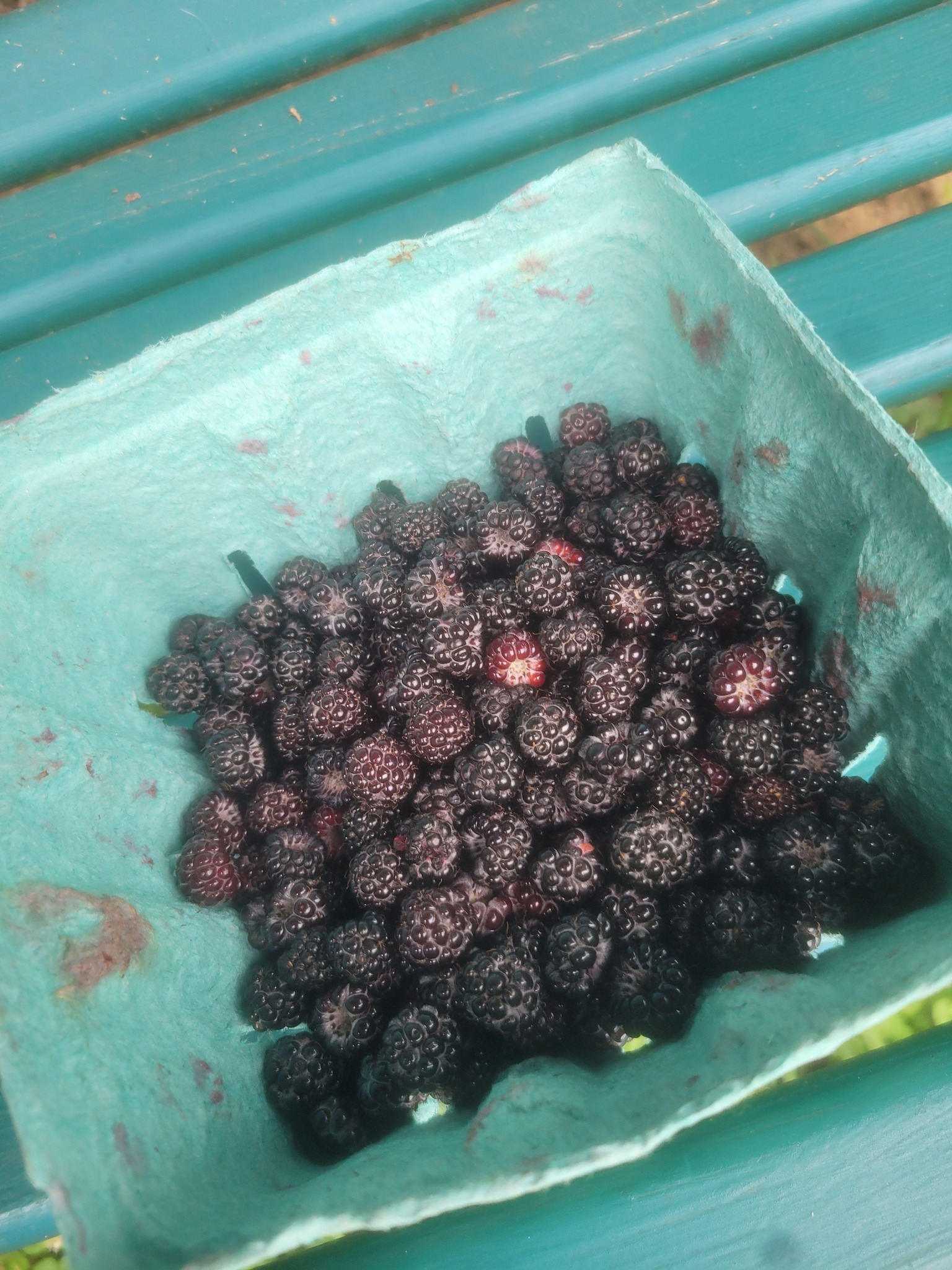
Actually, they’re wild black raspberries, someone informed me. They usually ripen around the end of June, and everything eats them–orioles, robins, catbirds, deer, possums, raccoons, possibly even foxes. Black bears, if they’re in the vicinity, though we haven’t seen one here.

Humans enjoy eating them, too. Usually I don’t get more than a few for yogurt or ice cream toppings, but this year–a bonanza. Maybe the canes liked all that rain. Harvesting them is quite a task, because the canes are in the hedgerow thicket and twined about with poison ivy and cat’s-claw and other spiky and rashy flora, not to mention the thorns of the berry canes themselves. And harvesting comes as the hot, humid weather descends on this valley, making the effort a sweaty and uncomfortable one. I always think of farm workers, almost all of them immigrants, who get hired to do this sort of work–the vital work no one else wants to do. They deserve better pay and considerably more compassion than they generally receive. Half a quart of blackberries cost me half an hour of sweat, many scratches, and a swath of dermatitis; but, like Flopsy, Mopsy, and Cottontail, I had bread and milk and blackberries, (for breakfast).

Current mood: harrowing. Aghast. These two poems, though I wrote them many years ago, seem apropos to the moment.

~

Like Thumbelina

Where there’s green foliage
so dense my eyes ache
I spend an hour in shade
snacking on blackberries
the birds haven’t found.
My head hurts from the agonies
of money. The cell phone rings.
Ferns and five-leaf vines
muffle street sounds,
a little colony of feathery mosses
sits under a tree-burl shelf.
I find a hole pressed snugly
against old roots and leaf-mulch.
Like Thumbelina,
I want to curl myself inside
a sassafras leaf, sleep
beneath a toadstool
undiscovered,
unmolested,
temporarily free.

~~
Thicket

Behold the thicket:
it is deep with brambles.
It is blackberries in July,
wineberries in August.
Move, and the thicket
impedes you, catches
your sleeve,
plucks you awake.
The bee is here. The spider.
The thicket is alive, and crawling.
Green with jewelweed to salve
rashes from the thicket’s
poison ivy. Green with prickly
horsenettle, coarse pokeberry,
the brilliant, twining nightshade:
thickets sweat poisons
as well as fruits.
I have brought you here to show
that you can never get through,
not unscathed, not without
brutality of some kind,
the saw, machete, knife.
This tangle no amount of patience
will ever undo—
it will overtake you,
grow into your hair,
invite warblers in to nest,
spiders to unfurl their orbs.
You must learn not to hate
before entering the thicket;
you must acknowledge all its ways
to understand its wild embrace.


Back in PA

Last year at this time, I had covid and was languishing in bed, unable to tend to the garden. A regional drought meant I really should have been watering the new plants; and it also kept the weeds firmly rooted, fighting for dominance in the vegetable patch. This year, I timed a trip to New Mexico just when I ought to have been harvesting spinach and planting out tomatoes, beans, and squash. Oops. And then it rained buckets the whole time I was away (much-needed rain, but…). Therefore, the garden situation was not ideal. But garden situations seldom are ideal because Nature does its own thing regardless of my plans.

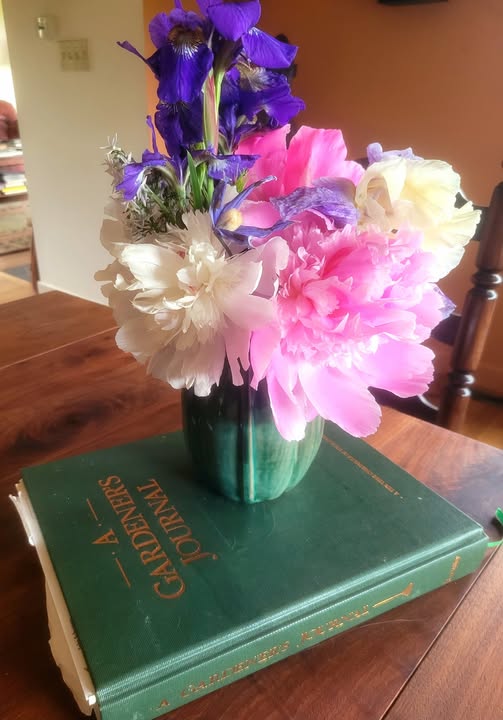
At any rate, eastern Pennsylvania finally moderated its weather enough that I got the weeds and the seeds and transplants more or less under control this past week–“control” being a general term subject to, well, Nature. The peonies bloomed gorgeously on schedule, as did the nefarious multiflora roses and Russian olives that plague the hedgerow. The catbirds and Eastern kingbirds are back; the robins’ first brood has hatched; the orioles are insistent in the walnut trees and brilliant in the garden, chasing the barn swallows. I’m not doing much writing, though I drafted one or two beginnings of poems. Outdoors takes precedence–not that I can’t write out of doors, I often do so. But poems can wait in a way the garden cannot.

And, speaking of poems (and Pennsylvania), I returned from my trip to find this Keystone Poetry anthology awaiting: https://www.psupress.org/books/titles/978-0-271-09990-3.html–the followup to 2005’s Common Wealth anthology, also edited by Marjorie Maddox and Jerry Wemple.

The new anthology, 20 years after the initial one, has poems by about 180 poets–yes, I am one of them–covering the corners and the center of the Keystone State. I like it even better than the first collection, and it is clear the editors learned much from the experience of curating poems and creating a cohesive “experience” of the regions. Granted, since I know both of the editors personally and appreciate their poetry and their visions, I may be biased. But that’s okay. Objectively, I truly get how huge an undertaking this was and how well it has turned out. For educators, there is a section at the close of the anthology full of suggestions for reading, writing critically, and writing creatively based on this anthology, and even in comparison with the previous one. As both editors are college professors who teach creative writing and critical writing, these appendices are well-thought out and worthwhile.

I miss the aridity of New Mexico, which seems to benefit my overall health. And I miss my daughter immensely. But springtime in eastern PA has many compensations, not the least of which are blooming even as I write.

Changes & alterations

We built our house here about three decades ago. At the time, I was young and excited about landscaping the place; although I had been growing our own vegetables for years by then, I was fairly new to ornamental gardening. I made mistakes; I underestimated the speed at which shrubs and trees grow; I thought I could keep a handle on invasive species; the world of various bark beetles and aggressive vines was new to me; and I had no idea how hard it would be to manage almost seven acres without, say, a team of landscapers.

Or how rapidly an environment alters when the climate changes, and when cornfields and early-growth wooded areas become housing developments, parking lots, and streets. I have learned a great deal and much looks different now than thirty years ago, but the swallows still return to my garden between April 26 and May 6. My land contains fewer efts in May than it used to, but the gray frogs, spring peepers, wood frogs, and toads make their usual frenzied chorus at mating time each spring.

~

Recent changes have come from the emerald ash borer, which has decimated, or worse, the green ash native to this valley. The huge trees have come crashing down during the past 10 years, making hard work for us even if it does provide a bit of firewood. Cutting, splitting, stacking hardwood isn’t a task I’m much good at anymore. Thirty years ago, maybe…and there does not seem to be any good that comes of this tree loss, which I’ve been mourning each year as we have less and less of a woodlot treeline above the hedgerow and see more and more of the neighboring subdivision.

But on my damp, early-morning walk today, I perceived some changes that I should have expected and that offer a glimmer of hope for native trees and shrubs–despite the proliferation of Russian olive, multiflora rose, Amur honeysuckle, mugwort, wintercreeper, Asiatic bittersweet, mile-a-minute weed, and more colonizing invaders than I can tick off in one blog post. There, beside the tractor path, along the edges of the hedgerow (for edges are where things happen most quickly), I observed more tree saplings than in past years. With the vase-shaped, leafy arcs of green ash absent, sun reaches further through the thickets. And there I spot horse chestnuts starting to push up, tiny walnut trees, oak trees of differing species, “baby” hickories and maple varieties, along with understory’s smaller shrubs and trees like amelanchier, ironwood, redbud, buckeyes.

Granted, most of them won’t survive to maturity, but some of them will–gradually re-making the woodlot unless other disturbances undo the renewal.

I won’t be here in another 30 years to find out, but I find hope in these saplings. I’m also happy to see that the little woodland and field wildflowers such as false Solomon’s seal, jack-in-the-pulpit, wild violets, and mayapples remain. And though I find myself swearing inwardly at the way the Russian olives grow massive along the property line and the invasive bittersweet sends thick tendrils coiling up into the trees, it’s not the fault of the plants that they got here. Humans brought them to North America, and the plants–like European colonists–became a bit too successful in their new homes, pushing out what was here before their arrival. Am I any different, really, than the dandelion or the honeybee? My ancestors came to these shores not so long after those species were imported with earlier “settlers.”

~

The rain we’ve been getting means I haven’t been out weeding in the vegetable garden. After I take my walks, I come inside to dry off and do household chores, or make soup, or work a little on my poetry. I feel excited by a little writing project I have recently given myself, and I’ve also been playing around with drafting prose poems. Next week, I head to the high desert again for further inspiration and a chance to travel with a good friend, visit museums, and spend some time with my daughter. When I return in mid-May, the gardens, the meadow, and the woods will already be much changed.

Reading my contemporaries

The poetry collections I’ve been reading during much of the past year have largely been works of contemporary writers–books that were published during the past two decades, some during the past two years. My focus on such current work was not intentional. After all, there is still so much poetry from the past three or four thousand years that I haven’t yet explored! Grad school, however, was decades ago; that’s when I last studied both contemporary and classic/canonical/influential poems with a specific eye to learning from them. I continue to learn from the poems I read, though. I just don’t take as many notes or write any papers about them these days.

Three collections I read recently have got me thinking about the grittier sonic elements in poetry; the use of scientific, foreign, antiquated, and invented words; wordplay in general as a poetry component; and how sound can push both experiment and meaning in a poem. I’ve been mulling about the task of writing anything that feels “new,” to me or to my readers, and about the challenges more sonic wordplay would mean for me as a writer. I’m saying here I think it would be difficult to do, because it differs from my long-accustomed voice and style. I’m also saying I like a challenge in creative work, and that my style(s) go though changes always, so why not? In creative art of any kind, the passing of years makes a difference in many things. Content (because: experience). Situation (because: life happens). Methods (because: technology and materials). And influence–what I was reading in high school vs. grad school vs. today–though some favorites will always hold a place in my creative mind.

My poems tend to be plain-spoken, although I’ve never been shy about going beyond the standard vernacular to employ a geological term, a botanical name, or a somewhat archaic noun or adjective when it suits the feel and sound of the poem. Most of my poems don’t fall under the description of experimental or edgy. I’m not making waves with language, but some poets are. And my recent reading has me wanting to experiment more. It will mean failing a lot, because I’m working against my habitual methods of composition. I won’t be as good at it as these poets (below) are. What I’m hoping, though, is that the practice of trying more sonic wordplay in my work implants a tracery of that practice onto my poetic voice.

~

So which contemporaries do I mean? More than the three I’ll briefly mention here, for sure (and it is not as if the only poets playing with words and sound are my contemporaries–far from it). However, here’s a start with some examples that I particularly love.

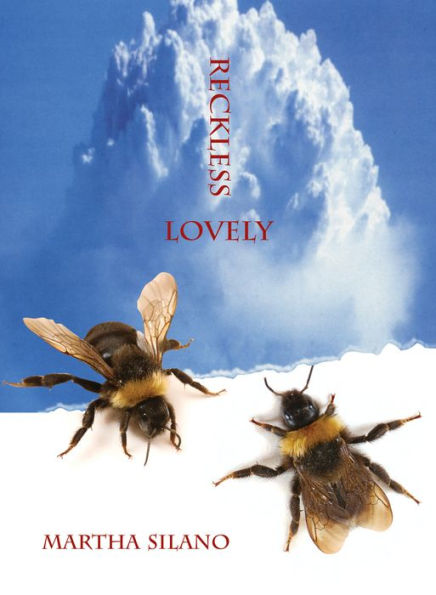
I mentioned Silano’s poetry in a recent post when I appreciated her scientific ideas that meld with an “everyday” life. Reckless Lovely contains many long-lined couplet verses that name objects such as a 64-ounce Big Gulp, Wells-Fargo, Italian Renaissance paintings, or the red spot on Jupiter as the poet observes and speculates on the cosmos that surrounds her. And she invents or alters words that suit her for rhythm, alliteration, sound: “the sfumato is sfumato-ing, the lute-r is lute-ing;” “when most of all that creep-eth/breath-eth buzz-eth/galump-eth sex-eth spar-eth/went AWOL/paving the avenue of asp/the boulevard of bee…” or the totally wild mashup Silano composes in “Summons and Petition for Name Change”:

Dim sum-my dilberry. Down there Daquiri.
Ear of Eden. Eminently Earthy. Empress Gensho.
Fandango-ing funnel. Fox foot. Flamingo.
Geranium in the Gate of the Gourd. Gentian's grin.

~

I find much to admire in Martha Silano’s work even though I often have to look up words (physics and geology nomenclature, usually).

Lesley Wheeler’s most recent book demonstrates her ability with form and sound in a different way, though in “Gran Torino Gigan” the alliteration is as snazzy as Silano’s abecedarian poem above: “Buzzes fade up front,/where beltless adults murmur and smoke//after unfurling musty sleeping bags…in rhizomatic zigzags, with a sharp zipper.” Contemporary technology gets into the poems and, with it, the sounds of our infrastructure, as in “I believe in utility poles, transformers,/lightning arrestors. Subtransmission lines/and static lines. The dead southern yellow pine…” and the theme of fungal connectivity means that we learn some useful and often beautiful mycology terms. Yet Wheeler often relies on shorter words when they suit the tone of the narrative. In a poem dealing with the aftermath of her mother’s death, she writes “No one’s grimmer inside/than me. My bully of a heart wears cheap/scuffed pumps and cusses like a mobster.” The repetition of the word “snow” in “Minus Time” establishes the poem’s pace. So many poems in the collection offer experiments in form!

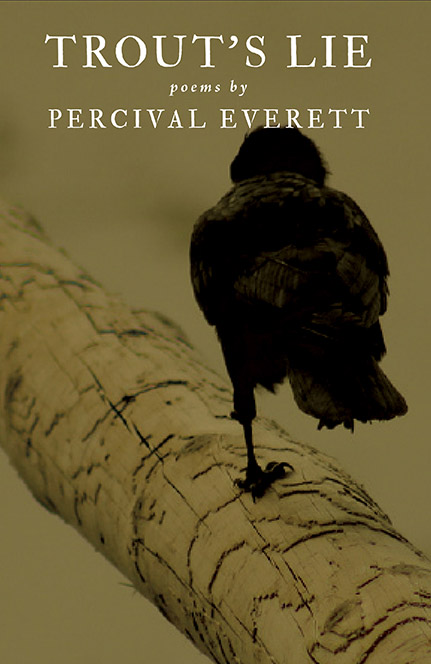
Percival Everett has gained an even stronger following thanks to his novel James, but he’s been writing poetry for years (Trout’s Lie is from 2015). This collection is deceptively simple in language and vernacular: there are surprises. Several poems make allusions to “great poetry of the past” by name or phrase; short lines build and build, twisting the lyric where we don’t think it would go. There are several examples I’d like to give, but this post is getting pretty long. I think I will close with an excerpt from Everett’s “Maybe Even Clouds,” the first section, which begins “Count the marines..”

They look like nice
Boys and bad boys,
From Vermont-and-Montana-
Following-orders-dumbshit-
Non-blinking-soon-
to-kill-soon-to-die boys,
Who might or might
Not, should or should
Not, but never would
Not and never can
not.
Not sure doesn't matter.
Doubt is a penniless
Customer, conscience
Waits for the weather
To change.


National Poetry Month may be almost over, but I’ll keep reading poems. And posting about them. And writing them. I encourage you to do the same, because there is no time in the history of the world when human beings haven’t benefited from poems.
Mud & connections

My region’s been unusually low on rainfall the past 18 months, but this year April showers seem almost to be compensating…my veg patch is mud. Weeding and more sowing will just have to wait. I walk around the neighborhood and my yard and the woods, squelching through muck and stopping now and again to upend a rock or rotten log and see who’s active now. Lots of worms and arthropods, the occasional spider, many ants.

In such moist circumstances, we get fungi; I’ve been enjoying Lesley Wheeler’s new book, Mycocosmic, which I’ve read twice now–once for content and sound, once to learn more from the poems’ craft structures, all the while fascinated by the science of fungus, which she incorporates into many of these poems. It’s a richly rewarding book, sometimes sorrowful, always intelligent, full of insightful poetry. The collection includes some poems that feel like spells, chants, divinations that suggest there are always imaginative methods for coping with anger, unfairness, and loss. Exploring the vein of how interconnected the natural world is, and the human world (with other humans and with the Earth) feels so vital to me, and Wheeler’s book pivots on this vitality. Look at the way Harry Humes threaded through my life, for example, in small but meaningful ways. The same goes for Lesley and for so many other people with whom I’ve shared intersections, interweavings, and connections over the years. That butterfly effect of influence. (Now that I think of it–Harry Humes has a book with that title: The Butterfly Effect). Or are those networks mycelial, as Lesley Wheeler suggests?

~

More connections: grad school was long ago now, but I’ve maintained a few colleagues from those days and will always treasure the fact that earning an MFA led to meeting fascinating people. For example, the recent issue of The Bookends Review features an interview my fellow Goddard alum Ian Haight conducted with me last summer. He asked me about teaching humanities, about higher ed in these fraught times, about AI and creative work, about my residency at Joya, and about poetry in general…https://thebookendsreview.com/2025/04/09/poetry-the-humanities-and-aesthetics-an-interview-with-ann-e-michael/. Some thought-provoking questions–thanks, Ian! And thanks to The Bookends Review for curating the interview into the journal.

Poetry month books & doings

~

It is, once again, April: National Poetry Month. My recent trip to the AWP bookfair has given me many poetry books to peruse at whatever pace I please, and because the weather here has been far too wet to do much in the garden, I’m using the free time to read. The outpouring of millions of peaceful protesters who oppose the current administration’s policies and who rallied on April 5 was somewhat heartening to me, but I remain skeptical and am aware that real change takes a long time. For the present, I’m bolstering my spirit through poetry.

~

I met Diane Thiel decades ago, briefly, at the West Chester Poetry Conference. She is incredibly talented, intelligent, frighteningly well-educated, and her work impressed me a lot; somehow, though, I did not get around to reading the many books she’s published since then, so her Questions from Outer Space (2022) is a delight and a revelation. Travel, literary and historical references, child-raising, teaching–the poems here cover a large range of topics. I bought her book at the Red Hen Press tables in LA. Red Hen is a terrific source for contemporary poetry books, if you’re looking…

At Saturnalia’s booth (another good small press with a large catalog), I found three of Martha Silano’s books and rejoiced. So far I have finished reading only The Little Office of the Immaculate Conception, which I love, but I can hardly wait to read her more recent books. She has a wry sense of weird, nerdy humor that’s inflected with science facts and grocery-store labels, pop culture and life in the burbs, and a healthy questioning of, well, everything.

My fellow Goddard alum and friend Lou Faber has a new book here, and it’s so wonderful to read the work of a long-time poetry colleague whom I haven’t seen in years but whose voice comes recognizably through this collection. The second half of the collection, in particular, deals with the emotionally-complex aspects of being an adoptee and this person’s efforts to untangle where (and who) he’s “from.” Contradictions abound over the years; then, DNA testing sort of, but not quite, sorts out some of the mysteries. But life–well, much of life contains mysteries and always will.

~

Meanwhile, this April I will be busy giving and attending in-person and online poetry events–even a radio spot! I’ll be reading mid-day at a local community college, participating in a No River Twice poetry event; and at some point this month, an interview about The Poetry Press Project (and my latest book) will air on WDIY 88.9FM. And a few of my poems will be appearing in print this month, the first of which is here: “Luna, Paloma.” I’ve also signed up for virtual attendance at a couple of poetry reading; and on May 4, I will be among the features for a virtual reading sponsored by One Art journal. My physical stamina isn’t what I wish it were, but thanks to technology that enables me to participate from home, I can manage to do a bit of yard work and STILL get to a poetry event.

Prose/poetry

In the first weeks of this year, I participated in a virtual poetry workshop with Anita Skeen. It was so useful to me that I signed up for another workshop, this one on writing the prose poem, with mixed-media artist and poet Lorette Luzajic. She is the editor of an online prose-poetry lit journal, The Mackinaw.

In this workshop, I’m returning to a form I learned early in my writing practice. My friend and mentor David Dunn may have introduced me to prose poems, I cannot recall anymore; but I do know he was writing them in 1980 and that some of the poems in our collaborative chapbook The Swan King are either prose poems or on the verge of being prose poems. Prose poetry was then considered a “new” form and was (& in some quarters, remains) controversial among poets and critics. It sounds self-conflicting: if it is prose, how can it be poetry?

In the decades since I was very new to poetry, reading everything I could find of contemporary work and experimenting all over the place, the prose poem has been much written-about in literary forums and academia and is–mostly–on pretty sturdy footing as a “form” of poetry. I never completely stopped writing prose poems, and a few appear in most of my books. I’ve been writing so many sad lyrical-narrative poems since 2018, however, that I haven’t spent much time really playing with poetry, and play is a huge part of creative thinking. So Lorette Luzajic’s workshop, which gives us a chance to experiment and play, appealed to me.

The workshop has got me thinking about versions and expansions of the form, turned up some exciting new poets to read, and offered amusing prompts that have moved me into ekphrastic, surrealistic, dream-based, and pop-culture themed poems. I have found some surprises in my own work, which is always a reviving feeling.

Also, we are almost at the vernal equinox. My environment is brightening in small ways, which tends to help with enduring the tough stuff.