Re-assessing

Another clear day; we finally got an inch or so of rain on Friday, which was much needed, and since then the temperature has cooled a little. This late in November, it finally feels like autumn. On my morning walk today, I was happy to see this handsome creature airing its wings in the sunshine. Our local turkey buzzards have been active lately. I’m fairly certain that the snag this one’s perched on is a green ash tree, clearly well-visited by woodpeckers.

My low mood seems to have abated, at least temporarily, and I wrote a few poems and revised a few others during the past three days. I’m trying to accept the fact that this year, we will see neither our son nor our daughter for the Thanksgiving and Christmas holidays. So I’m trying to get creative about things to do that we might not have done if we were preparing for family celebrations. Yet we miss the concept of family celebrations. I guess that’s a socio-cultural thing, right? I may need to reassess what value “the holidays” have for me these days.

~

I have also kept myself busy re-assessing a chapbook manuscript I’ve worked on forever (it seems) and am now looking for the sort of small, independent publisher that might consider a hybrid poetry-journalistic/historical work influenced by Muriel Rukeyser‘s long-poem The Book of the Dead. My poem is about a Korean War veteran tried as a traitor upon his return to the USA, a man who was my friend David Dunn’s father. It has been a real creative challenge to figure out how to tell his story, and the resulting text is definitely “hybrid,” with footnotes, magazine articles, military court proceedings, letters, and poems. People who believe that poems simply flow from some internal inspiration would probably take issue with a poem-ish thing like this, but I keep feeling compelled to find a way to tell this man’s story. The unfairness of it, the long-term damage, the people who used him as a scapegoat, his short life (he died at his mother’s, age 39, discouraged and unwell from physical wounds that never healed, divorced, unable to overcome the dishonorable discharge that kept him from gainful employment). David kept losing his father over and over: to prison, to PTSD, to divorce, to death. It’s an all-too-common narrative, but each tale is also deeply and profoundly individual. Hence the need to write it.

Nourishing

A few decades ago, at a time I knew very few infants, I made the acquaintance of a baby. This person stayed in my life for 20 years or so, but since then we haven’t had much contact–life happens, distances increase, friends of parents…etc. However, during their mid-adolescence they developed quite an interest in poetry, so we spoke a bit about that; I cannot say I was a mentor, but I may have been an inspiration of sorts. I had no doubt of their talent in the writing direction–at 14, they were composing better poems and essays than some adults I knew.

But again: life intervenes. Their life went in other directions than poetry. At least for awhile. Not long ago, though, when I was working with Moonstone Press on my chapbook Strange Ladies, I noticed the name Emma Wynn as author of Help Me to Fall, a recent chapbook from the press. Yes, the same person I knew when she was a child. I ordered the book, of course, and later attended a Zoom event that Moonstone hosted, in which Emma was reading. We said hello across the virtual divide. And now, Wynn has a full-length book out that I’m pleased to say is well worth reading. It is full of little marvels and careful observation, noticing the pain in love as well as the joys. Wynn writes, “Every day I turn over the stone of the world/ready to be surprised,” and I believe it. The section titled “Interlude” takes on such surprises with intimate words from letters written by historically-important people, crafted into poignant epistles of affection and potential regret and bitterness. To recognize that human beings are emotionally complicated seems to be one of Wynn’s impulses as a poet.

To be emptied is to be full.
To be battered without bitterness
is to bloom spacious
at one's heart
and nourish, unknowing,
the lives of others.
(--from "Kernel")

As it is gift-giving “season,” I remind my readers that books make good, modestly-priced gifts and that purchasing from a business other than Amazon when possible helps out independent small presses and independent booksellers (some small press publishers, however, use Amazon as their selling platform, as do two of my publishers; so does FutureCycle, which published Wynn’s book).

See the links to my books on the “My Books” tab above or the links on the right of this page. Sorry for the self-promotion, and if you aren’t inclined to get my books–buy books by another poet! There are many I’ve mini-reviewed here in past posts. Americans, especially, should spend more time reading poems and less time watching crappy TV shows or obsessing over unreliable news media sites. Of course, this is my personal (read: biased) opinion, but I believe poetry can help people gain a more well-rounded understanding of others and the state of the world. If we were to read and reflect on poems now and then, we would find the process nourishing.

Forthcoming

News!

Cover preview: 1980s Zine-style graphics

Okay, I’ve had some setbacks in the area of publishing recently. But–another chapbook is in the works, and here is the cover reveal, a graphic throwback to the early 1980s when photocopied zines were abundant and eccentric, which suits the eccentricity of the collection.

Many thanks to the folks at Moonstone Press in Philadelphia, especially to Larry Robin, who has been the resident angel of poetry events, books, and publishing in Philadelphia for decades (and I do mean decades). I almost referred to him as a poetry maven, but he’s more of a guide and stalwart in many ways. (However, I love this definition from Vocabulary.com’s dictionary: The word maven comes from the Yiddish meyvn, meaning “one who understands.” But to be a maven you have to more than just understand a topic, you have to know its ins and outs… You don’t become a maven overnight. That kind of expertise comes with an accumulation of knowledge over the years.) At any rate, after closing Robin’s Bookstore–an indie-publishing-supportive bookstore he operated for many years–Larry started the Moonstone Poetry reading series, the Moonstone Arts Center, and has been behind many other benefits to the poetry-loving community, including virtual and in-person readings and a press that publishes anthologies and single-author collections.

More about the publication date, where to reserve copies, readings, and about the book’s theme and histories will come later. In the meantime, excitement and gratitude.

Flurries

Every 20 years or so, my region gets a truly late freeze.

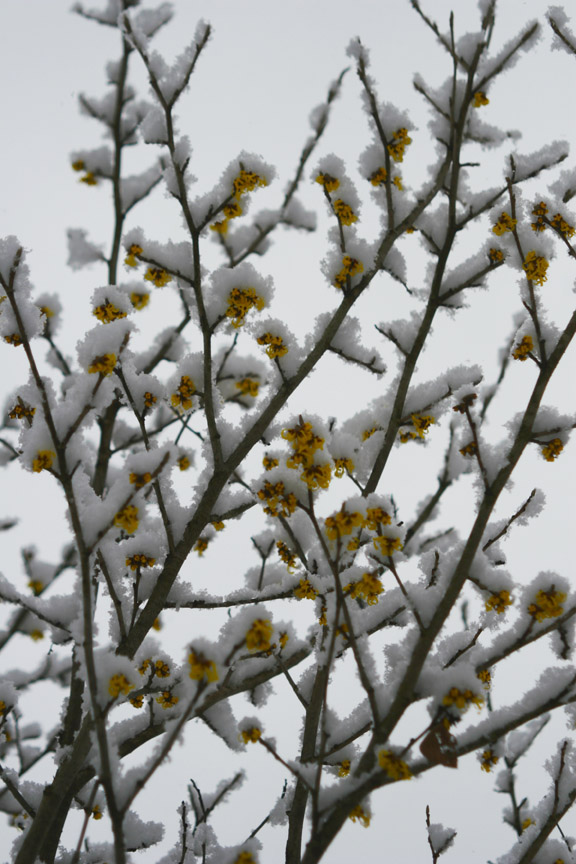
This is one of those years. It seems strange when snow flurries alight upon dogwood blossoms, but this period has been strange in many respects. What’s one more weirdness? We can adapt. It just requires employing strategies we haven’t used before.

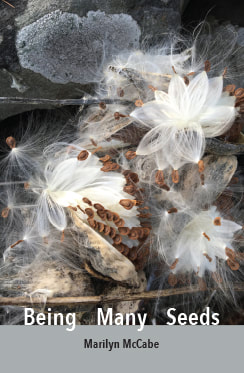
Which brings me, today, to Marilyn McCabe’s chapbook Being Many Seeds, just released by Grayson Books…like my own chapbook, a publication somewhat muted by the coronavirus. Make note, though, that you and I can still purchase books online. It just may take a little longer to receive the text. And isn’t anticipation fun?

Her chapbook has a lovely cover. [Readers may know I’m a fan of milkweed.] And the poems fascinate as they unravel–almost literally–on the page, in a form of erasure poetry followed by brief prose that is not so much interpretation as deepening. McCabe tries strategies with her poems as words and also as meanings. If that makes any sense. Want to know more? McCabe posted about the evolution of this collection on her own blog (which I suggest you follow) here.

beingmanyseeds-graysonsite_orig

~

I walked out into the meadow and scouted the broken stems and perennials emerging, on the lookout for seed-silk. I found several varieties, mostly dandelion, milkweed, coltsfoot, and eupatorium. Translucent puffs that evolved to disperse lightweight seeds through the use of breeze. Or breath.

Effective, and also quite beautiful. When the seed is stripped from the silk, the puff drifts away. The seed, however, now has the opportunity to sprout and grow. Even when the air is full of flurries.


~

New to me

Just prior to various stay-at-home mandates, I learned that the long-running, wonderful poetry press collective Alice James Books was having a 40% off, free shipping sale. How could I resist? Thus, I am happy to report, I received four poetry collections in my mailbox two days before we were given the full lock-down in my county.

In this edition of my blog (where, to celebrate National Poetry Month, I am responding to poetry collections), I post about Adrian Matejka‘s debut collection from 2003, The Devil’s Garden. I had read Matejka’s poems here and there, in Poetry magazine and online; and I know he has published three books since this one. I had never really sat down and read through one of his collections before, however.

GardenThe language here is clear and fine, frequently musical–a trait I like very much. Matejka’s newer work engages with the ideas society and individuals have about tribes, groups, races, mixing, and this early collection establishes those themes. The voice here strikes me as youthful, newly-minted. But sure in its control of the rhythm and sound of a poem.

Oh, the cruelty of people who see others as dangerous outsiders. That’s my feeling, disheartened; yet the speaker in the poems here strikes me as compassionate to participants and observers. No blame. Despite the hardships, no victim. The poems suggest a person who has become fascinated by complexity: complexity in language, in social background and race, in families, in physics, in music (jazz, particularly), in visual art and the movies and what’s going on next door.

While reading Matejka, I remembered my friend David Dunn, who died in 1999 but who would have liked this book, I think. So the book has done me some good, rousing my interest, giving lyricism room to gallop, reminding me to listen to Coltrane and Al Green a little more often, offering me recollection of a person dear to me, and thematically linking with so many other terrific books and ideas (Natasha Trethewey’s Native Guard and Thrall, my brother John S. Michael’s research on scholarly Enlightenment anti-racists–yes, there were a few–and even the BBC historic soap-opera I’ve been watching, season 5 of Poldark).

But also, these are lively, readable, inventive poems. A good reason to spend time with a poetry book.

Type


I was looking in my archive files for something I didn’t locate, and I happened upon this.

In 1981, I was a typographer; actually, I was a typographical proofreader who often stepped in when we needed another typographer (or, in a real pinch, typesetter) during rush times. This is one of the many style guide pamphlets the type designer-producers gave out to sell their fonts and as demos for set style and sizing.

When I was working in that field, I loved experimenting with the way words looked in different fonts. Sometimes I’d typeset my poems, or other people’s poems, to get a sense of how they would read on a “real” page (rather than as typewritten text; this predates word-processing and desktop publishing software). Those experiments led me and David Dunn to establish–briefly–LiMbo bar&grill books as an independent arts small press in 1982. I designed and typeset the books with help from my coworkers at various typography companies, and David did the editing.

I still love print text for the feel and look of how different printing and design choices affect the holistic environment of the page. Paper texture. Type size and choice. Gutter width. Titling. Binding, covers, front matter.

At present, I’m not yet a significant consumer of ebooks, so I can’t say whether similar design choices affect the reading experience. Surely there are differences, subtle and obvious. For the experience of reading poetry, from what I’ve seen on ebooks, I prefer print when reading poems. Technology may eventually change my point of view–I’m aware of that and open to it.

Here’s a poem from Red Queen Hypothesis (due out in 2021), designed appropriately as a bookmark by designer Ric Hanisch.

berthold005


Anticipation

Public relations and poetry are quite separate pursuits, in my mind, yet how else will readers learn that I have another chapbook nearing publication? Yes! Barefoot Girls, a series of 24 poems winnowed from a much longer set, will be appearing in print from Prolific Press later this year.

2021 still seems quite a way off, but perhaps it isn’t too early to mention that my full-length poetry collection The Red Queen Hypothesis will see publication then from  Salmon Poetry, an independent publisher in County Clare, Ireland.

Anticipation! I’m eager to see what the books will look like, eager to know whether anyone will read them, and experiencing that little frisson that comes with waiting for potential delight.

I cannot express how grateful I am to the folks behind small independent literary presses for all they do to keep poems circulating, to publish lesser-known writers, and to promote the literary arts generally. They are not making money from the process; they do it for love. Society benefits. Bless them all and donate to them if you can. But the best way to help small independent presses and publishers is to purchase books from them. Browse Prolific Press’ bookstore here, Salmon Poetry’s poetry book catalog here, and Brick Road Poetry’s books here (scroll down far enough & you’ll see my book Water-Rites, still available). Another small-press venture that has been plugging along for years is Michael Czarnecki’s FootHills Publishing. Two of my chapbooks are available from its website.

Dear Readers, purchase a few books from these stalwart independents, even when there’s a lower price used on Amazon. I’ll be thrilled if you buy one of my books but gladder still if you take a chance on an author you don’t know and discover some terrific poems and poets in the process.

Of course, when anticipation becomes realization and my new book becomes available, I will try to don my PR hat and let you know it’s in print. Thank you!!

bfg

Barefoot Girl ca. 1974 or 75

AWP follow-up

photo Ann E. Michael

winterhazel

Snow fell on Boston. Not a big snow, however, and rather typical for a late-winter storm: damp, swirling but not biting, swift-melting once the sun appeared two days later. Early Friday morning, I trudged with a friend over the as-yet unshoveled sidewalks to breakfast on Newbury Street at Steve’s. We met with conference buddies who are all members of the WOM-PO [women’s poetry] listserv. It is lovely to meet face-to-face people who have been virtual colleagues and splendid to discuss poetry over a good breakfast.

~

It is also a relief to realize that I have finally learned how to manage conference-going. It is all a matter of pacing and, I suppose, of taking poet William Stafford’s advice and lowering one’s expectations. The hardest challenge is making the choice between blowing the budget on terrific food (in a big city, wonderful restaurants abound) or on books, because the bookfair at the Associated Writing Programs’ annual conference is enough to inspire swooning among literary bibliophiles.

In three huge exhibit rooms, small presses and literary and university presses displayed chapbooks, literary journals, and books that range from minuscule to tabloid-sized, books that are handmade, letter-pressed, offset, print-on-demand, stapled, ribbon-sewn, die-cut, fancy-boxed, reprinted, spare, florid, illustrated, edgy, deckle-edged, marbled, second-hand, one-of-a-kind, limited-edition, mass produced, commercial, educational…in all genres including mixed-genre, collaborative, collage, anthology, with an emphasis more on the literary than the commercial text. These books can be devilishly hard to locate, even with the existence of Amazon and online sellers; and holding them in your hands is a far more convincing sell than seeing a picture file on your computer screen.

Heaven for poetry-readers, there are also wonderful creative non-fiction books, collections of short stories, novels, books on prosody and poetics, the craft of writing, on creativity and inspiration and toil and revision and on the complex and controversial topic of teaching writing. Oh, and there are people, too. Most of the attendees are writers of one stripe or another who are congenial and curious or else walking about with the glazed expression of the overwhelmed.

Or some combination of the two.

~

I exercised considerable restraint and managed not to load my bedside table with two months or more of reading material (see a related post here). And I got some terrific ideas for teaching writing to college students and found some wonderful poets whose work I want to study. The last night of the conference, I listened to the mesmerizing Anne Carson read an indescribable take-down of the fifth book of Proust’s À la recherche du temps perdu, the section titled The Captive (Albertine). It’s been years since I read Proust, which I did almost out of stubbornness in my junior year of college, but the book came back vividly enhanced by Carson’s peculiar approach to pacing, language, scholarship, whimsy and satire. I like what the Poetry Foundation’s biography says about her after the release of her text The Autobiography of Red:

According to John D’Agata in the Boston Review, the book “first stunned the classics community as a work of Greek scholarship; then it stunned the nonfiction community as an inspired return to the lyrically based essays once produced by Seneca, Montaigne, and Emerson; and then, and only then, deep into the 1990s, reissued as “literature”and redesigned for an entirely new audience, it finally stunned the poets.” D’Agata sees Carson’s earlier work as an essayist everywhere in her poetry, along with her deep absorption in Classical languages. Carson’s work, D’Agata alleges, asks one to consider “how prosaic, rhetorical, or argumentative can a poem be before it becomes something else altogether, before it reverts to prose, to essay?”

~

Altogether, Boston provided nourishment of many kinds: gustatory, intellectual, emotional, poetical…food for thought.