Reading in shade

It’s the time of year when, according to the lunisolar calendar, we move from 小暑 xiǎoshǔ–when the heat begins to get unbearable–to 大暑 dàshǔ, the hottest time of the year. It may also be the greenest time: my garden suddenly plumps out huge squash leaves, giant sunflowers, masses of beans, zinnias, basil. The tomatoes are finally burgeoning after a late start. It’s too hot to spend much time weeding and pruning: I harvest what I can and retreat to the shade as soon as possible, where I can read.

A friend recently lent me a book of short stories, Human Sacrifices, by María Fernando Ampuero, an Ecuadoran writer. It’s been ably translated by Frances Riddle, and the stories are startling and harrowing. Not something to check out for a light summer read on the beach, but memorable and thought-provoking. One critic says Ampuero’s work is South American gothic. I don’t agree–and I think it’s kind of a cheesy shortcut in a review–but perhaps that phrase does convey the flavor of some of her stories. Anyway, it’s always a treat to find a writer whose work I’m unfamiliar with and whose work is admirable.

I’ve been taking a break from reading poetry, though that wasn’t planned on my part. July brought a wedding, a death, and some travel; and now, in the intense summer doldrums, I prefer to read for entertainment or information, or just to pass the time. Poetry takes more brain and heart space for me, more “intentionality” or concentration, than most non-fiction books or novels do. This is not to say any other genre is less demanding in and of itself. It’s a personal quirk: I am more attentive when reading poetry than I am when I read other forms of literature, probably because I’m unconsciously (or consciously) endeavoring to learn something of the craft and style and context of poems by other poets. It’s a method of processing how to write poems. But as I have no plans to write fiction or non-fiction, I read such genres for entirely different reasons.

Usually I try to read outside on the porch, in the hammock, on the garden swing. Some days it is just too damned hot and humid, though, and I resort to the air-conditioning indoors. The indoor climate has no flies or gnats but also no bird songs, cicada hums, cricket calls, breezes, scents of summer. Indoors is less than ideal (except in the teeth of winter!).

Recently I’ve added a shade garden where the chicken run was in decades past, under the umbrella of our largest white oak. I haven’t yet added a bench, but a lawn chair suffices for now. Alas, it is a bit buggy, but so is the hammock. The pleasure of summer reading in shade outweighs the inconvenience of the minor fauna…most of the time.

Blue

At one of our local used book stores,* I found a copy of William Gass’ 1976 On Being Blue: A Philosophical Inquiry. Gass writes in a style one might term prolix; but if you are like me and sometimes appreciate lists, wordplay, allusions, lengthy sentences, and fine distinctions in your sentences–as well as humor–while exploring the limits and the stretches of words and language, this book-length essay on the word/concept/color/iconography/sexual innuendo/moody attitude and conflicting meanings of the word blue might appeal. I’ve been feeling a bit on the blue side lately, hence my attraction to the book (though I do like Gass as a writer, as long as I don’t have to read too much of him at one time). And guess? It cheered me! [I will caution the reader who avoids the use of “bad language” that Gass employs such words in this essay, for purely intellectual reasons…]

Granted, my feeling blue has a different tone from other uses of the word: blue postcards, sexual meanings of blue–I’m reminded of the movie “I Am Curious (Blue)” which was considered racy and given an X rating when I was a kid, though the blue in that title referred to the Swedish flag, apparently. My blue is the blue of songs like “Baby’s in Black” or Joni Mitchell’s “Blue” album. Or just that classic music form, the blues.

And I’ll get over feeling this way. That’s what moods are: feelings that come and go, transitory. It always seems as though low moods stay around longer than neutral or cheerful ones, but many scientific studies show that it is our perception and memory of the negatives that make us think we are sadder for longer. Even Wikipedia has an entry on negativity bias, with some sources if you want to check things out yourself. As I age, I realize that bad moods and sad events and past mistakes don’t need to stick around as much as I used to think. A bit of mediation, some practice and readings in Zen and in psychology, a lengthening perspective on life’s vicissitudes, some counseling and even some medicine; whatever it is that’s brought me here, I recognize that before long the depressive hours will lift. Also I know some methods of thinking that assist me to move to more neutral ground.

I will note there are many kinds and hues of blue, enough for Gass to write 112 pages on it and for the word to appear in 85 files of my own poetry during the past 12 years–I did a quick word search just to find out. That is in the files alone, and each file contains many poems. so I can only imagine how much I have over-used the word in my writing life! Certainly, not all of those blues are sad. Many are beautiful, sunny, the blues of blueberries and balloon flowers, the New Mexico sky, mountains and oceans; teal-blues and turquoise, the bright royal blue I like to wear, the pale color of robin’s eggs.

Blue. It has always been my favorite color.

~~

*The bookstore is Apport, in Emmaus, PA. Ben has an active Instagram feed and really cool catalogues of odd books, art, and ephemera.

*The first “blue” above is an encaustic painting by Deborah Barlow; the second is at Bandolier National Monument; the third is of the Blue Ridge Mountains; the last was taken at an inlet bay, maybe in Delaware–I’ve forgotten.

Perfumes and tunes

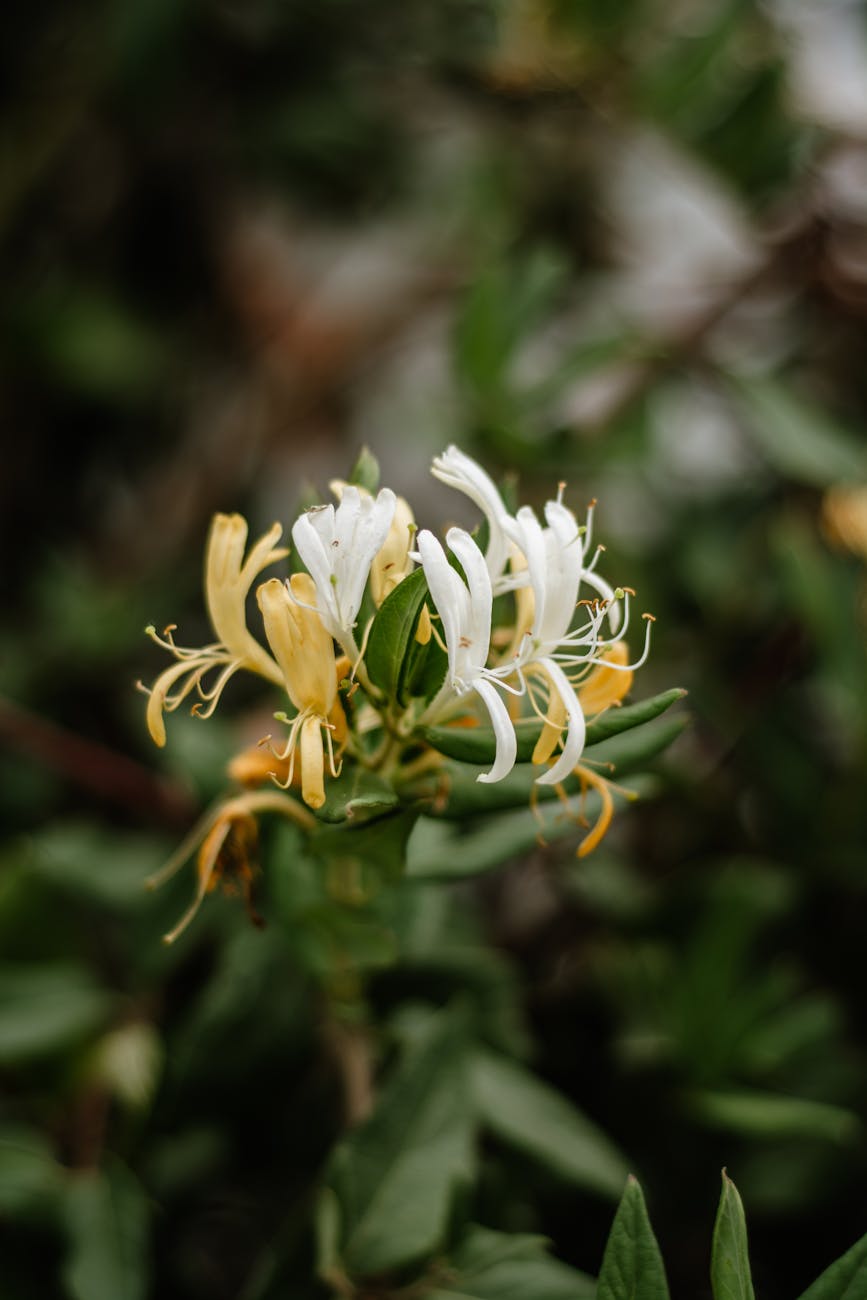
This time of year, certain blooms and fragrances evoke my childhood memories. I spent most of my childhood and all of my adolescence in southern New Jersey, along the Delaware Bay; the swampy coastal plains have now largely burgeoned into suburban housing developments, but in the late 1960s there were actual townships with old-fashioned suburbs–the kind with sidewalks–and many a privet hedge that bloomed in early June with small, white spires that gave off a faint scent. In overgrown areas of meadow and scrub, the sweet smell of Japanese honeysuckle perfumed muggy evenings. And while I don’t recall much scent from the mimosa trees in bloom on Harvey Avenue, once those fallen pink blossoms began to rot on the sidewalk, they added a distinct punk that meant summertime. The honeysuckle is blooming here now, making me wonder about the neuroscience behind the sense of smell. Gotta check out these books, perhaps: Kiser reviews four recent books on olfaction.

On a side note, none of these evocative plants are native to the Americas: Ligustrum vulgare, Lonicera japonica, Albizia julibrissin–and yet I associate them with South Jersey. It is almost like a refrain in my memory-mind.

To speak of associations reminds me of Alexis de Tocqueville. I’ll post a quote of his below, one that makes me think of language and poetry and science. But back to refrains:

Musical refrains also run through my brain, evoking memories and nostalgia, or just being irritating “earworms.” At any given time such tunes may include Tchaikovsky’s Serenade for Strings, strains from a late Haydn quartet, one of many Springsteen songs, Marvin Gaye’s version of “I Heard It Through the Grapevine,” or–most confounding of all–the Chock-full-o’Nuts jingle from the 1960s or some similar commercial sloganeering. Why such things wear a familiar groove in the gray matter I don’t know, though Oliver Sacks’ book on music (Musicophilia) and Daniel Levitin’s This Is Your Brain on Music offer some insights, and I’m thinking of reading this one by Samuel Markind when it comes out later this year.

Alas, I’m not gardening because once again the garden is awash in mud, so I entertain myself with endeavoring to discover how/why my brain works (and yours, and anyone else’s), since that’s one of my favorite lines of inquiry when I can’t work outside. I will take a sodden walk later and dwell on possibilities while enjoying the scent of the invasives; I’ll work on some poetry revisions; maybe I’ll listen to music…and freely associate with any and all possibilities. Here, as promised, Alexis de Tocqueville:

“When citizens can associate only in certain cases, they regard association as a rare and singular process, and they hardly think of it.

When you allow them to associate freely in everything, they end up seeing in association the universal and, so to speak, unique means that men can use to attain the various ends that they propose. Each new need immediately awakens the idea of association. The art of association then becomes, as I said above, the mother science; everyone studies it and applies it.”

Honeysuckle photo by Nadiye dabau015fu0131 on Pexels.com

Back in PA

Last year at this time, I had covid and was languishing in bed, unable to tend to the garden. A regional drought meant I really should have been watering the new plants; and it also kept the weeds firmly rooted, fighting for dominance in the vegetable patch. This year, I timed a trip to New Mexico just when I ought to have been harvesting spinach and planting out tomatoes, beans, and squash. Oops. And then it rained buckets the whole time I was away (much-needed rain, but…). Therefore, the garden situation was not ideal. But garden situations seldom are ideal because Nature does its own thing regardless of my plans.

At any rate, eastern Pennsylvania finally moderated its weather enough that I got the weeds and the seeds and transplants more or less under control this past week–“control” being a general term subject to, well, Nature. The peonies bloomed gorgeously on schedule, as did the nefarious multiflora roses and Russian olives that plague the hedgerow. The catbirds and Eastern kingbirds are back; the robins’ first brood has hatched; the orioles are insistent in the walnut trees and brilliant in the garden, chasing the barn swallows. I’m not doing much writing, though I drafted one or two beginnings of poems. Outdoors takes precedence–not that I can’t write out of doors, I often do so. But poems can wait in a way the garden cannot.

And, speaking of poems (and Pennsylvania), I returned from my trip to find this Keystone Poetry anthology awaiting: https://www.psupress.org/books/titles/978-0-271-09990-3.html–the followup to 2005’s Common Wealth anthology, also edited by Marjorie Maddox and Jerry Wemple.

The new anthology, 20 years after the initial one, has poems by about 180 poets–yes, I am one of them–covering the corners and the center of the Keystone State. I like it even better than the first collection, and it is clear the editors learned much from the experience of curating poems and creating a cohesive “experience” of the regions. Granted, since I know both of the editors personally and appreciate their poetry and their visions, I may be biased. But that’s okay. Objectively, I truly get how huge an undertaking this was and how well it has turned out. For educators, there is a section at the close of the anthology full of suggestions for reading, writing critically, and writing creatively based on this anthology, and even in comparison with the previous one. As both editors are college professors who teach creative writing and critical writing, these appendices are well-thought out and worthwhile.

I miss the aridity of New Mexico, which seems to benefit my overall health. And I miss my daughter immensely. But springtime in eastern PA has many compensations, not the least of which are blooming even as I write.

Plan B (reading)

While I was traveling the high-altitude desert regions, my home valley got its much-needed rain. And the rain continues. And continues. My plan was to get to work on my gardens as soon as I came back, to weed and plant out seedlings. Well, it’s a bit too wet for that. Also chilly and humid and sea-level, and therefore my physical adjustment has been a bit …bumpy. So, Plan B.

The Plan B default for me usually entails spending “down time” reading, writing, or housekeeping, though visiting the library and meeting friends for coffee fall under Plan B, too. Today, since I feel lousy and have a spate of brain fog, reading has been the choice. I still have a few books on the bedside pile that I haven’t gotten to–mostly poetry collections I bought at AWP at the end of March. But also there is Ocean Vuong‘s heartbreaking and beautiful novel-that-reads-like-memoir, On Earth We’re Briefly Gorgeous, that I finally got around to reading, and a back issue of Rattle Poetry a friend gave me–one that was largely devoted to haiku and related forms–that featured a fascinating interview with Richard Gilbert (thank you, Lesley S!). On the poetry-only book list, I read January Gill O’Neil’s Glitter Road, Julie Kane’s Naked Ladies, and Ross Gay’s first collection, Against Which. All quite useful to me in times when I feel bleak and physically frail–there’s humor, sorrow, and bravery in all of these writers’ poems. Though I’m too foggy-headed to write mini-reviews at the moment, I encourage my readers to check these poets out.

Perhaps my next post will be about the lovely time my friend and I had in northern New Mexico, visiting my daughter and Santa Fe, including my opportunity to see Bandelier National Monument again and ponder its environments and history. A trip like that takes some time for me to “digest.” But it was wondrous. And so is a day at home to recuperate in my favorite way: reading.

Reading my contemporaries

The poetry collections I’ve been reading during much of the past year have largely been works of contemporary writers–books that were published during the past two decades, some during the past two years. My focus on such current work was not intentional. After all, there is still so much poetry from the past three or four thousand years that I haven’t yet explored! Grad school, however, was decades ago; that’s when I last studied both contemporary and classic/canonical/influential poems with a specific eye to learning from them. I continue to learn from the poems I read, though. I just don’t take as many notes or write any papers about them these days.

Three collections I read recently have got me thinking about the grittier sonic elements in poetry; the use of scientific, foreign, antiquated, and invented words; wordplay in general as a poetry component; and how sound can push both experiment and meaning in a poem. I’ve been mulling about the task of writing anything that feels “new,” to me or to my readers, and about the challenges more sonic wordplay would mean for me as a writer. I’m saying here I think it would be difficult to do, because it differs from my long-accustomed voice and style. I’m also saying I like a challenge in creative work, and that my style(s) go though changes always, so why not? In creative art of any kind, the passing of years makes a difference in many things. Content (because: experience). Situation (because: life happens). Methods (because: technology and materials). And influence–what I was reading in high school vs. grad school vs. today–though some favorites will always hold a place in my creative mind.

My poems tend to be plain-spoken, although I’ve never been shy about going beyond the standard vernacular to employ a geological term, a botanical name, or a somewhat archaic noun or adjective when it suits the feel and sound of the poem. Most of my poems don’t fall under the description of experimental or edgy. I’m not making waves with language, but some poets are. And my recent reading has me wanting to experiment more. It will mean failing a lot, because I’m working against my habitual methods of composition. I won’t be as good at it as these poets (below) are. What I’m hoping, though, is that the practice of trying more sonic wordplay in my work implants a tracery of that practice onto my poetic voice.

~

So which contemporaries do I mean? More than the three I’ll briefly mention here, for sure (and it is not as if the only poets playing with words and sound are my contemporaries–far from it). However, here’s a start with some examples that I particularly love.

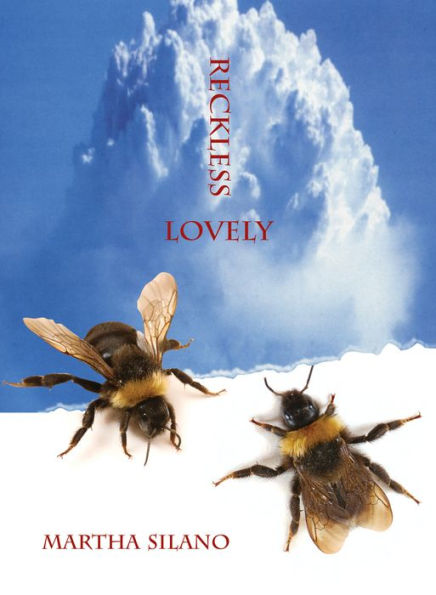
I mentioned Silano’s poetry in a recent post when I appreciated her scientific ideas that meld with an “everyday” life. Reckless Lovely contains many long-lined couplet verses that name objects such as a 64-ounce Big Gulp, Wells-Fargo, Italian Renaissance paintings, or the red spot on Jupiter as the poet observes and speculates on the cosmos that surrounds her. And she invents or alters words that suit her for rhythm, alliteration, sound: “the sfumato is sfumato-ing, the lute-r is lute-ing;” “when most of all that creep-eth/breath-eth buzz-eth/galump-eth sex-eth spar-eth/went AWOL/paving the avenue of asp/the boulevard of bee…” or the totally wild mashup Silano composes in “Summons and Petition for Name Change”:

Dim sum-my dilberry. Down there Daquiri.
Ear of Eden. Eminently Earthy. Empress Gensho.
Fandango-ing funnel. Fox foot. Flamingo.
Geranium in the Gate of the Gourd. Gentian's grin.

~

I find much to admire in Martha Silano’s work even though I often have to look up words (physics and geology nomenclature, usually).

Lesley Wheeler’s most recent book demonstrates her ability with form and sound in a different way, though in “Gran Torino Gigan” the alliteration is as snazzy as Silano’s abecedarian poem above: “Buzzes fade up front,/where beltless adults murmur and smoke//after unfurling musty sleeping bags…in rhizomatic zigzags, with a sharp zipper.” Contemporary technology gets into the poems and, with it, the sounds of our infrastructure, as in “I believe in utility poles, transformers,/lightning arrestors. Subtransmission lines/and static lines. The dead southern yellow pine…” and the theme of fungal connectivity means that we learn some useful and often beautiful mycology terms. Yet Wheeler often relies on shorter words when they suit the tone of the narrative. In a poem dealing with the aftermath of her mother’s death, she writes “No one’s grimmer inside/than me. My bully of a heart wears cheap/scuffed pumps and cusses like a mobster.” The repetition of the word “snow” in “Minus Time” establishes the poem’s pace. So many poems in the collection offer experiments in form!

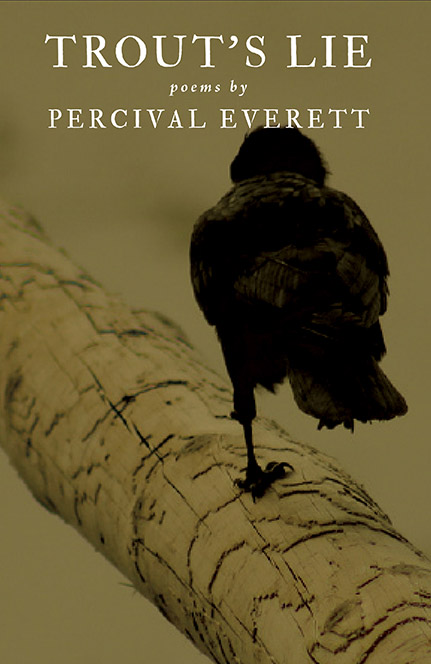
Percival Everett has gained an even stronger following thanks to his novel James, but he’s been writing poetry for years (Trout’s Lie is from 2015). This collection is deceptively simple in language and vernacular: there are surprises. Several poems make allusions to “great poetry of the past” by name or phrase; short lines build and build, twisting the lyric where we don’t think it would go. There are several examples I’d like to give, but this post is getting pretty long. I think I will close with an excerpt from Everett’s “Maybe Even Clouds,” the first section, which begins “Count the marines..”

They look like nice
Boys and bad boys,
From Vermont-and-Montana-
Following-orders-dumbshit-
Non-blinking-soon-
to-kill-soon-to-die boys,
Who might or might
Not, should or should
Not, but never would
Not and never can
not.
Not sure doesn't matter.
Doubt is a penniless
Customer, conscience
Waits for the weather
To change.


National Poetry Month may be almost over, but I’ll keep reading poems. And posting about them. And writing them. I encourage you to do the same, because there is no time in the history of the world when human beings haven’t benefited from poems.

Mud & connections

My region’s been unusually low on rainfall the past 18 months, but this year April showers seem almost to be compensating…my veg patch is mud. Weeding and more sowing will just have to wait. I walk around the neighborhood and my yard and the woods, squelching through muck and stopping now and again to upend a rock or rotten log and see who’s active now. Lots of worms and arthropods, the occasional spider, many ants.

In such moist circumstances, we get fungi; I’ve been enjoying Lesley Wheeler’s new book, Mycocosmic, which I’ve read twice now–once for content and sound, once to learn more from the poems’ craft structures, all the while fascinated by the science of fungus, which she incorporates into many of these poems. It’s a richly rewarding book, sometimes sorrowful, always intelligent, full of insightful poetry. The collection includes some poems that feel like spells, chants, divinations that suggest there are always imaginative methods for coping with anger, unfairness, and loss. Exploring the vein of how interconnected the natural world is, and the human world (with other humans and with the Earth) feels so vital to me, and Wheeler’s book pivots on this vitality. Look at the way Harry Humes threaded through my life, for example, in small but meaningful ways. The same goes for Lesley and for so many other people with whom I’ve shared intersections, interweavings, and connections over the years. That butterfly effect of influence. (Now that I think of it–Harry Humes has a book with that title: The Butterfly Effect). Or are those networks mycelial, as Lesley Wheeler suggests?

~

More connections: grad school was long ago now, but I’ve maintained a few colleagues from those days and will always treasure the fact that earning an MFA led to meeting fascinating people. For example, the recent issue of The Bookends Review features an interview my fellow Goddard alum Ian Haight conducted with me last summer. He asked me about teaching humanities, about higher ed in these fraught times, about AI and creative work, about my residency at Joya, and about poetry in general…https://thebookendsreview.com/2025/04/09/poetry-the-humanities-and-aesthetics-an-interview-with-ann-e-michael/. Some thought-provoking questions–thanks, Ian! And thanks to The Bookends Review for curating the interview into the journal.

Rest in poetry

National Poetry Month has brought with it a sad bit of poetry news: Harry Humes has died. If you are unfamiliar with his work, you might want to check Penn State’s PA Book site’s biography of him, and then find one of his books:

https://pabook.libraries.psu.edu/literary-cultural-heritage-map-pa/bios/humes__harry

He was an excellent poet, influential for many folks–especially for Pennsylvania writers–and while I never knew him well, our lives intersected in some surprising ways over the years…

~

In 1982 or thereabouts, I resided in Philadelphia and was participating in many poetry readings, mostly open mike events. Carol Ann Robertson, who lived at that time in Philly but who had connections in the Lehigh Valley, told me that Bethlehem’s Godfrey Daniels listening room hosted a monthly poetry reading and invited me to drive up with her to hear someone named Harry Humes read. If I recall aright, three or four Philadelphia poets crammed into her compact car and headed north. We arrived early and were introduced to Harry, who seemed to have quite a case of nerves; that surprised me, since he was my parents’ age and a professor. Apparently this was one of his first, or perhaps his first, public reading–whereas I had been reading at open mikes since I was in my early 20s and was pretty much over my nervousness. (Years later he told me he’d fortified himself with a bit of scotch before the event.)

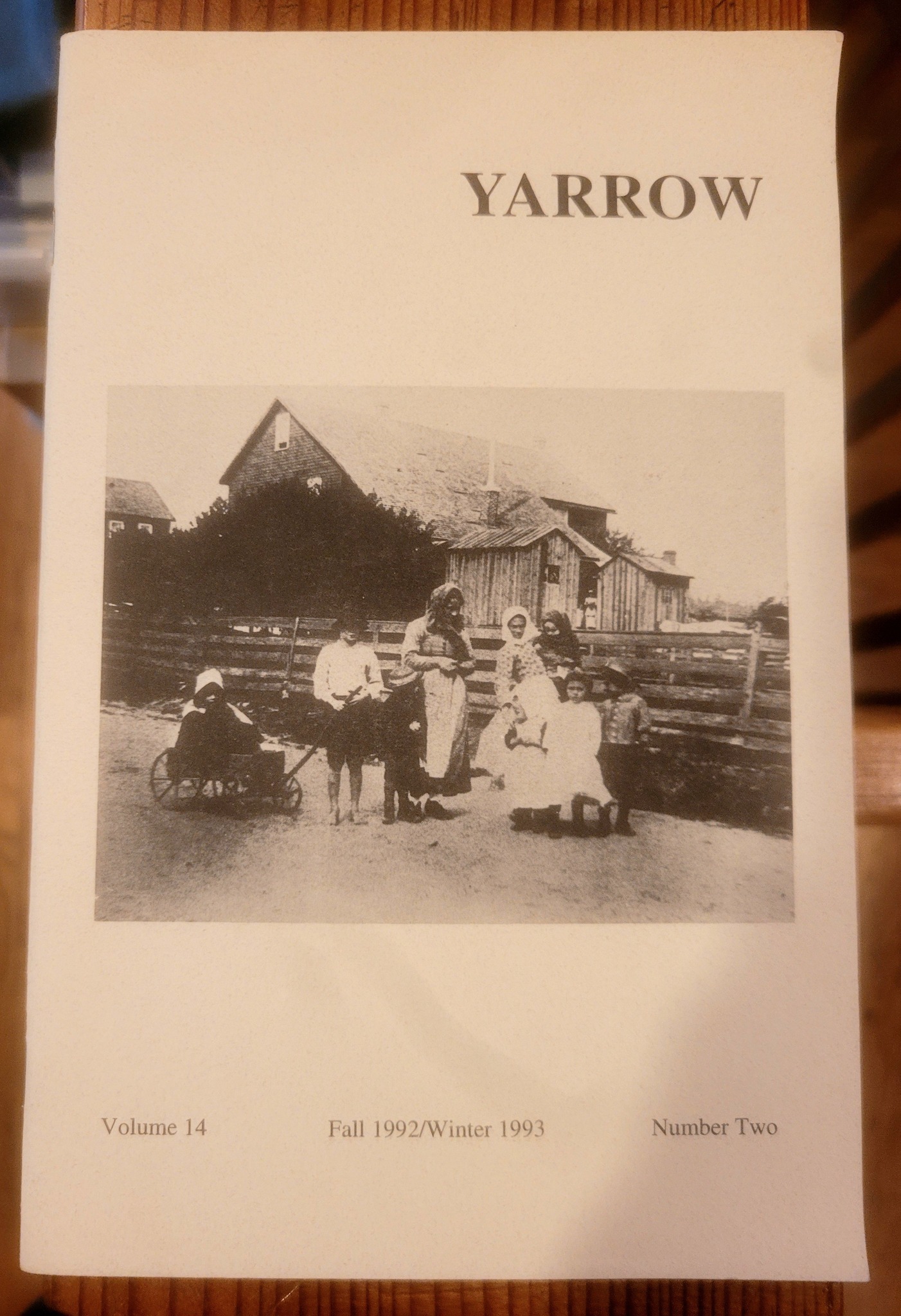
It was a beautiful reading. His work was both accessible and mature, and he clearly knew what he was doing when it came to writing poems. Indeed, his first full-length collection, Winter Weeds, came out shortly afterwards. Anyway, I moved out of Pennsylvania for awhile and, when I returned, it was to the very suburban Lehigh Valley. In 1992, I sent some poems to Yarrow, a lit journal published at Kutztown University–Humes was the faculty advisor and editor then, and he chose to publish my prose poem La Barbe.” For which, Harry, many thanks. I was so busy with toddlers that I was hardly submitting any work anywhere, or finding much time to write. The publication was a boost for me.

Then, in the peculiar way of small-world eventualities, my husband hired Harry’s wife, Nancy, as copyeditor for a Rodale Press magazine. I found that out when, a few weeks after she’d been hired, my beloved asked whether I had ever heard of a poet named Harry Humes! (By that time, Humes’ fourth collection, Bottomland, was in print)…

~

When I was hired at DeSales University around 2005, I learned that DSU held an annual poetry event for high school students. I attended/participated often, and Harry Humes–who was a good friend of the program’s administrator (Steve Myers)–was always involved in the workshops and events. Humes had retired from Kutztown by then, and was writing more poems, fishing, and enjoying family life. He always greeted me with a big smile and asked about my writing. That sums up for me what kind of person he was: generous; possessed of a self-effacing, even self-deprecating humor; kind and encouraging to people just starting out in poetry.

Here’s a poem of his that I like a lot, which I clearly recall him reading that day at Godfrey’s so long ago: https://www.poetryfoundation.org/poetrymagazine/browse?volume=154&issue=3&page=13

And here is one of his best-known poems, the title piece from his 2004 book. Harry, thank you for gracing us with your words. We’ll remember them for a long time.

~

August Evening with Trumpet

Up in the woods a neighbor or stranger
who has had enough of August,
its spider webs and first yellow

near the roots of things,
has out of the blue found his old voice,
wailing away everything

he can remember.
Perhaps he will play
right through fall and winter,

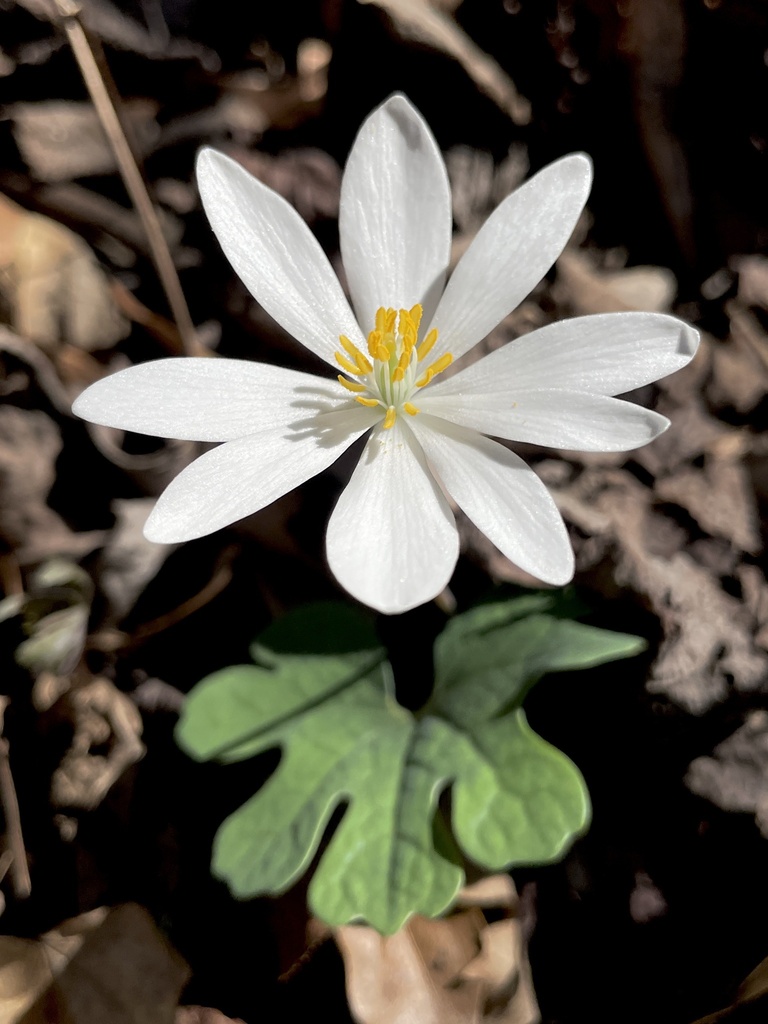
not stopping until bloodroot
and anemone blossom.
But now it is almost dark.

Mist veils the fields,
and last sounds play out
as simply as longing or breath.


Copyright © 2004 Harry Humes All rights reserved
from August Evening with Trumpet
University of Arkansas Press

Poetry month books & doings

~

It is, once again, April: National Poetry Month. My recent trip to the AWP bookfair has given me many poetry books to peruse at whatever pace I please, and because the weather here has been far too wet to do much in the garden, I’m using the free time to read. The outpouring of millions of peaceful protesters who oppose the current administration’s policies and who rallied on April 5 was somewhat heartening to me, but I remain skeptical and am aware that real change takes a long time. For the present, I’m bolstering my spirit through poetry.

~

I met Diane Thiel decades ago, briefly, at the West Chester Poetry Conference. She is incredibly talented, intelligent, frighteningly well-educated, and her work impressed me a lot; somehow, though, I did not get around to reading the many books she’s published since then, so her Questions from Outer Space (2022) is a delight and a revelation. Travel, literary and historical references, child-raising, teaching–the poems here cover a large range of topics. I bought her book at the Red Hen Press tables in LA. Red Hen is a terrific source for contemporary poetry books, if you’re looking…

At Saturnalia’s booth (another good small press with a large catalog), I found three of Martha Silano’s books and rejoiced. So far I have finished reading only The Little Office of the Immaculate Conception, which I love, but I can hardly wait to read her more recent books. She has a wry sense of weird, nerdy humor that’s inflected with science facts and grocery-store labels, pop culture and life in the burbs, and a healthy questioning of, well, everything.

My fellow Goddard alum and friend Lou Faber has a new book here, and it’s so wonderful to read the work of a long-time poetry colleague whom I haven’t seen in years but whose voice comes recognizably through this collection. The second half of the collection, in particular, deals with the emotionally-complex aspects of being an adoptee and this person’s efforts to untangle where (and who) he’s “from.” Contradictions abound over the years; then, DNA testing sort of, but not quite, sorts out some of the mysteries. But life–well, much of life contains mysteries and always will.

~

Meanwhile, this April I will be busy giving and attending in-person and online poetry events–even a radio spot! I’ll be reading mid-day at a local community college, participating in a No River Twice poetry event; and at some point this month, an interview about The Poetry Press Project (and my latest book) will air on WDIY 88.9FM. And a few of my poems will be appearing in print this month, the first of which is here: “Luna, Paloma.” I’ve also signed up for virtual attendance at a couple of poetry reading; and on May 4, I will be among the features for a virtual reading sponsored by One Art journal. My physical stamina isn’t what I wish it were, but thanks to technology that enables me to participate from home, I can manage to do a bit of yard work and STILL get to a poetry event.

Riches

The past week gave me riches galore; though I am somewhat poorer in the pocket for it, my cup runneth over in about every other way. It’s true that often, lately, I’ve felt that I am living in “interesting times” that are all too much and too awful to contemplate for long. Then again, I could have been alive (possibly quite briefly!) during Boccaccio’s time and weathering the bubonic plague. Thanks to The Decameron, readers later in history have been able to get a picture of what people were thinking about and imagining–or trying to escape–when things were truly terrible all around. And while I’m not pollyanna-ish about the present, I do feel grateful that I live during an era when travel to distant places is possible and rather speedy, that books are readily available, and that some of the wealthy people of the not-too-distant past decided that philanthropy included funding libraries, gardens, and museums for the average citizen to visit and enjoy. Current billionaires, please take note!

What the week entailed was a trip to Los Angeles to visit my eldest child and, while there, to spend a morning at the AWP conference book fair. Riches indeed! I “packed light” to be sure I had space in my carry-on for poetry books, which thankfully tend to be slim paperback volumes. I bought almost 20 books, I confess. So I came home weighted with literary riches, and while at the convention managed to connect (however briefly) with numerous poet colleagues. A shout-out here to Lesley Wheeler, whose book I had to purchase online because Mycocosmic had sold out! Congratulations, and I cannot wait to read it.

My days in LA were limited to four, but my son had curated a things-Mom-would-like-to-do list that included Mom’s necessary down time. It’s terrific to have offspring who are now old enough to respect my limits. [They have not always been so accommodating.]

The list included several lovely meals out, a full day at Huntington Gardens and Library, a day trip up to Santa Barbara, a visit to LACMA to get an “art fix” for me and for my son’s best beloved, who loves art and architecture, and a visit to the amazing Museum of Jurassic Technology which, as far as I am concerned, is basically a series of amazing poetry prompts. I cannot possibly explain it; and the museum’s website is purposely a bit obscure and limited, compared to the immersive experience of going to the place in person. I am still thinking about it and will be for weeks.

The barrel cacti at Huntington

While photo ops abound at the gardens, no photos are permitted in the Museum of Jurassic Technology; I will lead you to the website and just keep you guessing. But among the riches of the last week are germs of new poem drafts. We shall see what emerges.

Four+ days away, and I returned to spring in eastern PA: narcissus, magnolias, glory-of-the-snow, squill, bloodroot, forsythia, ornamental plum. Even more richness. Gratitude for the glory.