Silence (John Cage, Zen, head-noise)

Slow Muse blogger Deborah Barlow–artist, critic–recommended Kay Larson’s recent book on John Cage, Where the Heart Beats. Silence was so significant in Cage’s work and thinking that, given my recent reflections on noise or lack thereof, this seemed the right time to pick up that text. Lo and behold, synchronicity of several kinds. The author, Kay Larson, thanks John Daido Loori, a rōshi of the Mountains and Rivers order of zen Buddhists and long-time abbot of Zen Mountain Monastery near Woodstock, NY. She studied with him beginning in 1994.

In 1992 and 1993, I attended two weekend retreats there; the brief days remain vivid in my memory. Perhaps more on that another time. Haiku is involved…and silence.

Recently, given some irregular bumps along the walk of life that have led to excessive “head-noise” (my term for stress I can’t quite let go of), I have been returning to some zen-influenced texts and trying to remember to breathe and to be here now. Arne Naess’ writings on joy and environment and Buddhism–I’ve just finished reading a collection of his essays–dovetail very neatly into this reflective book on Cage’s life, work, and influences. Larson’s “Zen” approach to writing about Cage is so gentle and refreshing that reading this book soothes me. I find within myself a kind of inner silence, my breathing returning to its slower, quieter pace, as I read the brief selections of prose Larson uses to explore the life of the mind of this peculiar and innovative artist/composer/writer.

Very like philosophical analogies, Confucian fables, parables of many cultures, koans, meditations, prayer and other forms of contemplative practice.

What reduces head-noise? For me, the best strategy is calmness, but I am not an adept at meditation. I have sat zazen badly, and learned much from the practice of sitting zen badly, but I have never managed to make meditation a genuine practice in my life. Deep breathing and slow movement, such as tai chi or qi gong, seem to work better for me. In addition, the Quiet Place. I settle down better when I can detach from computer, phone, electric lights, appliances. Art reduces head-noise: art requires attentiveness. Poetry, yes. Gardening, walking out of doors–good choices. Music, sometimes.

Philosophy, not so much. (Alas.)

Politics? Weather reports? Analysis? ….as the Buddhist monks might say: mu. Translation into teen-speak from five years ago: “not.”

And also, compassion. The practice of compassion keeps a person attentive and also relaxed. It is a form of active prayerfulness, of acceptance of self through the acceptance of others. After the bruises and bashings of a presidential election year in 21st-century United States, a little compassion would reduce the malaise and anxiety we have had to endure intellectually, emotionally, and–in the wake of bad storms on the east coast–physically.

I give you Quan Yin, or Guanyin, or Kannon Bodhisatttva, known as Avalokitesvara  in Sanskrit and termed the goddess of mercy, a counterpart to the Christian Jesus or Mary. This being represents the compassionate, merciful, kind, non-judgmental, accepting aspect of the cosmos, the universe, or god. I realize that it seems I may have wandered a bit far afield of Cage at this point. But read Larson’s book; I haven’t drifted as far from my topic as it seems.

And just because it does seems as though I am rambling considerably in this post, I think I can close with a poem from my collection Water-Rites, and somehow make it fit with these topics:

Intervention

I am thinking about the cowbirds who fought
in my driveway this morning
and how they struggled, one overbearing the other,
pecking at its head, keeping it pinned
to gravel. I wonder, now, why I chose to stop
and free the losing bird from its aggressor,
lift its bloodied damp body in my hands,
rescue it even though
it was also a cowbird, a pest
that usurps the nests of thrushes—
although I respect the dominion of beak & claw,
I want to preserve the generation
of songbirds; there was no reason for me
to intervene, no logic but somehow I felt
surely there is a place,
in the battle that is this world,
for the mandate of compassion.

© 2012 Ann E. Michael

Another Reading reading

On All Saints’ Day, November 1st, I’ll be reading poetry in Reading Pennsylvania–again! And this time, I’ll be accompanied by my fellow Goddard alumna, the dynamic and talented Barbara DeCesare, author of Jigsaw Eyesore and Silent Type.

Reading, PA is home to GoggleWorks, a former goggle-making factory that now serves as studio, theater, and gallery space for Berks County area artists and craftspeople of all kinds. Small, struggling cities like Reading are turning to the arts as a means to fill abandoned factory space and create an economic and cultural reason to keep downtown areas alive. Sometimes these efforts succeed, sometimes they don’t. GoggleWorks opened in its current incarnation in 2005. So far, that’s a 7-year run, supported through grants and donations and rent. I am optimistic about GoggleWorks and about other such endeavors, including Bethlehem PA’s Banana Factory, which is a little closer to my neighborhood. I strongly believe the arts belong in our neighborhoods, in our school curricula, and in our lives.

I’m thrilled, therefore, to be reading from my book, Water-Rites, at 6 pm November 1st at GoggleWorks’ Cucina Cafe.

And I’m thrilled to be reading with Barbara, whose work is funny, poignant, imaginative, fierce, and charming by turns.

November 1st is the Day of the Dead in Mexico, a good day for elegies and to celebrate the lives of those we’ve loved and lost. I will be thinking of David Dunn, among other dear ones. And in honor of All Saints’ Day, I may also read a poem or two about saints; recently, I’ve composed a few imaginary lives of saints poems.

I have no idea what Barbara DeCesare has up her sleeve for this event, but it is certain to be delightful. If you are in the region, stop by at 6 pm. I believe an open mic follows the reading.

water-rites by Ann E Michael

Not a dry spell

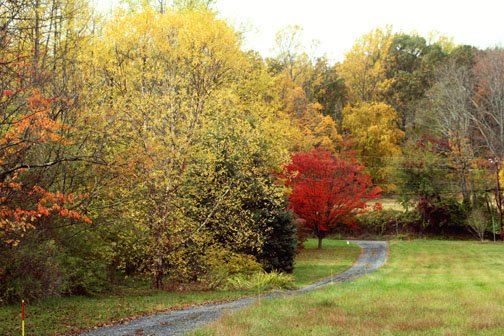
October arrived in a remarkably ordinary way, considering how inconsistent the weather in my valley has been during the past year. There were a few clear days of brilliant sky, some heavy breezes with leaves beginning to drift into the lawn, a couple of glorious autumn days–mild and crisp–followed by a spate of rain and humid air (and toadstools and mushrooms cropping up everywhere), a further yellowing and reddening of foliage, and then, chilly rain.

This is “normal” weather for our area in early- to mid-October. Although the heavy skies and damp chill are not always welcomed by residents, including me, the gardener in me feels relieved. We need the rain and the coming dormancy. The birds relish the late, large insects that frequent gutters and fields, ponds and puddles, providing proteins for a trip south or for winter ahead. Seeds need the watering-in and the cooling-down. Trees need reminders to store their nutrients deep inside when the cold air really sets in.

And pretty soon, I will have bulbs to plant. I want the soil to be moist enough to dig up and the ground temperature cool enough to keep the daffodils still and quiet for several months.

Some years, I write prolifically in autumn; it’s as though the change in season effects a kind of transition within me, and creativity abounds. Other years, not so much. I do notice that when I spend a good deal of time out in the garden, I write more. This fall has not been that kind of season. I have been busy with writing tasks that do not exercise the philosophical or metaphysical side of myself–though I have been writing, most of the work has been reviews, proposals, pedagogy.  I will be posting links to the reviews and essays on the sidebar to the right, adding to the list…

Should fortune–and the Muse–smile upon me, there may be a few new links to poems, as well, in the coming weeks. In November, I’ll be giving a few readings locally. In January, I’ll be teaching Introduction to Poetry again, and I’m eager to try new texts for my students.

Perhaps the post-equinox period will have a creative harvest after all.

Arts festival

Early autumn is a lovely time for festivals. The city of Easton, PA–situated on the Delaware River–is hosting its 15 annual Riverside Festival of the Arts. There will be music, art shows, food, etc. on September 22 and 23.


At noon on the 23rd, I will be reading poetry with Diane Lockward at the amphitheater. Next to the river: a perfect site to read from my book Water-Rites.

~

The link is here. Or check the Events tab above.


Poetry, art, & a little bit more about libraries

After writing about some memorable libraries lately, I realize that I have been able to pursue my passions–indeed, discover my passions–largely through the help of these marvelous civic institutions. It is time I brought my posts back to those passions, however, particularly to my love of poetry.

My family introduced me to poetry through nursery rhymes and hymns and taught me to love narratives through story-telling of several kinds, so the foundation for my lifelong love of stories and poems existed before I ever set foot in a library; but books solidified and focused my various enthusiasms, and libraries offered more books than I could hope to read (though I tried!). Libraries led me not only to novels and poems but to books on visual art, art museums, artists, art history, and art criticism. If I couldn’t get to the Louvre or Rijksmuseum, to Venice or to Rome, I could borrow an art book from the library and be on my way via imagination.

When I got to college, I spent many hours in the library on campus borrowing books I couldn’t afford to buy. Few of those books were required for my academic studies; in fact, I don’t recall doing much research for term papers. I was reading up on and diversifying my own interests, often unrelated to coursework. A look back at my undergraduate transcripts reveals only two classes specifically devoted to poetry, but I recall reading many poetry collections in the campus library. As a junior, I had a work-study job in an office in the library basement. When my hours were up, I’d walk upstairs to the stacks.

I was finding my own way to what I loved.

~

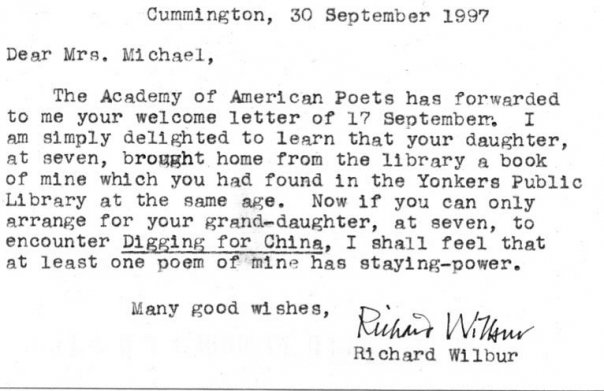
Needless to say, once I had children of my own, we visited the library often. Years ago, I wrote to the poet Richard Wilbur to tell him about my 2nd-grade daughter’s encounter with Digging for China and how, nearly 30 years earlier, I had been fascinated by the book too. He replied with this modest note. June 2009, I saw Wilbur at the West Chester Poetry Conference. What a talented writer, and what a sweet man.

~

Richard Wilbur

A moment of self-promotion

It’s a busy week. I am glad to note that my local newspaper (yes, our area still has a local newspaper) published the following article about my new book, Water-Rites. Many thanks to Collin Roche and Jodi Duckett at the Call.

Profile of Ann E. Michael in Allentown Morning Call.

Thanks for reading, and for everyone’s support for poetry.

“Not Writing”

~

Above, a lovely Jane Kenyon poem and a brief, relevant post from Deborah Barlow, artist, from her blog Slow Muse.

Deborah Barlow's avatarSlow Muse


Wasp’s nest: Entrances abound, but are hidden

Not Writing

A wasp rises to its papery
nest under the eaves
where it daubs

at the gray shape,
but seems unable
to enter its own house.

–Jane Kenyon

This poem is so succinct and so artfully constructed. Haven’t we all had that daubing frustration of madly circling and yet not being able to enter in to where we need to be?

The texture of my life in the studio is like the texture of my life in general: full tilt highs, full tilt lows, and lots of miles in between.

I’m just back from three magical days in Vermont, visiting friends and basking in a landscape that is richly rewarding on so many levels. I didn’t miss being in the studio once. In fact this protracted channel change felt like much needed relief from a fierce summer stance to rouse the inchoate…

View original post 45 more words

Short books and re-reading

~

clockWhen life gets busy and over-scheduled, even an inveterate reader may find she has to give up some of her precious book time to life’s other adventures and responsibilities. Philosophy and meditation require enough time for reflective, slow thinking; a hectic week precludes such activities. Creative thinking gets funneled into problem solving of a more mundane and practical variety. Creative writing? It may have to move, temporarily one hopes, to a back burner.

Last week was one of those over-scheduled periods when I take advantage of brief, unscheduled minutes to read short books. The beauty of reading short books is that the best short books reveal depths upon re-reading–one of the beauties of poetry as well. And if those short books happen to be books of poetry? “More’s the better,” as my great-aunt used to say.

During my crazy week, I managed to read three short collections of contemporary poetry, all by poets with whom I am personally (if marginally) acquainted. All three books are wonderful: layered, varied, well-crafted, interesting, moving, refreshing, surprising reflections on and of modern life with enough empathy and reach toward the “universal” to keep the poems valuable beyond today’s context. All three books are going on my re-read list so I can study and savor them again later, yet each collection is vivid and entertaining enough to read when crunched for time.

~

Will Greenway’s 1999 collection Simmer Dim was published by University of Akron Press and offers the reader a travelogue to many places in the world without as well as the more interior worlds of memory, relationships, and reflection. Greenway writes in both free verse and in rhyme, which he employs so well it seems natural even in the informal diction his work often takes.

April Lindner’s 2012 collection This Bed Our Bodies Shaped was published by Able Muse this summer. The poems offer the sense of a personal speaker, suggesting intimacy that is revealed subtly through well-crafted lines and images of flowers, scene-settings, and  allusions from the classic to the modern (rock n roll). Lindner presents the woman’s perspective as individual, surprising, and non-stereotypical; when she writes about jobs, a lover, motherhood, or menopause, her observations are often quirky but wonderfully observed.

Elaine Terranova’s 2012 collection Dames Rocket was published by Penstroke Press. I love Elaine’s work, steeped as it is in the natural world, plausible and tactile, yet positively ascendant in tone. Her memoir-type poems evoke the kind of childhood that is fast becoming historical, and her awareness of that fact–the fact of aging–gives these pieces poignancy and occasional irony.

~

All three books are also available on Amazon.com. Or ask your librarian to locate a copy for you.

Amazon…

The second week of August is always a busy one for me. There’s little time for reflection–or writing.

I do have some news to impart, however: Water-Rites is now available on Amazon.com at this link. In the best interests of my publisher, Brick Road Press, I’m going to request that you order from the press itself if you can.

Thanks!

Ambition & failure

Some of my non-writer friends are surprised to learn that I am in the process of trying to get a new book into print. After all, Water-Rites just came out! So shouldn’t I be concentrating on selling that book and resting on my laurels awhile? To be sure this collection is a “success” before continuing on?

Those who write poetry or literary fiction, however, recognize that by the time a book finally gets published, the work in it is “old.” We are already well into new projects, working on new ideas, using new styles to express ourselves, addressing different topics. If I were to wait to write new poetry until after my book got into print, I’d probably never write another collection. The economics of the poetry world are too close to what Lewis Hyde calls the “gift economy” to imagine we can stop writing, sell a book, live off of the income and then write another one. Even many best-selling authors cannot do that. Poets are lucky to sell 500 copies of a book. We write for other reasons. Need. Love. Ambitions of a non-monetary kind.

Like all artists, poets take risks. Sometimes the changes we make in our work are not well-received. Sometimes they aren’t any good. Failure, however, can be a most excellent instructor. Sometimes, to shake myself up when the writing seems stuck, I attempt a completely different activity. Gardening clears my mind, and gardening offers many chances to fail at what I do. I’ve also tried watercolor painting, sumi ink calligraphy, modeling clay, embroidery, dancing, piano, and many other endeavors. I cannot claim to be remotely good at any of them yet each of these pursuits has taught me much…often through my lousiness.

janis ian

Janis Ian, 2012. Photo by David Sloan.

Recently, Janis Ian–singer, songwriter, science fiction author, and philanthropist–offered the commencement address at Warren Wilson College in Asheville, NC. In her speech, Ian talked about being self-taught; being a self-taught success. And she had important things to say about failing, as well. She said, “We are rarely asked what success really represents to us, or why failure is so demeaning.” Then, she admitted that she herself had always avoided failure but that at a point in her life when she felt unhappy with everything she was producing, “I had to learn to fail before I could find my way again.”

Her approach was to take ballet lessons! At age 33. And she was awful at it, but she enjoyed doing it. Then she attempted other things at which she was terrible, and she learned to overcome some of her fear of failing.

An autodidact myself, even though I do have academic degrees, I found I could easily relate to Ian’s experiences. The part of her speech that spoke to me most was this section:

“You see, I am an artist. I believe that art saves. I believe it is often the only thing that stands between us and chaos. I have faith that while the world is crumbling, art survives. So to feel like my work was a mockery of what I could do, that I was not living up to my talent…well, it was killing me.”

Art requires us to do our best, to be ambitious and strong, to take risks and –occasionally– to fail. To fail spectacularly perhaps, or just to produce a bunch of small, humiliating, stupid failures…like dancing badly in your own room where no one can see you.

But dancing can feel so wonderful, so freeing, so different from writing! It’s worth doing badly. Sometimes when we have less at stake, we find new methods of expression and new ways to keep our fears, including the fear of failure, at bay.

~~

The full speech is available on Warren Wilson’s site here.