Fruition

In 1999, my beloved friend and fellow poet David Dunn died of a diabetes-related embolism. A few years later, some of the poems I had written as I worked my way through my grief made their way into my graduate school (MFA) thesis. After more years of writing and revision, that manuscript became Water-Rites…

which is now a book. Many thanks to Keith Badowski and Ron Self of Brick Road Poetry Press and to the friends and colleagues who helped me to work on these poems and who encouraged me to persist in finding a publisher for the book. Link to purchase is here: Water-Rites.

water-rites by Ann E Michael

Thanks also to sculptor Steve Tobin, whose sculpture “Retretti River” as photographed by George Erml gives Water-Rites a striking cover image.

Thanks to my writing group for almost 20 years of critique and support, and to my mentors and instructors at Goddard College, and to colleagues who have written kind words about the poems. Here’s a quote from Barbara Crooker (whose poetry & website can be found here):

Ann Michael says, “There is nothing wonderful here,” but clearly, she’s wrong, as Water-Rites contains many wonders:  goldfinches, “lovely in the lost way of beautiful things,” the richness of beans that “lie warm / one inch below the earth; uncounted yet,” an ordinary robin’s egg, a yellow-shafted flicker in black and gold tail feathers. This is the natural world Ann Michael inhabits and explores: her home, her garden, the landscape of eastern Pennsylvania that surrounds it. Michael takes us on a journey through the woods of loss and grief in poems that are as clean and clear as water running over stone. “And what is as beautiful as water?” she writes.  These poems are unencumbered by unnecessary wordiness, enhanced by careful word choice and a richly varied vocabulary. “I know what I daily know,” says Ann Michael, and now we, her readers, know these things, too.

     ~Barbara Crooker, author of Radiance, Line Dance, and More

More thanks to my non-writing friends who have enriched my life in so many ways, and to my wonderful and supportive family members.

And to David Dunn, who is with me still wherever he is.

Art and “human intelligence”

I’ve gotten almost to the end of Brian Boyd’s intriguing and well-argued book On the Origin of Stories, which makes fairly large claims about sociality, cognition, theory of mind, art, and storytelling (ie, fiction) given an evolutionary perspective (art as adaptation). The first 200 pages lay the foundation for his claims; he provides evidence from the “hard” sciences, most often biology and neurology, and from archeology, anthropology, and psychology, to back up his theory that art is an evolutionary adaptation humans developed in order to live as social animals. And that art is necessary for human cognition in terms of further developing intelligence and the ability to communicate among our peers: it is cognitive play, practice and skill strengthening for mind and muscle.

Big claims, and occasionally hard to “prove” from the hard sciences. I believe he does a good job with that set of proofs, but I’m not a scientist. His claims based on social sciences—anthropology, sociology, psychology—are very convincing; but many people have arguments with those fields because they are so apparently subjective. Most exciting to me is the way Boyd synthesizes neurological findings with evolutionary developments.

Actually, most exciting to me are his chapters on the Odyssey, but that may be because I am a literature geek. He essentially writes a literary analysis of the Odyssey based upon the inferences and findings in the first half of this book (evolution) rather than the customary literary analysis grounded in, say, context or culture of style or theme, ad infinitum. The resulting analysis is, for me, a truly exciting way to look at Homer’s work and why it matters now, as well as why it mattered then.

Boyd comes close to making the assertion that Homer made Socrates possible, and hence all of Western civilization’s philosophy and social intelligence. Of course, he is careful not to go that far in his argument—he steers as far as he can from logical fallacies— but the thought certainly feels planted in the reader’s mind. His argument does suggest that metacognition in human beings is the definer that makes us human, and art as more-than-play separates human from not-human. He also demonstrates that the Odyssey offers great leaps beyond older epics and posits that the author(s) composed the epic for contemporary audiences that were capable of intelligent, sophisticated, “modern” thought processes; the piece is therefore not primitive literature, as some critics claim.

Boyd’s work has also turned my thoughts to how the attributes of attention, perspective and foreknowledge, overturned expectations, audience-sociality, false belief, cooperation and competition work in the poem as well as in narrative. Granted, many poems have a narrative framework, however thinly sketched, but not all of them do. When there is no narrative frame, these other aspects of storytelling (audience expectations in particular) take precedence and can be employed in almost infinite ways, bounded only by imagination and the willingness of the reader to pay attention as the writer earns that attention through a host of innovative or traditional skills.

A last thought…I spent the long weekend visiting octogenarian friends, both of whom are wonderful tellers of stories. The value of such people to human society is priceless:

“Story by its nature invites us to shift from our own perspective to that of another, and perhaps another and another.”  ~Brian Boyd

Just-so

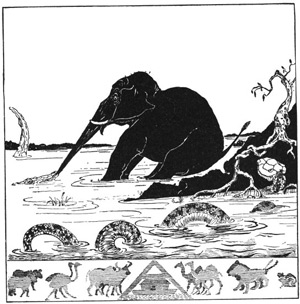
This classic illustration was posted here: http://www.jwoolfden.com/classics.html

OKAY, cynics, I know this may be a bit of a gloss; but here is another older post which is the keynote speech I gave for DeSales’ Sigma Tau Delta induction (Honors society of English majors), April 2010.

~

Why the English Major Is So Adaptable: A ‘Just-So’ Story

When I was an undergraduate, Oh Best Beloved, I was not at all certain of my life path. I attended an alternative, seminar-college program that—gasp—did not require me to proclaim an academic major. In my first two years of college, I wandered through classes in studio art, Renaissance history, feminist literature, social anthropology, psych, physics, dance, and philosophy. Then, I began reading in earnest. Previously, reading had been merely an obsessively entertaining hobby; as a junior, I wanted to learn the “how” of writing. I graduated with enough credits in both English and Philosophy to have been a double-major, if my institution had required majors, or to have received an undergraduate creative writing degree, if such a thing had existed in days of yore.

And then, I was out in the world. The world was in a terrible recession. Jobs were scarce. Inflation was in the double digits. Gas prices were skyrocketing. The sky was falling, and I was a newly-minted English major.

All my Wise Elders advised me to specialize. That meant going to graduate school, which I probably should have done a little sooner, or learning a trade. I thought I could survive outside of academia despite the economic woes, the scarce want-ads. My reasoning was that I had four years of humanities training in critical thinking, research, and problem-solving and that at 21 years old it was time to put those theories into application. I thought I had learned to be adaptable.

And what do you think, O My Children?

I was right.

You are likewise English majors, and you are also facing a time of recession and a paucity of careers in your chosen area of interest. This will not hinder your success, though it may make your career journey a little more…circuitous. Or shall we say: intriguing. But you like a challenge, don’t you? That’s the most terrific thing about choosing creative writing, or English, or rhetoric, or literature—the more you study them, the more intricate and complex and revealing these subjects are. I have never met an English major who wasn’t also a dedicated life-long learner. But I have met English majors who are lawyers, and psychologists, and social workers, and business executives, and filmmakers, and visual artists, and physicians, and ecologists, and diplomats, even computer geeks, not to mention those other careers: screenwriters, playwrights, poets, novelists, journalists, bloggers, teachers…

So, Best Beloved, do not sell yourself short. Furthermore, do not expect a “Reader, I married him” moment with your career. Allow yourself room to transform. Carpe diem.

What that meant for me back in 1979 was a temp job for the legal discovery department of a large law firm. From there, I signed on as a member of the International Union of Typographers No. 6 and learned a specialty: typographical proofreading. That field went extinct with the advent of desktop publishing. But by then, I’d jumped to advertising, which I hated, and into magazine work, which wasn’t so bad. There’s a Darwinian term for this: co-adaptation. I was finally getting close to a more specialist use of my English major background as the economy improved; and I married and had children and, in time, went to graduate school for the scholarly pursuits I’d missed so much.

I didn’t starve. Neither will you. You can do research. You can make yourself clear. You know your audiences may require different modes or styles of you, and you’ve learned how to adapt yourself and your arguments to those audiences. You can be persuasive. That’s how I got my first job after the temp work wound down; I was inexperienced but convincing. Even in a tight job market, employers are seeking people like you—adaptable, well-educated people. My husband recently directed me to an article in the New York Times that stated today’s businesspeople want employees who are clear communicators, especially in writing. This is partly because executives do their own writing nowadays. Fewer secretaries to rely on; each person’s expected to make herself clear—on her own written merits. Even if it’s email instead of the paper memos of my day.

English majors can write.

The jobs I’ve briefly mentioned paid my bills and got me medical insurance but did not satisfy my urge to practice the how and why of writing, so I did what writers generally do: I wrote. I cannot emphasize enough the role that constant practice of craft plays in the development of a writer. It doesn’t matter if no one sees your work—though I encourage you to share it with others and get feedback and critique—what matters is that you continually practice what you’ve learned in college and extend your education through application and extension of those principles.

If you find yourself in a day job that has little, apparently, to do with your major, don’t despair. Because writing is portable. I still write most of my drafts with pen or pencil in a small notebook, and laptops are pretty easy to transport—you can, with a little self-discipline, write anywhere. In my day, I have written in small dingy office warrens, in the waiting rooms of doctors and music teachers, in the parking lot while the high school band wrapped up its practice, in the sun beside the dressage ring at the horse farm, while my babies were napping, while the laundry was cycling, in the wee hours of the morning before anyone else wakens. The poems and essays I drafted under these circumstances sometimes reflected the places of their composition—but not always. I have waxed metaphysical in playgrounds. Another example of becoming adaptable out of necessity, Best Beloved, when the Great Magician or the Djinn of All Deserts or the small god Nqa tried me with obstacles to test my persistence.

Make the time to write, because writers can get rusty. Above all, make the time to read, because after you graduate, reading is the best way to continue your literary education.

But you knew that.

Of course, there is graduate school. And there are writing seminars and getaways and retreats and conferences. If you haven’t got the time or money to get to writers’ conferences or workshops, you can adapt by exchanging literary emails with a few like-minded friends or gathering in a library or coffee shop to exchange work or discuss books that excite you. Scholarship may seem like a solitary pursuit, but it benefits from lively interactions with other human beings.

Yes, Oh Best Beloved, do remember other human beings. We do not, after all, write only for ourselves; we write in and of and for a community of people. If our work is obscure, obtuse, or unclear, we are not taking part in this communication. The most fundamental purpose of language is to make clear our intent to another person who is, after all, not inside our brain but functioning under his or her own neurological system. Language—in our case, English—is the most formidable tool for demanding, commanding, sharing, expressing. Those in this room are understandably passionate about it. I am pleased to be among you. The world badly needs your talents, enthusiasm, and the abilities you possess to analyze the facts and transform yourselves and others because, My Children, the English Major somehow became adaptable, and that is all to the good.

Reveries toward childhood

My childhood was happy and full of isolation—bored, lonely, occasionally melancholy daydreams and reflections. Some readers will find contradiction in that opening sentence, but Gaston Bachelard would have understood. His chapter (in The Poetics of Reverie) on Childhood and Reverie resonates deeply with me.

The claims Bachelard makes for the crucial importance of childhood reverie are that the child, solitary, daydreaming, finds happiness as the “master” of his or her reveries and that poetry is the way adults can return to the deep daydreams of childhood in which humans are—briefly—free beings and fully receptive: “Poets convince us that all our childhood reveries are worth starting over again.”

He further claims that images “reveal the intimacy of the world” and that all poetic images are a kind of remembering. I suppose this particular claim for poetry puts Bachelard in the “deep image” arena of poetry—Rilke, for example, as filtered through the concepts of Carl Jung, whose influence appears everywhere in The Poetics of Reverie. I waver in my complete acceptance of this claim, though I can’t yet articulate why—because I do agree image can evoke, or even be part and parcel of, intimacy. It may not be the sole method of achieving the shock of recognition or the tug of familiarity among readers, however. I’d assert that Ammons, Menashe, even Ponsot (in her tiny poems in Springing) get there by other means.

What I love about Bachelard’s philosophy on childhood reveries is the idea of “reveries toward childhood.” Interesting phrase, and I wonder if the translator (Daniel Russell) struggled with it. To dream toward childhood denotes an intentional action, a moving forward in order to reach back, a paradox. He claims we can almost reach (regain) the child’s “astonishment of being,” our “world of the first time,” through reading poems. We daydream with the poem itself…not with the poet, who remains a distinct individual with his or her own being and past.

I’ve experienced this feeling, and now Bachelard has described it for me.

The philosopher was late in his life when he composed these reflections; this is his last book. As he explores the “uselessness” of childhood memories, the flashes of recall through sensory stimuli, he posits that reveries toward childhood nourish the person who is in “the second half of life.” Combining memory and reverie can restore us, he says; and to do so, we first beautify our pasts—even our tragic episodes are reconsidered, reconstructed, through the lens of distant memory. (Hence the opportunity for sentiment). I think he means that once we have dealt with vivid past traumas earlier in adulthood, older people are able to recall the amazement of having once been new to the world. Perhaps this is merely sentiment, but it is certainly a phenomenon that appears in many works of drama, fiction, even memoir.

Bachelard describes such experiences as “the strange synthesis of regret and consolation” and adds that “a beautiful poem makes us pardon a very ancient grief.” (I love that sentence.)

In this way—among other ways, I might add—poetry’s images help us believe in the world, revive “abolished” reveries in a fresh light; the poet’s images may not be our images at all, yet they work to move the reader toward childhood, by which I mean toward a seeing-afresh of human experience. I may be parting ways with Msr. Bachelard here, for he classifies these images as almost wholly archetypal, and I do not; nonetheless, I don’t think our differences negate his claims nor hurt my general agreement with his insights. The amazement that took off the top of Emily Dickinson’s head when she read a great poem, the astonishment of being that arrives via the poem, strikes me (and the pun is intended) as exactly like the Zen whisk: “Wake up!”

And what is a child but a being who is wholly awake to the world?

“When we are children, people show us so many things that we lose the profound sense of seeing,” Bachelard says. Yes, like Whitman when he “heard the learnéd astronomer”… Whitman’s speaker—the child in him—ventures outside to see the stars. He does not need to be shown.

This is a long blog entry, I know. But if you’ve gotten this far, I hope you are eager to go read some poems now.

Wake up and dream!

Still daydreaming in adolescence…(Switzerland, 1974)

22 years ago this week

Here’s another post from some time back, one I have updated to reflect current experiences: the graduation and the 22nd birthday of the subject of this brief reflection.

azaleas by Ann E. Michael

The morning was hot, and I had not kept up with the gardening. I needed to get the zucchini seeds, etc. in the ground before the weather got too hot and dry. We were a little behind schedule with the garden because we had a 17-month-old, and I was 9 months pregnant. I was sowing and weeding as women have done since the earliest establishment of agriculture, heavy with child, my back aching, working like a woman obsessed.

You know, that “nesting” thing you hear about with mothers-to-be? I was a week overdue and sick of waiting around; and  gardens won’t wait. The weather was perfect for planting the post-frost seeds. The time was–of course–ripe. Eight hours later, I gave birth to a daughter.

A couple of years later, too busy to write much, this set of cinquain stanzas arrived in my mind (published in 2001 in June Cotner’s anthology Mothers & Daughters, A Poetry Celebration).

Now, that infant is a grown woman with a  college degree. Happy Birthday, Daughter.

To My Daughter

Early
morning I had
planted seeds, cucumber,
melon, squash—I pressed them into
warm earth.

The blood
in my body
sang and I listened for
a cry to join my own—straining
to hear.

And there
you were, all pink,
unfolding in our hands,
a blossom opening with a squall:
daughter.

© 1994 Ann E. Michael

Fragments…

I just want to re-blog this brief and thought-provoking piece by Michael Klein in Ploughshares:

Notes on Narcissism and the Line

Klein’s musings have inspired me to go back to my drafts of the past year and look more closely at fragments, lines, and the self in the poems.

I’ve also discovered, via Deborah Barlow’s delightful art-centered blog, Slow Muse, the art and prose of Altoon Sultan. Reading and viewing creative pieces and creative critical thinking is a marvelous spur toward one’s own creative endeavors. Although I do risk spending more time online, reading and viewing, than I ought…

Enjoy!

A William Carlos Williams moment in Emmaus

As the spring semester closes, I am trying to get to some housekeeping of several sorts–literal and metaphorical housekeeping. Yard work, filing, dusting, going through poems and essays and books I meant to comment upon…revisions, half-finished proposals and papers, and folders on my computer that are obscurely titled and mysteriously organized.

One thing I thought I’d do when I have a few minutes at the computer is to upload some past notes from a site I no longer use. Most of them are not worth saving, but there are a few I still like. Here’s one dated Saturday, April 18, 2009:

~

Working in the yard and garden this morning. The peas are sprouting, the asparagus are poking up. Here’s the anecdote of the day for those of you who appreciate a little poetry allusion.

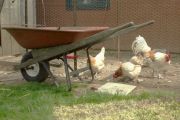
My husband, preparing to move some topsoil, yells to me, “Where’s the red wheelbarrow?”

And I was able to reply, because it was literally true: “Glazed with rain water, beside the white chickens!”

white chickens

[A photo from later in the day–the rainwater glaze had evaporated.]

Re-reading & reverie

Writing a book is a hard job. One is always tempted to limit himself to dreaming it.

Above all, the great books remain psychologically alive. You are never finished reading them.

–Gaston Bachelard

~

In The Poetics of Reverie, Bachelard writes of reveries on words, then moves to reveries on reveries themselves, which brings him to books. Books (philosophy, fiction, and poetry books in particular) are, for Bachelard, a kind of dream made real. Books are places to dawdle and to dream as one reads, places in which the reader can interact with imagination: the reader’s  imagination, not the author’s imagination. The author’s work, if it is great, tempts readers into reverie. For this reason, Bachelard says he likes to read his favorite books many times. Each reading produces new reverie.

The chapter in which he makes his case for literature as reverie is an odd one, less of a philosophical argument and more a blend of literature, psychology–particularly along Jungian themes, and sociology, with side trips into discussions of duality (more on the masculine and feminine), the physiology of sleep/dreaming, alchemy (more Jung!), Strindberg, Goethe, Nietzsche, Henri Bosco, and Balzac.

I prefer the chapters on either side of this one (on words and on childhood). But this section made me consider the books I have re-read in my lifetime, and the idea of dreaming with literature. And the lovely idea of books as “psychologically alive.” What a terrific observation!

When I was a child, I preferred reading the next book to re-reading a favorite, although there were a few books I read over, more than once in some cases. As I read my way through high school and college, my inclination toward novelty continued. Why spend time reading books I had already read? The dreaming-with the book aspect Bachelard describes did happen for me, but the reflection lasted only as long as my engagement with each text. I was not a “close reader,” and as a result it was easy to get wrapped up in the dream-world when I read fiction. Still, the dream was the book’s dream, not my own. Closer reading is what leads to reverie, I think: re-reading and reflecting.

It was poetry that taught me to read more closely, to re-read, to dream with the text, to find true reverie in the process of reading. Poetry has always felt psychologically alive to me, and I agree that one is never finished reading a great poem. Or a great book.

I find I must also concur with Bachelard that “one of the functions of reverie is to liberate us from the burdens of life.” Nothing like a daydream, or a great piece of literature or art, to free us–however temporarily–from the things that weigh us down.

Interview

“Who has not sat, afraid, before his heart’s
curtain?  It rose:           the scenery of farewell.
Easy to recognize. The well-known garden…”
–Rainer Maria Rilke
~

primrose by Ann E. Michael

Herewith, a recap of my side (much edited) of the ArtsAlive! conversation this past Sunday at Soft Machine Gallery. SØrina Higgins was also reading and being interviewed by Lehigh Valley Arts Council director Randall Forte, but I can’t adequately summarize her insightful comments. You can find her book here, however.

~

RF: What is your favorite poem in the collection Water-Rites?

AM: I hate to try to pin down a favorite poem, by my favorite writers or by myself. I once heard Billy Collins reply to that question by saying his favorite poem is always the one he is currently in the process of writing. That’s kind of cleverly evasive, but it’s also a little true. Though sometimes I hate the poem I’m currently working on…

I like the title poem, but I get a kick out of “Doxology” because it is so odd; and perhaps my favorite poem is “Tailfeathers” or “The Big Umbrella” or, for purely sentimental reasons—not because it is my best poem—“At Bull’s Head Pond.”

~
RF: What was the most difficult poem to write?

AM: The most difficult poem to complete was probably the long poem in the center of the collection, “The Valley, the Whitetail: A History.” That was difficult in terms of managing the length and the purpose of the poem; also, it required some research. Yes, occasionally poems take quite a bit of research—I have no desire to be inaccurate when I am writing about history or geology or botany (though I often am, inadvertently, despite my best efforts). Not all poetry is solely a work of the imagination.

There are other ways to be “difficult” however. A poem that was hard to complete was the elegy “I Shall Never Be Nearer,” which came quickly initially but took a long, long time to revise and to come to terms with. Not all of these poems—or any of the poems I write—are “about” me or my experiences, I mean, not as biographical as they may seem. But this poem does deal very specifically with the death of my close friend. It was the day after I learned of his passing, and, completely numbed and sleepless, I went with my family for a canoe trip on the lake. I titled this poem “Single Lines” for several years while I was revising it, because the images came to me in – well – single lines. Single images. I must have revised little tiny things in it oh, about 14 times. So I guess that means it was “hard to write.”

~

RF: So, the opposite question. Which poem was easiest to write?

AM: Some poems do come quickly and relatively easily. Not often, and sometimes those that come rapidly end up being sort of crappy poems. But “Lot’s Wife” only underwent about 2-3 drafts and mainly arrived, haiku-like, as a visual image that carried with it some cultural freight.

Another poem that arrived rather miraculously is “River by River.” That was the result of a car trip to Indiana with my kids and is kind of a list poem. It spooled out as a result of a kind of inadvertent prompt. Will Greenway and Elton Glaser were looking for poems about Ohio for an anthology. I read the call for work, went back to my notebook about the car trip, and recalled an incident with my son and a roadmap. The editors chose it as the opening poem in the main text of the book—immediately following the preface poem by James Wright. I felt completely graced and humbled.

~

RF: How did you choose the title of the collection?

AM: Early on, while I was working on my graduate thesis project, I chose the title for the book. I’d written the title poem but hadn’t really thought of it as the title poem until I recognized how many of the poems dealt with drought or with bodies of water or rain or artworks that portrayed water. And spelling the second word as “rites” as in ritual, rather than as an other interesting aspect of water—the “rights” to water that have caused so much conflict over the centuries—seemed fitting given that there are also rites associated with death. Funerary rites, religious rites. And rites in the form of chants and dances people have done to invoke rain during times of drought. So there’s a pun there, rights and rites, and I love literary puns.

I wanted to use Steve Tobin’s sculpture as the cover art, and Steve granted the rights for that photo (more rights, legal rights) and Keith at Brick Road approved of the image for the book cover. So I am gratified by all of that. The sculpture is an early work of Tobin’s, when he was making art using surgical glass piping. It’s environmental, site-specific art that really looks like a splashing creek. But it isn’t—it is glass.

~

RF: Tell us about your publishing history and about how and if poetry publishing has changed over the years.

AM: I had my first poem published in a tiny literary journal back in the days of Xerox-ed micro-magazines, 1981 or 82. I’ve been publishing pretty regularly since then, regularly but not ambitiously. Lots of individual poems and essays in individual journals. I had no academic reason to get a book out, and I had no real direction either. It didn’t seem to be on my to-do list when I was in my twenties. Then, at 30, I had my children. Most of my creativity went in the parenting direction, though I continued to write. I didn’t really work toward book publication until about 1999. Then I began to think about it—after David Dunn had died. In fact, I got a chapbook and a full-length collection of his work out after his death. This is hard to do—to convince a publisher to put out a book posthumously. After all, the poet cannot promote his work. That’s hard on small publishers. But I succeeded. So I thought, I guess I can get my own books published. Maybe. And my first collection was a chapbook Spire press published right after I graduated from Goddard, 22 poems about building a house, sort of ecologically-invested nature-type poems.

Things have changed in the world of poetry publishing, but it is still hard to get your work into actual print—ebooks and POD self- or partially-self-published options, as well as the web and blogs, have changed the spirit of the poetry world only marginally, though I do think these options have made it possible for more people to read and encounter poetry. The absence of critical, discerning, well-read editors & proofreaders is a loss, in my opinion; but poetry is finding other ways to deal with that. And those editors are still out there. Underpaid and overworked and cranky, but out there nonetheless. MFA programs, perhaps. Critique groups have maybe replaced salons and absinthe cafes. I don’t know.

~

RF: Any advice for aspiring poets who want to get published?

AM: I’d advise aspiring poets to be ambitious. But there are many ways to be ambitious. I’m a bit of a plodder, but I hang in there. I’m not great at networking or schmoozing or even being sort of normally assertive—I’m quite shy with strangers and hate to ask even small favors…like asking an editor to consider publishing my work. Or asking people to host readings. I mean, that goes with the job, but it’s taken me a long time to get good at doing that. I hate that stuff lots more than I hate being rejected. I don’t take the rejections hard at all. My weaknesses lie in other areas. So I can say, if you want to get published, you might not want to do what I did…anyway, if you are eager to see print soon, you might want to be more assertive and organized. On the other hand, I have been self-promoting rather badly for thirty years; and I’m okay with that because the poems are better after thirty years even if my publicity skills are not.

I’m kind of outside the box as far as the “po-biz” goes. I do my job at the college, which is only marginally poetry-related, and then only when I am teaching a section of intro-to-poetry. (Mostly I teach remedial comp and tutor students in English; I like to remind myself that Kay Ryan has the same kind of job!). I attend conferences when I can get away and when I can afford them; I have taken seminars and workshops over the years, but not religiously or frequently. The “big thing” I did for my so-called career was to get an MFA from Goddard College in 2003. This was after I had won a PA Council on the Arts Fellowship—back when the council was giving those out. Please lobby your congress people for an increase in federal and state arts funding. That was so crucial for me, earning that grant. A great confidence-builder.

Since then, I’ve earned my MFA and have four chapbooks and this full-length collection coming out and a job in academia that I probably wouldn’t have if it hadn’t been for my graduate studies and a certain amount of dogged persistence of a sort of quiet variety that I seem to possess in abundance. I still send out individual poems for publication in print and online, though not as often as I should if I were really eager to stay on the po-biz radar. I keep up a blog and a Facebook page for “promotional purposes” but don’t expect to see me on your Twitterfeed anytime soon. Technology takes me away from my reverie zone and is, generally, bad for my poetry. What’s good for my poetry are long walks, gardening, and genial loafing, visits to museums, viewing architecture and geological formations, long face-to-face chats with friends, and reading reading reading.

The quote that opens my book, the Rilke quote, kind of sums that up for me. It’s really the well-known garden that makes me recognize where the poems are coming from. The scenery of farewell, in this case, opened up the place this collection began, in loss and later in fullness.

Reading & discussion

Sunday, April 29th, at 2 p.m., I will be reading at Soft Machine Gallery in Allentown PA, at a special program hosted by the Lehigh Valley Arts Council. The event is described below:

Poetry: Getting the Word Out!

Location: Soft Machine Gallery, 15th & Green Sts., Allentown, PA

Arts Alive series event. Local poets will read selections from their new books and unravel the mystery of getting published. Hosted by LVAC director Randall Forte.

~
Ann E. Michael, author of the upcoming (June 1, 2012 release date) poetry collection Water-Rites and
Sørina Higgins, whose poetry collection Caduceus was released late last year.
Books available for sale. Refreshments provided. Sun 2 pm. Admission $10.