Correspondences

Dear Beejay,

Remember how we used to correspond by email every week? Sometimes more often. You, the best correspondent ever, though we never wrote paper letters–in those pre-internet years, we’d lost touch, moved too often; no postal mail from you until, once we were connected again, you sent me a birthday card. And tomorrow is your birthday. So here’s your birthday email. You see? I didn’t forget.

It remains dry here. That spate of rainy days in early April? Over with and barely a half an inch since then. I’m watering my veg garden daily. Today I sowed another row of spinach. The first and third sowings are doing well, but the second sowing didn’t germinate–can’t figure out why not. The lettuces and other greens are looking good, and the strawberry plants are in bloom. I even took a chance and planted some zucchini seeds. The task of thinning lettuce and carrots is indeed tedious, but it is a lovely day and the air is mild; and frankly, thinning carrots is less tedious than sending poems out to literary journals, I know you’d agree.

I’ve been reading a lot of contemporary poetry. It comforts me somehow, even when the poems are sad or angry poems (that seems to reflect the times, which poetry can do). Your own writing, who has it? Does it exist on some hard drive somewhere? You always were excellent at organizing things. A talent I envy and do not possess.

Anyway, I did a bit of weeding to prep for the tomatoes and peppers when the seedlings are ready to transplant, but I got a late start on them and may not even move them to the garden until after my trip to New Mexico. Right now we’re getting pollen blow here. I expect your pollen blow was over two or three weeks ago, and that the azaleas are past their showy bloom time down there. I know how you love azalea season. And the beach–I guess you won’t get there this year.

I do find myself, at odd moments, wondering about your cats. When our lives were routine and there was nothing of interest to write about, we could always turn to cat anecdotes. Today, my Nessie joined me in the garden while I was working on the carrot patch. The catnip plant in the herb bed has leafed out quite early, and Nessie stretched his whole lean body over it and lolled himself into a snooze-fest, exposing his white belly. You would have laughed. You always called tuxedo cats “Holsteins.” I’m insulted on Nessie’s behalf.

When a person we love dies, I guess there’s an impulse–almost an instinct–to memorialize them, at least among those of us in “Western societies.” Or maybe it is a human impulse, I can’t say. I have written too many poems of elegy, and there will be more; but sometimes, it takes awhile before I feel I have the right perspective or frame of mind to write about them, or about my feelings of loss. Today, so much reminded me of you, Beejay, that I had to write something. If not a poem, then an epistle–the way I used to write to you, of ordinary things, the garden, cats, seasons, poetry.

Happy birthday, wherever you are.

Reading my contemporaries

The poetry collections I’ve been reading during much of the past year have largely been works of contemporary writers–books that were published during the past two decades, some during the past two years. My focus on such current work was not intentional. After all, there is still so much poetry from the past three or four thousand years that I haven’t yet explored! Grad school, however, was decades ago; that’s when I last studied both contemporary and classic/canonical/influential poems with a specific eye to learning from them. I continue to learn from the poems I read, though. I just don’t take as many notes or write any papers about them these days.

Three collections I read recently have got me thinking about the grittier sonic elements in poetry; the use of scientific, foreign, antiquated, and invented words; wordplay in general as a poetry component; and how sound can push both experiment and meaning in a poem. I’ve been mulling about the task of writing anything that feels “new,” to me or to my readers, and about the challenges more sonic wordplay would mean for me as a writer. I’m saying here I think it would be difficult to do, because it differs from my long-accustomed voice and style. I’m also saying I like a challenge in creative work, and that my style(s) go though changes always, so why not? In creative art of any kind, the passing of years makes a difference in many things. Content (because: experience). Situation (because: life happens). Methods (because: technology and materials). And influence–what I was reading in high school vs. grad school vs. today–though some favorites will always hold a place in my creative mind.

My poems tend to be plain-spoken, although I’ve never been shy about going beyond the standard vernacular to employ a geological term, a botanical name, or a somewhat archaic noun or adjective when it suits the feel and sound of the poem. Most of my poems don’t fall under the description of experimental or edgy. I’m not making waves with language, but some poets are. And my recent reading has me wanting to experiment more. It will mean failing a lot, because I’m working against my habitual methods of composition. I won’t be as good at it as these poets (below) are. What I’m hoping, though, is that the practice of trying more sonic wordplay in my work implants a tracery of that practice onto my poetic voice.

~

So which contemporaries do I mean? More than the three I’ll briefly mention here, for sure (and it is not as if the only poets playing with words and sound are my contemporaries–far from it). However, here’s a start with some examples that I particularly love.

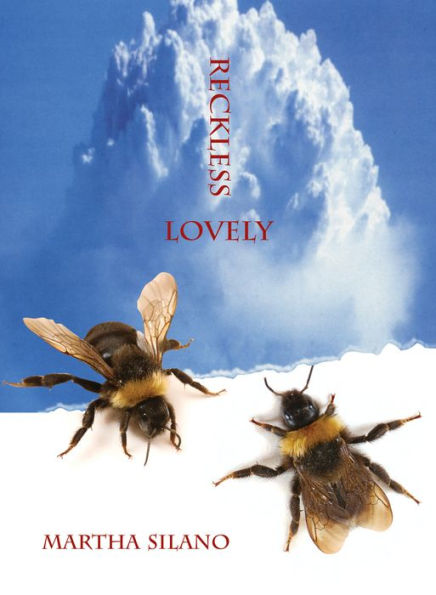
I mentioned Silano’s poetry in a recent post when I appreciated her scientific ideas that meld with an “everyday” life. Reckless Lovely contains many long-lined couplet verses that name objects such as a 64-ounce Big Gulp, Wells-Fargo, Italian Renaissance paintings, or the red spot on Jupiter as the poet observes and speculates on the cosmos that surrounds her. And she invents or alters words that suit her for rhythm, alliteration, sound: “the sfumato is sfumato-ing, the lute-r is lute-ing;” “when most of all that creep-eth/breath-eth buzz-eth/galump-eth sex-eth spar-eth/went AWOL/paving the avenue of asp/the boulevard of bee…” or the totally wild mashup Silano composes in “Summons and Petition for Name Change”:

Dim sum-my dilberry. Down there Daquiri.
Ear of Eden. Eminently Earthy. Empress Gensho.
Fandango-ing funnel. Fox foot. Flamingo.
Geranium in the Gate of the Gourd. Gentian's grin.

~

I find much to admire in Martha Silano’s work even though I often have to look up words (physics and geology nomenclature, usually).

Lesley Wheeler’s most recent book demonstrates her ability with form and sound in a different way, though in “Gran Torino Gigan” the alliteration is as snazzy as Silano’s abecedarian poem above: “Buzzes fade up front,/where beltless adults murmur and smoke//after unfurling musty sleeping bags…in rhizomatic zigzags, with a sharp zipper.” Contemporary technology gets into the poems and, with it, the sounds of our infrastructure, as in “I believe in utility poles, transformers,/lightning arrestors. Subtransmission lines/and static lines. The dead southern yellow pine…” and the theme of fungal connectivity means that we learn some useful and often beautiful mycology terms. Yet Wheeler often relies on shorter words when they suit the tone of the narrative. In a poem dealing with the aftermath of her mother’s death, she writes “No one’s grimmer inside/than me. My bully of a heart wears cheap/scuffed pumps and cusses like a mobster.” The repetition of the word “snow” in “Minus Time” establishes the poem’s pace. So many poems in the collection offer experiments in form!

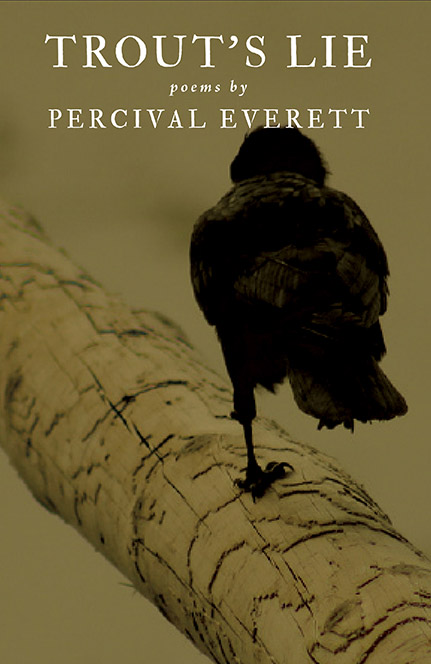
Percival Everett has gained an even stronger following thanks to his novel James, but he’s been writing poetry for years (Trout’s Lie is from 2015). This collection is deceptively simple in language and vernacular: there are surprises. Several poems make allusions to “great poetry of the past” by name or phrase; short lines build and build, twisting the lyric where we don’t think it would go. There are several examples I’d like to give, but this post is getting pretty long. I think I will close with an excerpt from Everett’s “Maybe Even Clouds,” the first section, which begins “Count the marines..”

They look like nice
Boys and bad boys,
From Vermont-and-Montana-
Following-orders-dumbshit-
Non-blinking-soon-
to-kill-soon-to-die boys,
Who might or might
Not, should or should
Not, but never would
Not and never can
not.
Not sure doesn't matter.
Doubt is a penniless
Customer, conscience
Waits for the weather
To change.


National Poetry Month may be almost over, but I’ll keep reading poems. And posting about them. And writing them. I encourage you to do the same, because there is no time in the history of the world when human beings haven’t benefited from poems.
Mud & connections

My region’s been unusually low on rainfall the past 18 months, but this year April showers seem almost to be compensating…my veg patch is mud. Weeding and more sowing will just have to wait. I walk around the neighborhood and my yard and the woods, squelching through muck and stopping now and again to upend a rock or rotten log and see who’s active now. Lots of worms and arthropods, the occasional spider, many ants.

In such moist circumstances, we get fungi; I’ve been enjoying Lesley Wheeler’s new book, Mycocosmic, which I’ve read twice now–once for content and sound, once to learn more from the poems’ craft structures, all the while fascinated by the science of fungus, which she incorporates into many of these poems. It’s a richly rewarding book, sometimes sorrowful, always intelligent, full of insightful poetry. The collection includes some poems that feel like spells, chants, divinations that suggest there are always imaginative methods for coping with anger, unfairness, and loss. Exploring the vein of how interconnected the natural world is, and the human world (with other humans and with the Earth) feels so vital to me, and Wheeler’s book pivots on this vitality. Look at the way Harry Humes threaded through my life, for example, in small but meaningful ways. The same goes for Lesley and for so many other people with whom I’ve shared intersections, interweavings, and connections over the years. That butterfly effect of influence. (Now that I think of it–Harry Humes has a book with that title: The Butterfly Effect). Or are those networks mycelial, as Lesley Wheeler suggests?

~

More connections: grad school was long ago now, but I’ve maintained a few colleagues from those days and will always treasure the fact that earning an MFA led to meeting fascinating people. For example, the recent issue of The Bookends Review features an interview my fellow Goddard alum Ian Haight conducted with me last summer. He asked me about teaching humanities, about higher ed in these fraught times, about AI and creative work, about my residency at Joya, and about poetry in general…https://thebookendsreview.com/2025/04/09/poetry-the-humanities-and-aesthetics-an-interview-with-ann-e-michael/. Some thought-provoking questions–thanks, Ian! And thanks to The Bookends Review for curating the interview into the journal.

Rest in poetry

National Poetry Month has brought with it a sad bit of poetry news: Harry Humes has died. If you are unfamiliar with his work, you might want to check Penn State’s PA Book site’s biography of him, and then find one of his books:

https://pabook.libraries.psu.edu/literary-cultural-heritage-map-pa/bios/humes__harry

He was an excellent poet, influential for many folks–especially for Pennsylvania writers–and while I never knew him well, our lives intersected in some surprising ways over the years…

~

In 1982 or thereabouts, I resided in Philadelphia and was participating in many poetry readings, mostly open mike events. Carol Ann Robertson, who lived at that time in Philly but who had connections in the Lehigh Valley, told me that Bethlehem’s Godfrey Daniels listening room hosted a monthly poetry reading and invited me to drive up with her to hear someone named Harry Humes read. If I recall aright, three or four Philadelphia poets crammed into her compact car and headed north. We arrived early and were introduced to Harry, who seemed to have quite a case of nerves; that surprised me, since he was my parents’ age and a professor. Apparently this was one of his first, or perhaps his first, public reading–whereas I had been reading at open mikes since I was in my early 20s and was pretty much over my nervousness. (Years later he told me he’d fortified himself with a bit of scotch before the event.)

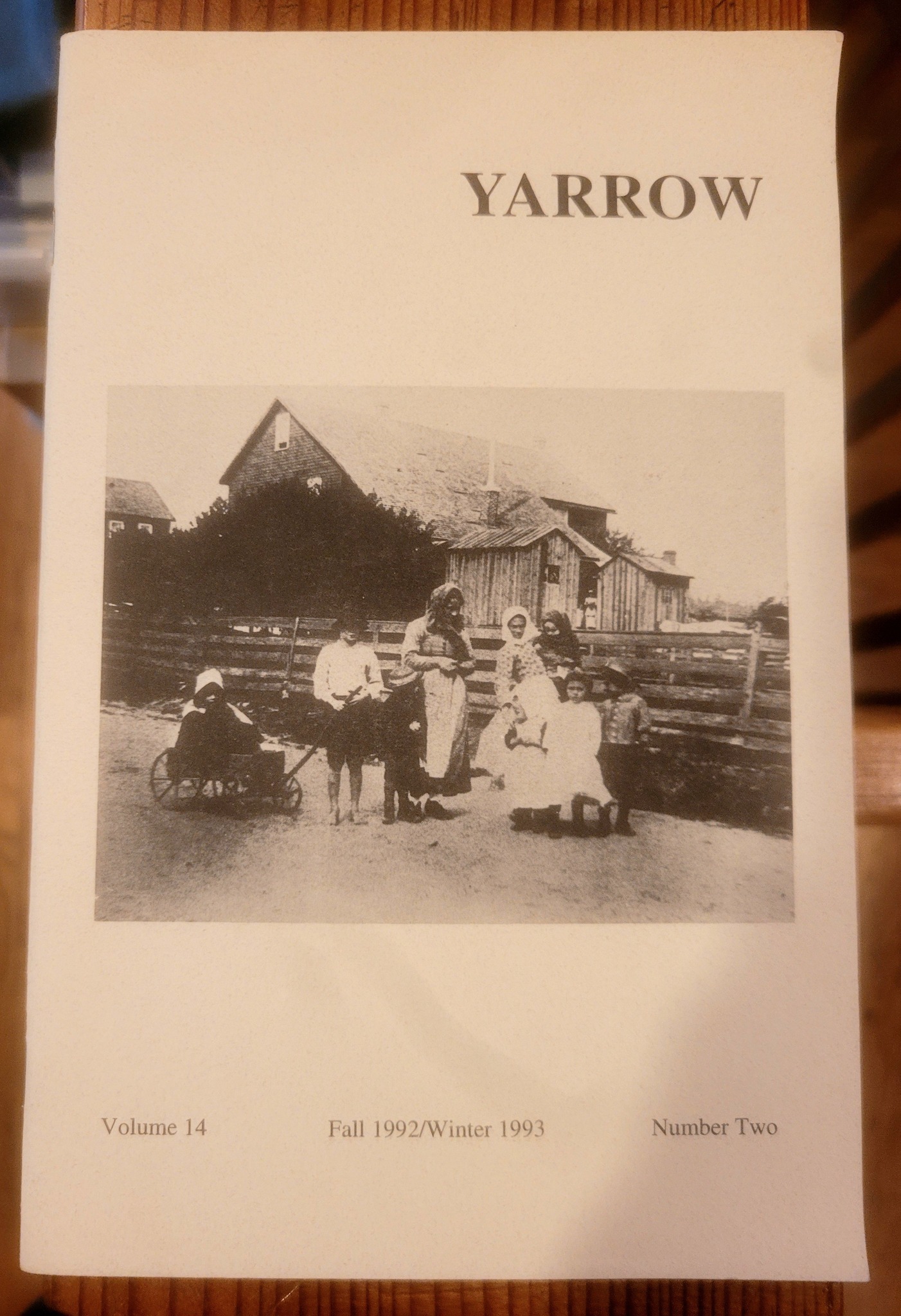
It was a beautiful reading. His work was both accessible and mature, and he clearly knew what he was doing when it came to writing poems. Indeed, his first full-length collection, Winter Weeds, came out shortly afterwards. Anyway, I moved out of Pennsylvania for awhile and, when I returned, it was to the very suburban Lehigh Valley. In 1992, I sent some poems to Yarrow, a lit journal published at Kutztown University–Humes was the faculty advisor and editor then, and he chose to publish my prose poem La Barbe.” For which, Harry, many thanks. I was so busy with toddlers that I was hardly submitting any work anywhere, or finding much time to write. The publication was a boost for me.

Then, in the peculiar way of small-world eventualities, my husband hired Harry’s wife, Nancy, as copyeditor for a Rodale Press magazine. I found that out when, a few weeks after she’d been hired, my beloved asked whether I had ever heard of a poet named Harry Humes! (By that time, Humes’ fourth collection, Bottomland, was in print)…

~

When I was hired at DeSales University around 2005, I learned that DSU held an annual poetry event for high school students. I attended/participated often, and Harry Humes–who was a good friend of the program’s administrator (Steve Myers)–was always involved in the workshops and events. Humes had retired from Kutztown by then, and was writing more poems, fishing, and enjoying family life. He always greeted me with a big smile and asked about my writing. That sums up for me what kind of person he was: generous; possessed of a self-effacing, even self-deprecating humor; kind and encouraging to people just starting out in poetry.

Here’s a poem of his that I like a lot, which I clearly recall him reading that day at Godfrey’s so long ago: https://www.poetryfoundation.org/poetrymagazine/browse?volume=154&issue=3&page=13

And here is one of his best-known poems, the title piece from his 2004 book. Harry, thank you for gracing us with your words. We’ll remember them for a long time.

~

August Evening with Trumpet

Up in the woods a neighbor or stranger
who has had enough of August,
its spider webs and first yellow

near the roots of things,
has out of the blue found his old voice,
wailing away everything

he can remember.
Perhaps he will play
right through fall and winter,

not stopping until bloodroot
and anemone blossom.
But now it is almost dark.

Mist veils the fields,
and last sounds play out
as simply as longing or breath.


Copyright © 2004 Harry Humes All rights reserved
from August Evening with Trumpet
University of Arkansas Press

Poetry month books & doings

~

It is, once again, April: National Poetry Month. My recent trip to the AWP bookfair has given me many poetry books to peruse at whatever pace I please, and because the weather here has been far too wet to do much in the garden, I’m using the free time to read. The outpouring of millions of peaceful protesters who oppose the current administration’s policies and who rallied on April 5 was somewhat heartening to me, but I remain skeptical and am aware that real change takes a long time. For the present, I’m bolstering my spirit through poetry.

~

I met Diane Thiel decades ago, briefly, at the West Chester Poetry Conference. She is incredibly talented, intelligent, frighteningly well-educated, and her work impressed me a lot; somehow, though, I did not get around to reading the many books she’s published since then, so her Questions from Outer Space (2022) is a delight and a revelation. Travel, literary and historical references, child-raising, teaching–the poems here cover a large range of topics. I bought her book at the Red Hen Press tables in LA. Red Hen is a terrific source for contemporary poetry books, if you’re looking…

At Saturnalia’s booth (another good small press with a large catalog), I found three of Martha Silano’s books and rejoiced. So far I have finished reading only The Little Office of the Immaculate Conception, which I love, but I can hardly wait to read her more recent books. She has a wry sense of weird, nerdy humor that’s inflected with science facts and grocery-store labels, pop culture and life in the burbs, and a healthy questioning of, well, everything.

My fellow Goddard alum and friend Lou Faber has a new book here, and it’s so wonderful to read the work of a long-time poetry colleague whom I haven’t seen in years but whose voice comes recognizably through this collection. The second half of the collection, in particular, deals with the emotionally-complex aspects of being an adoptee and this person’s efforts to untangle where (and who) he’s “from.” Contradictions abound over the years; then, DNA testing sort of, but not quite, sorts out some of the mysteries. But life–well, much of life contains mysteries and always will.

~

Meanwhile, this April I will be busy giving and attending in-person and online poetry events–even a radio spot! I’ll be reading mid-day at a local community college, participating in a No River Twice poetry event; and at some point this month, an interview about The Poetry Press Project (and my latest book) will air on WDIY 88.9FM. And a few of my poems will be appearing in print this month, the first of which is here: “Luna, Paloma.” I’ve also signed up for virtual attendance at a couple of poetry reading; and on May 4, I will be among the features for a virtual reading sponsored by One Art journal. My physical stamina isn’t what I wish it were, but thanks to technology that enables me to participate from home, I can manage to do a bit of yard work and STILL get to a poetry event.

Riches

The past week gave me riches galore; though I am somewhat poorer in the pocket for it, my cup runneth over in about every other way. It’s true that often, lately, I’ve felt that I am living in “interesting times” that are all too much and too awful to contemplate for long. Then again, I could have been alive (possibly quite briefly!) during Boccaccio’s time and weathering the bubonic plague. Thanks to The Decameron, readers later in history have been able to get a picture of what people were thinking about and imagining–or trying to escape–when things were truly terrible all around. And while I’m not pollyanna-ish about the present, I do feel grateful that I live during an era when travel to distant places is possible and rather speedy, that books are readily available, and that some of the wealthy people of the not-too-distant past decided that philanthropy included funding libraries, gardens, and museums for the average citizen to visit and enjoy. Current billionaires, please take note!

What the week entailed was a trip to Los Angeles to visit my eldest child and, while there, to spend a morning at the AWP conference book fair. Riches indeed! I “packed light” to be sure I had space in my carry-on for poetry books, which thankfully tend to be slim paperback volumes. I bought almost 20 books, I confess. So I came home weighted with literary riches, and while at the convention managed to connect (however briefly) with numerous poet colleagues. A shout-out here to Lesley Wheeler, whose book I had to purchase online because Mycocosmic had sold out! Congratulations, and I cannot wait to read it.

My days in LA were limited to four, but my son had curated a things-Mom-would-like-to-do list that included Mom’s necessary down time. It’s terrific to have offspring who are now old enough to respect my limits. [They have not always been so accommodating.]

The list included several lovely meals out, a full day at Huntington Gardens and Library, a day trip up to Santa Barbara, a visit to LACMA to get an “art fix” for me and for my son’s best beloved, who loves art and architecture, and a visit to the amazing Museum of Jurassic Technology which, as far as I am concerned, is basically a series of amazing poetry prompts. I cannot possibly explain it; and the museum’s website is purposely a bit obscure and limited, compared to the immersive experience of going to the place in person. I am still thinking about it and will be for weeks.

The barrel cacti at Huntington

While photo ops abound at the gardens, no photos are permitted in the Museum of Jurassic Technology; I will lead you to the website and just keep you guessing. But among the riches of the last week are germs of new poem drafts. We shall see what emerges.

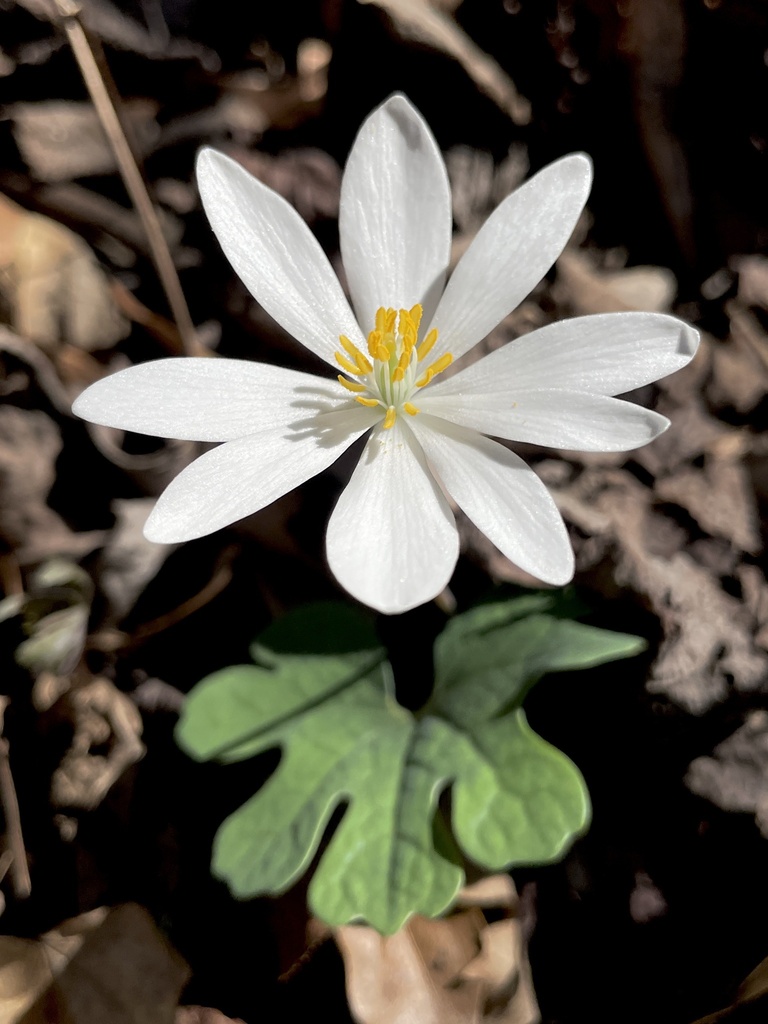
Four+ days away, and I returned to spring in eastern PA: narcissus, magnolias, glory-of-the-snow, squill, bloodroot, forsythia, ornamental plum. Even more richness. Gratitude for the glory.

Prose/poetry

In the first weeks of this year, I participated in a virtual poetry workshop with Anita Skeen. It was so useful to me that I signed up for another workshop, this one on writing the prose poem, with mixed-media artist and poet Lorette Luzajic. She is the editor of an online prose-poetry lit journal, The Mackinaw.

In this workshop, I’m returning to a form I learned early in my writing practice. My friend and mentor David Dunn may have introduced me to prose poems, I cannot recall anymore; but I do know he was writing them in 1980 and that some of the poems in our collaborative chapbook The Swan King are either prose poems or on the verge of being prose poems. Prose poetry was then considered a “new” form and was (& in some quarters, remains) controversial among poets and critics. It sounds self-conflicting: if it is prose, how can it be poetry?

In the decades since I was very new to poetry, reading everything I could find of contemporary work and experimenting all over the place, the prose poem has been much written-about in literary forums and academia and is–mostly–on pretty sturdy footing as a “form” of poetry. I never completely stopped writing prose poems, and a few appear in most of my books. I’ve been writing so many sad lyrical-narrative poems since 2018, however, that I haven’t spent much time really playing with poetry, and play is a huge part of creative thinking. So Lorette Luzajic’s workshop, which gives us a chance to experiment and play, appealed to me.

The workshop has got me thinking about versions and expansions of the form, turned up some exciting new poets to read, and offered amusing prompts that have moved me into ekphrastic, surrealistic, dream-based, and pop-culture themed poems. I have found some surprises in my own work, which is always a reviving feeling.

Also, we are almost at the vernal equinox. My environment is brightening in small ways, which tends to help with enduring the tough stuff.

Mid-March

Tulip poplars begin to plump out their winter bud scales, where they will leaf out later in spring.

A marsh hawk zips overhead, winging above the treeline and vanishing over the northern hill.

Early ornamentals bloom: crocus, snowdrop, aconite, i. reticulata.

Red-winged blackbirds make the mornings noisy–they have so many different songs and calls that three or four of them sound like multitudes, almost drowning out our year-round singers, the song sparrows. Early migrant passerines have returned, but it’s still winter here. Some bugs have gotten active and are emerging from hibernation or incubation. No bees as yet. When I turn over rotting logs, I find amphibians’ eggs and lots of different varieties of soil centipedes.

And, of course, worms. March’s moon is sometimes called the Worm Moon, and tonight there’s a total lunar eclipse around midnight here in PA. Is that auspicious? It’s also when I will be reading at the Lambertville Free Public Library in Lambertville, NJ. I’m excited to participate in an on-site, in-person reading again…I’ve been hibernating a bit from poetry events, but it is time to get stirring.

At the end of the month, I’m packing up for a brief trip to Los Angeles, where I will be attending one day only of the annual AWP Conference (Saturday’s Book Fair!) and spending the rest of the visit with my son. The conference always offers a terrific infusion of writerly companionship, community, and inspiration. Whereas time with my son offers love, cool places to see and eat and hike, a host of things I didn’t know I wanted to learn, and many moments of hilarity and conversation. It’s hard that he’s so far away–hard for me; I don’t think he minds, he is busy and having fun, which is as it should be.

Also, yes, the whole situation here in the USA is something I never could have imagined as a younger person, when I somehow had an unquestioning faith the US Constitution could actually be workable as an enduring rule of law. That careless people who value money over community could indeed disrupt that 1787 document was always a possibility (the moneyed property owners and slaveholders had their way with the original, after all), but most of us didn’t see this coming–naive, I suppose. Busy with our own concerns. I get it, and maybe we deserve what’s coming, but [ugh]. A concerned European friend recently asked me how I was faring under the stress of these first three months, and I told him that since making art (poetry) has generally been an unconventional act/behavior/response even under the patronage system, my response is to keep making art. Granted, it isn’t much, nothing earth-shattering, not gonna change society that way; but it keeps us observant little non-conformers on our toes, creative, and flourishing in the face of weirdness and oppression.

Which is something we can do. Like early bloomers in the cold days of late winter.

winter witch hazel blooming in snow

Unexpected directions

What gets a poem started?

Sometimes, it is a prompt; I depend on those when I am feeling a bit “dry” creatively. Most of the time, though, the prompting comes from some unexpected quarter. The poem below was prompted by something a colleague said–that she’d consider belonging to any religion that permitted red wine and brie cheese. She was joking around, but the idea stayed in my mind. When I elaborated on it in a draft, the poem needed to be in first-person. And then it took off in an unexpected direction. Kind of a world-weary, sardonic direction, a commentary on our society perhaps. No: certainly. The poem changed tone from something rather amusing to something more reflective and serious. I had not seen that coming when I sat down to draft it!

I like that unexpected directions happen when reading, and writing, poems. One thing I have noticed when I see so-called poems “written” by an artificial intelligence program is that they deliver no such surprises. An algorithm’s surprise is called a bug; it occurs when something goes screwy in the code string. But AI isn’t human enough to understand surprise. Not yet, anyway.

~

Luxuries

A five-year-old chianti reserva, recompense enough
for a day of malingering and, yes, loneliness—
as though that were reason to drink, as though drinking
requires reason when, for most of the last few
centuries, wine’s been safer to drink than water,
and I’ve no right to complain.

Aphorisms tell us we choose our own ways
(paths, journeys, lives); anthropologists say we are
society’s children, which limits our choices.
Religions narrow the decisions further, although I’d
choose one that permits wine, Camembert, and almonds—
I admit a taste for luxury.

In my milieu, chianti and Camembert are luxuries and
I haven’t had my house bombed, my family sundered, the water
turned to poison in the reservoir, not yet, though sixty years
may not be an entire lifetime. And no quantity of wine erases
the wrenching violence done in the name of my society,
of keeping me secure

and those like me. As though we deserve to be kept, and not
others, so we can purchase a more than palatable wine
and French cheese and almonds, to ensure the economy’s
robust, and money—that expression of magical thinking—
can continue to pour itself into the stock market’s statistics,
somehow to save us all.


~~
Photo by Josu00e9 Antonio Rivera Vallejo on Pexels.com

Febru-dreary

I try not to hate on February. The days do get longer; there’s often some early blooming or greening, a little more birdsong in the mornings, days that aren’t too miserable for walking. But. A lingering malaise of the spirit often natters about in the background of my days. This year, I am trying an infusion of art.

I’ve enrolled in an art class–visual art–drawing, sketching, experimenting with different media such as gouache, watercolors, pastels, colored pencils. I just want something to do with my eyes and hands that isn’t reading, writing, photography, social media/texting. I think of it as an exploration. The workshop I took with Anita Skeen and Cindy Morgan Hunter in October made me realize that using other forms of art might feel good to me, body and soul. This year, starting now (February), I’m taking an 8-week art class with Helene Parnell of Blue Church Art. We shall see how that goes. I am not doing this to create a good “product” but to enjoy the less-intellectual, more freeing aspects of the art as process…the way I did with the collages and book-making in the New Mexico workshop.

In that frame of mind, I accompanied my Best Beloved to Philadelphia to visit PAFA, Pennsylvania Academy of Fine Art. It’s something I have been meaning to do for, literally, decades–even though we are often in the city, somehow I haven’t gone back to PAFA which I recall from a visit (in my teens!) and kept meaning to see again.

Pennsylvania Academy of the Fine Arts

Here’s irony! The historic 1805 building I recall so well is closed for renovation until next year, and many of the paintings are “traveling,” i.e., on loan to other museums, through a show called “Making American Artists.” Most recently, to Albuquerque NM, though the exhibit closed there in September. The Academy, however, has employed the large, windowed, modern gallery spaces across the alley from the old building as temporary museum space and curated some fascinating exhibits for viewing and learning from. We enjoyed the Philadelphia-themed historical and cultural arts, crafts, and objects that came from the Atwater-Kent Museum. The mix of mostly-20th c. American paintings, prints, and sculptures in the upstairs galleries showed us how little we know about more contemporary US artists (outside of the super-famous ones like Hopper, Hockney, de Kooning etc). The plaster casts of famous European sculptures which students used–and still use–for drawing practice are now located in the lower level.

That brought back memories of when I was a teenager in love with art. I will have to go back once the renovations are done, because I remember the building as I visited it in the early 1970s, a strangely decorative place where students could be found sketching one of Michelangelo’s carvings or painstakingly drafting the composition of a painting by Winslow Homer. How I longed to be one of those art students!

PAFA interior, pre-renovations

That desire has been much altered by time, but my love of “the visual and plastic arts” stays with me. I enjoy writing ekphrastic poems; perhaps my foray into making artwork will energize me these last weeks of February and keep me going into spring.