Seen from above

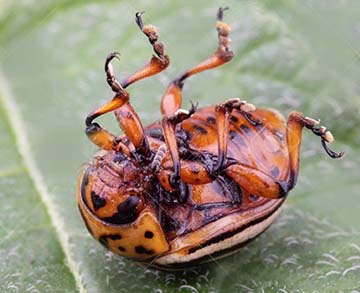
Wislawa Szymborska’s poems are in my head today, prompted by finding a dead beetle on my porch. Novice entomologist identifies dead bug, then thinks of poems.

~

Seen from Above

Translated by Stanislaw Baranczak and Clare Cavanagh

A dead beetle lies on the path through the field.
Three pairs of legs folded neatly on its belly.
Instead of death’s confusion, tidiness and order.
The horror of this sight is moderate,
its scope is strictly local, from the wheat grass to the mint.
The grief is quarantined. The sky is blue.

To preserve our peace of mind, animals die
more shallowly: they aren’t deceased, they’re dead.
They leave behind, we’d like to think, less feeling and less world,
departing, we suppose, from a stage less tragic.
Their meek souls never haunt us in the dark,
they know their place,
they show respect.

And so the dead beetle on the path
lies unmourned and shining in the sun.
One glance at it will do for meditation —
clearly nothing much has happened to it.
Important matters are reserved for us,
for our life and our death, a death
that always claims the right of way.

~

In Joanna Trzeciak‘s translation, the second stanza begins:

For our peace of mind, animals do not pass away,
but die a seemingly shallower death

…a phrasing that evokes more clearly (to me) how humans use a sort of euphemistic, possibly spiritual phrase for being dead. And in this translation, the last stanza reads:

So here it is: the dead beetle in the road
gleams unlamented at the sun.
A glance would be as good as a thought:
it seems that nothing happened here.
Important supposedly applies only to us.
Only to our life, only to our death,
a death which enjoys a forced right of way.

Both translations are lovely, but I think I prefer the Trzeciak version, though I would be hard-pressed to say why; and I certainly cannot compare either to the original, since I do not know Polish.

What I love about this poem is its perspective, as reflected in the stances of title and stanzas. Literally, the speaker is above–looking down at a beetle husk. Tidiness in an insect’s demise–as opposed to our own. Then the point of view shifts, suggesting we humans are “above” the animals, their deaths less upsetting to the cosmos. But we are the cosmos, in our egotistical narcissism; and then, at last, death reminds us how unimportant we are…no matter how we think of ourselves.

20775536-dead-colorado-potato-beetle-belly-up

River of poetry

I attended a lively and unpredictable poetry reading/performance recently, No River Twice. The poets who participate in the group reading develop the concepts at each performance, endeavoring to find meaningful and entertaining ways to permit audience members to sense an active engagement with poets and to experience poems more vividly. It appears to be an evolving performance process, and I enjoyed myself!

Grant Clauser explains the idea on his blog. Most of the poets involved have at least some acting or performance background. They are also active as mentors, instructors, advocates for the arts, and “working poets,” by which I mean they get their work published and performed and are constantly writing, revising, and reading the work of other poets in the service of learning new things.

The poets who performed in Phoenixville, PA, on Friday evening are as follows, but I understand the line-up may change from event to event.

Ethel Rackin

Hayden Saunier

Chad Frame

Cleveland Wall

Bernadette McBride

Joanne Leva

Grant Clauser

Kudos to these folks, who presented a varied and exciting performance. Let’s hope there are more to come.

1978 South Whitley IN, Eel River

South Whitley, IN. Eel River Bridge, 1978.


Connections


4446_1159463871068_1826910_n

August has arrived and a few of our incoming freshmen are on campus already, as well as students on various fall sports teams who need to get a jump on the competition season. It was quite awhile ago that I was a teenage person entering my first year at college, but each year our students arrive with the same anticipation and excitement I felt. They’re ready to exercise a little responsibility, a little freedom, and to make the kinds of connections–personal, emotional, and intellectual–that will affect the rest of their lives one way or another.

~

In the 1970s, science historian and television broadcaster James Burke created and hosted a show called Connections. I was a fan of the series because I loved the surprising ways discoveries, events in history, people, and accident led to innovations and the criss-crossing of continents and ideas. The interdisciplinary aspect of human culture, of science and the arts, fascinated me as a teen. Those networked ideas have shown up many times through my life.

Connections: The photo above was taken by my fellow student Steve Lohman when we were freshmen. Steve later attended Pratt School of Art.  We lost touch for a long time, and–I have forgotten how–I found his metalwork while I was looking for cover art for my book of poems The Capable Heart.


running_horse

Running Horse by Steve Lohman

Connections: I liked Steve’s wireworks, but I remembered him as a photographer. Granted, what a person pursues at age 17 or 18 is easily liable to change–but I was curious about how he started doing sculpture. When he mentioned he’d attended Pratt, I asked if he had ever met Toshio Odate, who taught there for years. “One of my favorite teachers!” said Steve. “I loved his class.”

Connections: My spouse took a job writing for a woodworking magazine, where he met Toshio, who wrote about Japanese tools and woodworking techniques. Meanwhile, Toshio was creating his own works of art at his home as well as mentoring many students. He’s now a long-time friend of ours. (Photo of Odate’s “Pride of New England,” below, by Laure Oleander).

toshio-pride copy

Connections: Neural networks, the embodied mind, the ways writing assists in psychological healing, the twists in a good novel’s plot, the turn in a poem, metaphor, surprise. The unexpected thrills us–unexpected connections fill us with curiosity and a kind of joy, as does the closure.

~

Connections: The commercial creation Thinkhub, invented for teaching, offers yet another example of connections. A cultural thinkhub project based in Toledo, midstory.org has produced my poem “River by River” as a soundscape: click here.

The project researchers found my poem in the anthology I Have My Own Song for It: Modern Poems of Ohio. Look around, folks–connections are everywhere, and we learn from them.


Process

William Stafford:

A writer is a person who enters into sustained relations with the language for experiment and experience not available in any other way…A writer is not so much someone who has something to say as he is someone who has found a process that will bring about new things he would not have thought of if he had not started to say them.

Writing is a process that elicits consciousness in the individual writer, often as the writing unfolds. Flannery O’Connor: “I write because I don’t know what I think until I read what I say.” Joan Didion: “I don’t know what I think until I write it down.”

imagestafford

Perhaps oddly–perhaps not–Stafford’s definition that what a writer is comes down to what a writer does bears a certain resemblance to Gerald Edelman‘s “neural Darwinism” theory (ca. 1989 in Bright Air, Brilliant Fire, a more reader-friendly version of models developed in his neural topology trilogy*). Edelman basically says consciousness isn’t a “thing in itself” so much as it is a process that the embodied brain does. The brain’s processing capabilities are individual and endlessly myriad and they operate, claims Edelman, through the re-entry of information in intricately complicated links and physiological systems.  Thus, through evolution’s incremental layering of human beings’ brains, what we call higher-order consciousness makes its appearance.

And then on to gesture, semantics, lexicon, syntax, language, culture, &c.

~

Gerald Edelman:

What is daunting about consciousness is that it does not seem to be a matter of behavior. It just is–winking on with the light, multiple and simultaneous in its modes and objects, ineluctably ours. It is a process and one that is hard to score. We know what it is for ourselves but can only judge its existence in others by inference.

…Once a self is developed through social and linguistic interactions on a base of primary consciousness, a world develops that requires naming and intending. This world reflects inner events that are recalled, and imagined events, as well as outside events that are perceptually experienced. Tragedy becomes possible–the loss of the self by death or mental disorder, the remembrance of unassuageable pain. By the same token, a high drama of creation and endless imagination emerges…The wish to go beyond these limits [of embodiment] creates contradiction, fantasy, and a mystique that makes the study of the mind especially challenging; for after a certain point, in its individual creations at least, the mind lies beyond scientific reach…the reason for the limit is straightforward: The forms of embodiment that lead to consciousness are unique in each individual, unique to his or her body and individual history. [italics mine]

To me, this passage–in a book about neural mapping and brain physiology–feels “poetic.” But what do I mean when I say the concept of embodied consciousness, and consciousness as a series of intricate, synthesized processes, coincides with being a writer? Or in my case specifically, a poet?

It has something to do with taking in the world–through the senses, which is all my body’s really got–and synthesizing all those years of experiences, memories, books I’ve read, poems and plays I’ve loved, people I’ve known, relationships with the environment and with human beings and with other creatures, the whole of my personal cosmos. Referents and reentrants. Relationships actual and imagined. “The remembrance of unassuageable pain.” The process of loafing through the world.

Writing, where much of my so-called consciousness dwells. Not in the outcome, the resulting poems or essays, but in the doing.

~

More about writing-related processes and politics here: Poet Bloggers


* Neural Darwinism: The Theory of Neuronal Group Selection; Topobiology: An Introduction to Molecular Embryology; The Remembered Present: A Biological Theory of Consciousness.

Difficult books, iterum

After some readings on metaphor and language, I tackled A Grammar of Metaphor (1958) by Christine Brooke-Rose. Admittedly, I was hampered in my reading by my lack of facility in the jargon and structure of what used to be, but is no longer, “basic” English grammar. It did help that I have read The Trivium and could refer to it now and again; and of course it helps to have a background in poetry and literature, though not one nearly as thorough as Brooke-Rose’s. I definitely can add this one to the “difficult books” I have enjoyed, and benefited from, reading.

The grammar part of metaphor was not something I took into much account when I studied poetry. Certainly, when I read for pleasure, I do not analyze for grammar. Poets often experiment with grammar–altering syntax purposefully, creating sentence fragments, run-on sentences, new compound words, jarring phrases, all in an effort to make something happen in the poem. That “something” may be sound, dream, argument, exhortation, emotion, surprise, pattern, recognition, or a matter of perspective on outlooks, worldviews, culture, tasks, the personal. I do not read for such insights until I want to return to the poem and find out how the poet managed to make the amazing process of language work upon me.

If I were to try parsing a contemporary poem using the Reed-Kellogg system I learned in elementary school, some poems would buck and kick and refuse to reveal their structures. It would depend upon the poem and upon how one interprets such things as line breaks and stanza breaks. I am not convinced the process would really assist most readers in developing an understanding of the poem.

diagram

NPR.org Juana Summers [read here]

Then again, it might. Analytical scholars have taught me many things I would never have thought to investigate on my own.

~

Here’s a post from the 2018 blogroll journey: Marilyn McCabe on mindset–in writing and other things. Also a matter of perspective.

Back to metaphor

I recently read James Geary’s entertaining book I Is an Other–The Secret Life of Metaphor and How It Shapes the Way We See the World. Geary takes his title from one of Rimbaud‘s letters, calling this phrase metaphor’s “principal equation”:

Metaphor systematically disorganizes the common sense of things–jumbling together the abstract with the concrete, the physical with the psychological, the like with the unlike–and reorganizes it into uncommon combinations.

I like this definition because it feels more complete than the typical definition of metaphor as a comparison without the use of the adverbial comparative (i.e., no “like” or “as”). Indeed, metaphor probably forms the basis of language itself; while that conclusion’s much debated in semiotics, linguistics, and other scholarly disciplines, common sense and common usage strongly suggest that even thought itself–in terms of how we think internally about the world–employs metaphor as an underpinning.

Maybe I believe so because I’m a poet. Geary, as it turns out, has written some poetry, though he’s best known for his books about words, word origins, wordplay, aphorisms, witticisms, and the like. (He’s also got a TED talk…everybody’s got a TED talk…)

As to poetry, and how metaphor behaves in the poem’s context, I like what Geary says here (although in this excerpt it’s not actually poetry he’s discussing, but rhetoric):

Readers actively retrieve a metaphor’s meaning, just as a punch line requires listeners to resolve a joke’s incongruities for themselves…though the speaker may make the metaphor, the hearer makes its meaning. Hearer and speaker are accomplices; the one unpacks what the other presents. In terms of creativity, producing a metaphor and penetrating one are almost the same act.

I think the above lines go far to explaining why I love to read poetry and also provide implications as to why poems can be so damned difficult to compose. The poet endeavors to create a context and container for an often-unknown audience who will nonetheless need to invest, one hopes willingly, in the process of reorganizing the surprising (metaphor) into the recognizable.

And what a fine task that is!

2011A-rainbow

Beach reading

Mock orange and honeysuckle scents pervade the evening air. It’s the season of lightning bugs in the meadow and fireworks on Fridays at the local AAA baseball stadium over the hill. While I was preparing for the reading (this evening, in New Jersey!), I sat on my back porch surrounded by my own poems.

It’s interesting to look at one’s work and find “old friends” among the poems. Even among work I wrote thirty years ago, there are a few poems that I’m happy to meet up with again.

poster


Now to garner the stamina to do what needs to be done!

Haiku, moon, peony

During busy times, we may need a few moments of solitary reflection.

~

381-1233891708GdW7.jpg

Full moon moonlight
Sony Cyber-shot DSC-V1
10/800s, f 2.8, ISO 100, 7 mm

253142_2101392498695_2412222_n


~
flower moon
fireflies enlighten
the pear tree
~

I’m currently reading David Bayles’ and Ted Orland’s encouraging little book, Art & Fear. Nice reading to tuck around the edges of a few full weeks.


Nesting

Nesting. I’ve just finished reading Sarah Robinson’s thoughtful, gentle book by that title, which has offered me interior space at a time I need it. Deborah Barlow does a lovely review here.

9780981966717.jpeg

~

Outside my window every morning…conference of the birds.

The Conference of the Birds (or The Speech of Birds, or The Bird Parliament) is a Persian (Sufi) poem by Attar of Nishapur, an allegory of sorts in which the hoopoe instructs the other birds on how to find their king, which they can do by following the path of the right way to live. Here is an excerpt from the 1888 FitzGerald translation:

Behold the Grace of Allah comes and goes
As to Itself is good: and no one knows
Which way it turns: in that mysterious Court
Not he most finds who furthest travels for’t.
For one may crawl upon his knees Life-long,
And yet may never reach, or all go wrong:
Another just arriving at the Place
He toil’d for, and—the Door shut in his Face:
Whereas Another, scarcely gone a Stride,
And suddenly—Behold he is Inside!—

There are more adept, contemporary translations such as those by Dick Davis, Sholeh Wolpe, or others. This one’s copyright free and thus available here.

conf-birdsThe poem inspired the title composition of one of my favorite jazz albums of all time, this one by The Dave Holland Quartet, recorded in 1972. A college friend who loved Anthony Braxton’s music introduced me to this record, and it was one of the things I had in common with my dear David Dunn–early in our friendship, we learned that we loved some of the same poets and some of the same music.
~

Nesting season. The earliest fledglings have begun to leave their temporary homes. Some birds seem to return to their house sites–or perhaps their offspring do so. There are ledges here that shelter robins’ nests every year; there are certain trees the orioles seem to favor over and over again.

My children “fledged” some time ago. One’s returning to the house soon, but only for a visit. All homes, no matter how long loved and lived in, are only temporary shelters.

smallnest2


Friendships

April: a busy time. During my busy times at work or on the home front, I often spend less time with my friends.

The best thing about that is: my friends understand. They will still be there when I crawl out from under whatever has me crushed for time, whether it’s illness, job stress, time-consuming family-related challenges, home maintenance, garden or lawn work, travel, or depression.

[insert here, me, waving to my friends!]

Social media is no substitute, although I confess to using it to keep connections with those I care about. Social media, for example, has been significant in helping me to stay in touch with poetry colleagues; but much as I admire and learn from other writers, they play different roles in my life than friends do. Also, even from the beginning of my Facebook use, I knew the platform essentially was a “me and those like me” social bubble.

The specter of “us vs. them” has raised its snarling head on social media sites ever since the early days of chat rooms. There’s a reason for that, and Natalie Angier of The New York Times reports on some recent findings in this article:


~

Meanwhile, on the “unalloyed good” side of friendship–The real friend listens, gets busy herself, drops a line now and then if I’ve been absent for awhile, and drops everything if I find myself in difficulties and ask for help.

She or he also shares my brainwaves, apparently–and not just metaphorically! The studies Angier writes about in the article below offer some really intriguing possibilities about human beings as social animals and how our brains work. PubMed.gov lists a large number of research articles that examine the topic of health, neuroscience, and sociability; the interconnectedness strikes me as relevant and fascinating.


~

Boy, do I love neuroscience! This work synthesizes physical actuality with metaphorical possibilities in ways that inspire me.

Probably, there will be poems. Meanwhile, if you want to watch some brain functions in action, some cool animations: http://www.neuroplastix.com/styled-99/therapeuticanimations.html