Useful avoidance

Trapped inside with the air conditioner on for over a week, I sat by my bookshelves going through the poetry books in my library. I’m re-reading, assessing which books I truly want to keep because I turn to them often or learn something each time I read them, which books I keep for sentimental reasons (maybe I know the author personally), which ones to keep because they are signed copies, which ones are long out of print and I would never be able to replace them. Some of them remind me strongly of places or eras in my life: I bought this one in a small bookshop in Grand Rapids MI, or this one at Barnes & Noble when it was just one store on a NYC street corner, or these at the storied and much-mourned Gotham Book Mart or St. Mark’s Bookshop. What are good reasons to keep books when I really have to downsize? It’s not an easy task, and the first of many in the process of getting rid of stuff so my kids won’t be stuck doing it. Besides, I enjoy re-reading these books. My children are not as enthusiastic about poetry as I am, so it makes sense that someone who loves the works on the shelves be the one who makes such decisions. It feels good to be surrounded by the words of wonderful writers when the outdoors is brutally hot and humid, and every joint in my body aches.

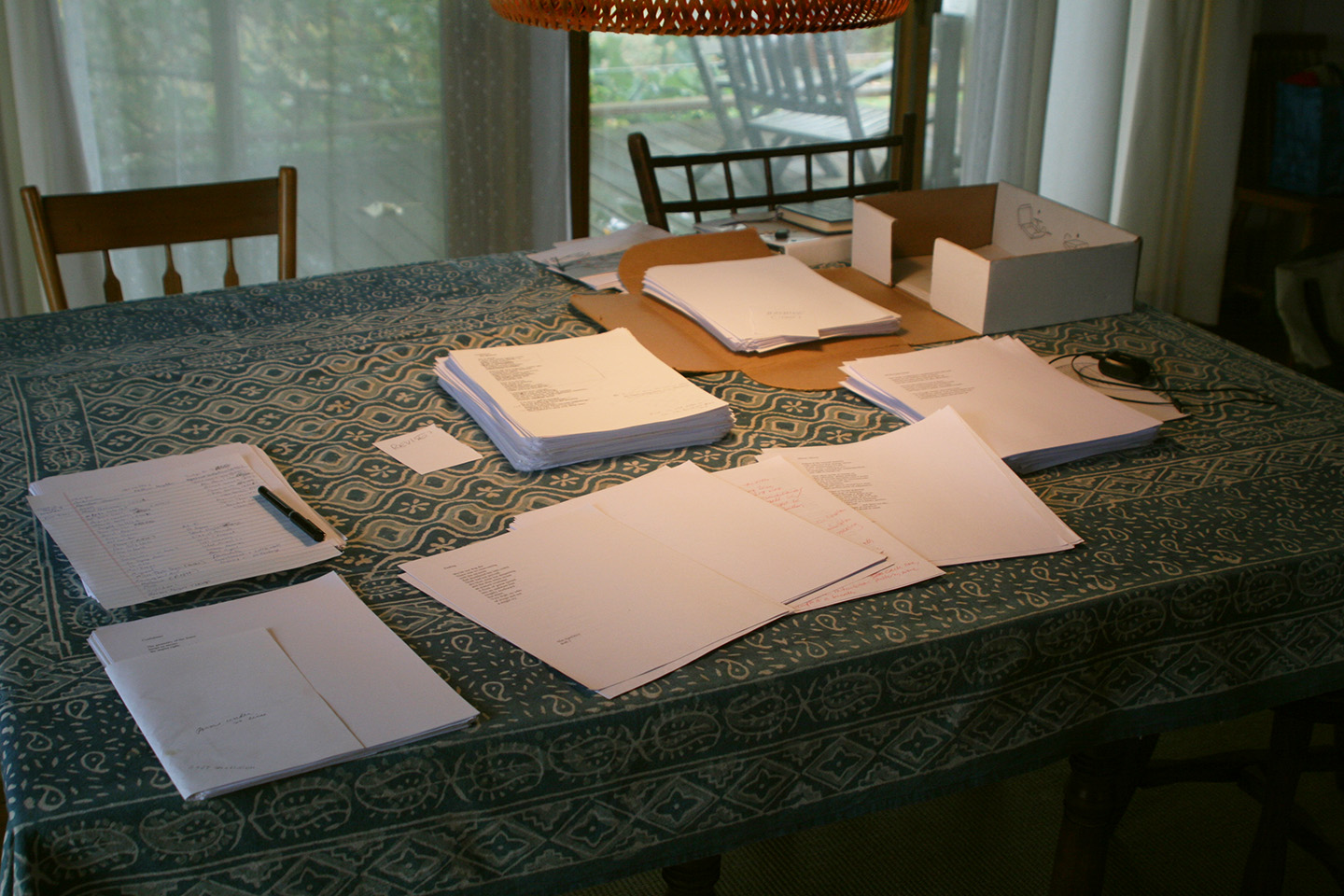
Surrounding myself with other people’s books also acted as one more way of avoiding my own creative work. Sometimes, though, waiting around and doing nothing on a project ends up bringing clarification or new ideas. It can prove useful. I have been stalled on my in-progress manuscript, so a month or so back I asked someone to take a look at it–and then I got caught up in doing other things. Like getting cataract surgery and having covid, and then it was gardening in full swing under sweltering weather, and then the bookshelves… I wasn’t exactly procrastinating, but neither was I actively working on, or even thinking about, the collection.

Acquired when I was much younger, and cool bookshops abounded.

And one night recently–during a much-needed rainstorm–I got a brainstorm! I realized I was trying to pack too many topics into what really should be a manuscript more closely focused on how people who love one another vary in their relationships to old age and death, and on how the contemporary social and medical aspects of the aging process pull us in uncomfortable directions, often distancing us from those relationships. So yes, there should be family poems, hospice poems, biblically-influenced poems, and dealing-with-everyday observation poems. Also some poems of hope and love, poems reminding me (and readers) of the need for compassion in all dealings. But the draft had 92 poems in it, far too many; and some were there just because I like them or they’d been published in a good journal. Which are actually not good enough reasons to include a poem in a collection, according to most of the editors I know.

I am back to thinking about the manuscript and digging up potatoes–a nice crop this year–instead of culling the poetry books because, thank goodness, the heat wave’s subsided a bit. But in the process of this non-routine summer I have allowed numerous weeds to flourish and set seed; all the more work for NEXT year’s gardening, but it’s been too hot to deal with said interlopers. I like to believe the weeds and I are reaching a sort of understanding, but it is not really a compromise. All the concessions have been on my part. [Note: weeding a personal library is less physically taxing but not really any easier.]


Transformation & intention

During the past few weeks, I have been reading–one at a time, with pauses–the essays in Ross Gay’s book Inciting Joy. His earlier book (The Book of Delights) was easier, a bit less complicated. About, you know, gratitude–even though he describes his father’s death in the first essay of that one. He gets to something about grieving in the 13th “Incitement” of this book, however, that made me put the text down and say to myself: This is what I have been trying to get my poems to do for some time now.

(I did pick it up again and finish reading it, by the way.)

He insists that we remember how transforming grief is. Not can be, but is. Always: “When that one thing [that we grieve] changed, everything changed. Light through the trees in October now different. The sound of the playground…cooking a meal. The future. The past. All of it changed. That is what the griever is metabolizing.” He points out this metabolizing can’t be timed, that grieving pays no attention to whether it has been a day or a year or decades: “It seems to me that grief is not gotten over, it is gotten into. And the griever teaches us, or reminds us, there is no pulling it apart. Because grieving, alert to connection, is never only one person’s experience.”

Maybe we grieve for one person, or one beloved companion animal. Maybe we grieve that our youth is over, that our children are grown, that our favorite mom & pop store has been razed to make way for a Starbucks. Or perhaps we grieve for our planet, as Greta Thunberg does: “You have stolen my dreams and my childhood with your empty words…People are suffering. People are dying. Entire ecosystems are collapsing.” There are so many reasons why we feel loss. Loss is what life offers us, loss but also transformation. I think what Gay tries to say in his recent essays is that because there is something to sorrow that we all can connect with, our grief itself can connect us, give us understanding–maybe even joy.

A complicated kind of joy. A joy that acknowledges that life can be tough and sad. And instead of reeling away from people who are clearly–and sometimes not so clearly–suffering, we could connect instead, even though we are also terrified of suffering. Maybe that is another reason I became a hospice volunteer years ago, after my dad had been in and out of the ICU frequently, even though I had spent my childhood and many of my adult years being frightened of death and dying.

Good poems offer readers that sense of connection, which Gay and others sometimes refer to as mycelial (Lesley Wheeler in her poems, Robin Wall Kimmerer in her books and Merlin Sheldrake in his, the movie “Fantastic Fungi”…among others). My favorite poems by my favorite poets, now that I think about it, have always had that effect on my heart: recognition of connectedness with other humans or with other beings, with the environment, with the past-and-future, with (thank you, Walt Whitman) the Kosmos. The recent interactions I had and connections I found at the Joya residency cemented this fundamental awareness, that all of us are part of our huge, interconnected experiences in life.

Of course, writing strong work isn’t easy, doesn’t often happen; but here’s the place in our mutual social connectivity where intentions really do matter–because the intention impels us to work, practice, and dream. The intention is to create and, through whatever we create, to extend our human network. NOT our much-ballyhooed “social networks.” Those can go to hell (and we can’t take ’em with us).

Anyway, such are my intentions for working in the world of words, of poetry. And that’s also the reason I read so much poetry, in case you were wondering.

~

https://www.smallwoodlandthings.com/ Heather Brooks, artist

Practice makes poetry

I’ve been challenging myself to write 7-line poems lately. Half-sonnets? Not necessarily. Just an exercise in writing a poem in brief. I have used haiku and tanka as brevity/image exercises in the past, and that work has been helpful. While I seldom write poems that are longer than, say, 30-35 lines, practice with conciseness never hurts, especially when my inclination is to go narrative.

I’m not knocking narrative poetry: I love it. Love reading it, love writing it–especially the lyrical narrative. In addition, I’m a big fan of the discursive and tangential in poems and essays (looking at you, Ross Gay). But one does tend to fall into familiar territory, and it’s useful to push away at what’s easy. That means, every now and again, trying something unusual: persona poem, aphorism poem, Spencerian sonnet, cadralor, surrealism, slant rhyme, golden shovel, or an invention of one’s own…something to freshen up the craft.

Many writers I know rely on prompts for imagery, language use, theme, or topic. For some reason, that sort of prompt seldom gets me really working in a new vein, though I can get a poem draft or two that way. Using a form, trying something new with how the words land on the page, is much harder to do (for me)–and therefore, more useful. I honestly want to feel as though I am working at poetry, doing the good and rewarding sort of work during which I learn new techniques and rediscover how craft can deepen meaning.

Real work takes practice. And real practice doesn’t actually lead to perfection. It leads to new explorations and revelations. There’s my wisdom-for-the-day to poets who are just starting out.

practice doesn’t make perfect…

Considering the collection

Recently, reading through Dave Bonta’s Poetry Blog Digest, I noticed a few posts on stalling with a manuscript and subsequently clicked on those links and read what other poets have to say about it. Mmm, yeah. I understand the challenges. I have kind of stalled on my next book, too. Or shall I say, neglected my work on it. In fact, today–when I finally thought I had some time to review the draft ms–I could not find it. I had forgotten where I put the printout.

Yes, it resides on my computer. But I prefer to work with hard copy when structuring a collection. And where was the hard copy? I wasted a good half an hour seeking it but finally noticed it peeking from under a pile of other papers. This is not a sign of determined intent.

Why do I allow it to languish? There are so many possible answers to that. The poets who posted (see above) had structural concerns, other things going on in their lives, also a bit of second-guessing and self-doubting. I had eye surgery and covid, but those circumstances did not keep me from drafting new work, only kept me from putting the book together. I recognize now that these tasks involve, for me at least, very different processes, and maybe that is why I’m stalled but not “blocked.” I mean, hooray, I’m writing poems! Which is a process I enjoy, along with revising. But drafting and revising revolve around the process of an interior reflection and creative surge. I wish I could feel that way about putting this collection together, but I don’t. The manuscript-making process is lengthier, broader in scope, requires more critical analysis and a consideration (to a degree) of audience/readership that an individual poem does not. It asks questions of chronology, topic, and forms in aggregate that matter much less when working on one poem at a time.

Perhaps that means I’m not ready to put this collection together yet. Or that I have chosen the wrong theme or mix of poems, and I should reconsider the entire project.

*le sigh*

Maybe I need to take another amble around the garden to clear my head. It’s nice to have that option. It feels more like rejuvenation and less like…procrastination.

~

In residence

It’s been some time since I was away at a residency with other artists and writers. Conferences, yes, but residencies are different–more intimate in scope, less social-life activity, more one-to-one conversations, and a great many overlaps in interests, inspirations, and approaches. The intensity doesn’t feel at all like the intensity of a large conference such as AWP, where I often feel I must cram my schedule with panels, meet-ups, and attendance at presentations and where the exchanges, while often intellectual, generally require the context of careers and situational details. At a residency, we certainly don’t avoid topics like families and day jobs; but such getting-to-know-you chats are secondary to conversations about art, artists, reading, technical methods, responses to environment, discussions about intent and audience, aesthetic and artistic philosophy.

A residency also offers that key component of creativity: unstructured time (or, time one gets to structure to one’s own liking). I cannot stress enough the value of reflection, contemplation, and woolgathering; the residency I attended in Spain offered this to a degree I haven’t had in quite some time, and I relished it. I took along Olga Tokarczuk’s book Flights, perfect reading for a plane-bus-train trip, and Mark Doty’s Deep Lane, contemplative and fearless poems that urged me to spend the necessary time with my thoughts and my environment.

~

It was interesting to hear about the methods and processes of other participants who were there the week I was. While all of them write in some form, their creative work is visual: Photography, film, digital art (animation, 3D, comics), performance/performative art, painting, multimedia. At first, I felt a bit out of step since what I “produce” is…well, abstract, I guess? And the means a person uses to create poems is mostly invisible; it’s not as though you can see us at work. A person at a desk, sitting on a rock, or lying under a tree doesn’t appear to be in the process of making anything and, except when the written work appears in print/online, the “artwork” isn’t something one can show to others. As I began to converse more with the visual artists, however, once again I experienced the joy of discourse with fellow creatives, no matter their discipline. I certainly have friends who are sculptors, painters, photographers, ceramicists, dancers, musicians, actors, & craftspeople of all stripes–and I don’t feel out of step when talking with them. I suppose it is my initial hesitation around “strangers” that kicks in. Shortly into the residency, we were no longer strangers.

The word la joya is Spanish for “jewel,” and it can also refer to a geographic hollow–a bowl-like area, which is fitting since the cortijo is situated in a sort of high valley surrounded by the mountains of the Parque Nacional de Sierra Nevada. On my last day at Joya-AiR, we held an artist talk to inform one another of our creative work and processes, influences, and possible future directions we imagine our work going in. Some of the other participants will be working there for another week or two! Which would be lovely, but I could not extend my stay at this time. Nonetheless, the residency has been very useful and productive for me. I feel so grateful to the people at Joya and to my Best Beloved for encouraging me to attend.

Change of scene

Land of Lorca: Andalucia, Spain. I haven’t traveled out of the USA in 7 years, and the travel-abroad process has changed a great deal in response to covid and the use of the ubiquitous cellphone and its hosts of apps, so this trip has already been quite the adventure. No problems, however–despite my primitive Spanish language skills, people have been kind and helpful. The cellphone plan we thought we had acquired did not turn out to work in Spain for reasons I can’t explain, so I have been traveling old-school using maps instead of Google and without access to handy translation software.

You know what? That is how it used to be, and we managed somehow. I am learning a lot and viewing everything as adventure. Even the occasional snafu.

But here I am. A couple of miles from this:

Almond trees and La Muela in Almería Province in southern Spain, at an artist residency hosted by Joya-AiR. They are also on Instagram, if you are interested.

~

I guess I’m the resident poet this go-round; among us there are a photographer, a graphic artist, and two multi-media artists and they hail from UK, Canada, Italy, and USA. I have been here half a day and am already full of ideas and have had interesting conversations and have enjoyed meeting a dog named after Frida Kahlo and a goat named Fou-Fou.

This post is just a say-hi and to share my enthusiasm for this beautiful rugged place and the people who want to get into their artist-zone here. More later.

The courtyard patio of Cortijada Los Gazques, Velez Blanco

Close of the cruelest month

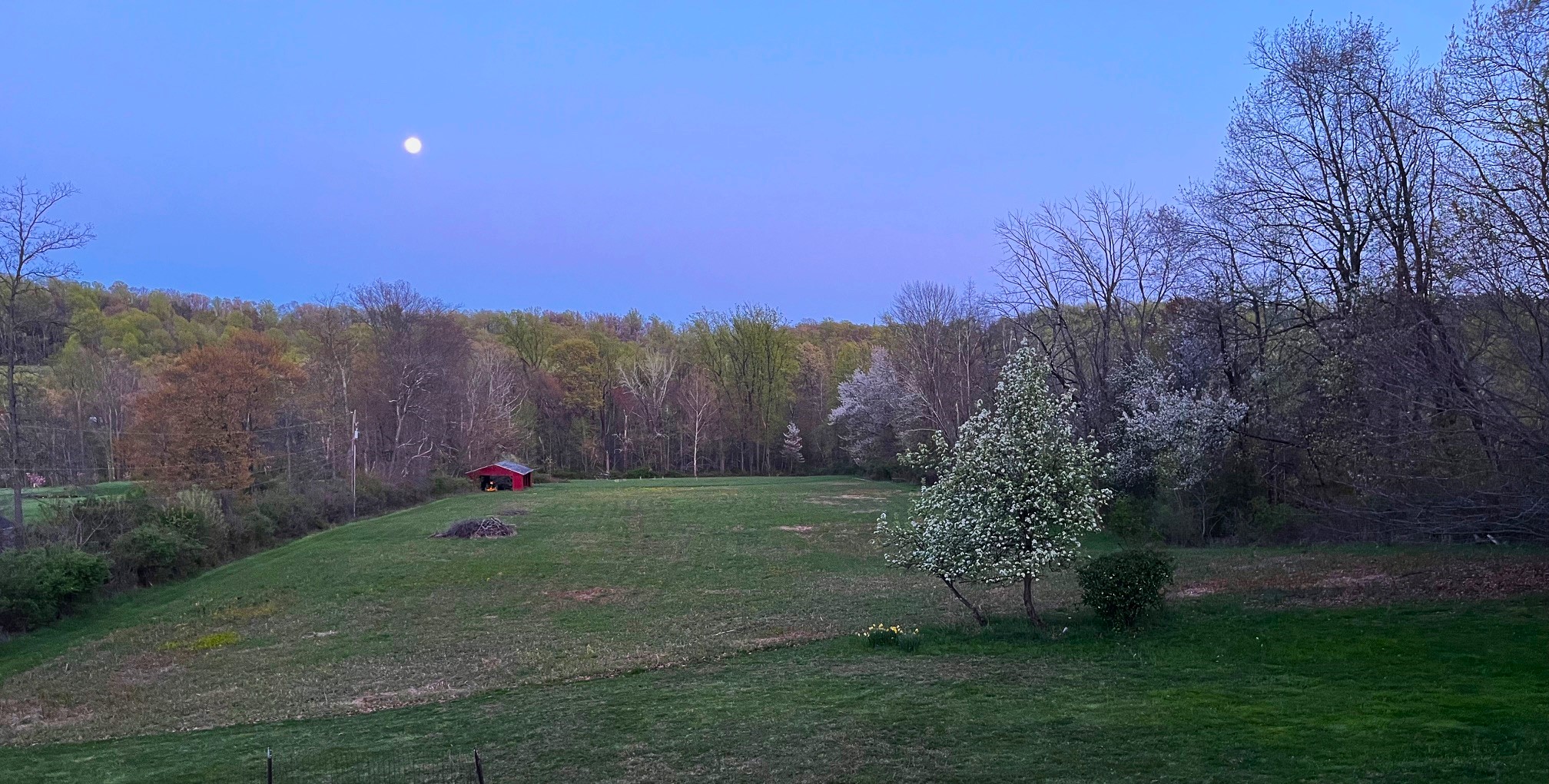
Full moon began the week as April reaches its closing days–when the redbuds and ornamental cherries are at their peak and the apple trees bloom. Soon the lilacs will open, and oak catkins will send chartreuse pollen all over the deck. Then there will be peonies and irises. I love the first weeks of May but this year will be missing some of those days. I’ll be traveling.

Because I have to prepare for my trip, attend a friend’s memorial, and prep the garden for my absence, this is my last post for National Poetry Month. I’ve chosen a poem from my book Water-Rites, a quiet poem that has always felt near to my heart. Maybe because I romanticize childhood, who knows. At any rate, I hope your poetry month was beautiful and that you continue to read and enjoy poetry. Thanks for reading mine this month.

~

On Having Lost the Confidence of Birds

Once, I was very small,
prone to long silences
and spells of aimless drifting
in the world's embrace,
staring at ants in their
grainy colonies, patterns
of activity, the slender
waists and legs,
frantic antennae waving
at me so I seemed,
for an hour, large.
Once, I could skip and sing
until dinner time, but chose
to lie front down among
dandelions, decided to watch
the skip and sing of bees,
their several kinds inducing me
to wonder about categories--
What Will or Will Not Sting--
and marvel at the dark swift birds
that lived in the martin house
and found bees edible.
In those long days I was
no threat, a quiet object
natural in the grass and breathing
at the meadow's pace.
I had not lost, yet,
the birds' confidence
nor learned how not to trust
my own body
in the world's embrace.
~

Au revoir, institution

It was not a huge surprise–the proverbial writing has been on the metaphorical wall for some time–but the college I attended for graduate studies has announced that it is folding.

In January 2001, shortly after I won a grant in poetry from the PA Council on the Arts, I rallied myself and my work, packed a bag, and took the family car by myself to Vermont for two weeks. In a burst of confidence and enthusiasm post-grant, I’d applied to creative writing graduate programs. There were none nearby enough to commute to, and Goddard’s low-residency model seemed my only choice. Well, I could have abandoned my husband and young children and moved to another area, but that seemed untenable and unkind.

But Goddard was perfect. I met new people and made (so far) lifelong friends-in-writing and friends-in-feeling. The work challenged me; the reading was intense! When I look at the bibliography at the back of my thesis, I admit I wonder how I managed. Hard work, intellectually demanding work, constant revision. Well, I needed less sleep in those days. Many times I read and annotated while waiting for my kids while they took piano lessons or riding lessons or whatever they were doing in middle school.

Sometimes my parents or spouse spent a Saturday or Sunday with the children so Mama could study and write. It is kind of a blur, but the community of fellow students seemed so supportive at the time. It’s not that I was without supportive people in my life–but the folks at Goddard, students and faculty, deeply understood my passion for writing. I found I could spend hours talking about things that matter to writers (which is kind of everything, but also, WRITING), which wasn’t easy to do in other areas of my middle-aged, middle-class, mom-life existence.

The iconic Goddard College Clocktower

Goddard often has been termed an “experimental” college. That term covers a whole host of meanings in the world of education. No point in trying to define it, since one thing that experimental institutions tend to do is change and evolve. The program I attended in 2000-2003 differed from the programs of 1985 or 2015. Which is as it should be–education should not be a static set of activities even when some exploration of canonical texts is necessary. One reason I chose to pursue my education at experimental colleges (The New School, Thomas Jefferson College, Goddard) is that I am a slightly odd bird, an autodidact who did well enough in standard subjects but who got the most benefit from deep study of things I felt passionate about–literature, history, botany, poems, dance, philosophy, feminism, visual art. Experimental colleges offered mentors who could guide me in self-directed learning, recommend books and authors, feed my often-changing interests, offer personal, one-to-one advising and critique. I am 100% sure I would not have excelled in universities that followed more standard educational subjects and protocols, and I’m glad I received good guidance (usually) and a well-rounded, if eclectic, education.

Many of the poems in my book Water-Rites are from my time at Goddard, since Water-Rites in an earlier form was part of my graduate thesis. And a fair number of the poems in The Red Queen Hypothesis were first drafted during my years there, when I was experimenting with forms. So, having just learned for certain that Goddard will cease to function as an offbeat, transformative, self-directed institution of higher education–thus joining my undergraduate school, Thomas Jefferson College of Michigan, as defunct institutions–I will post a poem that I know for certain I drafted just before I graduated. It’s a response to the events of 9/11 and was not quite ready, nor suited, for inclusion in my first collection; it appears in The Red Queen Hypothesis and Other Poems.

~

Shreds
for Judith

We ran, leaves before a bitter wind,
& some ran headlong & some in circles,
we did not know what to do with ourselves,

& watched, pressed to our windows & could
do nothing: streets erupted with people
like clustered beetles wakened from dormancy.

We walked, in all directions but mostly north,
& we were silent and our mouths were dry.
Things like shoes and hats made us human.

We wept and it was not sufficient,
& swept, then, for months & recalled
mostly paper, the ways we occupy ourselves,
the mild wind carrying what lingered. Scraps.


(after “Exhibit 13,” Blue Man Group, 2002)


~

Reading by day

While I await the eventual drying-out of the garden soil so I can plant a few early veggies and herbs, it seems a good time to ready a few more poems. I’m revising, drafting, but not sending out work. That feels comfortable at the moment; anyway, I much prefer writing to submitting poems.

I’ve also reserved myself some quiet hours to read books of poetry and a novel or two. Jessica Cuello’s Yours, Creature just arrived in my mailbox, and I’m on an Isabel Allende kick at the moment, so I definitely need some time to devote to reading. My husband, who tends to do his reading in the evenings, recently forwarded a Washington Post column by Stephanie Shapiro about why so few people read for pleasure during the day. Its title is “Why Does Daylight Reading Feel So Wrong?” She writes, “Although I am retired, I find it hard to allow myself an afternoon with a book or a long magazine article. Just the thought of settling onto the sofa in daylight hours, especially on weekdays, smacks of laziness and stirs up guilt. If I must sit at all, it should be at a desk or a countertop to do something ‘useful’— answer an email, write a grocery list, look up a recipe, what have you.”

I’m sure this is a common feeling, but it isn’t one I acquired, probably because my dad was ALWAYS sitting around reading a book, newspaper, or magazine–day or night. Reading during the day seemed normal to me. It still does, I’m happy to say.

~ Here’s a poem from my chapbook Barefoot Girls.

Night Drawn

I drew the night
with a number 2 pencil
I'd sharpened with
a Girl Scout penknife.
It was 1969. Night
needed blurred edges
so I smudged at it
with two fingers of my
right hand. And then
night left its prints
on my thumbs and palms,
somehow, on the yellow
print blouse and blue
jeans I wore.

I sketched shadows
the way I saw them
under beds and outside
windows, how they
deepened the early hours
when Grandmother
wakened by gaslight
to start her chores--
in darkness
which I learned to draw
with a pencil and
which stayed on my skin
the whole day.

Legacy vs the present

For National Poetry Month, I’ll be posting a poem here every few days…something from one of my books and chapbooks.

First, though, musings on why it matters to me that my poems get collected in book form. I’ve been asked about this by a few people recently, sparked by conversations about the changing technology of “print,” and also artistic purpose, and even the concept of legacy. If I were a visual artist–say, a painter–there would be objects my hands had produced. Even a mediocre painter creates something apparently lasting or worth something. You die, and your paintings go to family members or to flea markets where people can purchase them (for the frames if nothing else…). A ceramicist may make truly useful things such as bowls and mugs; those items can last and be used, even if they end up in thrift shops or post-apocalyptic archeological digs. Maybe the painter or potter isn’t remembered, but the product endures for awhile.

But poems? So many people leave behind sheaves of unread, unpublished, perhaps private writing, much of which won’t resonate with anyone. Even if it could, the chance that anyone would care enough to sort through before burning or recycling and uncover a heretofore unknown genius is vanishingly small. I, for one, am not writing for eternity or for the future. I write for the now. The main reason I want to get books in print is that the product (a book! I love books!) matters while I’m here. After I die, no one will want my pile of drafts, old journals, revisions, false starts–not even my children. And why should they? Will future society value archives of anyone, let alone very minor poets of the early 21st c? Maybe the demise of technologically-based societies is right around the corner. All the more reason to work in and for the present moment. If I garner a few readers today, I feel blessed.

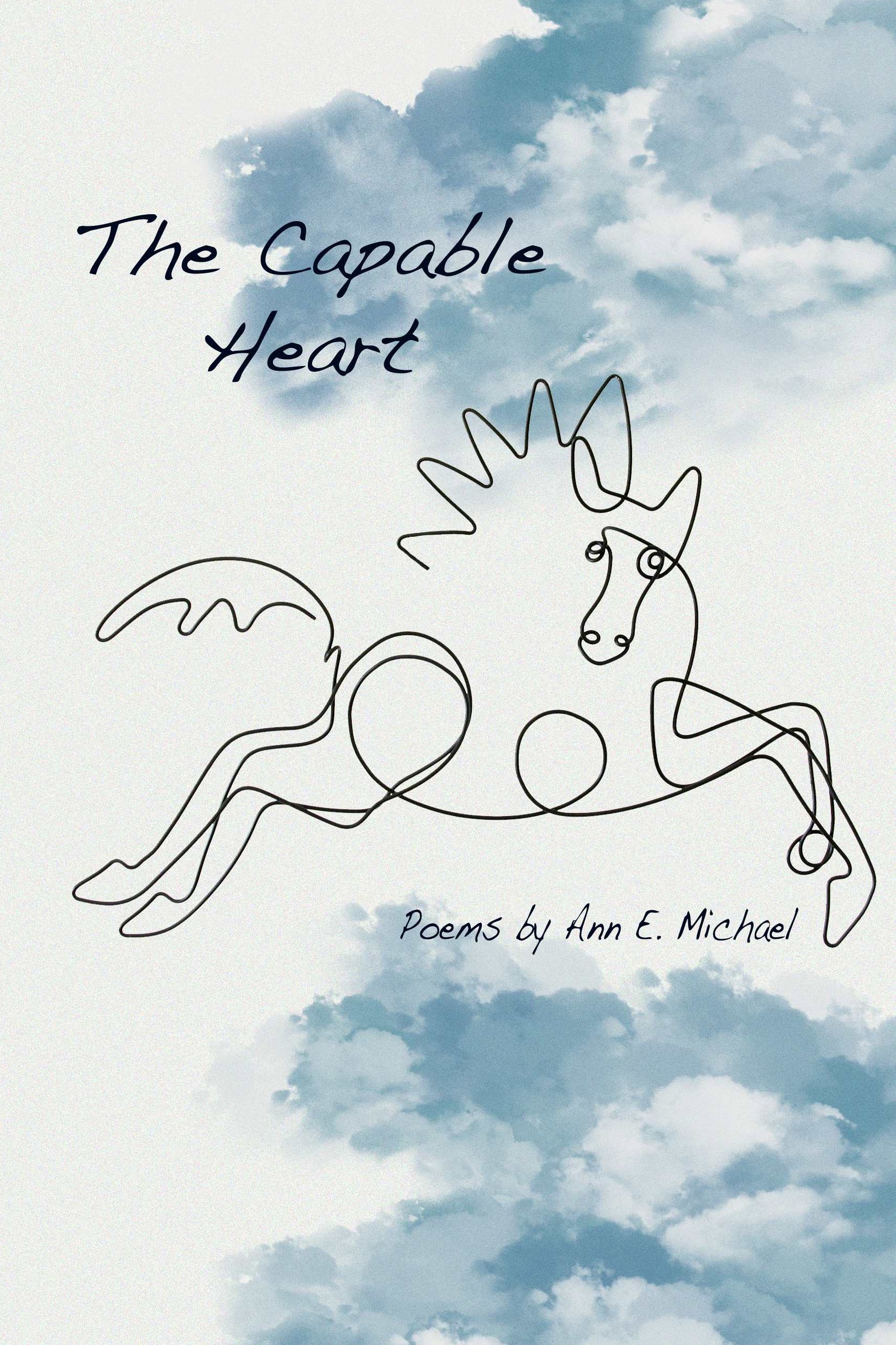
~ Today’s poem is from my 2011 FootHills Publishing chapbook The Capable Heart.

No Long Farewells

The weedy field.
On the rise beyond,
armies of brown corn,
ready to fall.
Willow looses streamers,
yellow kites
floundering in
tall grass.
I look at my hands,
fingers gold. We
walk past grapevines.

Later I think of this day
as a drafty barn,
sun on its walls,
clouds high beyond rafters:
roofless.
Nothing blocks our vision
for once. No blinders.

There is little time
for long farewells.
A light goes on.
Your bus is leaving now.
Moon follows you home.