Hawks & fragments

When I take the commuter bus into New York City and back, I prefer daytime trips because I can count hawks.

I’m not a birdwatcher; but I have noticed, over many years of traveling the route (Interstate 78 Pennsylvania through New Jersey), that the highway offers good predatory-bird landscapes. The bus has large windows and elevates the passengers above the usual traffic lanes, so even though I’m traveling 70 miles an hour, I have a panoramic view through eastern Pennsylvania and north-central New Jersey, where there are scrims of woodlots behind the noise barriers, scrubby undergrowth on medians and embankments, a few cornfields, many high-density housing communities, railroads, creeks, and small county park lands.

I seldom get a close enough look to identify a bird positively; yet from my motor-vehicle perch I can tell a buteo from a harrier or an accipter. The fairly small kestrel is difficult to note, being about pigeon-sized (and pigeons are legion in NJ &NY) but I’ve identified them by their flight pattern. The buteos are most common around here, and from a bus I can’t usually discern a broad-wing from a redtail. But I see them roosting at dusk, or perched, or soaring over the fields and the strip mall parking lots. Twice, I have even spotted a great horned owl in trees along the route.

There are important raptor flyways along this path and into the region just west of where I live: Hawk Mountain is a big birding attraction along the Appalachian Trail. I have counted as many as 18 raptors along an 80-mile stretch of road. The commute takes just under two hours; I am probably the only person on the bus who spends most of her time looking out the windows at what is, admittedly, a rather uninspiring and predictable landscape.

redtail

See below for a link to raptor id at Hawk Mountain

~

51YVrgMy9sL._.jpg

Hawks have been very much on my mind because I recently read Helen Macdonald’s quite wonderful memoir, H Is for Hawk, which I highly recommend.

~

Here are a few fragments of notes I wrote in my journal while I traveled home last Sunday.

what could be a hawk. but isn’t–

paper wasp nests     squirrel dreys (nests of food for hawks!)     leaf clumps      plastic bags[tangled in boughs]

big crows. until they fly.          traffic cameras. the particular angle of them, perched (as it were) above streetlamps.

without binoculars, and in motion. not birdwatching. I scan for raptors.

frozen swamp–The Meadowlands–

snow. out of which phragmite grasses emerge, brown, russet brown. color of redtail feathers.

cranes/high tension wires. canadian geese–also in snow, feeder creeks & streams frozen, Hudson frozen, Delaware frozen.

raptor count NJ 10, PA 4. Four in 16 miles, Pennsylvania.

And yes, I composed a couple of poems during the trip.

But only one of the poems featured hawks.

~ Link to a great page for Eastern US raptor identification
About art (a poem)

While trying, I fear in vain, to tidy up and organize my poetry files, I came across this poem composed before 1997. Despite its flaws, I decided that rather than revise I should post it here, because it offers a narrative about how a person–shall I specify, this particular person–might come to love the wide, multicultural, historical, spiritual, experimental, transcendent “world” of art.

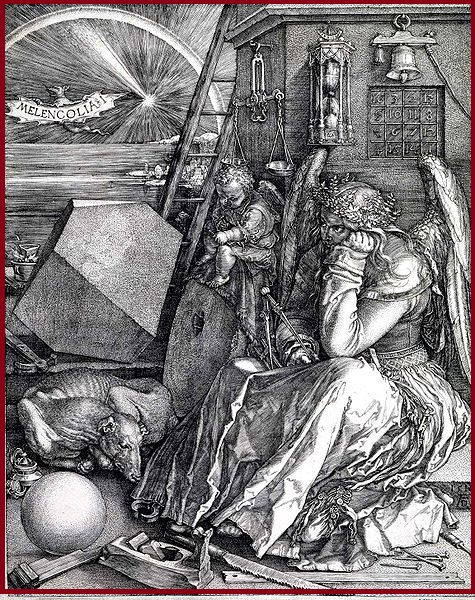
Melencolia_I_(Durero)
A Life Saved by Art

The library’s card catalog led me
to shelves of art books: oversized, glossy-paged,
crabbed with tiny, inarticulate commentary
about volume, form, structure,
perspective, light and shadow,
innovation and rebelliousness
and the emotive content of the line.

What did it mean? I was eleven.
I made a hagiography based upon
the beauty of still things, life arrested,
mid-gesture, on canvas, wood, stucco,
merging all my saints and artists into
a collage of stories as naive
as Rousseau’s jungle scenes–

but I believed Rousseau, and Breughel
and the intimacies of Rembrandt’s Bathsheba
and the endless processions of amazed Magi
through the narrow streets of precarious Italian towns
and Degas’ women tying up their hair
and the rich invitingness of Gauguin’s flowers
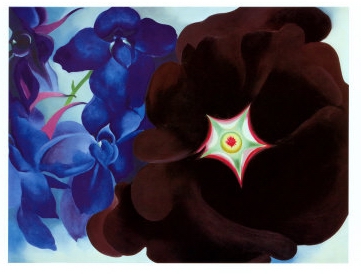
and the stark heart of Georgia O’Keeffe–12-01-05MagiFraAngelico

I believed I would learn to comprehend my life,
put it into perspective through
Giotto’s tiny and exquisite backgrounds,
Dürer’s precise grids, believed I would discover
an understanding of the abstract.
I wanted to be transformed through art,
the sanctity and structure of the line,
and, through them, out
of the coming confines of adolescence.

I forget so much of what I learned,
but still I possess Arles, and Athens,
the buff-colored pages of
Da Vinci’s notebooks, ink and ideas:
ink which now sprawls abstract upon the page
while I consider the emotive content
of each line–and brilliant fields of color
daubed in wild and perfect order:
a moment, a childhood, a life
saved by art.black-hollyhock-blue-larkspur-georgia-okeeffe

~ © 1997 Ann E. Michael

~

There are better poems about art (even by me); but I treasure the yearning outlook this piece suggests, and its tendency toward overstatement as well.

♥

Consciousness as story

Some recent questions to myself:

Reading philosophy and psychology for so many years, was I looking all along for an explanation of consciousness?

Through neurological and evolutionary science, and more philosophy and more psychology and, in addition, some anthropology, some history. And fiction. And rhetoric. Trying, perhaps, to understand the self? Through criticism, through art, through literature?

Looking carefully at art, reading literature closely: were those also endeavors to comprehend what mind is? Other minds? My own mind? Through the creative act, perhaps?

Is the ars poetica a kind of manifesto of human consciousness from an individual perspective, yet open to interpretation by other human minds? And the beautiful–what is it that even makes beauty a significant concept? Where did that come from? Evolution and the sexual drive (see Dutton riffing on Darwin)? Society? Synthesis? Ego? Inspiration? Angels?

Is every story a scaffold to consciousness? A hedge against oblivion? (Self-oblivion, the hardest navigation act there is: depression, hopelessness, loss of self-knowledge, coma).

I wonder if the stories we tell to others and to ourselves, employing memory selectively whether or not we realize it, act as a kind of (modern-day, metaphorical) Chain of Being through which we develop Theory of Mind and, beyond that, a sense not just of ego but of neurological consciousness. If stories are what make us human.

~

The chain of being, from Charles Bonnet, Œuvres d'histoire naturelle et de philosophie, 1779-83

The chain of being, from Charles Bonnet, Œuvres d’histoire naturelle et de philosophie, 1779-83

[Note: I do not hold the medieval concept of a hierarchy in which Man, angels, and God stand above all other things; the stone and the plankton have as much value–likely more–than I do in the workings of the cosmos, as far as I am concerned. I post this Enlightenment-Era engraving here for metaphorical and aesthetic reasons because I take pleasure in the delightful monkey.]

~

Stories have tremendous value to human beings in ways we are still discovering; see my previous posts here, here, here, and here (among others). I keep coming across claims for the significance of story in surprising places–most recently in Dutton’s The Art Instinct and in Atul Gawande’s latest book, Being Mortal. Widely different texts, similar observations.

How is it we know who it is we are?

Possibly, in the process of inventing the story of ourselves, we become human. Perhaps the story of ourselves is fundamental to conscious “human” minds.

Speculation. But I love recalling that my children, when they were very very young, consistently made one particular demand of me: “Mama, tell me a story!”

~

Key images

I had intended to post on Denis Dutton’s book The Art Instinct: Beauty, Pleasure, and Human Evolution; and I will (I suppose) at some point, because I enjoyed it immensely. Looking through my files, however, I found the transcripts from the initial interview Karen Jogan and Hernán Pereira conducted with me when they were compiling the book So Far…So Close and realized that my answers to some of their inquiries connect with my last post about poetic voice and Kunitz’s thoughts on key images. (The longer, but edited, version of the interview appears in the book).

~~

  1. What colors or aromas remind you of your childhood?

Cinnamon toast, mown grass, onion grass (wild garlic), lily-of-the-valley, cedar-water and pine trees, the scent of a muddy river in summer, wintergreen, play-dough, school paste, steam-irons, fresh peaches, campfires, burning leaves, talcum powder, Pepto-Bismol, air-dried clothes and linens, mimosa blossoms, roses, strawberries.snowdrops

  1. Describe yourself as a child.

I wonder from whose perspective I should attempt to answer this question. I know from others that I was considered to be shy and polite, talkative when comfortable, imaginative. I certainly felt uncomfortable among groups of people, preferring small groups of friends with whom I played make-believe. I made up stories which I told my sister and brother, and when I was old enough to write I made little children’s books that I illustrated and bound in cardboard.

My sister was my best friend, but I spent a good deal of time all by myself. When alone, I walked my dog, climbed trees, played on the swings, sketched and painted, and read books. I really was a bookworm and spent many happy hours with books and in libraries. Being alone was, and still is, deeply satisfying for me—it helps me regain creative energy.

  1. At what moment in your life did you begin to write?

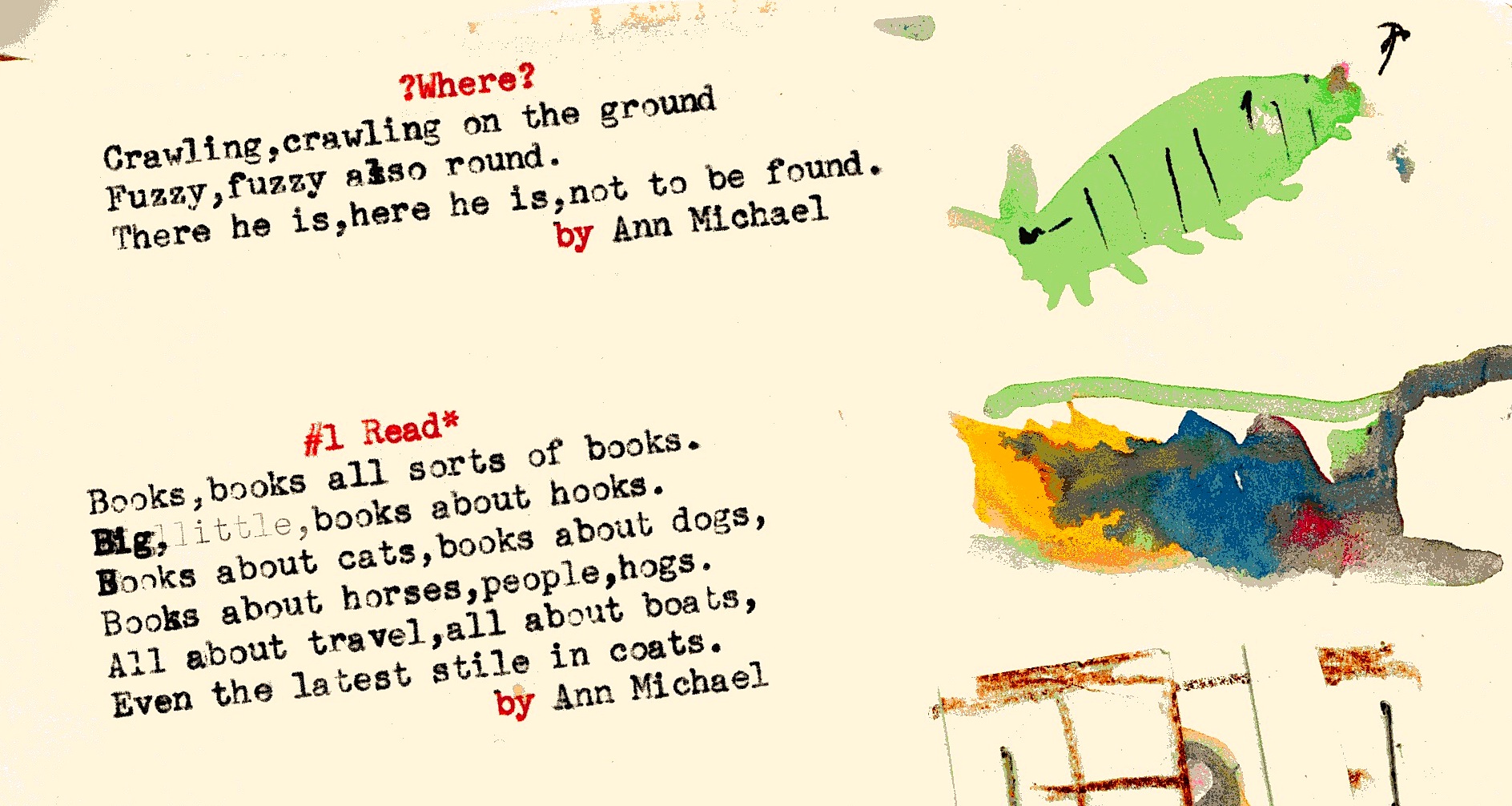
I don’t remember when I began writing. My storytelling began early, and I suppose the writing developed from there. The first story I recall writing down was about a princess; I was in second grade. I felt proud of myself, even though the story was only about three sentences long. Apparently, the poems started when I was about nine. I don’t remember writing poems then, but I recently found some that I had composed and typed up (I was fascinated by the typewriter), and my mother’s notes said I was nine when I wrote them. What I really wanted to be was an artist, but writing seemed natural to me. I started keeping a journal when I was ten…

9yroldpoems010

Rhyming and typing and illustrating and bookmaking– at nine years old.

  1. What influences have been important to you?

Other writers, naturally, but first of all, visual art. From the time I was very small, I’ve loved paintings and sculptures and architecture. Church hymns and Bible verses and nursery rhymes were influential to me, as well as folk music and the lyricists of popular music when I was growing up. I am also influenced by non-fiction work, especially in the sciences, and philosophy. My early poetry influences were Donne, Shakespeare, Blake, and the King James Bible; but then I fell in love with contemporary women writers, then surrealist poets, then Latin American writers, then Asian poetry, then contemporary lyric poems…it goes on and on. It might be easier to say what I have not found particularly influential!

~~

With further reflection, I could go deeper about early images that have become, for me, “key” aspects of my writing voice…a particular landscape, the feeling of an empty nave, bees and birds, milkweed, cloud patterns, my parents singing, my little sister beside me in our shared bed, the sound of a symphony. They may not appear in my poems as such, but these images connect with me in ways I probably don’t understand. What do such keys unlock, I wonder?

~

Voice

I follow the Women’s Poetry Listserve (Wom-Po), and recently there was a discussion there concerning what poetic voice is. Can it be defined clearly? Does it differ, and if so how, from style? Is it personal, belonging to the writer herself–an attitude? Is it distinct from the creator of the poem, as the “speaker” of the poem arguably is in the case of poetic voice/persona?
A listserv member offered this quote from Kunitz:
“One of my convictions is that at the center of every poetic imagination is a cluster of key images which go back to the poet’s childhood and which are usually associated with pivotal experiences, not necessarily traumatic. That cluster of key images is the purest concentration of the self, the individuating node. You can tell the poets who are working at their center by the distinctiveness of their voice, their constellation of key images, their instantly recognizable beat.” … from Stanley Kunitz‘s 1975 lecture at the Library of Congress, “From Feathers to Iron.”

A constellation of key images may seem to be imagery, not voice at all; but Kunitz’s decision to connect distinctive voice with a recognizable beat and images, and to further suggest that these mesh to in the compositions of a poet who is writing with clarity and authenticity (my interpretation of what he means by “working at their center”), indicates that voice is a critical component of poetry. I have read the above-mentioned lecture, but Kunitz does not there elaborate on whether he means the writer’s personality, style, or attitude or whether he means, instead, persona. It seems to me, though, that he wasn’t talking about persona (the “speaker” or mask the writer uses in an individual piece). I interpret that the key constellation of images, the “individuating node,” would have to be personal experience of the actual writer–Roland Barthes be damned.

CH Chucrch

Gaston Bachelard’s phenomenological approach to poetics and, to some extent, psychology, appears to jive with Kunitz’s pivotal childhood images. It is easier to recognize one’s own key images in one’s work, of course…and I cannot help but recognize that Kunitz has nailed it for me, at least, if not for all poets (writers, artists, musicians, etc.). My own cluster of images, drawn from childhood, include the church. Also the beat of hymns and responsive readings and the King James and RSV Bibles. Also the bleat and wail of diesel engine horns, the progression of fields and trees and flowers, the hum of highways, the sluggish flow of certain rivers. To mention but a few that stay with me.

I am not an adherent to any particular style or form of literary critique, and I am not a whole-hearted phenomenologist, either–but I have to admit that these concepts (the individual’s key images, the individual voice and the persona voice, the rhythm or beat of a writer/speaker) intrigue me. I find them well worth exploring, mulling over.

See Dave Bonta’s Via Negativa post here for a mini-photo-essay that illustrates what I mean.

Protest (Selma)

The past 10 months have been especially notable for public protest here and abroad. As it happens, I’ve been trying to write a poem about my father’s participation in the voting-rights march (1965, Selma to Montgomery AL), a kind of occasional poem to commemorate the 50-year anniversary. Then the movie “Selma” was released, which I just saw at the cinema.

The film, like all “based on a true story” dramatizations, may have focused on perspectives of the protest that worked best for the scriptwriter, may have some historical inaccuracies, may raise some controversy. But as a child whose parents were, though marginally, connected with civil rights through the churches’ participation, the movie felt true in the big way: “capital T” True. Funny, the aspects of the film that engaged me: how I could immediately identify who the actors were portraying (Abernathy, Young, Lewis); the way so many important discussions took place in church basements and classrooms (as the child of a minister, I am intimately familiar with church basements and classrooms); the televising of Bloody Sunday.

And another True thing:  the familiar, biblical-style, preacher-cadence and allusions in King’s speech. People do not talk that way anymore. But they once did, and I recall it well. Rhythm and intonation and the use of allusions and analogies impress the sort of listeners who eventually become poets, I am sure of it.

Right now, I am struggling with my poem. I am not sure I will ever complete a draft that I feel pleased with–maybe it will end  up in my “dead poems” file. What I will do instead is to devote my next post to my father’s depiction of the Selma-to-Montgomery march, from his point of view, looking back 50 years.

Poetry, history, connectivity

We are connected, perhaps too closely, too immediately. With Nigeria and Boko Haram. With Paris and Charlie Hebdo. Ferguson, MO. Eric Garner in New York. George Zimmerman. Iraq. Syria. It’s easy to continue this list–too easy.

What we tend to want are simple solutions, dichotomies, dualities, one choice or another–not complexities and subtleties. But the human brain, the human culture, the human genome, the human body and the systems in and through which we operate are damned complicated.

~

Former US Poet Laureate Billy Collins gets a great deal of press, and sometimes he gets criticism for his popularity; but in a recent interview he states in apparently simple terms how complex the human condition is, and why we need compassion, and poetry:

The poem shows us that these emotions, love and grief, have been going on through the centuries; and that the emotion we’re feeling today is not just our emotion, it’s the human emotion.

Poetry is the only history we have of human emotions. Most history books, what we call history books, are stories of battles and treaties, negotiations and beheadings and coronations. But poetry is the only reminder of this very essential part of being human, which is one’s emotional life and all the dimensions it entails.

The history books will leave out many of the crimes, massacres, terrorist acts, and bloody little belligerent actions of people and their governments and cultures and belief systems. History cannot help but be compromised by point of view–it is always, as Churchill noted, “written by the victors,” even when they are trying to be even-handed and objective. But poetry is all about point of view. The “tell it slant” of Dickinson, ambiguity and mixed feelings, individual imaginations and individual interpretations. As Collins puts it:

I think writing and creating are expressions of an epistemological position — that is, how you look at the world, that slant you look at it from. And that’s all I feel I am in a palpable way responsible to: using that slant to get at some truth or a little smidgen of beauty.

It’s a matter of being true to your imagination, and being true to your vision, and true to the material you’re working with, whether it’s a violin or the dictionary of the English language. You have to listen to all the other violinists who have ever played, and read all of the poetry you can consume. That’s my sense of responsibility. It’s an artistic responsibility, not so much a political one, not so much a financial one or a responsibility based on commodity. It can’t be commodified.

As a teacher myself, I love the anecdote in this interview about a past student who, years later, could recall a poem he’d memorized for Collins’ class. Collins says:

[T]eaching is a very mysterious process. You’re throwing information, in a sense, into the dark. I mean, you spend an hour talking to this group of increasingly younger people and you walk out of there and you think sometimes you’ve had a good class, and other times it’s not been that great. But no matter what it is to you, you’re not sure how it’s being taken or what effect you’ve had.

The story reminds me of one time when I was getting my teeth examined; my dentist (knowing I teach poetry) said to me, “You know, in college and dental school, I took Chemistry. I had five classes in Chemistry. And I never, hardly ever, in my current job, use that information. I almost never think about chemistry. But I took a class on Milton’s Paradise Lost. A poetry class, really. And  you know, to this day–sometimes I find myself thinking about that poem. And that class, and those lines. Really. It’s stayed with me much longer, and more significantly, than any of the chemistry courses I took.”

Billy Collins would surely smile and nod if I were to tell him this story. Those connections are the invaluable sort: beyond information and into the mystery of what makes us human beings. Teachers learn from this sort of experience. It stays with us.

~

We may not be able to resolve the wars, prejudices, pride and anger and sense of  injustice that cause people to murder one another for revenge, honor, religious feeling, economic or territorial needs, or fears so deep we may not even be able to name them. Even tolerance has its downside: a tendency to refrain or excuse when speaking up might be necessary, if dangerous. Not all of us enjoy the learning we can gain from adversity or from trying to understand our enemies, who may not respect a willingness to listen. Not all of us learn from great literature, or have the patience to live with art that discomfits or challenges us. It is easier to paint Satan with the broad brush of evil, when Milton’s character possesses nuance and depth. The same with Mohammed or Jesus, the Pope or Buddha, Putin, Obama, or any world leader or financial oligarch.

We are all people in the world, flesh and bone, loved by someone, suffering and gratified by daily life, under the same sun and moon. The sun and moon that have appeared in poems from time immemorial. The biosphere that connects us whether we like it or not.

Gestation

Without committing to any resolution to do so, I spent some time recently with my own poetry: the unfinished drafts, the partially-revised pieces, the fragments and the poems I had put aside for the time being. “For the time being” was, in some cases, over a decade.

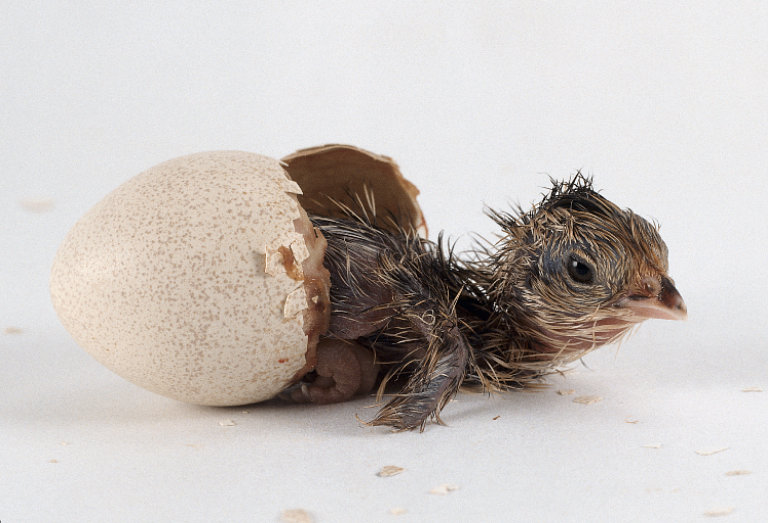
This putting-aside led me to wonder what process–other than forgetfulness–leads me to abandon a poem for such a long time. I am aware that artists in other media experience this sort of pause in the working of making; sometimes, the years on a project are full of revision and detailing (Rodin’s doors “The Gates of Hell,” for example) but often, the composition just lies about for a perhaps-indefinite number of years. I believe the poet Donald Hall refers to this as a poem’s necessary gestation.

In a 2008 interview (by Wendy Andrews), Galway Kinnell said, “When I can take a poem of mine that I think is finished and put it aside for a month and pick it up and read it and find it interesting, and if I encounter no place where I think it should be changed, and if at the end it surprises me, even though I wrote it, I think it might be done.”

That’s what I have been endeavoring to accomplish for the past two weeks or so: a reading of my own drafts to discover whether any of the poems are capable of surprising me, or if any of them might be revised into achieving that state. It is a lengthy project and a quiet one that requires considerable internal analysis and an objective stance. And maybe that is one benefit to letting the work sit around for so long…by the time I peruse the draft again, I have forgotten the initial inspiration, so the poem has to operate on its own merits as a composition rather than through any residual inclination or emotional attachment I may have once had for it.

If my own work manages nevertheless to impress me in some way, I tend to harbor the hope that it may be salvageable. If not, I can keep revising, or put the drafts into my “dead poems” file and consider it incapable of resuscitation.

The parallels to pregnancy and gestation may be inevitable–parents harbor hopes that their children will be good people who are successful in the world, just as poets want their poems to be “good” –but that sort of gestation analogy only goes so far. We cannot revise or rework our human offspring, and an objective analysis of their strengths and weaknesses is unlikely to lead to betterment of either party. But a work of the imagination can be re-envisioned, reconsidered, and made new.

That’s the work of the next many weeks. I am curious indeed as to where the work, after its long gestation, will lead me.

chick-hatching

Spaces

Ah, the traditional New Year’s blog post! :) I have spent time away from the computer to tend to other things, among them, my own “space” for being less busy. Finding that space has not been easy, but it is the sort of discipline we human beings ought to practice in this Age of Information. Without a little inner space, it is far too easy to become anxious and overwhelmed.

So I think of Bachelard’s quiet exhortation to cultivate the creative or childhood space, which I contemplated in 2013 at about this time of year (in this post). And I think of Jon Kabat-Zinn and other writers–often classed as spiritual self-help authors but whose writings need not be considered spiritual at all (Kabat-Zinn, in particular, avoids using the term)–who remind us to be attentive, aware, mindful, compassionate even to ourselves, and willing to take ourselves away to inner stillness now and again.

I am particularly drawn to the notion that contemporary human beings can come to mindfulness through actions rather than through withdrawal from the body and the world. Really, we hardly have any other choice. Although I enjoy solitude more than most people do, I am ill-constituted to be a hermit or a renunciate. My temperament precludes noisy advocacy against injustice or for specific good causes; but I could certainly do more helping, more of the kind gesture, more listening, and more giving of the type that lets not my left hand know what my right hand doeth (Matt. 6:3).

There were difficulties this past year, and aggravations, and sufferings both personal and social. So be it; we can learn from failure and adversity. The best way to learn to problem-solve is by being faced with problems!

In his 2000 book about aging and dying, Ram Dass wrote: “My guru once said to a visitor complaining about her suffering, ‘I love suffering. It brings me so close to God.’” Well, that is another way of looking at things; and perspective matters. Creative thinking involves full analysis (even when the analysis seems intuitive, immediate) and often employs a total restructuring of the problem at hand–a widening or narrowing of scope, a different point of view, a new set of tools or skills for puzzle-solving, or quiet cogitation while the thinker digests the whole situation…which may be, for some folks, prayer.

Or poetry. When I am not writing poetry, I am always reading it. Other writers’ words open me to a sense of communal understanding, a sense that we are not alone, not a single one of us, who can hear or read or remember a poem or a word of love or praise. Even when those poems depict sorrow or suffering, for then we know we are not the only ones who feel troubled.

“And our problems will crumble apart, the soul
blow through like a wind, and here where we live
will all be clean again, with fresh bread on the table.”

― Pablo Neruda, 100 Love Sonnets

Let the wind make space for fresh bread on your table in 2015 and always.


bread

bread

Some endings

On a bleak wet day: thinking about revising my poems. The pile of “needs work” drafts appears daunting; I have put off for too long the required work of rethinking, the hard, conscientious effort–and unstructured time–necessary to the craft. I have always enjoyed the task of revision because it offers a chance to revisit the initial urges of the poem and to refine and reconsider my ideas, but lately my motivation has abandoned me.

I notice, above, all of the words that begin with “re.”

Latin: “in the matter of” or, (res), “thing.” But as a prefix: “again,” likewise, to indicate a backwards or repetitive motion.

revise   §    require      §      revisit     §    refine   §

    rethink    §     reconsider

Maybe I am eager to move forward instead of always going back. Nevertheless, one method of moving on is to complete what one is working on so as to create a sense of closure. Sometimes, all a poem needs is a better ending.

When I think of revision under that perspective, as a means of completing an unfinished job in order to prepare for the next, new task, the pile seems slightly less unmanageable.

And by way of re-envisioning the endings…Molly Spencer’s blog The Stanza offers a good list of closure options here.

sunset1~The ending of a day~