Linkage

Thanks to a student who pointed out how many of the links to the right (on this blog page) were inoperable, I have finally updated them. Well, most of them; I have limited time for tweaking around on my WordPress settings page.

Links appeal to me because they mean connection. The interconnectedness of the web parallels the many relationships among human beings, societies, and environmental entities from forest to desert, as well as infrastructural connections from town to city and across waters and the physiological connections that make life in a carbon-based embodiment possible. And neuro-connections that maintain our pulses and our consciousness–without such linkages, what would we be?

linkage-5 University of Utah

see link in para. 3

Our genetic linkage influences what we look like, what forms of illness or robustness our bodies possess, and the likelihood of carrying those traits to our offspring.

When we link ideas or concepts or theories, the resulting concatenation can be innovative, revelatory, novel–even if the result is a failure, there’s much to learn from trying to solve the puzzles we encounter when putting together unlike things.

Writing a poem, for example, involves such a combinatory effort. Combinatory logic is a mathematical concept but an intriguing metaphor for what poets do when we mash together observations with ideas and emotions and whatever values each writer operates under.

Linkage permits us to steer things, too, and to integrate systems elegantly:

baesystems-parallelhybridrives_OEMoff highway

[thanks to OEM Off-Highway]

So, please check out the links to my work and to the interesting sites on the right of the page on this post. And likewise, links below (yes, I am still taking part in reading blogs on the Blog Tour!)

On capital letters in poems and making craft choices in poetry, an interesting blog post by Marly Youmans.

And Leslie Wheeler on whether a poem can be a monument.

~

May you remain always connected, one way or another.

Poetry books & the $

April has been designated National Poetry Month by the Academy of American Poets–the campaign was launched in 1996–and because I write poetry and love the art, and read poetry and know poets personally as well as through books, I try to keep the awareness of the month-long love-feast for the crafted word going in whatever small way I can. Hence, if a reader should happen to type the words “National Poetry Month” in the searchbar on this page, said reader would find tagged posts on the subject going back about eight years.

Some years I have endeavored to draft a poem a day for 30 days, some years I have been active giving and performing readings, some years in teaching; it varies on circumstance and energy. This year, I am celebrating by reading more than by writing.

When I buy poetry books, I try to purchase them–if possible–from the author or from the author’s original publisher rather than more cheaply (Amazon, used books, etc.) The author gets no royalties from books bought second-hand, and because few poets are rolling in cash from book sales–and while gaining an audience may be of value–even a small royalty check is a welcome thing, a confirmation of the work in the world.

Best-selling poetry is not necessarily the “best” poetry. Those of us who love the art can contribute in small ways by using the almighty dollar to support the writers we think need to be read.

Here are some poetry books I have bought, or borrowed from my library, in the past two weeks or so. I don’t usually go this crazy with poetry-bingeing; but as I’m not doing much else for Poetry Month this year, I figured I would contribute by doing what I love best: reading books!

Lesley Wheeler, Propagation; Louise Gluck, A Village Life; Grant Clauser, The Magician’s Handbook; Jan Clausen, Veiled Spill: A Sequence; Luisa A. Igloria, The Buddha Wonders If She Is Having a Mid-life Crisis; Aaron Baker, Posthumous Noon; Ian Haight, Celadon; Erica Dawson, The Small Blades Hurt; Brian Turner, Here, Bullet; Margaret Gibson, The Broken Cup. There will be others!

And two notable non-poetry books I loved, Elena Georgiou’s The Immigrant’s Refrigerator, short stories; and Laura Miller’s The Magician’s Book: A Skeptic’s Adventures in Narnia (a subject close to my own heart–her approach to the book and her history with it ring close to my own experiences).

There will be others, if I have any spare time. I am also planning to read a book by philosopher Andy Clark and a biography of C. S. Lewis and to proofread my brother’s latest paper on Samuel George Morton. If only the weather were warm enough that I could read in the hammock!

hammock

image from www.meditationrelaxationclub.com


Begun in reverie


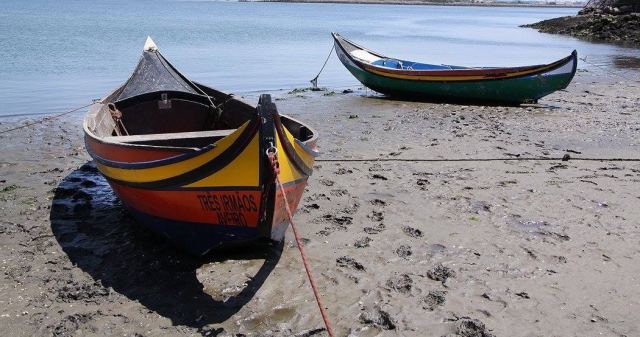
wooden fishing boats

Near Aviero, Portugal; photo: David Sloan

Today, I was thinking of Portugal. Nice memories. I went through my digital photographs, found this one, and fell into reverie. It is amazing how images enhance memory or enable us to embellish it. Sometimes, that is where a poem begins.

When my physical body walked upon this sand, beside this bay, the encounter was a mix of new–a place I’d never been before–and familiar or expected: smell of brine and fish, the feel of breezes in my hair and on my skin, of damp sand underfoot. I recall my delight at seeing the vividly-painted wooden boats, though I had certainly seen paintings and photographs of similar fishing crafts, so their appearance was not surprising. That’s because I have a friend who is an expert in wooden boat-making, Simon Watts; he has been around the world examining wooden boats and had told us to watch for these along the coast of Portugal. Simon is a teller of stories, as is his sister Marjorie Watts. So many hours Simon has regaled us with tales of the writing life, the sailing life, the traveling life, the woodworking life, his forays in Portugal…

Back to Portugal. I think of a most pleasant week there, not so long ago. Mind hums with possibilities. With images. With words.

~

This post is an effort to illustrate how image, memory, sensory experience, stories, human connections, and activities bounce around the neurological synapses while a person experiences reverie.

It isn’t reverie, of course, because I am writing; true reverie seldom includes much activity. Let me suggest the paragraphs and picture are somehow analogous to the reverie process, which often leads to imagination.

~

Next stop: Imagination! train 1And perhaps even a draft for a poem.


Filling the world with poems

Taking part in the blogging tour means trying to keep up with what other poets have been posting, and in the process raising my own writing frequency. Recently I’ve read several writers’ insights about, fears of, and approaches to the process of submitting work for publication. I have also had several in-person and by-email discussions about the perceived or genuine value of publication of one’s work, and some advice on how fervently to pursue publication (and in which venue).

A perennial topic among literary types:

http://ofkells.blogspot.co.uk/2018/02/on-rejection-and-some-advice-from-drag.html

http://webbish6.com/what-ive-learned-from-my-millennial-friends-as-a-gen-x-writer-or-how-to-submit-like-a-millennial/

https://uniambic.com/2018/01/24/poetry-submission-strategy-whatever-works-for-you/

http://webbish6.com/the-importance-of-resilience-in-the-poetry-game-and-in-life/

https://lissaclouser.com/2018/01/26/accepted/

https://lissaclouser.com/2018/01/30/scared-to-submit-yer-poems/

~

I’ve also read articles urging poets to consider submitting on a “tier” basis. First-tier journals are the long-standing literary magazines such as Poetry, The Paris Review, APR, and the better-known university-affiliated literary journals. The tiers move down from there, and it gets complicated deciding whether a lively, well-visited online site is a “higher tier” than a lesser-known print venue.

A friend advised me not to post drafts or unpublished poems online, as they are then ineligible to appear in most literary venues, online or in print–generally, these journals want first-rights for publication. These concerns once mattered to me; I no longer care.

Why the change?

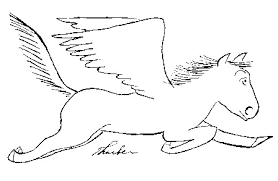
My outlook has moved on. I’m not seeking an academic appointment or a job teaching creative writing at the college or graduate level. I’m no longer starting out–I’ve had my poems published in literary venues of many types since 1981! If I haven’t made the “top tier,” maybe I never will; I still submit to those journals now and then, but I set no store by their rejections, though I would be happy if I had a poem accepted by–say–Poetry. [I miss the days when I’d get a little slip of paper with the formatted rejection emblazoned with what a friend calls Thurber’s “Evil Pegasus.”]


pegasus

This image by James Thurber belongs to The Poetry Foundation


My intention in this decade of my life is just to keep writing and to get the poems out into the world in whatever form, venue, media, or technological method may exist. I do recognize that many other poets are either just starting out or trying to secure a career in the writing field–or trying to advance in the university–and for those poets, a concern for the cachet of the journal or venue and the extent of its reach for the correct audience matters considerably. I’m not suggesting anyone take a cavalier approach to publishing; it is serious work (those curious about publishing, see the blogger links above).

Tedious work, for me.

Nonetheless, I do occasionally submit to journals, as the listing to the right with links that sometimes but not always work discloses. Most recently, I am glad to report that I have two poems in Antiphon #22. < The link will take you to the journal in .pdf format. This time, I did not provide an audio file; but some of the authors have, and these are always worth a listen.

Yet another new way of filling the world with poems. Psalms. Antiphons. Moving poems. Texts. Podcasts. Anthologies. Journals. Websites. And more.


The beloveds

In my last post, which featured a draft of a new poem, I should have mentioned my indebtedness to Gregory Orr and to the King James version of the Bible, as well as to Rudyard Kipling for the affectionate phrase “O Best Belovéd.” *

It’s fascinating, the inflections of English–and the way some of our archaic forms of speech still show up, such as the extra syllable pronunciation option for a word like beloved. I appreciate, too, the connotation of one whose emotional being feels connected to another person. We nurture those connections when our children are young, when we fall in love, when we feel intense compassion for another person–sometimes, even, when the person has died and the feeling of being a beloved and having that beloved near linger.

My own best-beloveds fall into all of those categories. I believe I can say I have a full heart.

~

As my last two posts featured poems of sadness, I wish to change things up. This one’s a love poem and a food poem, a cozy piece for the approaching darker weeks.

stewcook


Says the Stew Cook to Her Belovéd

Cat’s leaped on the kitchen counter, pawed a walnut from the bowl.
Liter of red wine waits for dinnertime—can’t say I’m not tempted, though.

Low sun highlights the bottle’s deep maroon while I make stew:
turnips, potatoes, garlic’s liquor, bay-leaf—needs only you.

Cool weather calls for firelight and whatever cooks long.
This cook longs to influence your taste, your tongue.

Since night’s expanded its acreage, taking over December,
we can build upon the dark, fill nooks with aromatic hours.

Come taste soup, share coriander scent, sip from this spoon.
Lick clean the bowl, my love, cover pots, come to bed soon.


~


~~  * I recognize, however, that for many many readers, the word Beloved will most closely be associated with Toni Morrison’s daring, beautiful, wrenching novel by that title–a work I highly recommend.

The narrative vein

Every time there is a crime, journalists seek the story.

Police talk about putting together the story of the perpetrator. The person’s story assists in determining motive. Motive can assist in solving a crime or prosecuting the perpetrator.

Stories require conflict. What is a drama or novel without plot? There is a whole world of plot for narratives, but they tend to need conflict somewhere.

The narrative vein in poetry follows the same story source, although in poetry much can be compressed. There are nonetheless implications of conflict, sometimes powerfully so.

I have posted before about human beings as “The story-telling animal.” Brian Boyd and Daniel Dennett and others note the ways in which stories help us to understand ourselves and others.

I begin to think that storytelling gives us not merely a method for examining cognition, but that perhaps telling stories=human sentience. That perhaps we would not be sentient if we were not aware of stories, able to invent them, or try to recall our own memories in a storytelling fashion. We could be human beings without them, but we could not be sentient.

This is just a story I’m creating for myself in this moment.

This is my own story about sentience, consciousness, and compassion through understanding of narrative persons, personas, and perspectives.

At the same time, I find I wonder:

Do we need better stories?

33414458

Beautiful brain

While waiting for the snow to evaporate and melt, the gardener experiences agitation; the days are longer–it must be time to plant seeds…but the soil is too wet and too cold.

Fortunately, there are always books! I have read Daniel Dennett on religion, George Lakoff on the embodied basis for philosophy, and am plowing rapidly through Ruth Whippman’s (acerbic and very funny) America the Anxious.  Also I am slowly savoring an anthology of Jewish women’s poems, The Dybbuk of Delight, that I randomly discovered in the library.

beautifulbrainbook04-1080x644

But here’s a book I want to own, when I can justify more book purchases: Beautiful Brain: the Drawings of Santiago Ramon y Cajal, because Art! because Neuroscience! because Beauty! The blog Hyperallergic says the drawings are going to be touring museums (see The Dynamic Brain Drawings of the Father of Neuroscience), which might also become a must-do for me when the exhibit travels to New York City next January.

What Cajal was doing back at the turn of the last century still inspires artists, not just medical scientists, today (see my post on Greg Dunn’s neuro-artworks). These compellingly beautiful and quite accurate drawings may also inspire poets and armchair philosophers who have lately spent a great deal of time pondering the resilience of the brain and the challenges that rupture a sense of self when cognition is interrupted.

beautifulbrain01-1080x1373

~

Credit goes to Abrams Books for these graphics and for the decision to publish this beautiful text.


Diversity of form

“Diversity” is a buzz word among educational institutions these days, and I sometimes get a bit tired of hearing it. Diversity as a buzz word becomes like a dead metaphor; we stop thinking about what it means.

Yet when I am reading about biology or evolution, “diversity” flowers into meaning again.253142_2101392498695_2412222_n

Also, after the reading I recently gave, a thoughtful member of the audience remarked upon how literal and concrete the poems in my first book are–especially compared with some of the more speculative and abstract poems I read in response to the “questioning” theme.

Has my writing become less concrete over the years, I wondered. The response is yes and no. In some respects, my poems convey specific and concrete images and actually-possible events, but a mixing tends to occur between & among the lines. Even in that first book: it is, in fact, about building a house. (Concrete was involved!) As I composed the poems that make up the book, however, I realized how metaphorical the whole idea of house, home, hearth, shelter is. Think of the imagery of a house and ingrained, almost mythical connotations arise. The window. The door. The key. The roof. The rooms (stanza means “room” –even the poem offers shelter).

So back to diversity–there is, in the world of poetry and poetics, diversity of form, just as in biology. There are “set forms” such as the sonnet, which turns out not to be quite as “set” as might be expected (see this entry at The Academy of American Poets and this one by Rachel Richardson at the Poetry Foundation). I love diversity of form and have experimented throughout my life with different strategies of written expression, sometimes sound-based or rhythm-based or image-based or codified by the “rules.” I have also broken the rules just for fun, often to good effect. Free verse, metrical verse, alliteration, allusions, puns…I love them all.

The downside of such play, if this can be considered a downside, is that winging it the way I do–as to formal approaches–means that my collected work does not fit a style. I wonder if that is why my second full-length collection languishes unpublished. It’s entirely possible that the poems in The Red Queen Hypothesis are not very good poems. Critical feedback has suggested that isn’t the problem, though (whew!). The problem may be diversity! Publishers, like most human beings, love to categorize. What does not nestle into categories becomes the odd duck.

http://asymptotia.com/wp-images/2009/10/odd_duck.jpg

odd duck

The reason I chose these poems for this collection, however, has much to do with varieties. The poems deal with the abstract and the biological, the cosmological and the everyday. They stem from a notion that life evolves continuously, making each object and being individual as part of an ever-changing, meshing, chaotic and– paradoxically, but of course!–unified universe. Uni (one). Verse (a pun). The underpinning of The Red Queen Hypothesis is diversity, though that may not be its theme.

So I am not planning to revise the already-much-revised collection; I’ll just persist in sending it out to publishers while hope springs eternal. In the meantime, I have been pondering where the next set of poems is headed. Possibly along the edges. It will be interesting to find out.

Renewal, work

One never can know when work will arrive. By the term work, I mean what some people call “inspiration” but which, for me, is more work than it is a shower of divine gifts from the Muse. The past week brought an uptick in poetry drafts, as well as the acceptance of a poem by a publication I admire. All the more reason, therefore, to continue the process of working on the composition of creative writing.

I wonder if there’s an urgency pushing me to write new poems–the semester begins this week, and once I am teaching and tutoring again, time to write seems to evaporate–so I had better get cracking! Or it could be my response to the losses about which I have recently written, supposing that there is merit to the practice of writing as a way of healing or the writing cure (and I do suppose there is merit).

Maybe, just maybe, one might presuppose a connection with the arrival of a new year. Renewal. That would be arbitrary and perhaps subconscious; but the possibility remains. I can consider myself in the not-quite-midwinter renewal period, wrestling with potential poems that might turn out to be essays or blog posts or total duds or, if I am diligent and analytical and compassionate and lucky, completed poems.

Wintry hours ahead

Winter arrives…in red & white

~

Wish me luck. And hard work. I don’t mind being urged toward hard work; it’s the only way renewal really ever happens.

Writing the new year

To renew myself as a writer of poetry, I need–every now and then–some way of re-engaging with the work of writing itself. Revision, for example, often means hard effort slogging through material I wrote long ago; but the process renews my dedication to the salvageable poems and sharpens my analytical and evaluative skills.

Sometimes there’s no saving a poem, but the concept behind it might be worth exploring in an essay.

Sometimes there’s no saving a poem, but the words needed to be expressed at that time.

Revision requires taking a stance of compassionate distance from the work itself so that I can feel both judgment and kindness toward my own poems. The bonus here is that, often, the work of revision gets me writing new work.

Beside my desk at this moment is a stack of poems I spent the past few days thinking about and revising. The work creates its own energy; the buzz of words and imagery emanates…

I feel ready to write the new year.

:)

objects, stories