Reading, eagerly

Another of the books I got from Alice James is the 2018 collection pray me stay eager by Ellen Doré Watson. 9781938584688_FCMy initial responses to the poems herein vacillated between the intellectual and the…ear? Sound? I guess what I am trying to say is that a significant part of Doré Watson’s poetic craft employs sonic crushes of alliteration and internal near-rhyme, storms of assonant wordplay and sudden stops in syntax; just when the lyrical narrative seems almost to narrate a story, other pressures intervene. The feeling reminds me of times I cannot concentrate, when I’m full of either ideas and intentions, or fears and concerns.

So I felt, “These are hard to read.” Because it can be uncomfortable to stay, purposely, in such ambiguous moments. I found the poems puzzling for awhile until I stuck with the reading and settled into the poet’s sound and methods. And then, response, reward: ideas and experiences that struck chords, places evoked, sentences that capture the way human beings think and process their circumstances. Revelations, even.

Maybe I was just in the wrong mood for reading when I started this book…there are times when I want an “easy read,” a comforting novel with a happy ending for example. Such texts, though, seldom teach me or show me anything new, whereas pray me stay eager has made me think about the mechanics of a line of poetry as well as sound, and touched me deeply as the poet writes of her aged father and the deaths of friends and her keen appreciation of the world and the word.


New to me

Just prior to various stay-at-home mandates, I learned that the long-running, wonderful poetry press collective Alice James Books was having a 40% off, free shipping sale. How could I resist? Thus, I am happy to report, I received four poetry collections in my mailbox two days before we were given the full lock-down in my county.

In this edition of my blog (where, to celebrate National Poetry Month, I am responding to poetry collections), I post about Adrian Matejka‘s debut collection from 2003, The Devil’s Garden. I had read Matejka’s poems here and there, in Poetry magazine and online; and I know he has published three books since this one. I had never really sat down and read through one of his collections before, however.

GardenThe language here is clear and fine, frequently musical–a trait I like very much. Matejka’s newer work engages with the ideas society and individuals have about tribes, groups, races, mixing, and this early collection establishes those themes. The voice here strikes me as youthful, newly-minted. But sure in its control of the rhythm and sound of a poem.
Oh, the cruelty of people who see others as dangerous outsiders. That’s my feeling, disheartened; yet the speaker in the poems here strikes me as compassionate to participants and observers. No blame. Despite the hardships, no victim. The poems suggest a person who has become fascinated by complexity: complexity in language, in social background and race, in families, in physics, in music (jazz, particularly), in visual art and the movies and what’s going on next door.

While reading Matejka, I remembered my friend David Dunn, who died in 1999 but who would have liked this book, I think. So the book has done me some good, rousing my interest, giving lyricism room to gallop, reminding me to listen to Coltrane and Al Green a little more often, offering me recollection of a person dear to me, and thematically linking with so many other terrific books and ideas (Natasha Trethewey’s Native Guard and Thrall, my brother John S. Michael’s research on scholarly Enlightenment anti-racists–yes, there were a few–and even the BBC historic soap-opera I’ve been watching, season 5 of Poldark).

But also, these are lively, readable, inventive poems. A good reason to spend time with a poetry book.

More reading, more poems

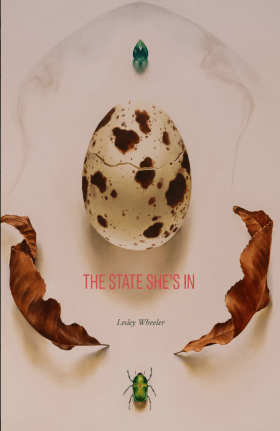
Here’s my second post on what new or new-ish or new-to-me books of poetry I am reading during 2020 National Poetry Month. This time, newly-released from Tinderbox Editions, Lesley Wheeler‘s collection The State She’s In.

wheeler-state

First, a little background about Wheeler, a poet, novelist, and educator who has been extremely supportive of contemporary poets and poetry in her classes at Washington & Lee University, in her administrative positions and presentations at AWP, and on her blog and other social media platforms. The state she’s in is metaphorical, but it is also Virginia, with its fraught history, and it’s also the body: female, white, mid-life.

What I want to write are responses to, not reviews of, the books I have been enjoying. And there is much here to enjoy! Each of the book’s sections carries the same title: “Ambitions;” and after I read these poems (almost in one go, the way I’d read a novel), I returned to the table of contents and considered how each set of poems made a list of ambitions, and also, what it means to have ambitions. Particularly for a woman in a 21st-c Western capitalist society, sometimes ambitions read like anger. Are met with anger. Require rage to confront, even though rage alone will not solve the problem. (Appropriate to insert here how I love her poem “Spring Rage”? Yes, appropriate.)

Wheeler’s use of haibun forms to explore state’s-rights racism or workplace harassment is something I found startling. I keep returning to these and other poems to appreciate, on each subsequent reading, the surprises in the craft as well as the barely-contained frenzy expressed, and also the keen observations of the world that act to calm the speaker down. A tough balance, that.

On the whole, The State She’s In feels like a fierce call to pay attention, not just to the reader but to the speaker in these poems–she’s finding her route toward sagacity but kicking away at what we take for granted, not wanting to find personal equanimity if it means hiding what she knows to be true. These poems oppose ignorance in all its forms, including the privilege of choosing not to learn (or not to act, or not to act fairly and justly) that gets practiced at the highest levels of the academy, the government, and in any form of society. Wow!

If enough of us could get together and recite Lesley Wheeler’s “All-Purpose Spell for Banishment” (p. 57), maybe we could make “The Nasties” vanish.

Reading poems

In the midst of a pandemic, we have poetry. Pragmatists ought to be listened to, and scientists as well; and poets? Let us not ignore them. It is April, National Poetry Month, and poets offer readers much in the way of reflection, consolation, compassion, entertainment, satire, humor, joy, grief, and the shared experience of being human. All things that are of use at any time, but especially when times are uncertain.


Last April, I challenged myself to write a poem a day and posted the drafts on this blog. That turned out to be a useful experience, but I feel no need to repeat it. This year, I want to post about some new(ish) books of poetry. Not critiques or book reviews, just what the poems evoke for this particular reader.

~

First up– Lynn Levin‘s The Minor Virtues, 2020, Ragged Sky Press. The cover’s appropriate to the month: a lovely image of dogwood blossoms. And I have to admit that what drew me into the book is the charming mundanity of the first few poem titles, in which the speaker is tying shoelaces or buying marked-down produce. Most of the poems in the first section begin with a gerund phrase and place the reader in a present-progressive act of doing something. The poems here feel so grounded in reality (quite a few are sonnets), often humorous–grabbing the wrong wineglass at a banquet, trying to think about nothing–that I immediately settled in to the pages.levin_tmv_cover

The topics, or the reflective closures, move toward seriousness at times; her poem “Dilaudid” shook me awake and left me in admiration for a number of reasons (some of them personal resonance–but). Levin’s humor tends to be intellectual–wordplay, allusions, wry asides–and I revel in that sort of thing. Her approach to craft also works for me, because she’s usually subtle going about form or rhyme schemes, so I enjoy the poem for what it says and means and then enjoy it again for how it’s structured and inventive.

I mean, that’s one way I read poems. There are other ways. Some books carry me pell mell through word-urgency or the writer’s rage or passion and some build lyrical intertwining networks of imagery and some make their own rules and some stagger me with their innovation. And I may have to be in the right mood to read a collection.

I was in the right mood to read Levin’s book. It was a good way to begin National Poetry Month in the midst of stay-at-home mandates, taking me gently through a “normal life” and reminding me of all that is surprising there, the riddles and the unexpected, the minor virtues and the actions we take as we practice them. Whether or not we think of them as virtues.


Miscellany

I reside in one of the Pennsylvania counties under “shelter in place” advisory, but I can work from home; also, we live on almost 7 acres, so outdoors activities continue. The buds bloom. The insects waken, goldfinches molt to their bright yellow, the magnolia tree bursts into blossom. The meadow is muddy, and vernal pools appear in the hedgerows.

Today, a miscellany of links and virtual or reading-related forays.

My new chapbook, Barefoot Girls, can be purchased at https://prolificpress.com/bookstore/chapbook-series-c-14/barefoot-girls-by-ann-e-michael-p-317.html

(Here I am as a barefooted teenager)

bfg

1975, New Jersey, USA

Poets House is offering live workshops (video) and has a great archive of past readings. Check them out. https://poetshouse.org/

Dave Bonta continues to compile fascinating writing-related blog posts. From his site, you can link to many other poets and writers who are pondering pandemics and etc: https://www.vianegativa.us/2020/03/poetry-blog-digest-2020-week-12/

~

Meanwhile, I am still making my way through the 910 pages of The William H. Gass Reader, a selection of some of the prolific writer-critic-novelist-philosopher’s essays and excerpts. I love his piece on the book as a container for consciousness, and I suspect I’ll be saying more about that in future.

~

Two friends have come down with the coronavirus; it’s no joke, people, take the slow-down seriously and “level the curve.” Please.

Finally, here is a photo of the wonderful hospice staff at the in-patient unit where I volunteer (though, for now–no volunteers are permitted in the hospital to assist, so these folks are doing it all themselves, bless them!).

thumbnail

<3   <3   <3


Memoir-ish

While we are self-isolating, how about reading books? As it happens, I have a short chapbook of poems that’s being released just in time for National Poetry Month. Here are some thoughts.

~

I enjoy reading memoirs–a well-written memoir reads like fiction or poetry, with interesting perspective and description revolving around not an entire life but one event or series of events that has a dramatic arc the way fiction does–and, often, some of the same ambiguities. Now that my chapbook on adolescent New Jersey girls in the 1970s is coming out (March 26, Prolific Press), however, I realize that readers are likely to interpret these poems as memoir. After all, I was indeed a teenager in south Jersey in the 1970s. That being the case, I might go only so far as to call these lyrical narrative poems memoir-ish.

barefoot girls cover

What people who read poems often forget is that the poem does not necessarily reflect the poet’s experience, only her interpretation, only the potential or the possible–the imagined. Poets choose personas as narrators when we endeavor to imagine other people’s insights, points of view, or experiences. Or even other beings’ or objects’ “points of view.” But of course, we can only imagine–we cannot really know anyone else’s lived experience. That gives poets and fiction writers and dramatists room to speculate, pretend, imagine: “What must it be like?”

This booklet tries to evoke various voices from a collective past but, I hope, will feel familiar to anyone who has ever been an adolescent. These poems emerged from Bruce Springsteen songs, from memories, from rumors, from attending a class reunion,  from experiences my 21st-c students had, and from my imagination. I filled in some gaps and created perspectives that would certainly not have been my own when I was a teen. And yet, any writer’s disingenuous if she claims her characters or narrators have nothing to do with her own perspective, that everything she writes is completely made up; if that were true, readers would feel left out. There would be nothing in the poem to relate to, nothing from which to derive personal meaning or insights. No “Aha!”

Any poem that can be called lyrical takes up the close point of view. Any narrative poem tells a story of some kind. An example is Patricia Smith’s book Blood Dazzler. Readers find it easy to believe that Smith resided in New Orleans, was there when Hurricane Katrina hit, because the poems are so authentic and personal–fierce, believable voices describing the devastation and its particular toll  on elderly and non-white citizens. But Smith did not live in New Orleans, and it doesn’t matter. It is an excellent and shattering work all the same.

Here’s one of Ren Powell’s posts on the unreliable narrator of our own lives. What we writers work with, often, is evoking the emotional memory, which isn’t the same as other ways humans recall events.

Yet it often fells more “true.”

~

Something like a poem

I am writing. Honest, I am! –This is what I tell myself. I have dribs and dots and bits of ideas, crumbs, atoms, iotas, shards and dabs of images and sentence-starters and such. The writer feels stuffed full of goodies; but the work schedule has “het up” (as my great-grandmother used to say), and the weather shows hints of warming (so there is seed starting I must set up).

~

Perhaps 150 steps too many
or too steep a descent or the sun too hot,
not enough water to sip maybe just too old now
for such exertion viewing the falls of Rio Olo
Fisgas de Ermelo where the chestnut leaves
provide a bit of shade

~

interstices. pine’s seeds.
its imbricate bracts, reptilian.
interlaced. at each base
the offer of replication.

~

…fat possum eating our birdseed two hours past dusk
in the faint light–what’s left of the moon’s crescent
and what the neighbors’ lamps cast up the hill
dimming everyone’s view of the stars. One dry oak leaf
skims the slate. Tumbles onto the lawn. Not unlike
the gray and white omnivore whose naked tail, sinuous,
wraps the step after the rest of it has slipped
away from the sunflower seed, into the dark.

~

Not anywhere near to poetry, yet bookmarks for what I may yet compose.

~

Meanwhile, I have been reading William Gass and thinking about the roles of listing (ah, specifics and details!) in prose, poetry, and in fiction, and the uses and limits of wordplay (which can be off-putting to some readers) and allusions and dialect or arcane or jargon words. Seamus Heaney–so good with the occasional archaic Irish term! Robert Macfarlane, giving me the beautiful word “clarty” which, during the muddy months of 2018, so often applied. Can I keep them in my vocabulary? Dare I use them in poems?

~

Found poem, from a dictionary of geological terms:

Lateral Moraine

Ridge-like moraine carried on and
deposited at the side margin
of a valley glacier.

Composed chiefly of rock fragments
derived from valley walls
by glacial abrasion and plucking,

or colluvial accumulation
from adjacent slopes.

~
Well, it’s something like a poem.

Death & beauty

I may be misquoting Edvard Munch; but I think I once read a translation of his letters in which he said, “From my rotting body, flowers shall grow and I am in them and that is eternity.”azurea

There’s a famous line in Wallace Stevens’ poem “Sunday Morning” that reads, “Death is the mother of beauty.”

Simone Weil wrote, “The destruction of Troy. The fall of the petals from fruit trees in blossom. To know that what is most precious is not rooted in existence – that is beautiful.”

Many human cultures have, from all appearances, created beautiful rituals, art, cultural objects, music, literature in commemoration of the dead, or have believed that death is a necessary part of a cycle that would lead, again, to living beauty. What is it about human beings that inclines to such an impulse? Is it just fear? Or a desire to be remembered, or to remember the beloved?

Poe claimed that there was no subject more suitable for poetry than the death of a beautiful woman; but he was full of crap about that or, at any rate, too swayed by the culture in which he resided in his awkward and outsider way. Nonetheless, he puts forth the assertion that from death can come something that is itself beautiful: a work of art, a lyric, a poem. I do not disagree with him on that point.

virginia poe

Edgar Allan Poe’s sketch of his young wife Virginia

Certainly many poets end up writing about, with, or against death; raging or praising; querying, challenging, wondering, fearing, fighting, sometimes embracing or accepting. Do I hear Emily Dickinson in that chorus? Dylan Thomas? Walt Whitman? Marie Howe? Mark Doty? Ilyse Kusnetz?

In a previous post, I alluded to the death of a beautiful woman (a friend), and asked about the value(s) we humans place on beauty–and the way(s) we define, describe, and name it.

Because death’s one of The Big Mysteries–and writers tend to gnaw around the edges of things that are not easily put into words, and mortal is what we are–poets poke at death, encounter it, question it, and question the religious, biological, and social accretions that surround it. Can we find beauty in death, from it, surrounding it? Recently, I attended a philosophy lecture concerning death and the soul from a Catholic (Thomist) perspective,* and the talk briefly moved into inquiry concerning the intersection of death and beauty. I did not ask, what sort of beauty–aesthetics, or awe?

But I am asking now.

~~


*Dr. Marco Stango, DeSales University

Garden painting

The image on the right is from a book in the Metropolitan Museum of Art’s Department of Asian Art, available through its new digital collection of Japanese illustrated books. It is written in Chinese, however: Jieziyuan huazhuan; Kaishien gaden 芥子園畫傳 and is catalogued as The Mustard Seed Garden Painting Manual (3rd Chinese edition): [volume 3]. I do not read Chinese, but I think the drawing must be of quince in flower. My photo of pink quince blooms focuses on a particularly floriferous branch; in fact, the quince in my back yard is thorny, broken off in places, and often a bit scarce as to blooms–more like the drawing.

The book itself is interesting. It demonstrates and describes how to paint these shrubs. The sketches show the stems as the initial composition, with gaps where the blossoms are later to be painted. Then the blossoms get painted in, and then ragged lines of twigs and thorns to complete the painting. Since I cannot read the text, I interpret the stages from the drawings.

It occurs to me that this approach–one of guessing the stages–feels familiar. It resembles literary criticism; and it resembles the process of reading and re-reading a poem to try to determine its making, which is usually hidden since it takes place in the mind of the poet as she revises.

canvas3

note the gaps…

An analogy here: when I first write down the phrases, images, “inspiration” (if you will) for a poem, there are gaps. These lacunae appear in several forms, sometimes as spaces or blank spots in a sentence, sometimes as an unsatisfactory placeholder word, sometimes as a dash or ellipsis. These marks, or lack thereof, act as reminders to revise, rethink, resolve missing links or relationships in the poem’s developing ovum.

~

Winter makes for gaps. Skeletalizes the trees. Snowfall temporarily erases the known. Clouds cover sun and moon. Even the songs of birds, mostly absent.

As David Dunn, my long-dead friend (another emptiness), would sigh during moments that conversation became too intense or too difficult: “Anyway…”

In a temperate climate, we do need winter. The birds will return.

color birds-blooms1

~

when sap runs red
forcing budding trees into blossom
mating time

~

Apology

Speaking of February, here’s a poem trying to make amends for my dislike of the briefest month. This apology appeared in Prairie Wolf Press Review*, and I may include it in my next collection (whenever that may be).

~

Apology

For years I have held February
answerable to many sorrows
as though the month itself
were responsible for its appearance:
the dour days too short, long nights
steeped in frosty bitterness.
Resigned to hibernation,
February made me sleepy.
Dulled my skin, sucked dream
into a cold vacuum
like a vacant acre of outer space,
a stone of ice upon my chest.

But today, I watch a small herd
of yearling deer file gingerly along
the hedgerow over crusted snow
and sense thaw within.
The days, brief, are nonetheless
beginning their shadowy
stretch into spring. It is the month
owls urge themselves
toward mating, their querying calls
strung along night’s bare branches;
the month buzzards return
from foraging the more southerly dead.

Skunks break dormancy amid
tussocks of snowdrops;
sometimes, the hellebore blooms.
I have been observing February
from all the wrong angles.
No, this is not the wild greening of April
nor the fragrant abundance of June,
but it is something that deserves better
than repudiation or scorn.
To February, which has given me much
besides unhappiness, I offer my apology.

~

~~~

*Prairie Wolf Press seems to have folded, alas.