Poetry on chilly days

The region in which I live has been experiencing a lengthy spate of below-freezing weather, many a chilly day. When I do not feel like concentrating too much, I browse seed catalogues. But I am also reading poetry.

Today, I’ve begun reading a 2011 collection of poems by Rachel Hadas, The Golden Road, poems that are dense and beautiful and often elegiac in tone. I took a workshop with Hadas quite a few years ago and had enjoyed her work since long before the class; it was a pleasure to have her as a reader/instructor. And it is, so far, an excellent book. I’ve been keeping her poem “The Study” in my mind for hours now.

Good news, though–I have commenced the year with new poems of my own. I have three drafts as of January 7, which is a good start.

But for today–yet another chilly day–I’m posting this little verse by William Carlos Williams.

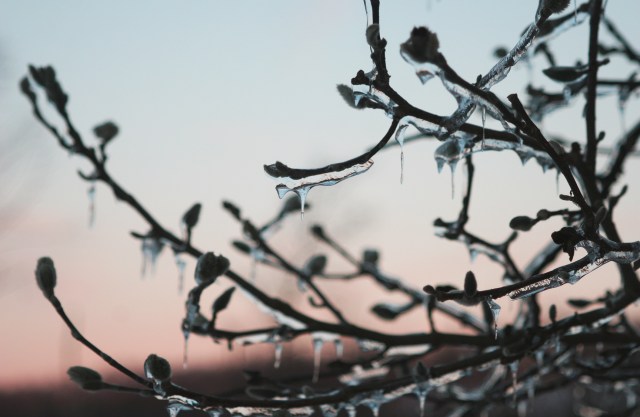
Winter Trees

All the complicated details
of the attiring and
the disattiring are completed!
A liquid moon
moves gently among
the long branches.
Thus having prepared their buds
against a sure winter
the wise trees
stand sleeping in the cold.
                              –William Carlos Williams
~
IMG_0516
~~
~~

Poetry & paradox

~
“Language is a profoundly mysterious technology, so constitutive of the human mind that we can only get glimpses, from inside the fishbowl of consciousness, of how it works.”
sea inside Charnine

 The Sea Inside. Charnine.com features information on surrealist artist Charnine and Surrealism – copyright © 1994 – 2011 Samy Charnine – All rights reserved

~
How do we get from language to poetry? However we do that, consciously or not, it must be as fluid and natural as it is damned difficult! I sometimes wonder whether paradox may be the basis of art. At least, if there exists a “something” that inspires me to compose a poem, paradox–and the way it requires effort to explore contradictions and ambiguities–could stand in as my motivating flame.
~

Paradox, randomness, juxtapositions and contradictions evoke imagery, dream, the realms beyond the rational consciousness we humans claim to possess. Poet and fellow poetry blogger Susan Rich recently posted about the surrealist painter Remedios Varo, an artist whose name and art I had never before encountered; and I felt an urgent pull to introduce her work to my friend David Dunn–he loved surrealism and appreciated it more than I ever have, and such paintings (particularly early de Chirico) exerted a large influence on his poems.

David, however, died in 1999. I share my memory of him here, by writing it on a blog, the same as I share the names of Varo and de Chirico and of the many poets and philosophers I have mentioned during my years of posting to this forum. It’s a form of immortality, if only a temporary immortality (another paradox…)
~
Here is Menand again, who wrote poetry in his youth but moved into journalism and critical reviews in prose later on: “… I got the same painful pleasure out of writing prose that I did out of writing poetry—the pleasure of trying to put the right words in the right order.” Painful pleasure. That mysterious technology, language, rises to the occasion of inherent contradiction.


“And I took away from my experience with poetry something else. I understood that the reason people write poems is the reason people write. They have something to say.”
~
Do you know what you have to say before you write a poem? Or does what you have to say appear in the process of writing? Or after the poem seems complete? Or once someone else has read it and decided what it is you had to say?

About time

It is the last day of the calendar year, and tomorrow evening a full moon will shine over our snow-dressed meadow. End-of-year events have left me thoughtful about time, memory, fear, love, and other such. Which brought to mind this poem I wrote quite a few years back. It’s part of The Red Queen Hypothesis manuscript.

Let 2018 be a time to press against the dam and swell into your next adventure.

~


Counsel

Wait for that wisest of all counselors, Time. —Pericles, Plutarch’s Lives

Always, you have hated the wait,
fidgeting at the desk, the queue, your bed.
You suffer the malaise of the young
whose imaginations collide
with the world’s dull and repetitive ways,

for whom responsibility is a petty bureaucrat
in a cheap gray suit
watching the clock you punch, counting
irretrievable minutes you spend
doing work you cannot love.

Do not despair.
After you’ve done some time
in the slow slog of nickel and dime
your passions, silvery as fishes,
will gather in schools that swell and press
against the dam—

that damn ordinariness
dulling your heart—
and spill themselves brilliant into
the crooked creek of your next adventure,
each carrying in its small body
the germ of an idea, yours
to pursue.

~

waterfall

Poetry as a value

If individual consciousness exists among human beings, and I believe it does, it is however the collective consciousness that has the longest-ranging impact. We are social mammals. We crave some object or objective with which we can connect and form relationships around in order to create community. Humans cannot survive without communities.

Those communities can be centered around almost anything as long as the focus keeps social members busy with the process of group-forming, skill-sharing, skill-teaching, communication and, ultimately, the development of a shared history. Hence family, tribe, language, or religion–among many other social magnets–keep us cohesive. Until we bicker and subdivide. Society works in ways analogous to the brain and body: through complex systems and nearly-random relationships and long, twisty networks.

I’ve been thinking about the things we “worship”–things we value and therefore believe are inherent among good human beings–and how such perspectives affect the consciousness of entire civilizations. Simon A. May, in Love: A History, suggests that in the early 21st century, “Western” societies have been elevating the idea of love to that socializing focus. An interesting premise, and I suppose there are worse rallying concepts than love, though May points out ways in which even love can be transformed into an ideology rather than an emotion.ann e. michael

In a large society are many sub-societies, each with its own locus of organizing a human collective; these may often overlap or coexist with the vast variety of human interests. Reflecting on this, I consider myself as part of the society of educators, and of book-readers and book-learners, and of art lovers; and also a member of those people who feel that poetry assists in the lifelong endeavor to engage meaningfully and attentively to life.

Here is a list of people like me who subscribe to the necessity of poetry and who write about it on their blogs. Donna Vorreyer has compiled a listing of poetry-related blogs to follow. I will be following some of them, too.

https://djvorreyer.wordpress.com/2017/12/26/it-feels-just-like-starting-over/

Weight of words

Words are making the news again–this time, the list of seven words that the Centers for Disease Control has been told may make the Center’s research proposals less likely to be approved by the government’s budgeting agencies and which should be avoided in reports to Congress.

Futurism and The Washington Post reported on the purported ban, and a CDC official responded to clarify that the words’ negative connotations were discussed as “part of a suggestion to use words and phrases that ‘might be more likely to win support for the CDC’s budget in the current Congress.’ The idea is that favorable word choice could help ease the budget’s passage through Congress.” Watch your words, scientists!

Words matter. Anyone who has ever written a grant proposal has first of all to learn the appropriate jargon and phrases that the funders expect. Job applicants need to suss out the keywords that a potential employer has submitted to its application software.

~

Then there are euphemisms–a pernicious variety of jargon that obscures, elides, or otherwise weakens meaning--misleading, mostly, euphemisms take the punch out of a sentence. I heard just this morning the term “fatals” in the description of a train accident: “There were three fatals and numerous injuries we haven’t yet accounted for,” said a safety official. Fatals used in this way is a “functional shift” (see Oxford blog). The adjective has become a noun, and the noun has become a euphemism for “deaths.”

Officials may rationalize that language used this way softens the blow somehow. I see it as another method of obfuscating fact and in particular, minimizing or hiding death. Deaths are too real, too weighty; the fact of death is a thing we would rather deny. Just as we might deny that there are vulnerable populations in our citizenry. Or that the scientific method requires evidence.

For some poetry that responds to the use of words, check the cdcpoems blog here.  And Paul E. Nelson’s poem in Rattle, here.


Whittling

Recently, as I was on the road through the suburban edge of a small city, I noticed something unusual. Sitting on the grass, under a large pine tree, a child of about nine or ten was whittling. Absorbed in his task, he ignored the traffic going by; he had no cell phone or mobile device, no electronic game. He simply remained intent upon the knife and the stick in his hands, shaving off layers of wood.

Seeing him brought back memories of my own childhood. I loved to whittle. I had a Girl Scout pocket knife, and there were plenty of twigs littered around the yard, streets, and sidewalks where I lived. Whittling occupied minutes of boredom, when no friends were around to play with, when I did not feel like reading or had run out of books for the time being (we didn’t always get to the library soon enough for me!). On camping trips with the Scouts or with my family, I whittled for a sort of purpose: pointy sticks on which to spear hot dogs or marshmallows. I attempted to fish as the native people did, with spears–an endeavor that never brought success. Several times, I tried to whittle fishing hooks.

Most of the time, however, whittling served no particular purpose. I shaved away at a stick until it was too slender to remove any more wood safely. I whittled to see how slim a stick I could make. I whittled to pass the time until something more interesting occurred.

While whittling, I imagined things. Told myself stories, remembered books and characters, wondered what would happen if…thought up inventions that might be useful or fun, dreamed up games to play with friends, pictured far away or fantasy places and how I would explore them. Probably I looked as intent and absorbed as that boy under his pine tree.

I noticed him because he wasn’t engaged with an electronic device. I noticed him because he did not notice me, or any of the vehicles zipping past his front yard. I noticed him because I identified with his busy hands and intent mind. There is a kind of Zen experience that can come through the process of whittling: busy hands busy mind; followed by busy hands, imaginative mind; followed by busy hands, quiet mind.

It has been awhile since I have done any whittling. But I have a few nice, sharp pocket knives in the house. Maybe I’ll try it again soon.

~IMG_5050.JPG

The beloveds

In my last post, which featured a draft of a new poem, I should have mentioned my indebtedness to Gregory Orr and to the King James version of the Bible, as well as to Rudyard Kipling for the affectionate phrase “O Best Belovéd.” *

It’s fascinating, the inflections of English–and the way some of our archaic forms of speech still show up, such as the extra syllable pronunciation option for a word like beloved. I appreciate, too, the connotation of one whose emotional being feels connected to another person. We nurture those connections when our children are young, when we fall in love, when we feel intense compassion for another person–sometimes, even, when the person has died and the feeling of being a beloved and having that beloved near linger.

My own best-beloveds fall into all of those categories. I believe I can say I have a full heart.

~

As my last two posts featured poems of sadness, I wish to change things up. This one’s a love poem and a food poem, a cozy piece for the approaching darker weeks.

stewcook


Says the Stew Cook to Her Belovéd

Cat’s leaped on the kitchen counter, pawed a walnut from the bowl.
Liter of red wine waits for dinnertime—can’t say I’m not tempted, though.

Low sun highlights the bottle’s deep maroon while I make stew:
turnips, potatoes, garlic’s liquor, bay-leaf—needs only you.

Cool weather calls for firelight and whatever cooks long.
This cook longs to influence your taste, your tongue.

Since night’s expanded its acreage, taking over December,
we can build upon the dark, fill nooks with aromatic hours.

Come taste soup, share coriander scent, sip from this spoon.
Lick clean the bowl, my love, cover pots, come to bed soon.


~


~~  * I recognize, however, that for many many readers, the word Beloved will most closely be associated with Toni Morrison’s daring, beautiful, wrenching novel by that title–a work I highly recommend.

Lament

Today, another draft of another poem, also recent. Next, I think I’ll move to older work…material that I haven’t submitted for publication (or that I have submitted but has not been accepted). For now, though–this recent, perhaps too-fresh, lament.

~ ~ ~

The Work of the Body as It Ceases

Before we know ourselves
the body exerts itself, pulses,
lungs open into breath
blood sings with that air.

Unless there is ache
or ecstasy, the body labors
unnoticed while we tend
to other forms of work.

Look, now, at the last days
when the reliable diligence
of heart, lungs, kidneys halts
under strain the body can’t abide.

The throat cannot do its job
though body needs sustenance
and consciousness yearns
to say something unconveyable.

There is work always.
The long labor of maintenance
which, being humble, produces
no outcome except living.

The body’s nothing if not persistent
even as it dies, as vision narrows
and breathing weakens.
Those lively nerves? They settle.

Slowing is also work, as is
decay: work of a new sort
to which the workhorse body
can adapt in the quiet room

where those who loved the body
during its years of industry
do the work of mourning
which does not ever cease.

~

sunset1

Lacunae

With some encouragement from friends and colleagues, and with some trepidation, I am posting for the next few weeks some unfinished poem drafts and some poems from my Red Queen Hypothesis manuscript. That’s the plan, anyway. Plans, especially creative writing plans, seem often to go awry.

Given that my last two posts concern how we tell stories and what interrupts us from our narratives, I present herewith a draft of a poem concerning just that. I experiment here with gaps in form; I think of erasure poems (see Dave Bonta’s erasure poems on Via Negativa or Tracy K. Smith’s “Declaration”) though this is not one–the “erasure” here is internal, a series of neurological gaps and stutters.

I don’t know if the poem works as is, could use more tweaking and re-arrangement, or is so confusing as to be far off-base. Perhaps that depends upon the reader.

~


Lacunae

The narrative vein

Every time there is a crime, journalists seek the story.

Police talk about putting together the story of the perpetrator. The person’s story assists in determining motive. Motive can assist in solving a crime or prosecuting the perpetrator.

Stories require conflict. What is a drama or novel without plot? There is a whole world of plot for narratives, but they tend to need conflict somewhere.

The narrative vein in poetry follows the same story source, although in poetry much can be compressed. There are nonetheless implications of conflict, sometimes powerfully so.

I have posted before about human beings as “The story-telling animal.” Brian Boyd and Daniel Dennett and others note the ways in which stories help us to understand ourselves and others.

I begin to think that storytelling gives us not merely a method for examining cognition, but that perhaps telling stories=human sentience. That perhaps we would not be sentient if we were not aware of stories, able to invent them, or try to recall our own memories in a storytelling fashion. We could be human beings without them, but we could not be sentient.

This is just a story I’m creating for myself in this moment.

This is my own story about sentience, consciousness, and compassion through understanding of narrative persons, personas, and perspectives.

At the same time, I find I wonder:

Do we need better stories?

33414458