Kairos

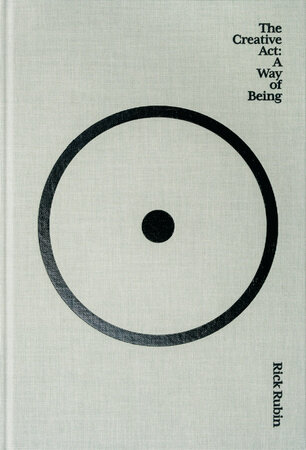
I have never followed or for the most part particularly liked the music produced at Def Jam records, but I’m finding Rick Rubin’s book The Creative Act: A Way of Being to be a calming, Buddhist approach to living an imaginative life. It’s the kind of book I can read in short bits at a time; frankly, having studied creativity and Buddhism and the arts for many years, nothing in it is exactly new to me. Yet the book acts as reminder and affirmation, for which I’m grateful.

Reminder that with a little objective space between me and my life sometimes, I can be reminded of my perspective and think more kindly about others’ perspectives. Reminder that whatever my readers take from my work, however they interpret it, however they critique it, whatever does or does not resonate with them–the work remains my own expression. It’s the best I could do at the time.

Reminder that the work of creativity doesn’t have an end point. Well–death, I suppose, ends the individual body’s ability to create; but if there is work out there in the world (music, poems, novels, films, paintings, sculpture, and so on), the creative acts of the past can continue. They continue to offer perspective. They continue to invite interpretation and expression.

This sort of reminder is good when I’m involved in making an ephemeral and very limited set of objects, a poem series made into an artist book. It’s so minor in the scheme of US culture in the 21st century, and so very much an expression of my own thinking, about which a limited number of people can possibly care. Rubin says that doesn’t matter–the culture, the popularity, the quantity. [Interesting, coming from a guy who has clearly made considerable money, and helped musicians earn considerable fortunes as well, and who hangs out in Tuscany much of the year.] But I don’t discount his words. Certainly, if I had been writing to make an impact on culture, to be popular, or to make money, I’d have stopped long ago. So I keep working, all in the fullness of time.

~

We never can know what will last, or why. Or why not. This weekend, we cut down a pair of “friends,” two pear trees that I planted over twenty years ago. We’ve had bountiful years and sparse years, years for pear butter, poached pears, and pear tarts, and years of drought and times the squirrels snagged fruits or wasps bored into them or deer leaned their long necks up to sample something sweet and juicy. Orioles loved the trees, and bees pollinated them. White petals carpeted the lawn after rainfall in spring. But fire blight found them and did its swift, fatal damage so rapidly the arborist told us to take them down and burn them.

Kairos: καιρός, an ancient Greek word meaning “the exact or critical time,” is a word I first learned through New Testament theology, though I now understand its use in science and philosophy. I suppose this autumn is the kairos for sawing down the blighted trees, just as it took me a few years to learn the kairos of when exactly I should harvest the pears. I’m sorry when I look out my kitchen window and don’t see them anymore, but I know fire blight spreads and could harm apples and cherries in the neighboring area (we have to burn the cuttings). So–it was time, as the saying goes. The pear trees’ work of making new seeds within sweet pears is over, but who knows what other work continues underground or what creativity will arise as a result? Possibly a poem. All in the fullness of time.
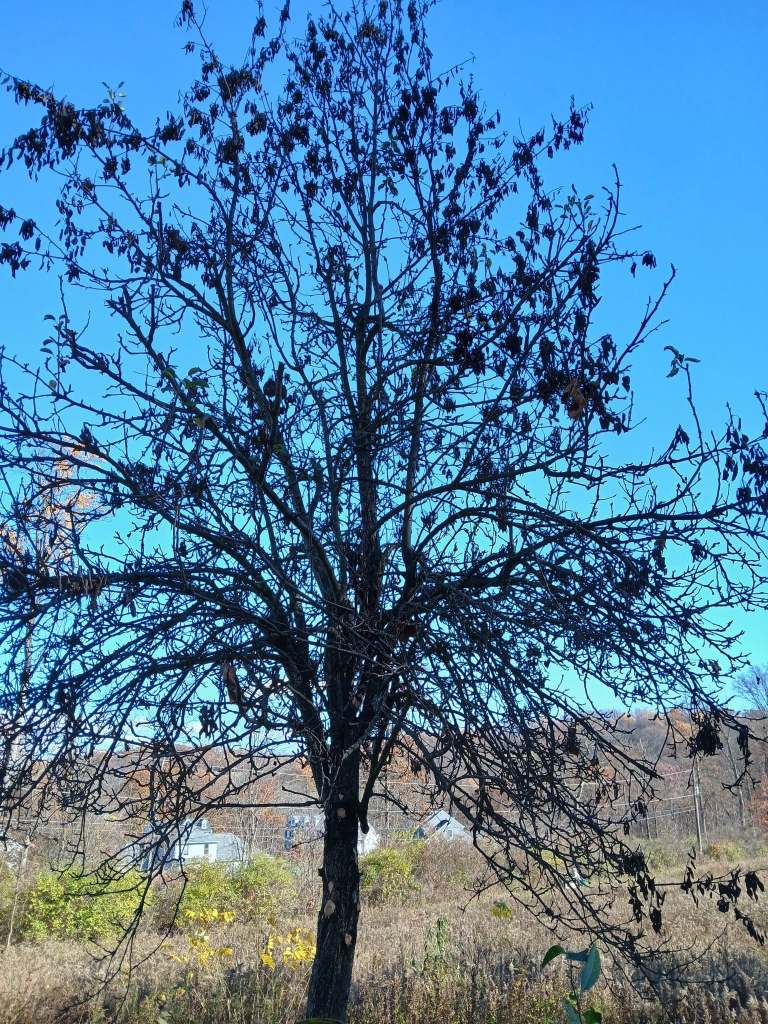
a case of fire blight
Decisions, revisions

Currently, I’m deeply immersed reading two very different new books of poetry. First, the late Harry Humes’ new and selected, Going across the Water, is out from Ohio University Press–a lovely, large collection that includes some biography and commentary, as well as some never-collected new poems (Harry’s former student and long-time friend, Daniel Donaghy, edited and co-compiled the selections). Some of the poems are a re-read for me, as I have most of Harry’s books in my own library, but they’re poems well worth many reads. And the work I’m less familiar with is rewarding. He was so good. The other collection I’m perusing at present is Daisy Fried’s brand-new My Destination, which could hardly be less like Humes’ in terms of topic, content, style, you-name-it. Katie Peterson writes that Fried’s book succeeds because of “the poet’s unapologetic curiosity about experience, and her remorseless hunger for the right words to know her moment…” I’ll concur, though I am only part-way through the collection. It’s fascinating to find myself enjoying the work of two such dissimilar writers at the same time; and I find they do have “things to say to one another,” at least through me as intermediary. Strongly evocative and well-observed poems in both cases.

~

And today I spent awhile obtaining a more complete idea of how much time and effort I’ll have to put in to my own artist book endeavor. So many new things I’ll have to learn to do, and how I’ll have to be much more finicky and careful than I usually am, if I want this book to be worthy of its story. Any project of value is liable to take energy, time, resources of one kind or another, and will require at least some revision, however. That’s my line, and I’m sticking to it.

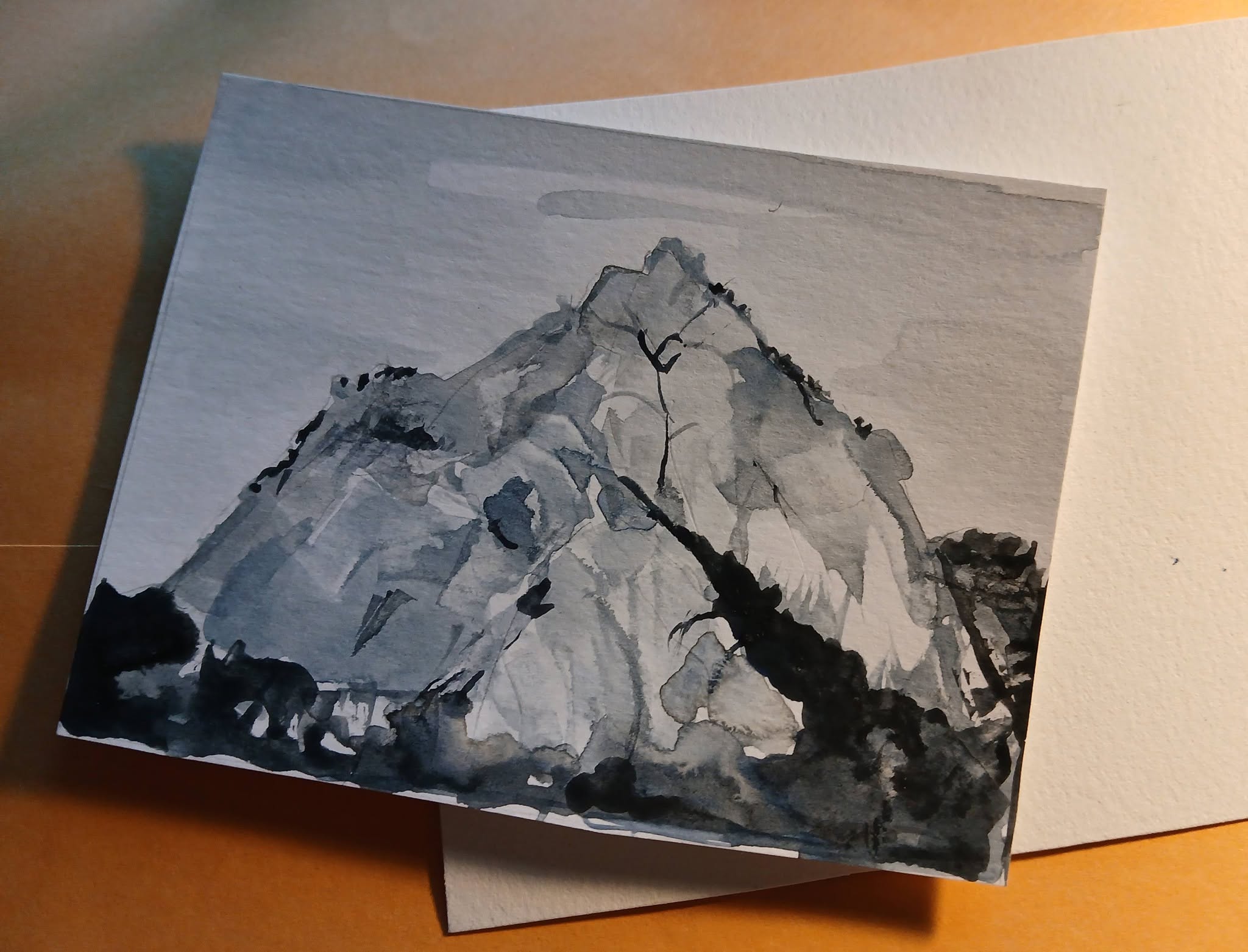
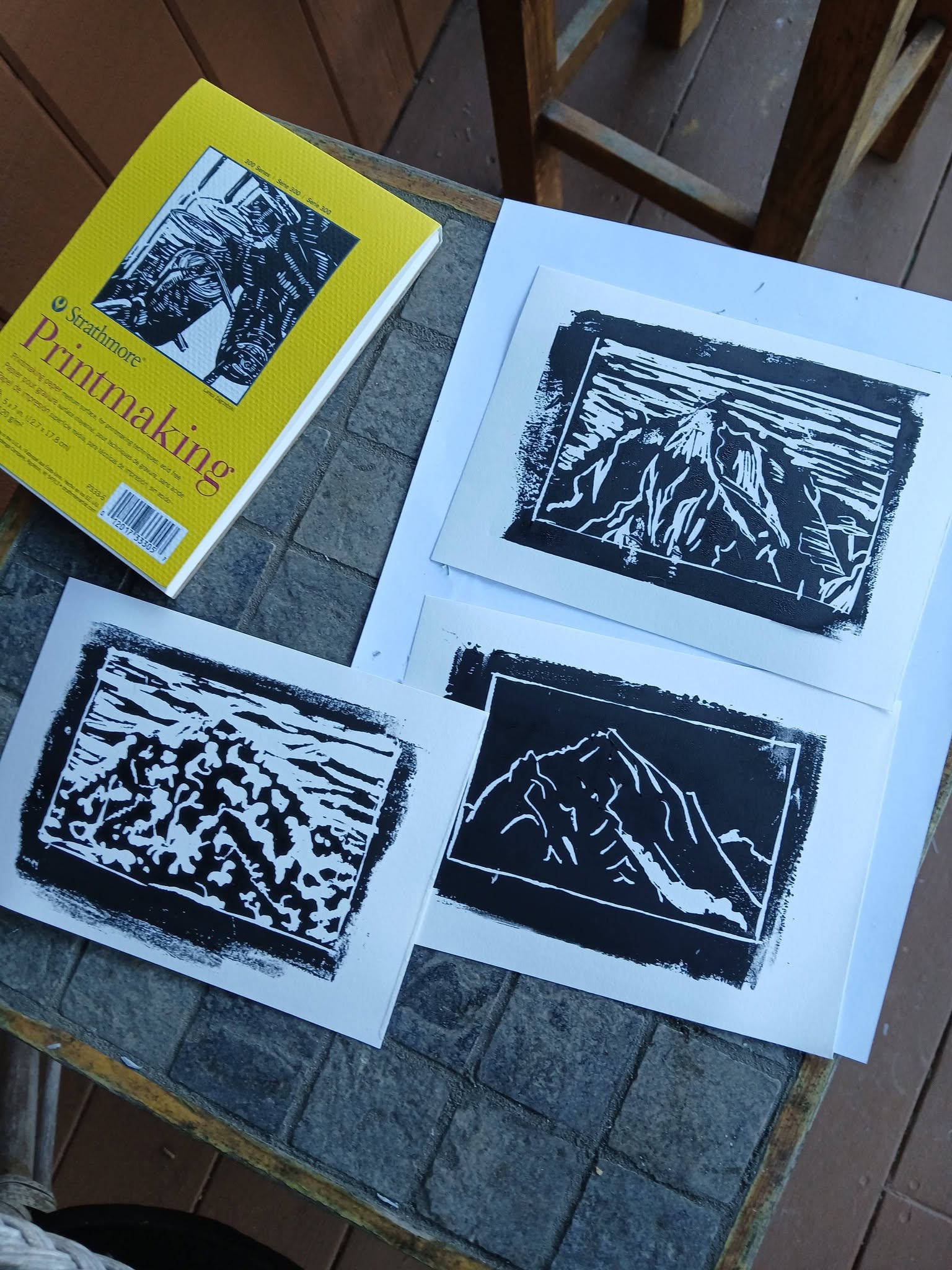
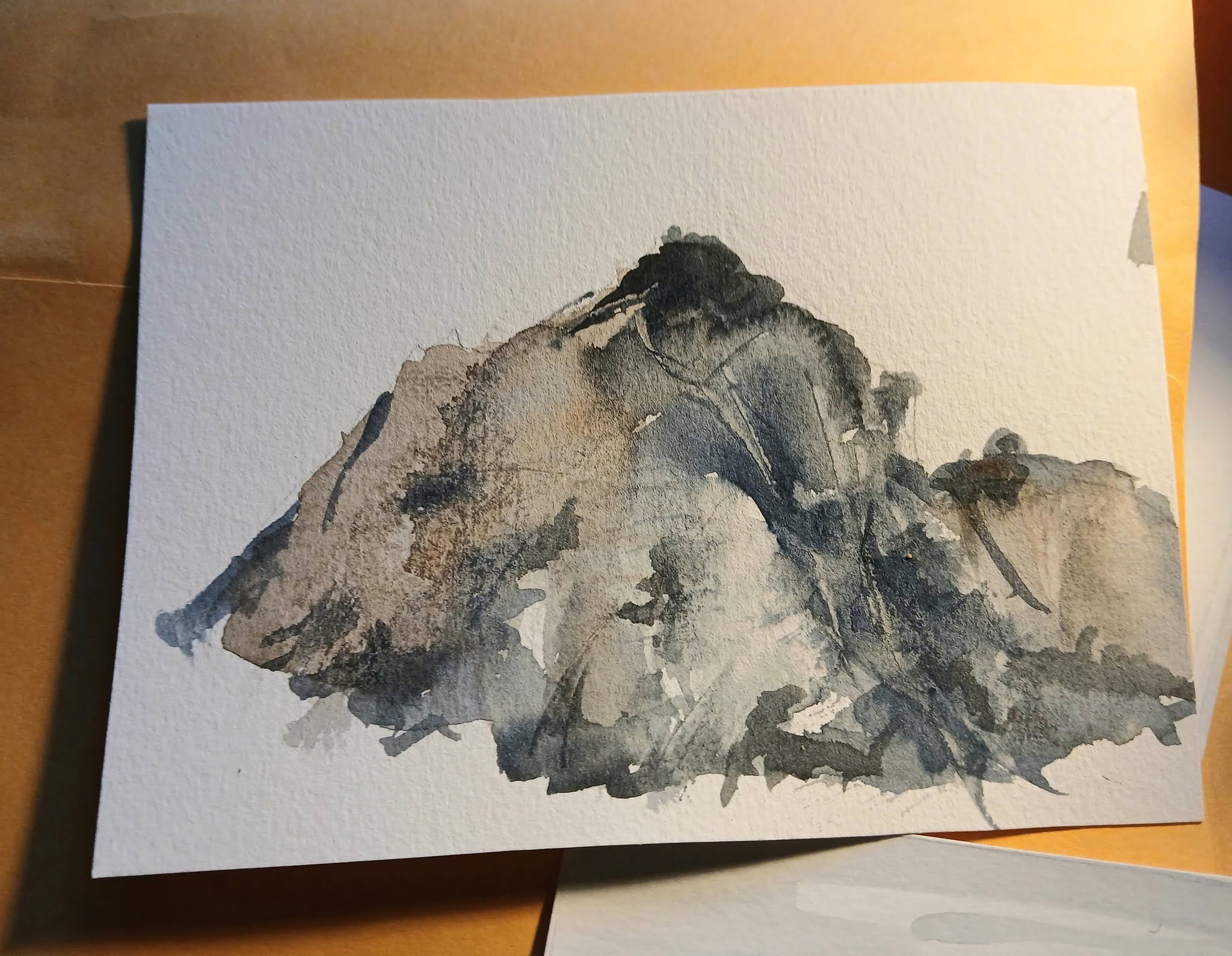
I have the layout almost correct: a few minor revisions should do it. The choice of paper? Check, except for the cover stock, still deciding on that. Of course, I have to do some math to figure out how much paper to buy and then get it cut to size. Do-able. Not a huge challenge, right? I spent an hour with my knowledgeable “consultant,” MaryAnn Miller, deciding on a cover image and learning what the steps of actually manufacturing (ha) a book will be. I was afraid my amateurish artwork wouldn’t be appropriate; but she thought that it might be best with something not so polished, something I could use without getting copyright for, something a bit–er–primitive. I experimented with linocut, something I haven’t done in decades, and with watercolor (in my class at Blue Church Arts), based upon a photograph I’d researched. It’s one of the craggy, cold mountains in western North Korea not far from the Yalu River.

I’ve no way of knowing whether this particular peak is near where prisoner Camp 5 was located, but it gave off the kind of forbidding vibes I was looking for. Trying to capture it with my rusty and limited skills kept me occupied for many hours.

This was exciting, working with something that isn’t words, wrestling with the materials, trying several techniques. Deciding, revising!

So, the process continues.

Paper

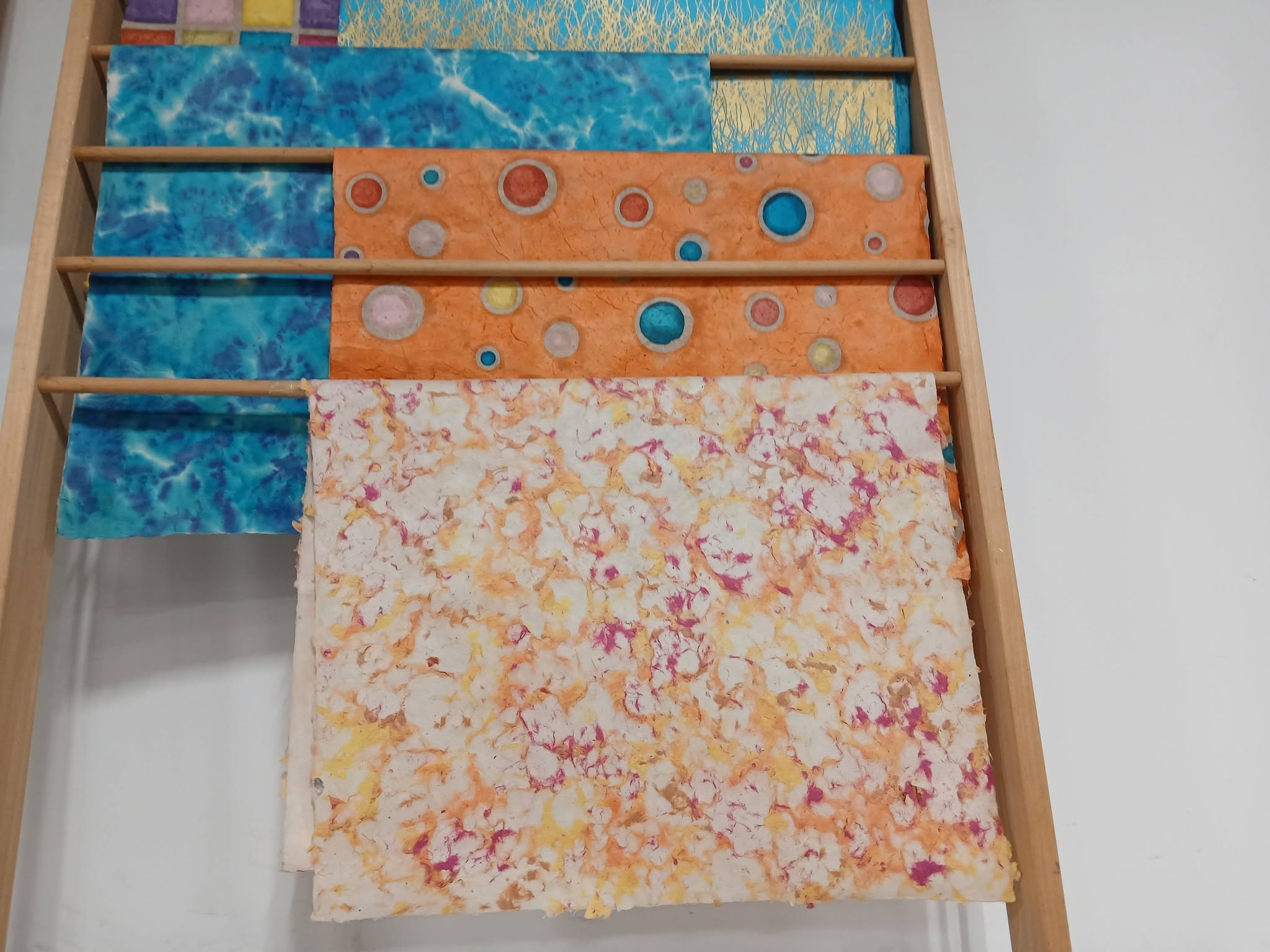
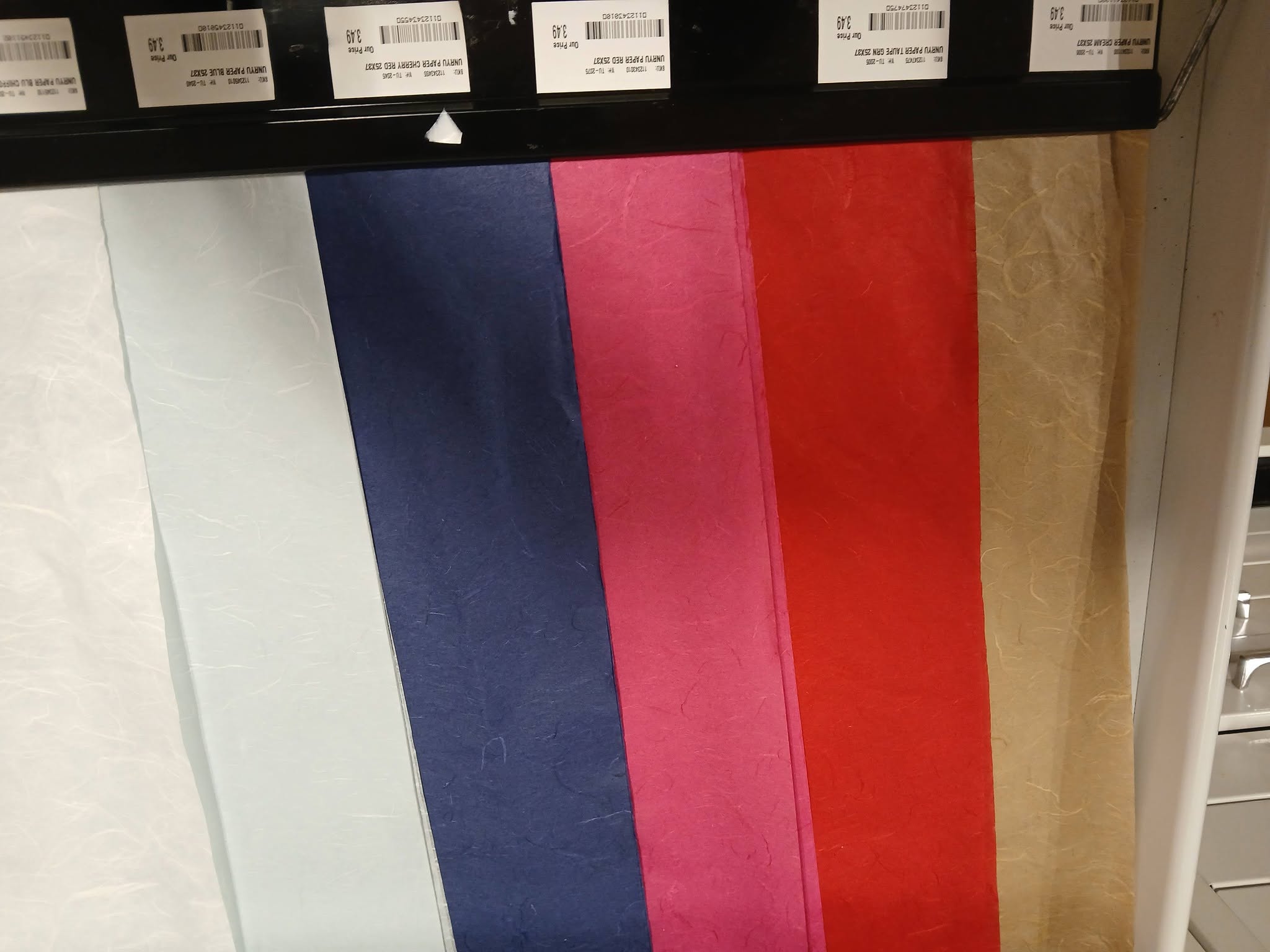
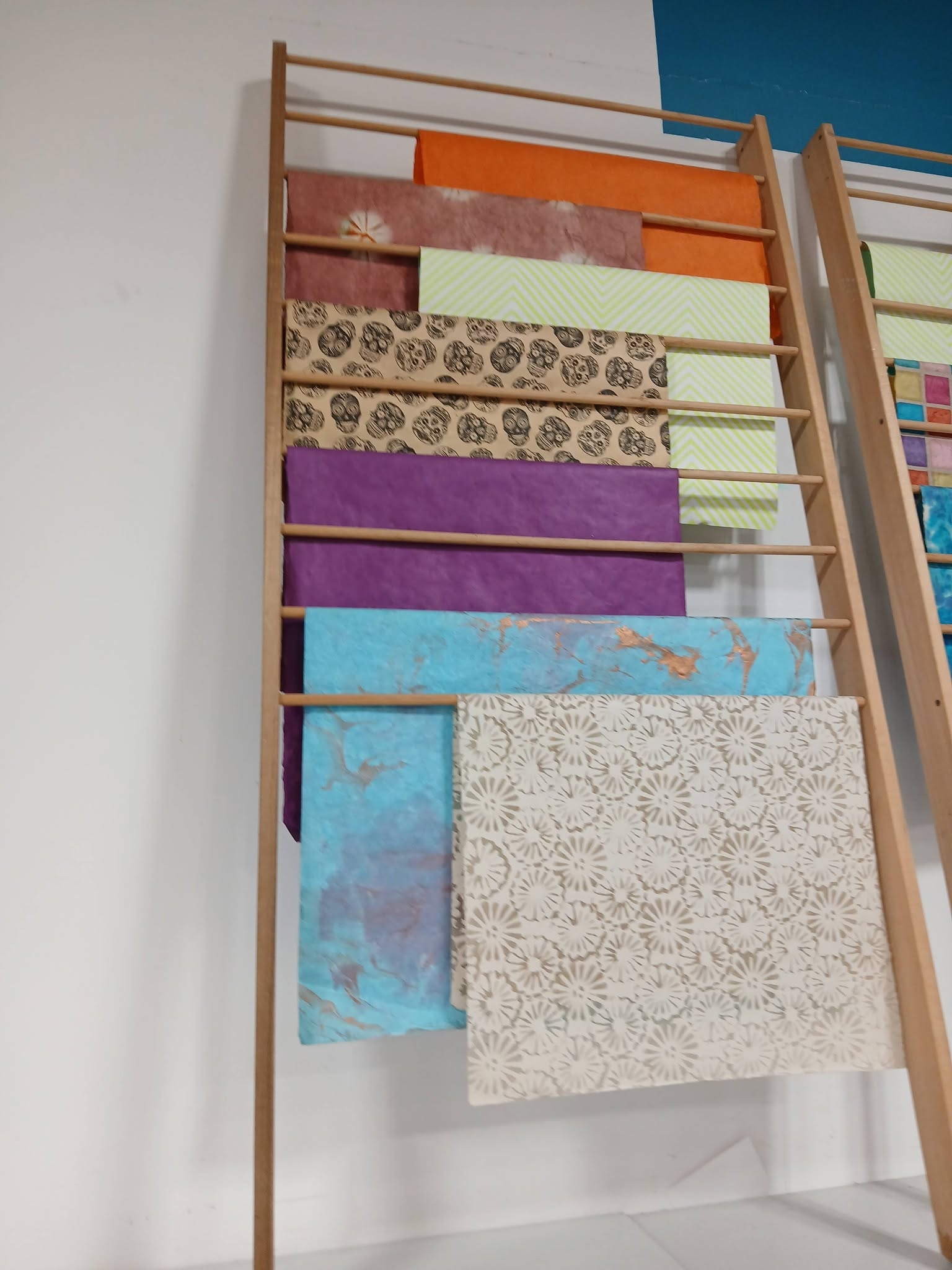
A handmade book is generally made of paper (I’m sure there are imaginative exceptions). So I went looking at paper for the cover of my chapbook-to-be [previous blog will explain]. Even at my local art supplies store in a suburban region, I felt a bit overwhelmed by options. But after my initial excitement about the marvelous diversity available, I settled down to think about the book, its content, its context. Color. And the feel of a chapbook in one’s hand: all of those things should rightly affect design choices, I believe.

Fancy, decorated papers are appealing, but they won’t work for this project. It’s not a cheery story. Perhaps colors of the North Korean flag? Um, no; the colors of the DPRK are…red, white, and blue! (Though a deep red is an intriguing possibility). MaryAnn Miller showed me a lovely black paper she has used for artist books, but I have decided that isn’t quite what I want, either. Anyway, aside from color, there’s also the paper’s texture to consider, and whether digital printing will work on it.

So many decisions!

Thinking about paper brings to mind my on-and-off obsession with ephemera over the years. I do love paper and things made of it, things that are probably not meant to last, and are fragile or easily destroyed. I’m not the only human who feels this way, which makes me wonder why ephemera is so appealing to some people, while granite or marble monuments are so appealing to others. I enjoy visiting Apport Used Books, the bookstore itself and its Instagram online “catalogue,” because Ben is one of the folks who finds, sells, trades, and shares postcards, letters, photos, chapbooks, poetry books, occult items, poetry broadsides, collages, and other fragile and nearly-lost things. I can drive over the hill and get my fix of wonders, though I don’t buy much because these days I’m trying to cull my own collection of books and oddments.

I also wonder why some of us write poetry, and others among us need to create architectural wonders. Which is no guarantee of lasting into the future: think of Antiochus I, whose tomb and history was lost for millenniums, while Sappho’s poetry fragments and Beowulf remained active in the minds of humans, who are certainly ephemeral creatures.

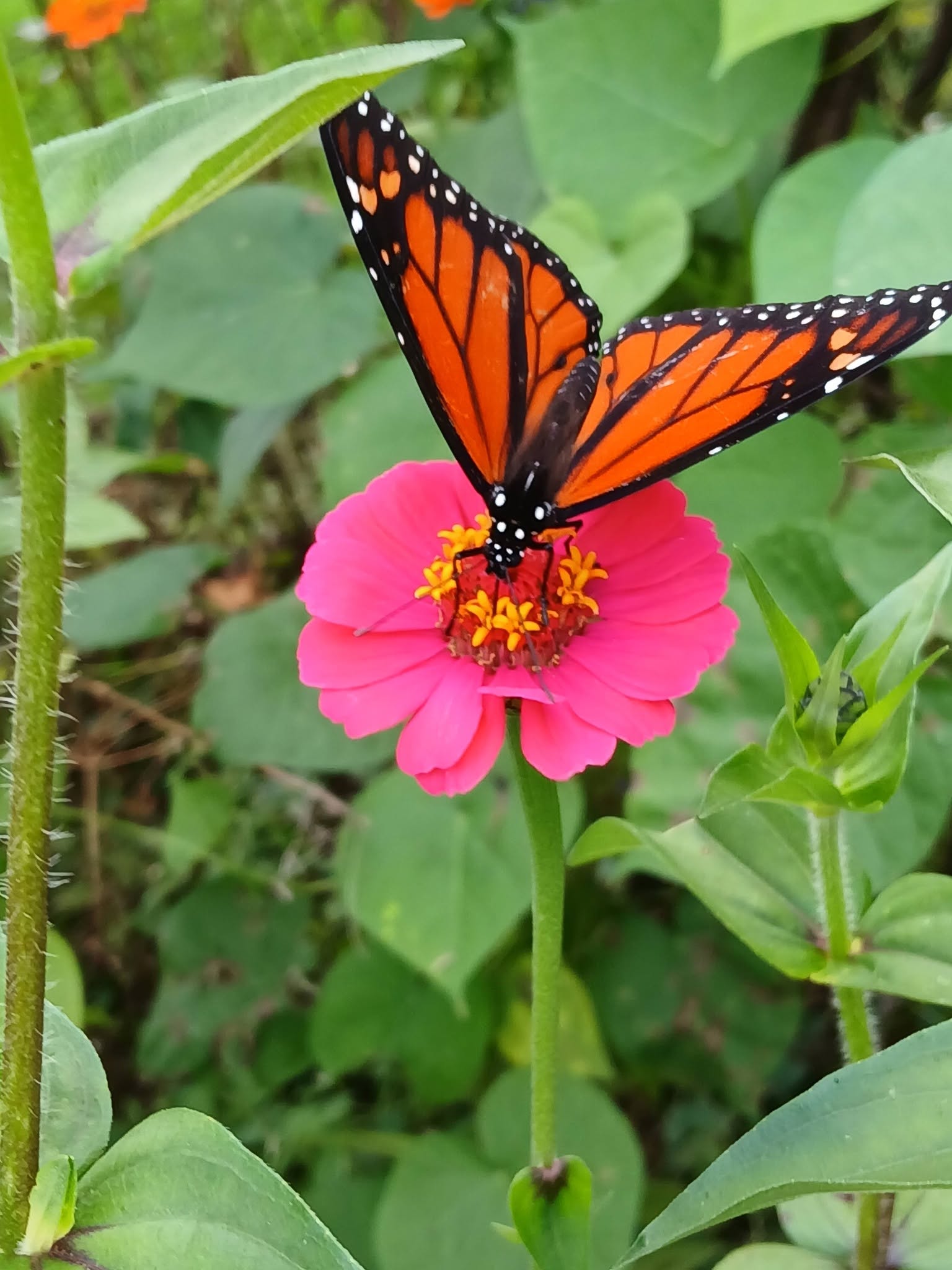
I don’t expect my current poetry chapbook project, or any work of my own, to live on after me. Paper and humans–we don’t last long on earth. Like butterflies, so temporary and so fascinating.

New project

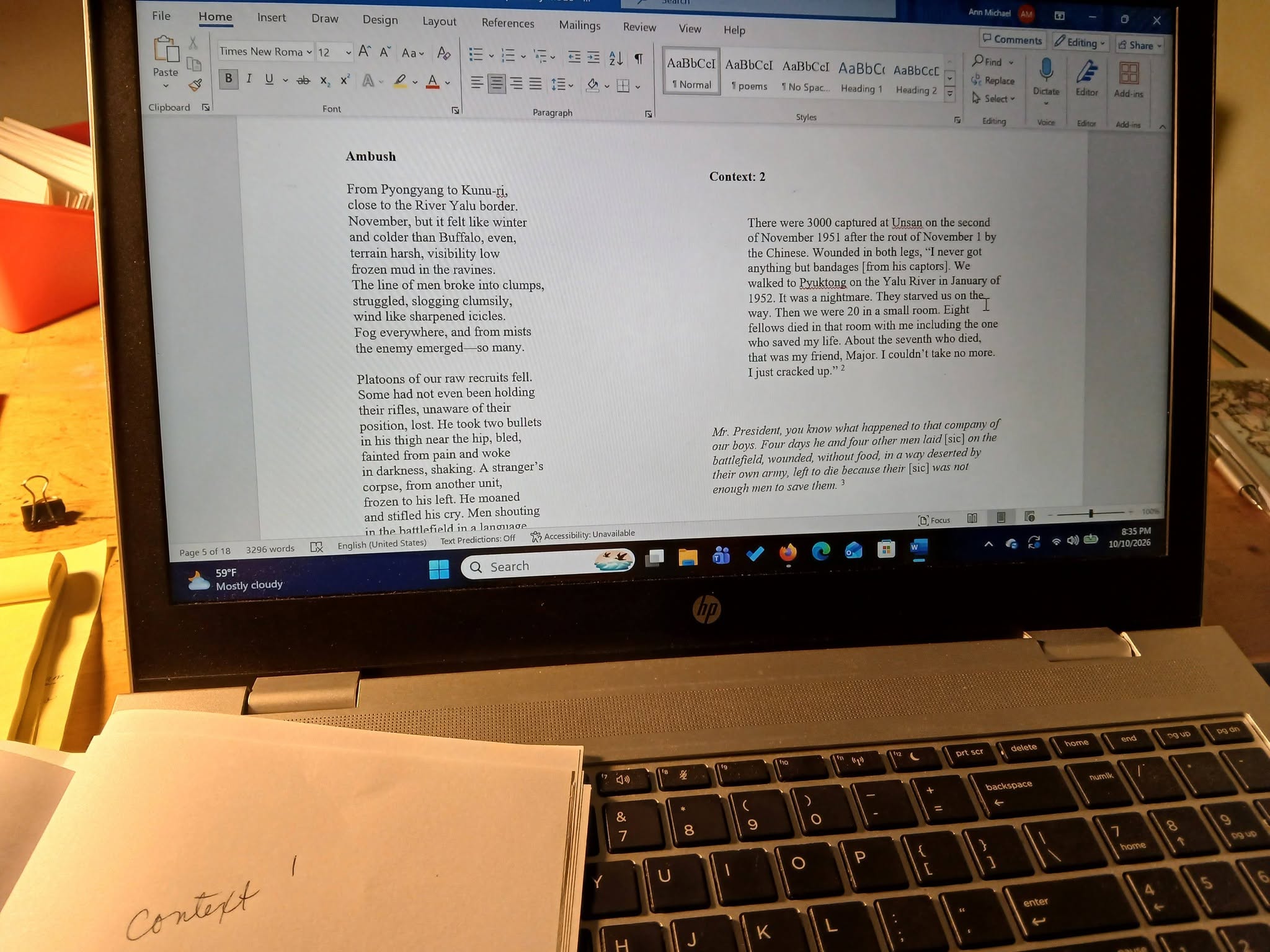
I’ve made a decision about my chapbook-length, hybrid-poetry manuscript The Librarian of Pyok Dong: I’m going to make it into a handmade artist book. I came to this conclusion after meeting with artist/poet MaryAnn L. Miller (Lucia Studio), who was generous enough to listen to my ideas, explain the process(es) necessary, and encourage me to go for it even though I do not feel fully prepared to embark upon, let alone complete, such a project. For people who are thinking of doing this themselves, and for those of you who have no idea what I’m talking about, I figured I would use my blog to write about the process. It will also serve to goad me into staying on track and actually completing it! Because you know how it goes. One gets distracted, or gets mired in details, or flags in general.

MaryAnn provided meaningful inspiration when I visited her at her studio. She has produced numerous artist books, and they are beautiful objects. Photos do not represent what a joy it is to handle an artist book–the textures of the papers, the feel of the book in hand, the subtleties of color. The book feels like a completed project, and this manuscript really needs that. Or I do, since I embarked on research about Harold Dunn in 2008 and have been working on the poems and historical excerpts on and off since then; it’s something I want to do to honor my friend David Dunn, to learn his father’s story, to help me to understand David’s story–cut short by his own early death.

I have sent the ms. to numerous chapbook publishers, but although two of them expressed some interest in the poems they also acknowledged that the layout of the work would pose challenges for their small presses. I understand that. I looked into print-on-demand options for self-publishing this text, and…let’s just say the process would not have been smooth. Since I’m not doing this to earn any profit, I may as well do it as art for art’s sake rather than tearing my hair out over tech issues. If I make only 10 or 15 books, at least I will have finished this particular project. If I consider this “artistic,” the process becomes more interesting and the result can take its time. I can make a lot of mistakes, and learn from them. Which I fully intend to do.

When she learned I had long ago been in the graphic design industry as a typesetter, proofreader, and small press publisher during the time of the dinosaurs, MaryAnn reminded me to draw upon my past skills. Sure, the technology has changed, but I found that I do recall how to use a mockup for a pamphlet. I can figure pagination and signatures, and I have done quite a bit of proofreading on the computer.

However, for most of the time I was employed in academia, I did not have much opportunity to keep such techniques up to date. The first couple of years I was employed, I put together a booklet of student-written and student-illustrated work for an umbrella program through which my department was partially funded, but that part of my job ended long ago. After that, I had little reason to employ my out-of-date graphics skill set. Now, I have to recall what I know and also learn how to use it with more “advanced” software.

And that’s where I began as of this weekend (a day of pouring rain meant I felt fine about sitting at the laptop for a couple of hours). I’m starting with the text itself, with its indentations and italics and footnotes because, yes, this poem has footnotes. Figuring out how many pages of 8 x 10 Somerset Book Wove paper I’ll need per book and how the text will “sit” on each page. Thinking about cover art.

There’s much more involved, and it’s exciting. To me, at least. On next week’s blog post: more on this project and what I’ve been learning. Or else more on the garden as I put it to bed.

Who can tell?