Garden painting

The image on the right is from a book in the Metropolitan Museum of Art’s Department of Asian Art, available through its new digital collection of Japanese illustrated books. It is written in Chinese, however: Jieziyuan huazhuan; Kaishien gaden 芥子園畫傳 and is catalogued as The Mustard Seed Garden Painting Manual (3rd Chinese edition): [volume 3]. I do not read Chinese, but I think the drawing must be of quince in flower. My photo of pink quince blooms focuses on a particularly floriferous branch; in fact, the quince in my back yard is thorny, broken off in places, and often a bit scarce as to blooms–more like the drawing.

The book itself is interesting. It demonstrates and describes how to paint these shrubs. The sketches show the stems as the initial composition, with gaps where the blossoms are later to be painted. Then the blossoms get painted in, and then ragged lines of twigs and thorns to complete the painting. Since I cannot read the text, I interpret the stages from the drawings.

It occurs to me that this approach–one of guessing the stages–feels familiar. It resembles literary criticism; and it resembles the process of reading and re-reading a poem to try to determine its making, which is usually hidden since it takes place in the mind of the poet as she revises.

canvas3

note the gaps…

An analogy here: when I first write down the phrases, images, “inspiration” (if you will) for a poem, there are gaps. These lacunae appear in several forms, sometimes as spaces or blank spots in a sentence, sometimes as an unsatisfactory placeholder word, sometimes as a dash or ellipsis. These marks, or lack thereof, act as reminders to revise, rethink, resolve missing links or relationships in the poem’s developing ovum.

~

Winter makes for gaps. Skeletalizes the trees. Snowfall temporarily erases the known. Clouds cover sun and moon. Even the songs of birds, mostly absent.

As David Dunn, my long-dead friend (another emptiness), would sigh during moments that conversation became too intense or too difficult: “Anyway…”

In a temperate climate, we do need winter. The birds will return.

color birds-blooms1

~

when sap runs red
forcing budding trees into blossom
mating time

~
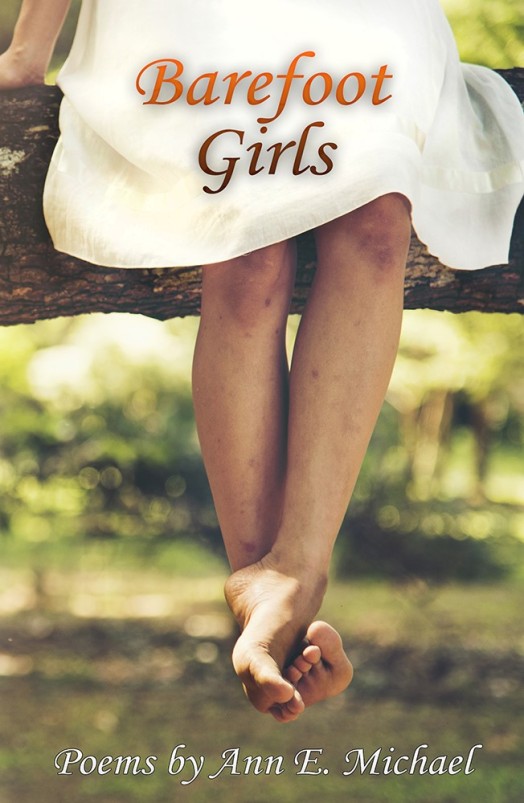
Cover reveal


barefoot girls cover

Coming this spring from Prolific Press.

~ ~ ~

Barefoot-Girls-Cover-Back-MD-1

Collection

As I’ve previously mentioned–I have been putting together another manuscript of my poems–a collection. I had a few ideas on how to make the poems work as groups, but it turns out they are not happy together. I don’t think a poetry collection needs an “arc,” but I like to have the poems converse with one another in some way. Resonate with or inform one another. That’s what I am enjoying in Louis Simpson’s 1980 collection Caviare at the Funeral. I realized my aim in collecting my work was off when reading his book just recently…and now, I am reconsidering my manuscript approach. Again.

This may be one reason why, despite being a fairly prolific and reasonably well-published poet (in journals, etc.), I am so pokey at getting books into the world.

But I am considering what it means to be a collector, which is not the same as a curator. There is a difference between collecting one’s work and curating it into an experience for a reader (including oneself). Curating has never been my strength: I was the kind of child who collected things randomly, attempted to organize a doll or rock collection, but mostly just had little piles of stuff that interested me.

That’s poetry, too…little piles of stuff that interest me.


Rhyme

Rhyme comes easily to some people. For me, rhyme presents no problem as far as lighter verse, parodies, ditties–which have their place in literature and in culture. In more introspective or reflective verse, though, rhyme tends to elude me and often seems not to mesh with the poem’s mood. Revising toward rhyme often succeeds in assisting the metaphors, imagery, or tone, however. Usually assisted by some sort of metrical strategy.

Today my poem-draft-a-day offers evidence of how rhyme can appear spontaneously in a poem’s first version.

If you are interested, here’s an excellent book on rhyme in poetry: Rhyme’s Reason, by John Hollander & Richard Wilbur–welcome authorities on the subject.

Quite long ago now, I dwelt in cities for a few years. The contrast to my current environment startles me now and then, makes me remember those years.

~

Outmoded

His back aches. It hurts to move.
How did he ever get so old?
The work it takes to walk a block
to buy a paper! Then he’s told
the news is found online, where he
can read it on a mobile phone.

He hates the sound of that idea–
the text so small–and, when alone,
he likes the paper’s rustling noise.
It’s domestic. One of life’s joys.
The work and pain are thus worthwhile.
That, and the newsstand vendor’s smile.

~

man sitting reading newspaper

Photo by Daria Obymaha on Pexels.com

Book review, mind review

My book group chose to read Michael Pollan’s latest: How To Change Your Mind. The subtitle says a lot: What the New Science of Psychedelics Teaches Us About Consciousness, Dying, Addiction, Depression, and Transcendence. That’s a bundle of complicated concepts Pollan takes on, but he recognizes his task looms large and that he can only make forays into the many overlapping arenas the book explores.

His approach–he uses this in his other books and articles, too–is a mix of serious research and journalism (interviews, mostly) and personal inquiry and experiences. If you have read Second Nature or The Omnivore’s Dilemma, you might find this one to be a more “difficult book.” It is heavily documented and features neuroscience (brain pathways and structure, mostly), psychology, pharmacology, and chemistry (tryptamine-related molecules). Not to mention mushroom biology and mushroom hunting, and serum produced by plants, toads, and ergot.

What attracted my book group members to this text is its chapters on dying; as a hospice volunteer myself, and having read articles on the potential value of psychedelics among people with terminal illnesses, this part certainly interested me.

Pollan writes: “The uncanny authority of the psychedelic experience might help explain why so many cancer patients in the trials reported that their fear of death had lifted or at least abated: they had stared directly at death and come to know something about it, in a kind of dress rehearsal.”

These outcomes seem significant enough that we ought to find ways to employ them in our palliative care work. In my own, somewhat limited, experience with dying people, those who are less fearful of death–for whatever reason that may be–stay alert longer, respond better to palliative efforts (pain medicine, massage, positioning, and so on), and are more likely to comfort their loved ones. They die more “easily,” if dying can ever be called “easy.”

~

Yet I found the parts of Pollan’s book which deal with the huge question of what consciousness is and where it resides most relevant to my own interests. Yes–that difficult neurobiology stuff. Pollan suggests, with the healthy pragmatism of the skeptic, that empirical approaches to consciousness based on the idea that “the brain is meat” (viz, medical science) are unlikely ever to explain consciousness fully or to anyone’s satisfaction. In other words, consciousness may possess a component one might name “spiritual.” Here is how he frames this concept:

“…it seems to me very likely that losing or shrinking the self would make anyone feel more ‘spiritual,’ however you choose to define the word, and that this is apt to make one feel better. The usual antonym for the word ‘spiritual’ is ‘material.’ That … is what I believed when I began this inquiry—that the whole issue with spirituality turned on a question of metaphysics. Now I’m inclined to think a much better and certainly more useful antonym for spiritual might be ‘egotistical.’ Self and Spirit define the opposite ends of a spectrum, but that spectrum needn’t reach clear to the heavens to have meaning for us. It can stay right here on earth. When the ego dissolves, so does a bounded conception not only of our self but of our self-interest. What emerges in its place is invariably a broader, more openhearted and altruistic—that is, more spiritual—idea of what matters in life. One in which a new sense of connection, or love…seems to figure prominently.”

~~

When I was much younger, I considered myself “spiritual.” I stopped using the term once I began a more serious exploration of my life and began to study philosophy, psychology, aesthetics, phenomenology, and consciousness more intentionally. But the crucial components–connection, relation to and with others (sentient and not), and love–those I have always understood as necessary. Even though my ego has never “dissolved” quite the way Pollan describes.

So maybe I can go back to considering myself somewhat spiritual. At this moment in life, Nature and Others matter more than accomplishments and outcomes.

Welcome Spring, welcome Spirit. Namaste, Amen.

iris reticulata

iris reticulata

Come let us sing

I have been reading Hayden Carruth’s poems, admiring the breadth of his experiments in styles from sonnets to jazzy free verse to prose poems and extremely short poems–even haiku. One thing becomes clear after awhile: his appreciation of song, of the poem as song, of the need to create song as an expression of life and against the things one wishes to resist, even when (especially when) it is impossible to resist.

His poem “Mother” says all of the things I wanted to write about my mother-in-law’s death, and more. It is achingly honest and achingly sad and deeply loving.

After reading it, I thought to myself, “You do not need to write those poems; Carruth has achieved what you are trying to accomplish.” But we compose poems under individual circumstances and for personal reasons, and I suspect that reading “Mother” will help me to revise my own poems in probing ways.

This is why we read other poets’ work. One reason why, anyway.

I am in mourning at present, shocked by the death of a Beloved Friend’s adult son. I thought of a poem I had recently read in Carruth’s Contra Mortem.  I searched through the book to locate it–it is, in fact, (appropriately) the last poem in the collection. Here is Carruth in a spiritual and almost elegiac mode, as the singer he always is in his work, exhorting us to give to one another our small songs, no matter how they fail, for whatever they are worth. I love the line “the was the is the willbe out of nothing” for the way the simplest verbs, forcibly combined, guide the reader to face a fundamental truth: “and thus we are.”

~

The Wheel of Being II

Such figures if they succeed are beautiful
because for a moment we brighten in a blaze of rhymes
and yet they always fail and must fail
and give way to other poems
in the endless approximations of what we feel
Hopeless it is hopeless       Only the wheel
endures      It spins and spins winding
the was the is the willbe out of nothing
and thus we are      Thus on the wheel we touch
each to each a part
of the great determining reality    How much
we give to one another        Perhaps our art
succeeds after all our small song done in the faith
of lovers who endlessly change heart for heart
as the gift of being    Come let us sing against death.

~Hayden Carruth

~~


Haiku, moon, peony

During busy times, we may need a few moments of solitary reflection.

~

381-1233891708GdW7.jpg

Full moon moonlight
Sony Cyber-shot DSC-V1
10/800s, f 2.8, ISO 100, 7 mm

253142_2101392498695_2412222_n


~
flower moon
fireflies enlighten
the pear tree
~

I’m currently reading David Bayles’ and Ted Orland’s encouraging little book, Art & Fear. Nice reading to tuck around the edges of a few full weeks.


Obstructions

Things that get in the way, viz., from Online Etymology Dictionary:

1530s, from Latin obstructionem (nominative obstructio) “an obstruction, barrier, a building up,” noun of action from past participle stem of obstruere “build up, block, block up, build against, stop, bar, hinder,” from ob “in front of, in the way of” (see ob-) + struere “to pile, build” (from PIE *streu-, extended form of root *stere- “to spread”).

I’ve been in an odd sort of writing funk–not a writer’s block in the classic sense, because I am writing–both prose and poetry. Drafting, anyway. I feel the obstruction in a different area of the writing life, about which I’ve written in the past: publishing, submitting work, creating the manuscript…getting the work into the world. All writers face these issues if they want their work to find its readers.

My current obstacle is … motivational? existential? self-inflicted? I have not decided yet, but it feels real enough. I want to put together another manuscript and have, I think, enough completed, “good” poems to make a manuscript; many of them have already appeared in literary journals. What stops me from corralling the poems together and composing my next book?

I know what it is.

My not-yet-second book stops me.

images

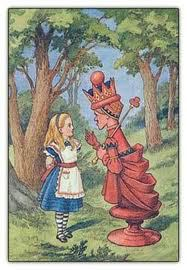
Sir John Tenniel, of course.

After about 7 years of endeavoring to get The Red Queen Hypothesis into print, no takers. Perhaps I have not sent it to enough publishers or contests, but I have done what I can given time and budget constraints. Perhaps, though I have had four excellent critical readers consult with me on it, the book still needs work; maybe the poems just are not strong enough (though the majority of them have previously been published in journals).

Maybe the book is simply too quirky to find a comfortable publishing house; I admit that I knew that before I even began submitting the manuscript around. The poems are semi-formal (yes, like a prom!). They range in form, and many of the poems use nonce forms, invented forms, slightly-damaged versions of formal poetry, and also free verse. Rhyme, off-rhyme. Rhythm, meter, off-meter, sprung rhythm. But a mix of these.

Outliers are often difficult to place, particularly when the imagery of the poems tends toward the natural environment, and the subject of the poems tends toward the speculative, and yet nothing about the poems is particularly edgy or youthful or ground-breaking.

This book represents me, the person (not just as poet) perhaps too well. I do understand why it’s been difficult to place.

As to how RQH acts as obstacle in my writing life? Um. I guess I have to say I am finding it hard to move to the NEXT manuscript when THIS one still hangs out in my psyche and on my hard drive, unpublished. I know that should not impede me; I have many colleagues who work on multiple books simultaneously, sometimes even books in different genres. How they do that remains a mystery to me, however; I guess I do not share that operating system–though I dearly wish I could learn it.

Etymology tells me I am building up a hindrance. There are other things building up can do, though. I need to build up a way over…and then “to spread” the words, perhaps in some other way. Maybe even self-publish. Or put aside the foundation I have built and use what I learned in that process on the next composition.

What is an obstruction but a challenge to surmount?

Manuscripts

A draft, inspired by the book Meetings with Remarkable Manuscripts and related to a series of poems titled “Self Portrait as…”

Self Portrait as Illuminated Manuscript

This one exhibits some damage:
a missing folio, signs of mildew
and rodent chewing—calfskin a protein
and rats inevitably hungry.

It lacks signs of eminence (even books
have breeding), meant for use
and not for show. No burnished gold
for the initial letters, no sign of patronage

or dedication, though the illustrator
had a talent for small birds and
winsome sheep. The marginalia’s
interesting for what it doesn’t record–

genealogy absent, no list of relics
or property. The uncial style, workman-
like and unremarkable; the parchment
rough, irregularly cut; the binding,

late 18th century, carelessly done.
Yet any medieval manuscript is rare,
expensive in its era, product of cutting,
scraping, grinding, sewing, economies

of the book. Scribe correcting his copying
error, following his exemplar. Illuminator
in his carrel, sketching foliage and dove,
flair of alphabet and the glory of god.

If somewhat the worse for wear after
six or seven centuries, anonymous,
modest, pedestrian, this manuscript’s
survived. That is one of its merits.


Honestly, I originally wrote the last line as “That is its only merit.” But I felt that was disingenuous, particularly given the title and the series of poems I’ve composed on this semi-ekphrastic self-portrait theme. Probably I possess other merits. As would any surviving medieval book.    :)


Edges & outcomes

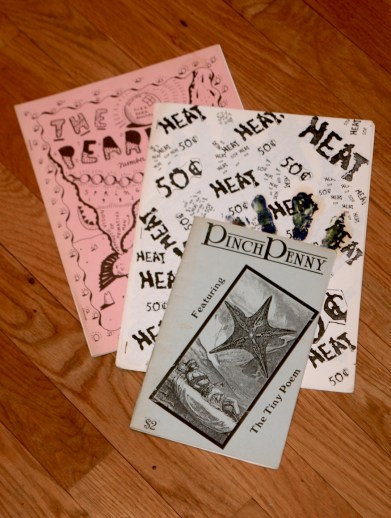
One outcome of participating in a “blog tour” is the opportunity to listen in on what writers younger than I–or newer to the act of being-a-poet–experience in the literary environment of the 21st century. In some ways that has become quite a changed adventure from the early 1980s when the alternatives to major presses and established print journals were little fly-by-night xerox-zines, copied and stapled in runs of under 100. But perhaps not so different from free blogs with just a few dedicated followers; those miniature publications gave me my first print credentials as a poet. Today, I read Lissa Clouser writing of “all the things I’m not” and recalled my own early and uncertain forays at the edges of the literary world.

IMG_5106

xerox-zines, ca. 1982-ish

I now enjoy being outside, observing the edges. It’s more interesting than I realized when I was in my 20s–when edginess was cool, but one might wish to belong with the edgy newcomers. [The paradox of being in the tribe of outsiders.]

Also, I found the garden and the woods and meadows intriguing, and also child-raising, teaching, neuroscience, philosophy. I became a nominal member of many tribes. Including, more recently, the tribe of the aging person and the tribe of the chronically ill–communities that range widely, encompass much, and are fraught with delicious and difficult complexity.

It took me 20 years to get to Arthur W. Frank’s book The Wounded Storyteller, and I might not have found it so useful and illuminating if I’d read it twenty years ago. Now, however, the book’s insights are relevant to my life and to the current moment. Frank powerfully reminds us that as members of the human collective, we need to listen to people; that in time, all of us become wounded storytellers; and, therefore, each of us benefits by learning how to bear human living with a kind of “intransitive hope.” By intransitive hope, Frank means finding a way to be with our suffering in life, recognize that suffering happens, but also to recognize that there are ways to be human that do not end in miraculous cures–that may (and will, eventually) end in death.

And that’s okay. He suggests that healing is a project, not an outcome.

Kind of like writing, you know?

~

“As far as I’m concerned, poetry is the best thing that exists in the universe.”             –-Kaveh Akbar

~

~
~