Fragments

The web journal qarrtsiluni is running an issue on “fragments.” I feel a bit fragmented myself lately. Here are a few recent, fragmentary thoughts.

~

I am reading Lewis Mumford’s tome The City in History and enjoying it for a number of reasons. One is Mumford’s ability to employ words such as “forfend” in a correct and even natural way. Another reason is the approach he takes to trying to reason through and tease out strains of pre-history that lead up to the establishment of cities world-wide, a kind of philosophical anthropology. Sixty years of subsequent archeological discovery and interpretation may alter his theories, or perhaps lean toward confirming them; I’m not enough of a scholar to know. I do, however, find his speculations appealing. One of his theories suggests that war developed along with hierarchical religion, kingship, and the city. It makes sense that militarization on any significant scale was not “invented” until there was population enough to support it and reasons (defend the king, the god, or the goods) to deploy a military body.

He does not say human beings are not inherently aggressive. He merely suggests that when we live in smaller, more isolated groups it is in our best interest to cooperate rather than to expend resources on warfare (soldiers, arms, defenses). Something to meditate upon in current times.

~

Mumford was researching and writing this book in the late 1950s (publication date was 1961). Interesting to me, he cites Jung’s archetypes and theories–though not in a way that implies Mumford was in any way a Jungian–about the feminine and the masculine as regards the development of human social structures. Bachelard, writing at about the same time, also cites Jung when he discusses the poetic space. I think of Bachelard’s brief passage about how a bird creates its nest with its own body, its breast molding the shape of the container that is its temporary home, and how this correlates with Mumford’s observation that the tent, hut, or village dwelling–indeed, often the village itself (and later, the city)–tends toward a cup-shape; it is a container. The earliest communities of human beings needed to develop containers in order to improve their chances of survival: jugs, skins, gourds for water and covered bowls or jars for grain and seed storage. Once humans could last through times when game or gathered food was scarce, they could procreate more efficiently. Mumford defines irrigation ditches as containers, too, as “feminine” objects as per Jung.

The garden wall, the city wall contained the human community or the sustenance for the human community, especially once domesticated animals were added to our communities.

As for the masculine/phallic, Mumford’s examples are all the expected objects: tools and weapons and stele.

~

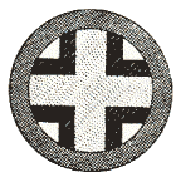
The ancient Persian word that is the root for our “paradise” comes from the term for garden, specifically a walled garden. The Egyptian hieroglyph for “city” is a circle with “crossroads” inside it. A link to one of Notre Dame’s open course lecture pages has an illustration comparing this hieroglyph with other ancient representations of cities. (Notre Dame course on the geometry of buildings that demonstrates some of the universality of “containers” as Mumford observed: Geometry of Buildings.)
~

Also, I wonder whether Jung’s archetype theories were still new enough in 1960 that it was kind of a trend to cite him in works like these two books. Jung does not seem to be as popular these days except among his devoted followers–a niche audience. Perhaps his ideas are now just accepted as given? Not all of his ideas, but the general understanding of archetypes, I mean. Or is he out of fashion? Or am I just missing the current books that base a significant understanding of human cultural development upon these aspects of his thinking?

~

Man and His Symbols was an important book for me when I was a college freshman.

~

I keep thinking of the places I find in the meadow where the deer bed down. They are round, cup-shaped, molded to the bodies of the deer. Containers, temporarily, for the warm animal that sleeps, that breathes.

Ambition & failure

Some of my non-writer friends are surprised to learn that I am in the process of trying to get a new book into print. After all, Water-Rites just came out! So shouldn’t I be concentrating on selling that book and resting on my laurels awhile? To be sure this collection is a “success” before continuing on?

Those who write poetry or literary fiction, however, recognize that by the time a book finally gets published, the work in it is “old.” We are already well into new projects, working on new ideas, using new styles to express ourselves, addressing different topics. If I were to wait to write new poetry until after my book got into print, I’d probably never write another collection. The economics of the poetry world are too close to what Lewis Hyde calls the “gift economy” to imagine we can stop writing, sell a book, live off of the income and then write another one. Even many best-selling authors cannot do that. Poets are lucky to sell 500 copies of a book. We write for other reasons. Need. Love. Ambitions of a non-monetary kind.

Like all artists, poets take risks. Sometimes the changes we make in our work are not well-received. Sometimes they aren’t any good. Failure, however, can be a most excellent instructor. Sometimes, to shake myself up when the writing seems stuck, I attempt a completely different activity. Gardening clears my mind, and gardening offers many chances to fail at what I do. I’ve also tried watercolor painting, sumi ink calligraphy, modeling clay, embroidery, dancing, piano, and many other endeavors. I cannot claim to be remotely good at any of them yet each of these pursuits has taught me much…often through my lousiness.

janis ian

Janis Ian, 2012. Photo by David Sloan.

Recently, Janis Ian–singer, songwriter, science fiction author, and philanthropist–offered the commencement address at Warren Wilson College in Asheville, NC. In her speech, Ian talked about being self-taught; being a self-taught success. And she had important things to say about failing, as well. She said, “We are rarely asked what success really represents to us, or why failure is so demeaning.” Then, she admitted that she herself had always avoided failure but that at a point in her life when she felt unhappy with everything she was producing, “I had to learn to fail before I could find my way again.”

Her approach was to take ballet lessons! At age 33. And she was awful at it, but she enjoyed doing it. Then she attempted other things at which she was terrible, and she learned to overcome some of her fear of failing.

An autodidact myself, even though I do have academic degrees, I found I could easily relate to Ian’s experiences. The part of her speech that spoke to me most was this section:

“You see, I am an artist. I believe that art saves. I believe it is often the only thing that stands between us and chaos. I have faith that while the world is crumbling, art survives. So to feel like my work was a mockery of what I could do, that I was not living up to my talent…well, it was killing me.”

Art requires us to do our best, to be ambitious and strong, to take risks and –occasionally– to fail. To fail spectacularly perhaps, or just to produce a bunch of small, humiliating, stupid failures…like dancing badly in your own room where no one can see you.

But dancing can feel so wonderful, so freeing, so different from writing! It’s worth doing badly. Sometimes when we have less at stake, we find new methods of expression and new ways to keep our fears, including the fear of failure, at bay.

~~

The full speech is available on Warren Wilson’s site here.

A Poet’s Craft

I am enjoying a text by Annie Finch, a fine poet–but this is not a book of her poems. Finch is the director of the MFA program at Stonecoast (Univ. of Maine); and her new book, A Poet’s Craft, draws on her experience teaching people to write poetry. She begins in the best possible way: teaching people how to read poetry.

It’s a gentle, encouraging book but passionate. The examples she gives are excellent, varied, and surprising, spanning centuries and continents. Even if you have no  intention of ever writing a poem but would like to learn how to read and appreciate the art and craft of poetry, you should consider getting this book.

Meanwhile, a thunderstorm approaches. Time to close up shop at the computer and get back to reading!

Generous community of writers

Lately, my days have been busy with gardening and household chores and efforts to promote my book Water-Rites. I find I can jot ideas into my notebooks but that more sustained creative writing efforts are not possible at this time. That’s okay. Writing, for me, often comes cyclically, with the slow periods acting as collecting points and reflective opportunities that may result in poetry later on. Also, when I am not writing much, I have time to read.

On this blog, I have a page devoted to ART which featured links to work by painters, sculptors, and other artists of my acquaintance. Today, I’m posting links to websites of and books by friends. One thing about the solitary life of writers is that we still require community of some kind: readership, first and foremost; but also reviewers, friendly but useful critique, emotional and career support, and misery-loves-company ranting and hilarity. This community develops many ways–face-to-face, mentorship, virtual collegiality, networking, even postal mail–and sustains the generous community of writers over years and miles.

The event that precipitated my desire to post these links was reconnection with poet Alfred Encarnacion, whose first chapbook, At Winter’s End, David Dunn and I published in the early 1980s when we were running LiMbo bar&grill books. You can find Alfred’s 2012 collection The Outskirts of Karma here.

One poet who has quietly been disseminating poetry for 25 years from his tiny press in Kanona, NY is Michael Czarnecki of FootHills Publishing. From his website, you can order books by many of the people in my writing community: Michael himself, and also Craig Czury, Heather Thomas, Karen Bashkirew, Paul Martin (whose beautiful 2009 full-length collection is available here), Steve Myers, Kelley Jean White, Elizabeth Bodein and many others…including two of my own chapbooks.

Finishing Line Press, which sells through Amazon as well as its own site, has published many of my colleagues in the poetry community and particularly supports female writers; I urge you to purchase books by Celia Lisset Alvarez, Kelley Jean White, Nancy Scott, Elizabeth Bodein. Finishing Line also sells my book The Minor Fauna.

Through Dave Bonta, I met the folks behind Phoenicia Publishing and, through Dave and through the Women’s Poetry Listserv, met Ren Powell. Dave’s book and Ren’s book are available through Phoenicia, and so are print issues of Dave’s online blog literary journal, qarrtsiluni. Also through Dave, my literary community grew through meeting Luisa Igloria, whose books you should definitely check out. Another connection with the inimitable Dave Bonta? That would be Ron Mohring of Seven Kitchens Press, which will be publishing Dave’s next collection and which advocates for the work of Pennsylvania-based poets such as the late Lou McKee and another of my colleagues-in-writing, Harry Humes. August Evening with Trumpet is a particularly lovely book, and Harry is a master. Other Pennsylvania poets to whose tribe I am happy to belong include my much-lauded friend Barbara Crooker, the unpredictable and enthusiastic Barbara DeCesare, Patricia Goodrich (sculptor and poet), and that magnificent woman of letters, Elaine Terranova.

Attending an MFA program at Goddard College granted me an immediate community for which I continue to be grateful many years later. Books by my fellow students and by my mentors include but are not limited to the following (really, there are too many to recall!):

Alan Smerdjian, Jessamyn Johnston-Smyth, Elena Georgiou, Christian Peet, Bea Gates, Ian Haight, Barbara DeCesare, Jan Clausen, Janice Goveas, Bill Moser, Jen McConnell, and forgive me for running short on time or forgetting others…and from my long-ago days at The New School, the amazing Maurice Eidelsberg, whose poems in Shit, Sex, Love, Palsy will have you viewing life from a perspective you may never have imagined.

Through the Women’s Poetry Listserv I mentioned earlier and through conferences and festivals, the generous community of writers has led me to Diane Lockward, Pat Valdata, Elizabeth Raby, Rosemary Starace, Julie Kane, Elaine Heveron, Lori May, Juilene Osborne-McKnight and Steven Allen May of Plan B Press; Ned Balbo, Jane Satterfield, April Lindner among many others. Wendy Ellsworth has written a book on beading and spirituality; my cousin Scott entered the world of book writing with a children’s book you can find here. And my brother, a true Renaissance man, has published a novel and is working away at a non-fiction Rip Van Winkle-type story of archeology, empiricism, Stephen Jay Gould and Samuel Morton.

So  you see, the life of a writer need not be–and seldom is–solitary. Writers love to read, and they therefore support one another inadvertently. My community also includes Shakespeare, Mark Twain, Charles Dickens, Emily Dickinson, Jane Austen, Vladimir Nabokov, Elizabeth Bishop, Robinson Jeffers, Dante, and Dostoevsky. To name a few.

Fruition

In 1999, my beloved friend and fellow poet David Dunn died of a diabetes-related embolism. A few years later, some of the poems I had written as I worked my way through my grief made their way into my graduate school (MFA) thesis. After more years of writing and revision, that manuscript became Water-Rites…

which is now a book. Many thanks to Keith Badowski and Ron Self of Brick Road Poetry Press and to the friends and colleagues who helped me to work on these poems and who encouraged me to persist in finding a publisher for the book. Link to purchase is here: Water-Rites.

water-rites by Ann E Michael

Thanks also to sculptor Steve Tobin, whose sculpture “Retretti River” as photographed by George Erml gives Water-Rites a striking cover image.

Thanks to my writing group for almost 20 years of critique and support, and to my mentors and instructors at Goddard College, and to colleagues who have written kind words about the poems. Here’s a quote from Barbara Crooker (whose poetry & website can be found here):

Ann Michael says, “There is nothing wonderful here,” but clearly, she’s wrong, as Water-Rites contains many wonders:  goldfinches, “lovely in the lost way of beautiful things,” the richness of beans that “lie warm / one inch below the earth; uncounted yet,” an ordinary robin’s egg, a yellow-shafted flicker in black and gold tail feathers. This is the natural world Ann Michael inhabits and explores: her home, her garden, the landscape of eastern Pennsylvania that surrounds it. Michael takes us on a journey through the woods of loss and grief in poems that are as clean and clear as water running over stone. “And what is as beautiful as water?” she writes.  These poems are unencumbered by unnecessary wordiness, enhanced by careful word choice and a richly varied vocabulary. “I know what I daily know,” says Ann Michael, and now we, her readers, know these things, too.

     ~Barbara Crooker, author of Radiance, Line Dance, and More

More thanks to my non-writing friends who have enriched my life in so many ways, and to my wonderful and supportive family members.

And to David Dunn, who is with me still wherever he is.

Winnowing books

My adult daughter began her clearing out of the childhood bedroom last week. After some fairly easy culling of bits of craft projects, 6th-grade ceramics efforts, broken sea shells, pencil stubs, dried-up bright-colored shaped erasers and outgrown clothing, the bookshelves had to be tackled.

She had no idea how many books she really had. We found them overflowing the shelves, under the bed, on the bedstand, in the toy box and in the closet. Reviewing the stacks was a journey back to her childhood, from YA paperbacks to Goodnight Moon; no fewer than ten oversized books claiming to be The Complete Guide to Horses, the Horse, Horsemanship, Care and Treatment of the Horse…not to mention similar books on dogs, cats, and guinea pigs. All of the Harry Potters and two sets of Chronicles of Narnia, the Time Garden books by Edward Eager, Rumer Godden’s Doll stories and Dover reprints of classic E. Nesbitt books, picture books for toddlers and collections of short stories and poems for children of all ages. Black Stallion novels and Marguerite Henry’s works and the animal novels by Felix Salten.

This experience was a physical and emotional and, I suppose, intellectual transition for her as she begins to look at what her life ahead may be and what texts she will want to keep as guides and as talismans.

A battered copy of The Phantom Tollbooth. Yes. The Runaway Bunny. Yes. Centered Riding. Yes. All of Laurie R. King’s mystery and adventure novels. Yes.

We moved about a third of her books into the give-away pile. Wrenching! Yet of course, what she saved still overflows the available shelf space.

What is the old saying about apples not falling far from the tree?

Art and “human intelligence”

I’ve gotten almost to the end of Brian Boyd’s intriguing and well-argued book On the Origin of Stories, which makes fairly large claims about sociality, cognition, theory of mind, art, and storytelling (ie, fiction) given an evolutionary perspective (art as adaptation). The first 200 pages lay the foundation for his claims; he provides evidence from the “hard” sciences, most often biology and neurology, and from archeology, anthropology, and psychology, to back up his theory that art is an evolutionary adaptation humans developed in order to live as social animals. And that art is necessary for human cognition in terms of further developing intelligence and the ability to communicate among our peers: it is cognitive play, practice and skill strengthening for mind and muscle.

Big claims, and occasionally hard to “prove” from the hard sciences. I believe he does a good job with that set of proofs, but I’m not a scientist. His claims based on social sciences—anthropology, sociology, psychology—are very convincing; but many people have arguments with those fields because they are so apparently subjective. Most exciting to me is the way Boyd synthesizes neurological findings with evolutionary developments.

Actually, most exciting to me are his chapters on the Odyssey, but that may be because I am a literature geek. He essentially writes a literary analysis of the Odyssey based upon the inferences and findings in the first half of this book (evolution) rather than the customary literary analysis grounded in, say, context or culture of style or theme, ad infinitum. The resulting analysis is, for me, a truly exciting way to look at Homer’s work and why it matters now, as well as why it mattered then.

Boyd comes close to making the assertion that Homer made Socrates possible, and hence all of Western civilization’s philosophy and social intelligence. Of course, he is careful not to go that far in his argument—he steers as far as he can from logical fallacies— but the thought certainly feels planted in the reader’s mind. His argument does suggest that metacognition in human beings is the definer that makes us human, and art as more-than-play separates human from not-human. He also demonstrates that the Odyssey offers great leaps beyond older epics and posits that the author(s) composed the epic for contemporary audiences that were capable of intelligent, sophisticated, “modern” thought processes; the piece is therefore not primitive literature, as some critics claim.

Boyd’s work has also turned my thoughts to how the attributes of attention, perspective and foreknowledge, overturned expectations, audience-sociality, false belief, cooperation and competition work in the poem as well as in narrative. Granted, many poems have a narrative framework, however thinly sketched, but not all of them do. When there is no narrative frame, these other aspects of storytelling (audience expectations in particular) take precedence and can be employed in almost infinite ways, bounded only by imagination and the willingness of the reader to pay attention as the writer earns that attention through a host of innovative or traditional skills.

A last thought…I spent the long weekend visiting octogenarian friends, both of whom are wonderful tellers of stories. The value of such people to human society is priceless:

“Story by its nature invites us to shift from our own perspective to that of another, and perhaps another and another.”  ~Brian Boyd

Creative reading

“There is then creative reading as well as creative writing. When the mind is braced by labor and invention, the page of whatever book we read becomes luminous with manifold allusion.” —Ralph Waldo Emerson

~

There’s a difference between simple literacy and genuine reading; that difference is partly discovery, partly imagination, partly hard work, and largely enthusiasm.

“To have great poets, there must be great audiences too,” said Walt Whitman.

Yes, I know I have covered this ground in previous posts. What interests me, though, is the way working on my writing has made me a more active and imaginative reader than I once was. Which may seem an odd thing for a lifelong bookworm to say, but as Stephen King has observed, “If you don’t have time to read, you don’t have the time (or the tools) to write.” The implication here suggests these skills–or crafts, or tools, or processes–are conspecific. Conspecific is a science term meaning belonging to the same species, and I think it’s an apt word to describe what I am trying to say here. We can have stories without writing, but we cannot have writing without context, whether it is grocery lists or epic narratives; in the literate world, our texts provide us with practically boundless context if we use our imaginations to proceed beyond our physical, past, or immediate experiences into hitherto unknown worlds. When writing imaginatively, we have to engage with what we’ve learned through reading. The writer must be a reader.

Perhaps there are other forms of reading: listening, observation. But we are basically still within the taxa of story. My latest reading material is Brain Boyd’s immense and intriguing volume On the Origin of Stories. This book and Bachelard’s The Poetics of Reverie are producing quite an intellectual and creative mash-up in my mind and firing up some slower synapses that tend to lead to writing of one kind or another. I think there will be poems…sprung from luminous manifold allusions…because these authors have forced my mind into working while I explore the depths of their invention.

O, let us labor over our books with joy! For one never knows what will result.

Re-reading & reverie

Writing a book is a hard job. One is always tempted to limit himself to dreaming it.

Above all, the great books remain psychologically alive. You are never finished reading them.

–Gaston Bachelard

~

In The Poetics of Reverie, Bachelard writes of reveries on words, then moves to reveries on reveries themselves, which brings him to books. Books (philosophy, fiction, and poetry books in particular) are, for Bachelard, a kind of dream made real. Books are places to dawdle and to dream as one reads, places in which the reader can interact with imagination: the reader’s  imagination, not the author’s imagination. The author’s work, if it is great, tempts readers into reverie. For this reason, Bachelard says he likes to read his favorite books many times. Each reading produces new reverie.

The chapter in which he makes his case for literature as reverie is an odd one, less of a philosophical argument and more a blend of literature, psychology–particularly along Jungian themes, and sociology, with side trips into discussions of duality (more on the masculine and feminine), the physiology of sleep/dreaming, alchemy (more Jung!), Strindberg, Goethe, Nietzsche, Henri Bosco, and Balzac.

I prefer the chapters on either side of this one (on words and on childhood). But this section made me consider the books I have re-read in my lifetime, and the idea of dreaming with literature. And the lovely idea of books as “psychologically alive.” What a terrific observation!

When I was a child, I preferred reading the next book to re-reading a favorite, although there were a few books I read over, more than once in some cases. As I read my way through high school and college, my inclination toward novelty continued. Why spend time reading books I had already read? The dreaming-with the book aspect Bachelard describes did happen for me, but the reflection lasted only as long as my engagement with each text. I was not a “close reader,” and as a result it was easy to get wrapped up in the dream-world when I read fiction. Still, the dream was the book’s dream, not my own. Closer reading is what leads to reverie, I think: re-reading and reflecting.

It was poetry that taught me to read more closely, to re-read, to dream with the text, to find true reverie in the process of reading. Poetry has always felt psychologically alive to me, and I agree that one is never finished reading a great poem. Or a great book.

I find I must also concur with Bachelard that “one of the functions of reverie is to liberate us from the burdens of life.” Nothing like a daydream, or a great piece of literature or art, to free us–however temporarily–from the things that weigh us down.

Reading & discussion

Sunday, April 29th, at 2 p.m., I will be reading at Soft Machine Gallery in Allentown PA, at a special program hosted by the Lehigh Valley Arts Council. The event is described below:

Poetry: Getting the Word Out!

Location: Soft Machine Gallery, 15th & Green Sts., Allentown, PA

Arts Alive series event. Local poets will read selections from their new books and unravel the mystery of getting published. Hosted by LVAC director Randall Forte.

~
Ann E. Michael, author of the upcoming (June 1, 2012 release date) poetry collection Water-Rites and
Sørina Higgins, whose poetry collection Caduceus was released late last year.
Books available for sale. Refreshments provided. Sun 2 pm. Admission $10.