Some awe

In 2015 (I think), I posted about the University of Berkeley’s professor Dacher Keltner‘s studies examining the experience and emotion of awe. Now he has a book, Awe: The New Science of Everyday Wonder and How It Can Transform Your Life. The subtitle’s unwieldy and promises a little much–I’m sensing a publisher’s or publicist’s input there. Keltner’s a psychologist, not a popular self-help author, but whatever…

The ways scientists attempt to study human emotions amaze me with their inventiveness. How does one conduct empirical experiments on anything so wildly subjective? (And honestly, I question whether empiricism is always as objective and reliable as scientists believe it is–though we haven’t developed a better method yet.) This book answers some of my questions about the “how” of studying emotion, which includes a good deal of physiology; after all, human emotions are based in human bodies. Qing Li’s book on forest bathing touches on some of these methods of study as well. Blood pressure, heart rate, breath rate: those can be measured, and there’s exhaustive research that shows how such aspects of our physiology connect with feelings of well-being, even before looking at the roles hormones and neurotransmitters play.
But what about awe? Isn’t that usually a feeling that takes your breath away? That might raise the pulse, that might be fear as easily as joy? Keltner writes about the line between fearful shivers of the Halloween-night kind and goosebumps that appear when humans feel awed. Also our tears–of joy, grief, physical pain, and those tears that we feel when we are “moved” by an act, a place, a work of art. He cites Rose-Lynn Fisher’s photos of tears, which I was happy to see mentioned because I love her work (a poem about those photos appears in my book The Red Queen Hypothesis). He cites Ross Gay’s poems and prose poems/essays of joy and gratitude, in books I happen to love. And Keltner offers an anecdote about poet laureate Robert Hass and the “whoa moment” that arises in “myriad cultural forms.”

Among those forms is poetry, and here’s where this text got me considering what I love in reading poetry and what I may be aiming for when writing it: the term he uses is everyday awe.

Deep awe–I’m not enough of a genius with words to create a sense of deep awe with a poem, though I admire the geniuses who have been capable of such art. But everyday awe? That’s a feeling with which I’ve been familiar since my childhood and which I have never lost sight of. For me, it arises from my favorite pastime: observation. The fog-mantled tent-spider web in tall grass, the sparrows sipping from city-street potholes, the toddler showering his baby sister with dandelion flowers, the smell of honeysuckle early in June, or campfires or cinnamon. Sea spray in my face. Sand in my shoes. The way my mother’s 90-year-old skin stretches and smooths when I stroke her arm. Skunk cabbage unfurling with the morning sun behind it. These things I can write about; the words are everyday words, and this is my everyday world. That, for me, is where the art of poetry and the experience of living intersect.

Once again, ambition

Dave Bonta, he of the Poetry Blog Digest, Moving Poems, via negativa, Dave Bonta blog, and more, recently posted a thoughtful essay about personal poetic ambitions vs. careers in the poetry field (see https://davebonta.com/2023/10/ambition-without-careerism/). The link’s here because I encourage you to read it! It is a topic many of us poets return to occasionally, especially when we find ourselves wondering things like why bother and who cares whether we write or not or whether we ever get any good at writing poetry…and whether poets should be paid better, or at all…and whether or not poets benefit by being attached to universities.

In fact, when I read Dave’s post I immediately recalled having written similar ideas, though from a different perspective, on this very blog some years back–and probably more than once. The concept of ambition in poetry, and how one defines that word in relation to poetry, is something I first encountered in Donald Hall’s 1988 book Poetry and Ambition–still in print from University of Michigan. I read this book of essays in 1991, in between changing diapers and coordinating naptimes for two children under the age of four. It was difficult to feel ambition about career at that time, and a career in poetry was ever a pipe dream; but the notion that a writer could feel ambitious about the work she might be doing in learning about and endeavoring to craft really good poems, even should she fail most of the time, felt encouraging to me. I recommend this book, as there’s also a good deal one can find to disagree with in it, and debate is useful for thinking.

Fast-forward to today (time does seem to move in fast-forward), and I find myself retired from a career on the fringes of academia, where I taught composition to students less-prepared for college and ran the writing center at a university. But I did not teach poetry or creative writing and was staff, not professorial/tenured; so the need to be career-ambitious through poetry was null. That suited my personality well. Maybe too well. Yet somehow I managed to get a reasonable amount of my work published (see the sidebar of this page) and to get several chapbooks and books into print (see the My Books tab here). I had my own form of ambition.

What now, I wonder? I have so much work to revise! Recently, I submitted an experimental, historically-based chapbook to a publisher, and I’m working on getting a new book of older work, though not as old as The Red Queen Hypothesis‘ poems, into print. Will I spend the next few years just catching up? Possibly. Is that “ambitious”? Nah, just means I wasn’t ambitious enough to get to it earlier!

Restorative

I often start a post with a mini-weather report; I guess that’s one way I prepare myself to write, centering myself in the environment I inhabit. Our region received much-needed rain this weekend, but I was out of town–and the weather in Chicago was glorious: cloudless, crisp, mild, a light breeze. Odd, though, how weather conditions can evoke strong memories for me. The amazing clarity of the sky and air reminded me vividly of September 11, 2001, and the two days following it when we had a run of glorious weather and a mood of intense disturbance all around us…and no plane traffic at all. It took a few moments for that recall to settle in, and a few minutes more to let the memory go so I could enjoy the present moment.

~

I was in the Chicago area–Highland Park– for the book launch of The Red Queen Hypothesis. Many thanks to my publisher, Julie Dotson, and the welcoming and supportive group of poets and audience; the reading went well, and we sold some books (always a satisfying thing). I met quite a few interesting people and learned a bit about the city of Highland Park, its relatively long history, its parks, architecture, the storied Ravinia Festival, and how the city’s been coping since the July 4 tragedy last year. Travel always offers perspective. In this case, travel offered community as well: a lively community of people who support the literary arts.

~

I even got to be recorded, with Jennifer Dotson as the interviewer–a first for me. Here’s the link:

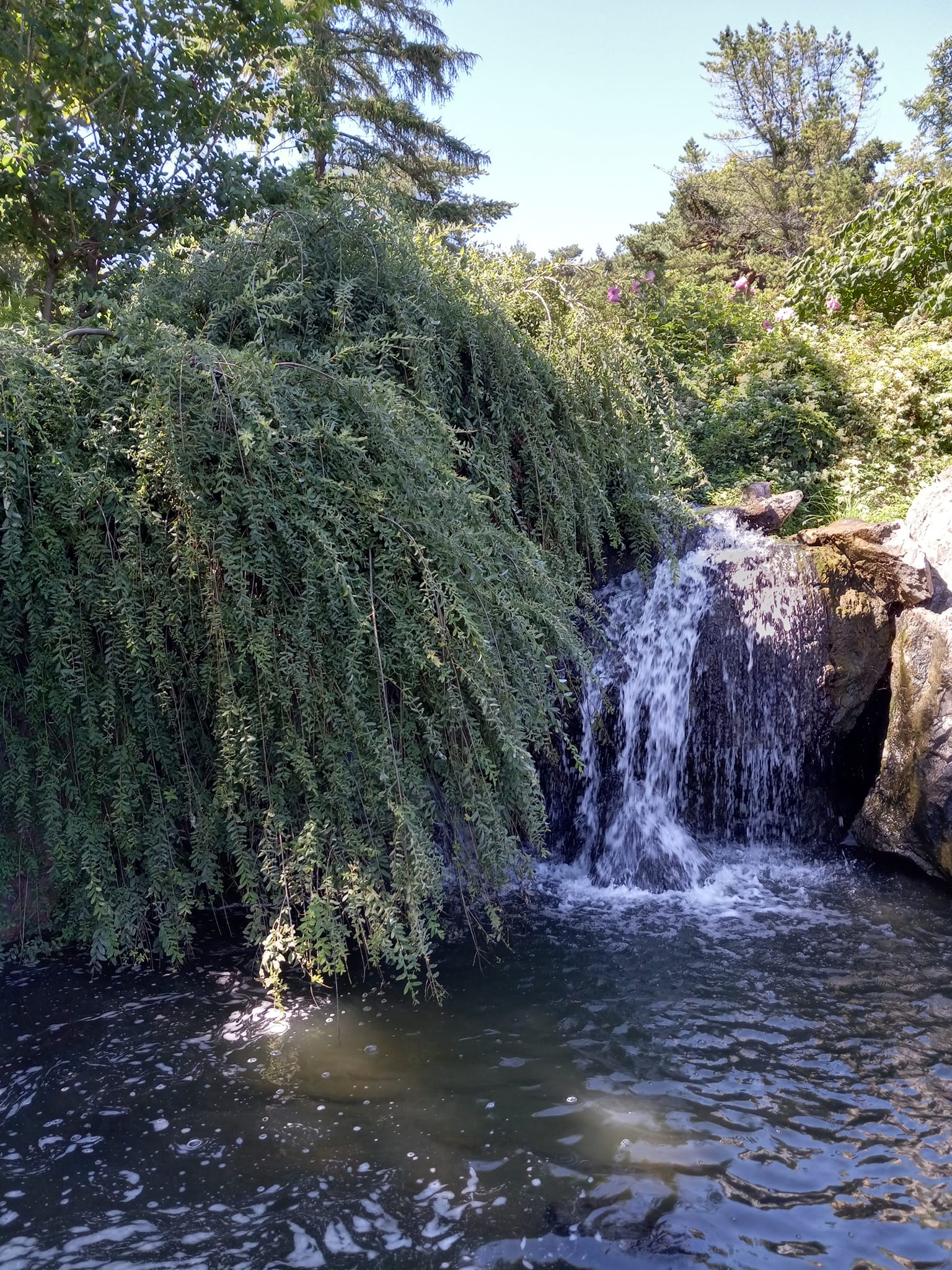
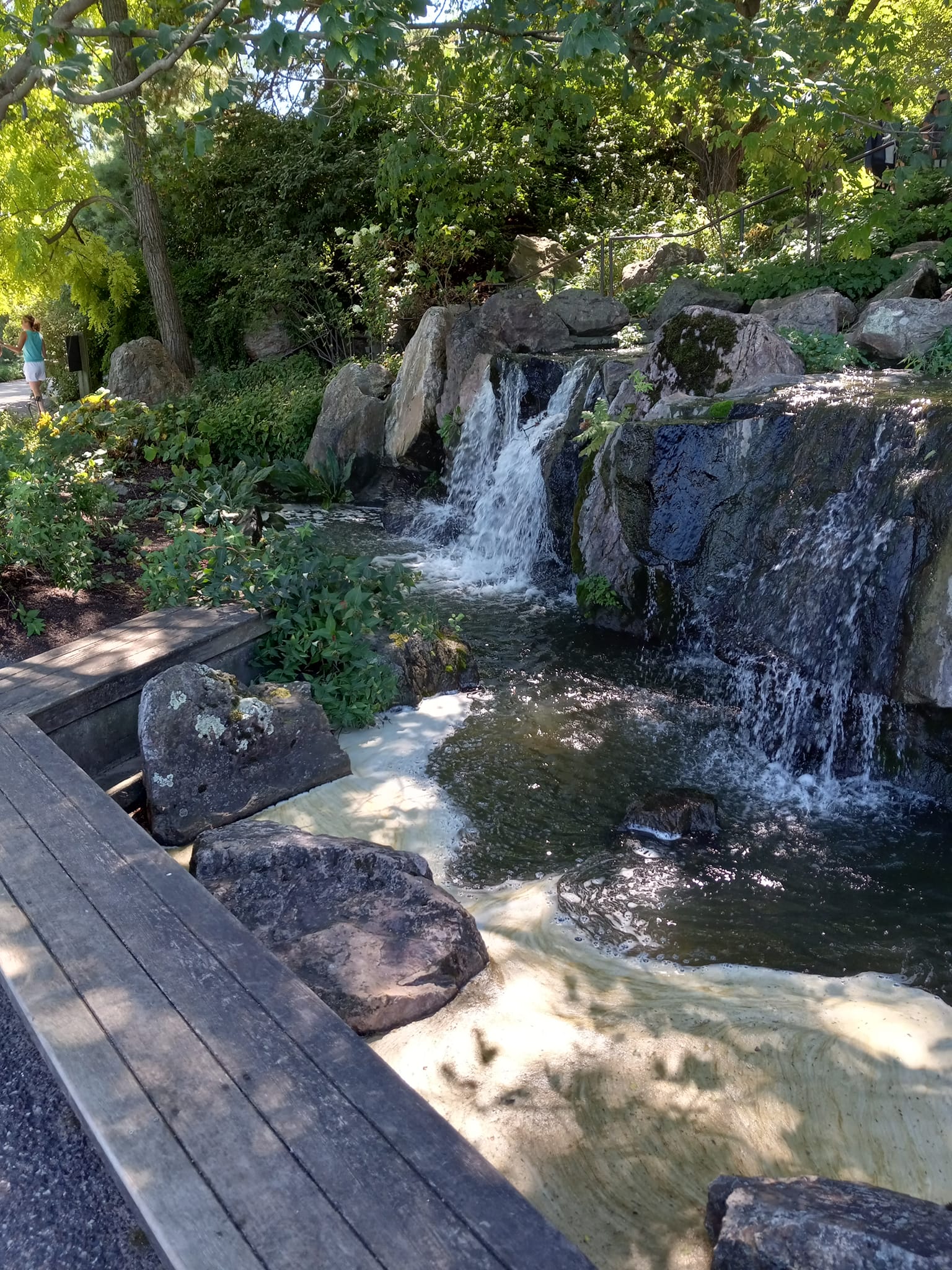
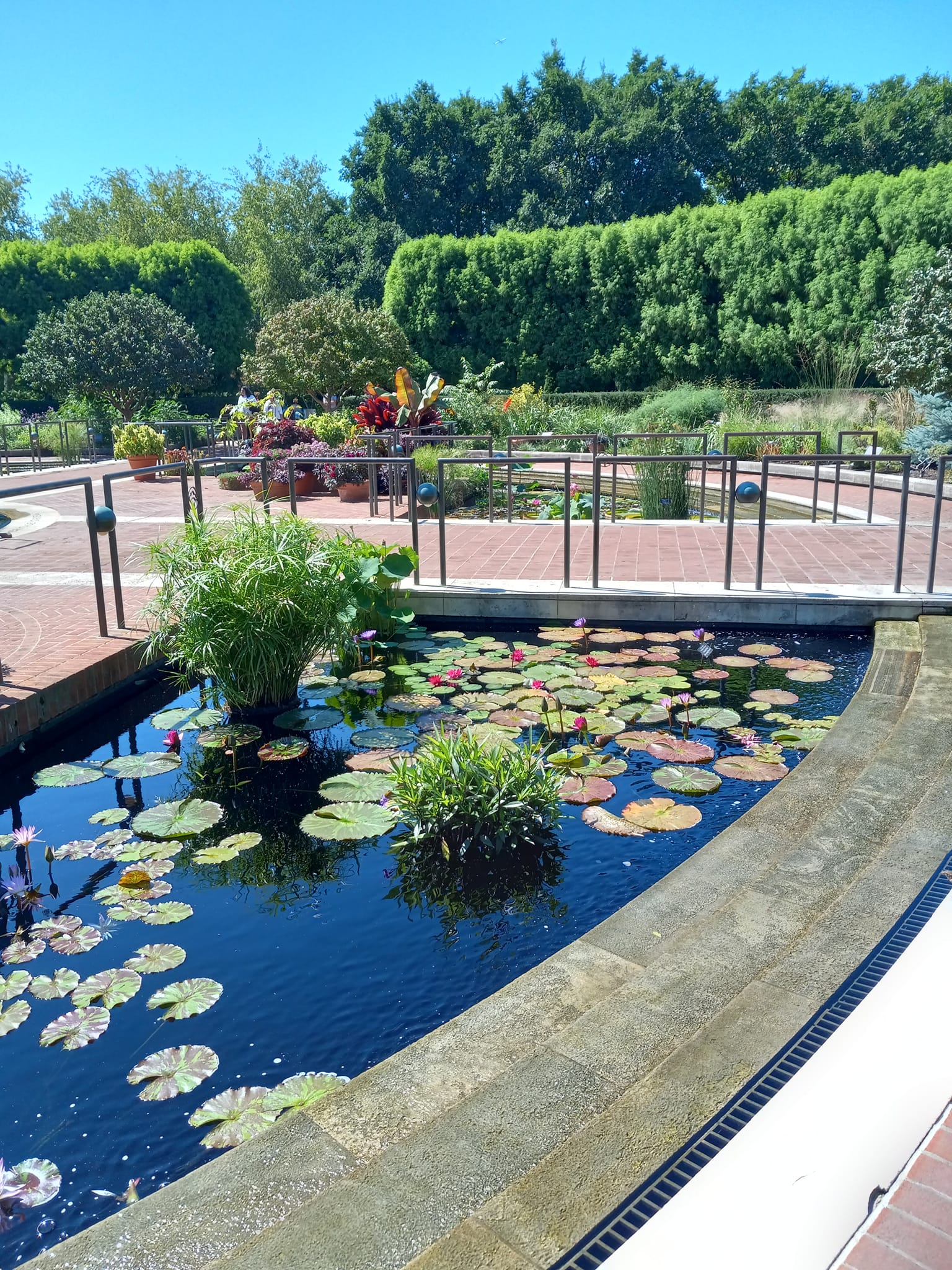
My generous poet-host, Julie Isaacson, knew from my writing and my biography that I would enjoy a walk around the Chicago Botanic Gardens–and she was so right! The gardens offered just the respite I needed after airplane travel. We hadn’t the time to stroll all 280+ acres, but the chance to walk amid trees and beside water in the middle of an urban expanse was genuinely restorative.

Now I am pulling weeds and pruning for the approaching autumn, activities that allow me to settle into myself internally and which sometimes result in poem drafts. Please wish me luck on both endeavors!

Script, postscript

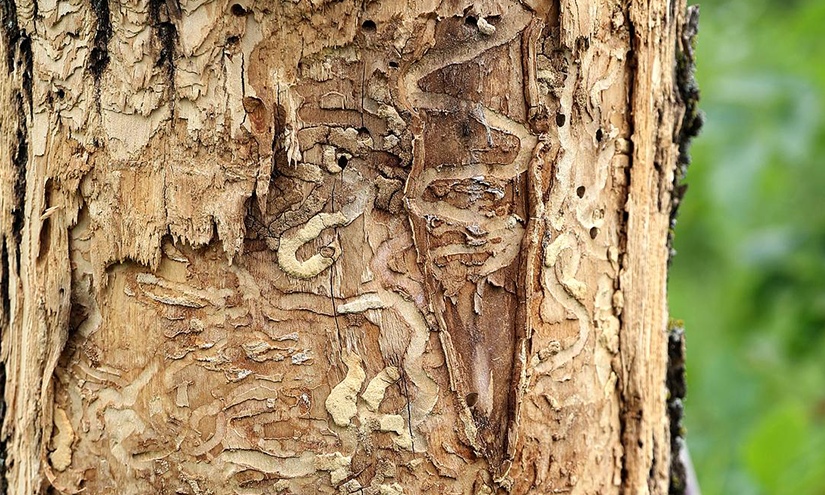
The weather has been glorious lately, which has the downside of getting rather droughty. No rain in the forecast, either, so it is time for supplemental watering if I want to keep harvesting from the vegetable garden. There’s not much left there, though; I may just wait things out and save the water. Meanwhile, some of our days have recently been punctuated by the sound of green ash limbs crashing in the nearby woods. When I investigate the trees, there are the telltale scribbles of ash borer on the trunks. The marks look like script.

I learned, while teaching college freshmen the past few years, that many younger adults do not know how to write or even to read script. Many children never get the lessons in handwriting in the second through fourth grades the way I did. Instead, they learn keyboarding–a skill I got to in my junior year of high school but never really have mastered (yes, even now I use a self-developed version that’s sort of an advanced hunt-and-peck method). It’s hard to believe that reading script is a task that will be relegated to specialists in years to come, but I shouldn’t be surprised if that’s what happens. To many of my college age students, handwritten script in English is almost indistinguishable from the marks of ash borers. They don’t see the need for that particular skill. Handwriting is going the way of letter-writing.

Perhaps we live in a post-script world?

I have been thinking about the handwritten word recently because of a recent incident while visiting my mother. She received a small refund check from an insurer, and though she understood what it was and that she no longer uses her checking account–we siblings take care of that through power of attorney–she was confused about what to do with it. “Sign it, Mom,” I told her, offering her a pen. “We’ll deposit it for you.” I turned the check over and pointed to the line for signature on the back.

She wavered, pen in the air. “I don’t…I don’t,” she said (her aphasia has advanced past the point of expressing full sentences). It took me a moment to realize that she could not recall how to sign her name. I placed my hand around hers and helped her start with the capital B.

I didn’t cry, but the experience hasn’t left me alone. I suppose there may be a poem in this incident, but if so, it’s a sorrowful one.

Classification

An admission: I’m barely competent at the promotional aspect of The Writing Life and would prefer to hole up in my house and garden and just… write. But writers need readers, and writers benefit by meeting other writers (and readers); and I’ve always been interested in learning new things, even things that are not particularly fun or that I am not naturally adept at. Such as educational learning management systems (ie, “portals”). Such as recording audiofiles of my poems. Such as contacting potential poetry-reading venues or reviewers. Or coming up with clever ways to let people know about my book.

I got a couple of responses from my initial forays, which is lucky. One of these sent me a sort of writer’s questionnaire about my book, and one of the responses I’m supposed to give is to say how I would classify my latest poetry collection. That got me mulling over the whole idea of categorization, classifying, and stereotypes. Genre–that’s easy. It’s poetry. But the sub-category of this book? uh…

~

At the beach earlier this week, we found a much-broken up rock jetty that teemed with creatures. As I sat back on my heels and peered into the mixture of sand-water-rock-mullosk-kelp, I found myself thinking about Aristotle’s immanent realism (epistemology/natural philosophy), ideas he likely nurtured while examining the tide pools of Lesbos. Or I imagine that he may have done so. We humans observe, and then classify or categorize based upon these observations: similarities, differences, various adaptations–in environment, habit, behavior, construction of the being or entity itself.

I think if I had known as a child and young woman that there was a career path called “a naturalist,” I would have pursued it.

~

Unclassifiable doesn’t strike me as much of a selling point. However, there are always art forms that are, to use a current term, intersectional or interdisciplinary, and creations that repurpose, alter, or reimagine the known or customary into something new and intriguing. Fellow blogger and talented poet and novelist Lesley Wheeler‘s books come to mind, as do works by Anne Carson and books from Coffeehouse Press and Tarpaulin Sky (among others).

My poetry is not experimental nor groundbreaking, though it is a little quirky; so here is my recent attempt to classify The Red Queen Hypothesis and Other Poems:

Touching on a range of topics and employing variety in poetic craft—free verse, metrical verse, rhyme, and classic forms—the poems in The Red Queen Hypothesis play with invention, science, and the environment of the everyday.  One example of these juxtapositions is the title poem: a villanelle, based on an evolutionary theory named for an episode in Alice through the Looking Glass, that sums up the corporate rat race. Sometimes tongue-in-cheek, sometimes disturbing, the poems urge readers to observe and to reconsider what is beautiful.

~

I dunno. Does that seem like a remotely interesting description?

(Really not adept at the promotional biz.)

Aristotle, supposedly.
from https://www.nytimes.com/2016/05/27/world/europe/greece-aristotle-tomb.html

Mindlessly

There are some necessary but mindless tasks that I’m good at and don’t mind doing. Weeding, for example (unless it’s raining, or disgustingly hot), or cleaning a bathroom. My morning chore today entailed removing staples that fastened carpet underlayment to the floor. There are dozens of these staples stuck in the subfloor, and most of them have bits of foam-like fabric wedged in them. The edges of the room are studded with tacking strips–annoying to remove when one is not a professional. Best Beloved and I did consider hiring someone to replace the floor, but since it is a job we can do ourselves…well, we have the time and are doing it.

There’s a difference between the mindless and the tedious. I don’t care for tedium; but a task I can mindlessly manage–something physical, but not too demanding, without a lot of surprises I need to problem-solve–those projects can be almost relaxing. When weeding, my thoughts can wander. The job is so familiar and repetitive that there is no need to devote much brainpower to it. Ideas, reflections, observations, images can float aimlessly in my mind. I can think about poems while weeding. Taking a walk in a woods or quiet countryside offers me the same sort of internal/external environment.

Proofreading was like that for me, back when I was a proofreader (when there were such things as proofreaders in every newspaper, type or print shop, publishing house, ad agency, and legal department). Editing takes some thought; but the less engaged a proofreader is with the text, the better. I was employed as a proofreader when I first recognized that I was truly serious about writing poetry, and I found value in the ’empty mind’ that my workaday job fostered. There was a bonus in that sometimes I did glean new information from the materials I read.

~

Composing this post, it strikes me that “mindless” is the wrong word, or not an accurate word to convey what it’s like to feel internally occupied while the physical body’s doing something else. “Reflection” implies more stillness. Something more akin to walking meditation?

At any rate, I can hope that the weeding and staple-removing might eventually get my poetry mojo re-booted. I have to work on my next manuscript and continue to promote my latest book, too. In the meantime at least I’m accomplishing something.

~

Transitions of one kind or another

Transitions require reflection and, quite often, reorganizing–and certainly that seems the case at present. I decided back in April to take a hiatus on submitting while I wound down at my college job, also recognizing that I need to put in some work on promoting my book (the cover should appear on my next post!). Besides, before I can send out poetry again, I need to assess what I have that might actually be worth sending out. It’s possible that much of the pile of not-yet self-evaluated poetry exists in unfinished form. That means further revision. While revising is an enjoyable task for me, at this point I confess to feeling overwhelmed. The first task, then, is one of organizing…which I admit I like a lot less than revision.

It was therefore with considerable resignation I faced the drawers, folders, computer files, and index cards that more or less make up my, uh, creative output. The project is nowhere near complete, but I got some cheer by realizing that I have been writing and revising more than I thought, a little at a time. The pile of papers on the chair pictured to the right is 16 months of revisions.

I would pat myself on the back more heartily if that stack had resulted in several damned fine pieces of poetry, but at least it means I’m doing the work that writers do and that I was doing it even when feeling taxed by situations not entirely within my control. Which is also what writers do. Sometimes you need to give yourself a little boost of validation.

A bigger boost of validation for writers is the publication of a book, and that ought to keep me buoyant for awhile even if I do dislike the promotional aspect of book publication (which falls more and more on the writer these days as the book industry contracts). My publisher says the book should be available in August– “Watch this space” –as advertisers used to urge.

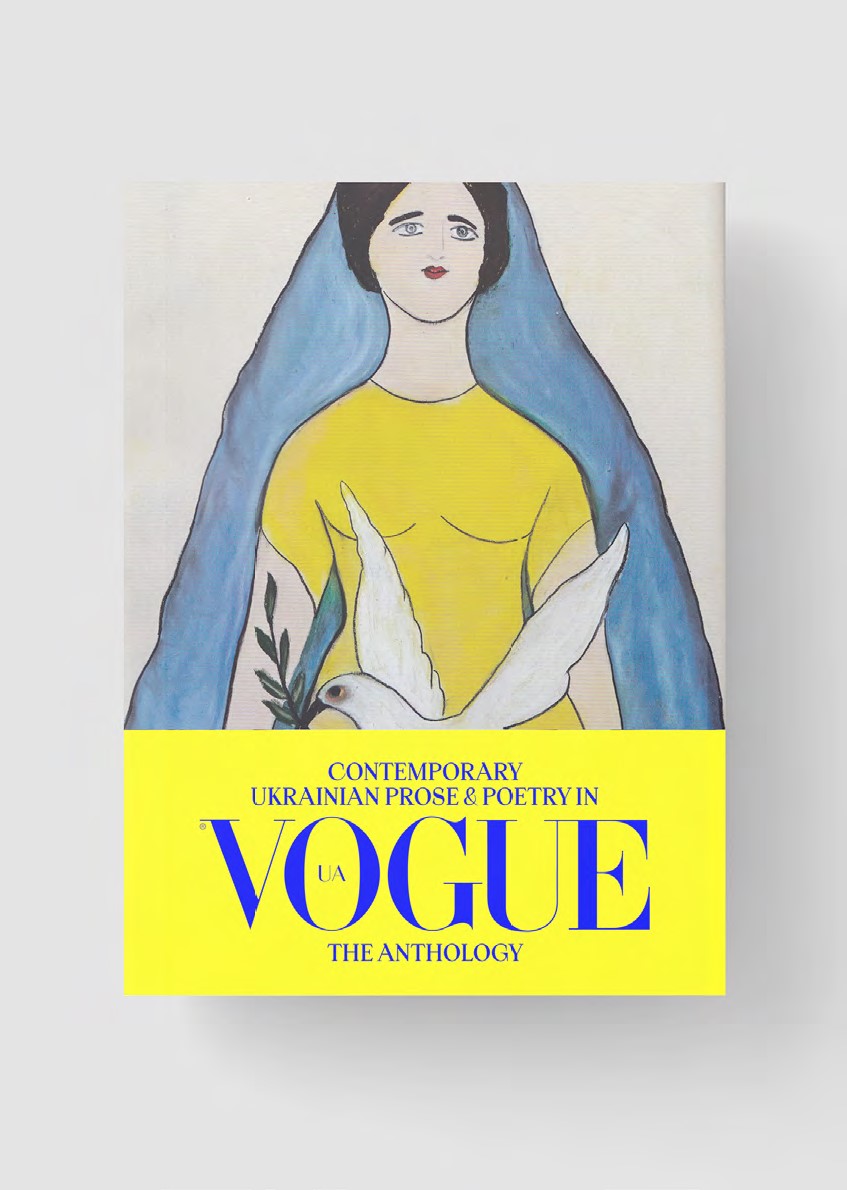
Meanwhile, the anthology of contemporary Ukrainian literature published by Vogue Ukraine is now in print and available; it’s full of passionate creative work and includes some internationally notable writers, the best-known of whom is Oksana Zabuzhko, who wrote a reflection about the appearance of her debut novel 25 years ago; one of the most shattering pieces is an extremely current non-fiction text by Olia Rusina written, diary-form, as the assault began on Kyiv. Info here.

Reading friends’ books

One thing about being a writer is that, after awhile, you meet other writers one way or another: sometimes through social media, Zoom events, or in person at book signings and readings; sometimes through conferences, workshops, or various educational programs; sometimes by finding local writers groups or getting an introduction to someone through a friend. When you meet writers, you get the additional privilege of reading their work. It so happens that lately, many of my writerly friends and colleagues have published books, and I’ve been busy reading them!

First, I want to mention that whenever possible, readers should purchase literary volumes from the writers themselves or from their publishers, or–if it’s an option in your region–from an independent bookseller. I do resort to ABE and Thrift and Amazon when a book has gone out of print or when the publisher prints through Amazon, but I want to remind people that the other sources will support the writers themselves or the independent small bookshops and publishers who launch these books into the world.

Now that my virtuous aside has been accomplished, here are a few of the books-by-friends-&-colleagues I’ve been consuming lately–not all of them newly-published (it takes me awhile to get around to the reading).

~

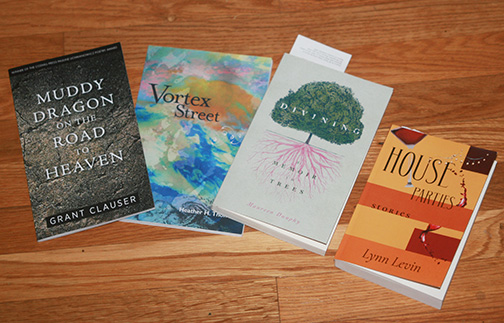
The near-abstract imagery and the concrete place-names and lyricism in Heather H. Thomas’ 2018 Vortex Street appealed to me on several levels, from the scientific (a repeating pattern of swirling vortices, see “fluid dynamics”) to the particular: my husband grew up in Reading, PA, where some of these poems are suspended in recollection. I’ve also loved reading Grant Clauser’s latest, the 2021 Codhill prize-winner Muddy Dragon on the Road to Heaven, a collection of poems that strikes me as both deeply beautiful and tenderly sad. Poet Lynn Levin has published a terrific book of short stories, House Parties, that remind me of the wry sense of humor and wide-ranging knowledge her poems have while proving she’s also a deft hand at plot and character. Maureen Dunphy’s memoir Divining, A Memoir in Trees, brought to mind parallels with Lesley Wheeler’s memoir in poems, Poetry’s Possible Worlds. In both books, the authors have chosen a locus [an American tree, a contemporary poem] and used the exploration of that “trigger” to draw out something personal. What better way to connect with readers than through something we love and value? Which brings me to a shout-out to Jane Satterfield, whose poetry collection The Badass Brontës isn’t in this photo because I’ve already lent it to someone who’s a Brontë fan.

~

In addition to the above books, I am eagerly awaiting new works from a host of other poet-friends: chapbooks by Beejay Grob (forthcoming from Moonstone Publishing) and Lisa DeVuono, poetry collections from Jerry Wemple, Jeanine Hall Gailey, and others that slip my mind at the moment. My only regret is that I have all this reading to do just as gardening season gets really underway!

Reading poetry

I find I’m drafting poems again, though most of them fall on the melancholy side of tonality. It’s odd because I’m not feeling exceptionally melancholy myself. Granted, the news cycle’s enough to make anyone feel a bit low; but my internal weather isn’t so bad, and the end of February has arrived with peculiar mildness this year. Last year, we were still covered in snow at Valentine’s Day. Could still happen–but the snowdrops and the crocuses are open, as are the iris reticulata.

~

Spending time reading contemporary poetry books may be a contributing factor to my flurry of new drafts. In the past two weeks or so, I’ve enjoyed perusals of books by Ocean Vuong, Lynn Levin, Jaan Kaplinski, Cleveland Wall, Kim Addonizio. I’m also reading Ian Haight’s newer (unpublished) translations of some Nansorhon poems, a process accompanied by research into the precepts of Taoism and its heavenly denizens and hierarchies. I need some context if I’m going to get as much out of her Taoist poems as I’d like. Thanks to Ian’s research and translations, I did some study of this poet and her work ten years ago; but I focused more on her family situation and constraints and did not examine the most religiously-influenced poems.

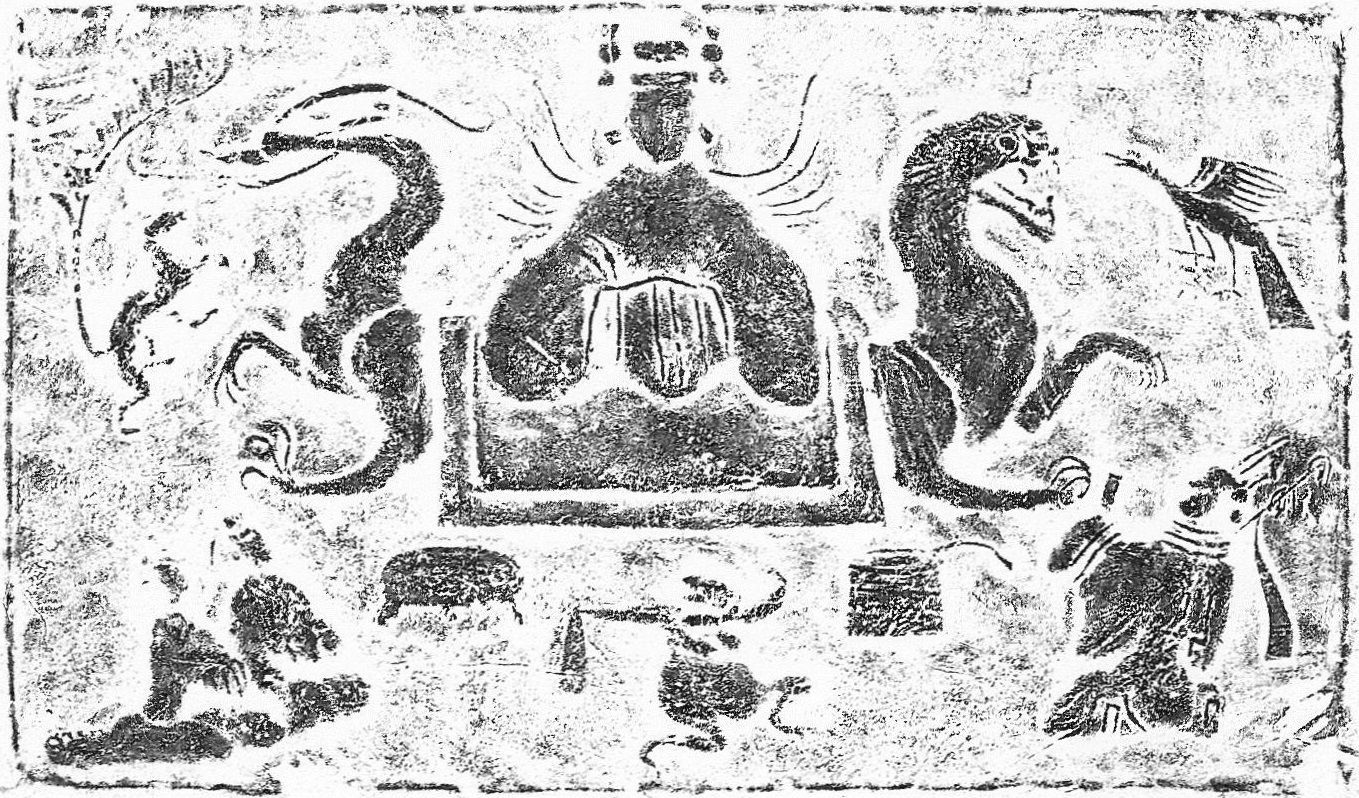
One Taoist goddess whose realms and attributes intrigue me is the Queen of the West, also called Queen Mother of the West, or Xiwangmu 西王母. She’s the mythical source of the peach of immortality and was likely important to Nansorhon as a powerful, much-worshiped female deity. Indeed, she’s invoked in several of the Nansorhon poems.

“Rubbing of a brick relief from the Han period, showing the Queen Mother sitting on her throne. To her right hand, a nine-tailed fox (jiuwei hu 九尾狐) and a dragon are facing each other, and to her left, a three-legged crow (sanzu wu 三足烏) and a tiger are facing each other. Just in front of the Queen Mother, a toad is dancing.” See http://www.chinaknowledge.de/Literature/Religion/personsxiwangmu.html (caption text by Ulrich Theobald, 2010).

~

Other translations I’m reading are from Ukrainian. One of my husband’s colleagues is working in exile on Vogue Ukraine, and the magazine plans to publish a print anthology of contemporary Ukrainian writers–as early as next month!–marking the one-year anniversary of the start of the Russian hostilities aimed at Kyiv. She sent me a few selections of the poems and prose that will appear in the book, and I’m impressed by the writing and the breadth and depth of the literature. And also heartbroken.

Vogue UA had been planning its 10-year anniversary celebration when Russia invaded. The magazine rapidly pivoted to online-only, and its editorial team decided to publish a commemorative print book titled, rather significantly, 9 1/2 Years of Vogue Ukraine (and if you are curious, you can purchase it here). Yes, it’s a high-end fashion magazine–not my usual jam. Proceeds support various Ukrainian cultural organizations (museums, libraries) and female veterans.

The forthcoming book, featuring contemporary Ukrainian prose and poetry, will appear on the Vogue UA site in March or April. I’ll keep my readers apprised…from what I have seen so far, the anthology will be well worth reading.

Solo endeavor?

It was great fun to be back in person, in Philadelphia, reading poetry aloud. Prepping for the performance made me aware, though, that I have no current obsession to mull upon; that may be why I have not been writing many poems of late. However, I recently felt inspired by Lesley Wheeler’s blog post including some prompts from poets. Prompts! Of course. Those are ways into writing when writing has not supplied the writer with her own ways into writing.

Therefore, I’ll close another year of my blog with a piece I drafted using Lesley’s conjunctions prompt. What resulted from the free-write surprised me, which is a good thing (it’s fun when I surprise myself, though this gets a bit dark toward the close–but dark contains interesting objects). And many thanks to Lesley and to the other poets whose prompts she shared. It’s likely I will keep working with them until my next poetic preoccupation.

~

So I’m tired of hearing people start their sentences with “So” on podcasts and the radio and TV, “so” a verbal tic, a word instead of “um,” which serves the same purpose but admits, more humbly, of uncertainty, which says I am pausing to gather my thoughts before speaking; whereas “So” sets up an explanation leading to opinion or argument, or so it seems to me.

So I’m sitting on my back porch even though it is late December, clouds gathering over bare trees. I hear woodpeckers deepening holes in trees, a rat-a-tat drill, and white-breasted nuthatches loud along the woodlot, and I ponder emerald ash borers and climate change and how to handle human aging in a capitalist society.

So what I wonder is “Am I afraid?” Some questions possess a looming quality, I guess this is one such. In my wicker chair, in my own backyard, no. Not afraid. The mood’s serene, no tightness in my chest no racing heart, not even facing death–as we all must do, though most of us refuse. Where are you going with this, Writer?

So all I’m saying is, I have fears about the future yes but not about dying, because dying I will face alone. Even when loved ones can be beside us, we are not an us when death comes. Each dies to their ego alone, interior to the world, most alone at death no matter who surrounds us.

So why, then, do I volunteer for hospice work, where the goal is not only to alleviate some of the pain but also to keep people from dying unaccompanied? My reasons are complicated, people are complicated. So let me just say that having been present when human beings die, that passage may not necessarily be a lonely one. But it is accomplished alone.