Novels & words

When I was about seven years old, I discovered books offered me a way to immerse myself in adventure and temporarily escape life’s discomforts. Novels, and later, poetry, were the genres I turned to most often. Though I also liked history, science, biographies, and art, there was something about a piece of sustained fiction that enthralled me so deeply I could easily ignore anything around me: the television, my siblings’ bickering, the vacuum cleaner, my parents’ calling me to dinner. In later years, immersed in a book, I risked going late to class or missing my stop on the F train. The only area of my life where I understand what is meant by hyperfocus has been reading.

Then I had children, which changed everything. I remained an inveterate reader, but I found it far easier to get through non-fiction, poetry, essay or short story collections, and literary memoirs than to devote myself to novels. It was simply too easy to get lost in a book of fiction, to wrap myself in those worlds to the detriment of my own. Too easy to become irresponsible to life’s requirements, which were suddenly so many and so urgent. If my situation had been different–let’s say, commuting by train for half an hour or more daily–I might have continued reading a hundred or more novels a year. But I was home in the rur-burbs with two young kids, and I could read only in short spurts throughout the day. Granted, I read a lot of books to my son and daughter, some of which were new to me and most of which were fictional…but a bit below my grade level.

Those children are in their 30s now, but I became so accustomed to the non-fiction genre that only recently have I begun to turn back to my first love, the novel. Granted, I did my reading-all-of-Dickens stint during covid, and I never completely abandoned reading novels; but I got out of the habit. Because my workplace office is now in the library, however, I have been picking up the occasional, usually contemporary, novel that appears on the library’s New Acquisitions display. This is where I found R.F. Kuang’s book Babel, or The Necessity of Violence: An Arcane History of the Oxford Translator’s Revolution. Imagine an alternative Dickensian-era Britain, with the underlying power struggles between education and political power as per Pullman’s His Dark Materials series, and the almost-believable otherworldliness (and creative footnotes) of Susanna Clarke’s fiction…with the late-adolescent outsiders who bond over knowledge that cements the Harry Potter books…and add some genuinely academic background on linguistics and etymology.

That’s about as close as I can describe Babel by means of other books, but what I really enjoyed about the novel is the way it got me thinking about how dismayingly interconnected education and scholarly pursuits are with power structures such as governments, politics, wealth, and colonialism. Kuang deftly shows her readers how the focus on knowledge that her characters love and possess talent for inevitably leads to a narrowness in their perspectives that differs almost dangerously from an uneducated ignorance. They are good young people, but they operate as elites in a fundamentally callous system. The system either corrupts or smothers. The “fun” part of her world construct is that power operates on the use of words: on languages and their etymologies, which are magical enhancements.

But of course, power does hinge on the use of words, doesn’t it?

The question this poses in my mind has something to do with poetry, with the writing of it, the speaking of it, its use of words that are not magic but can carry with them a power to evoke that seems pretty magical at times. Reading this novel was not only entertaining (sad, thrilling, surprising)–it got me, after I’d completed hyperfocusing, to reflect on ideas that twine with the roots of poetry. To me, that’s the best takeaway from any reading experience.

Humble pie

I have always understood gardening as a practice that keeps a person humble. Wise gardeners are not control freaks, as Nature has its own inconsistent methods to which climate change has added further randomness and unpredictability. The latest in my region is a winter/spring period of “abnormally dry” weather–not quite the same as a drought. In an area that averages about 46″ of rain annually (71″ in the amazingly wet year 2011), we’re now about 2″ below normal for the month and 10″ below normal for the past 12 months, even though we had a month’s worth of rain during three days in April. On May 2, a local news source reported:

…during a wet well draw down, workers at Lehigh County Authority’s wastewater treatment plant fished something unusual out of the water.
A baby American alligator was found embedded in a clump of material screened out before entering the plant along the Lehigh River…“This alligator was embedded with only its tail sticking out [of] a boulder of …horrible grease and motor oil and diapers and fat,” said Barbara Miller,
who was involved in the rescue.

Stephanie Sigafoos, WLVR

Poor alligator! [No, alligators are NOT native to Pennsylvania!] Meanwhile, this May I have been watering my vegetable garden and some of my perennials for days on end; we’ve had no appreciable rain since the first of May, and there’s no rain forecast for another week or more. It’s tough when there’s no rain during the time we sow seeds. Seeds need moisture to germinate. Climate weirding, as my friend Bill calls it, takes its toll randomly. For example, my daughter in New Mexico is experiencing a wetter-than-usual springtime in the desert that is not a direct result of the snow pack in the Rockies and Sierras. It’s just…rainy.

What all of this amounts to is that no matter how long you’ve been gardening or how much education you have acquired about gardening in your region, you’re going to be surprised sometimes. Like, maybe every year. Or many times in a year. So one also acquires a bit of humility. This year, my tomato seedlings, started from seed as I do every year, haven’t thrived (why? dunno) though I am attempting to keep them alive in the garden. And the spinach has been inconsistent, though it was fabulous the past three years: Viroflay, same seed, same supplier.

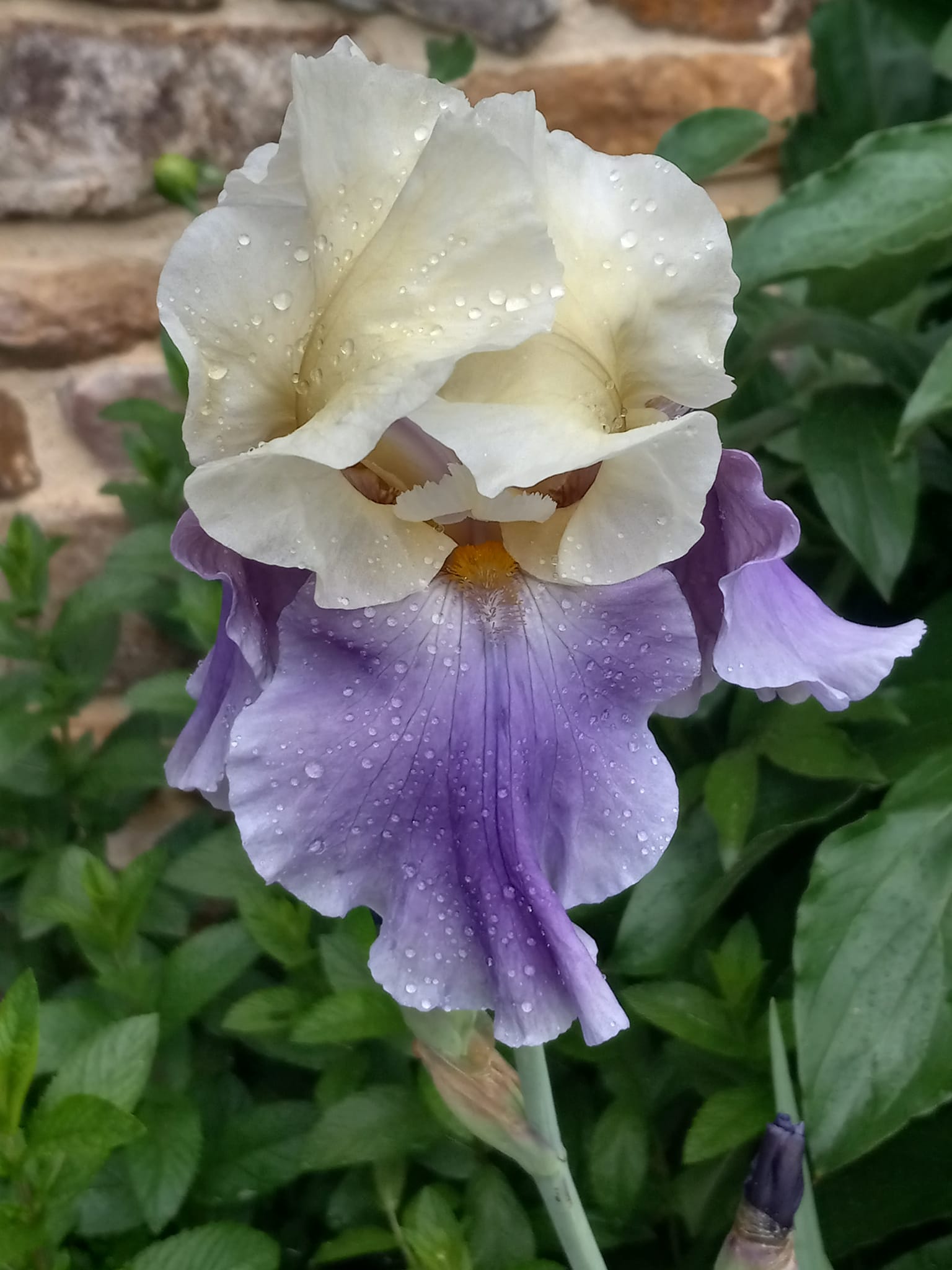
But then there is this iris, which needed no assistance from the gardener to achieve peak beauty in spite of weird weather. I didn’t even water this bed.

Random beauty.

Reading friends’ books

One thing about being a writer is that, after awhile, you meet other writers one way or another: sometimes through social media, Zoom events, or in person at book signings and readings; sometimes through conferences, workshops, or various educational programs; sometimes by finding local writers groups or getting an introduction to someone through a friend. When you meet writers, you get the additional privilege of reading their work. It so happens that lately, many of my writerly friends and colleagues have published books, and I’ve been busy reading them!

First, I want to mention that whenever possible, readers should purchase literary volumes from the writers themselves or from their publishers, or–if it’s an option in your region–from an independent bookseller. I do resort to ABE and Thrift and Amazon when a book has gone out of print or when the publisher prints through Amazon, but I want to remind people that the other sources will support the writers themselves or the independent small bookshops and publishers who launch these books into the world.

Now that my virtuous aside has been accomplished, here are a few of the books-by-friends-&-colleagues I’ve been consuming lately–not all of them newly-published (it takes me awhile to get around to the reading).

~

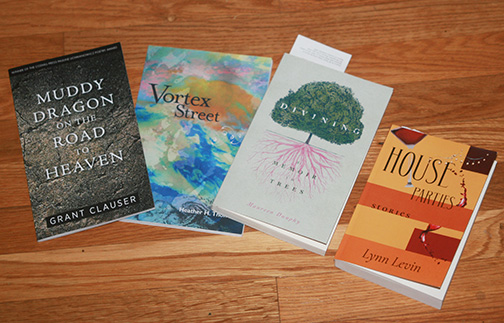
The near-abstract imagery and the concrete place-names and lyricism in Heather H. Thomas’ 2018 Vortex Street appealed to me on several levels, from the scientific (a repeating pattern of swirling vortices, see “fluid dynamics”) to the particular: my husband grew up in Reading, PA, where some of these poems are suspended in recollection. I’ve also loved reading Grant Clauser’s latest, the 2021 Codhill prize-winner Muddy Dragon on the Road to Heaven, a collection of poems that strikes me as both deeply beautiful and tenderly sad. Poet Lynn Levin has published a terrific book of short stories, House Parties, that remind me of the wry sense of humor and wide-ranging knowledge her poems have while proving she’s also a deft hand at plot and character. Maureen Dunphy’s memoir Divining, A Memoir in Trees, brought to mind parallels with Lesley Wheeler’s memoir in poems, Poetry’s Possible Worlds. In both books, the authors have chosen a locus [an American tree, a contemporary poem] and used the exploration of that “trigger” to draw out something personal. What better way to connect with readers than through something we love and value? Which brings me to a shout-out to Jane Satterfield, whose poetry collection The Badass Brontës isn’t in this photo because I’ve already lent it to someone who’s a Brontë fan.

~

In addition to the above books, I am eagerly awaiting new works from a host of other poet-friends: chapbooks by Beejay Grob (forthcoming from Moonstone Publishing) and Lisa DeVuono, poetry collections from Jerry Wemple, Jeanine Hall Gailey, and others that slip my mind at the moment. My only regret is that I have all this reading to do just as gardening season gets really underway!

Generosity

It is a well-documented fact that writers can be dismissive, hypercritical, and downright insulting when it comes to the work of their peers and predecessors. Juvenal, Samuel Johnson, Oscar Wilde, Dorothy Sayers and her nemesis Edmund Wilson, Dorothy Parker, John Logan…the list is long and spans centuries. Some of the critiques are valid, in their way; many are wickedly funny, which doesn’t remedy the unkindness of the barbs. Most writers who have been writing and presenting or publishing their work for awhile will have encountered some less-than-generous “feedback” from other writers. Given human nature, such responses are probably inevitable.

In the mediated circle of the voluntary critique group such as may be found among MFA programs or community writers’ groups, the group or mentor often establishes protocols for sharing work–methods of responding to creative efforts that avoid too-harsh criticism, ad hominem attacks, or dismissive/discouraging comments. Once your writing is out in the world in whatever public form (print, slam performance, live reading, video, online, etc), however, the best advice is sometimes “don’t read the comments.”

Many agendas may drive the urge to bash particular writers or their works, among these envy, attention, pride, status, self-preservation, righteous indignation, or a sense that one needs to scramble to make space for oneself in an already small environment (“the literary world”). Even, dare I say, ignorance. I could speculate on reasons for unkindness until the proverbial cows come dawdling home, but I suppose it can be attributed to a kind of social Darwinism. People can be mean-spirited when threatened. Though exactly how the writing of poetry poses a threat to other poets remains a mystery to me.

Maybe I am a Pollyanna (entirely possible), but although I can recall some incidents and critiques that have stung me, there have been far more instances of generosity from fellow writers. While contemplating writing this post I sat back and decided to count how many fellow writers have extended courtesy, respect, useful advice, helpful criticism, networking and publication leads, encouragement, and the sense that I’ve “been seen”–acknowledgment as a writer–and I found the list was long. I considered listing names, but there are so many…and I was afraid I’d inadvertently overlook someone. I consider this an excellent “problem” to have.

Granted, some stings have been…memorable. However, I’ve been writing and publishing poetry and related prose since the early 1980s, so there have been many years during which I’ve had the joy of connecting with other writers in generous ways. Writing is both a large community and a small one, depending upon where I am in my own life: local at times, semi-isolated other times, and then–thanks to social media platforms, with which I have love/hate relationships–national and international!

As I get ready to pull back a bit from my work in the realm of higher education, I hope that the lessons I have learned about being generous to my students, gently encouraging while pointing out areas to keep working on, will stay with me. My feeling about poetry is that there’s certainly room for more of it in a world which can be harsh, and that acknowledging other humans’ urge to express their awe, fear, grief, passion, love, anger, and perspective won’t actually harm many of us.

Thus, to all of the fellow writers and artists living and dead who have been generous to me: Bounteous gratitude. I’ll keep trying to pay it forward.

Artistry, art

Wednesday evening I participated in a lovely (if under-attended) event at a local listening room, Godfrey Daniels Coffeehouse. The venue’s been in existence nearly half a century and hosts many a folk, blues, and folk-rock band/singer-songwriter, as well as the occasional puppet show, jam, open mike, children’s event, and poetry reading. Quite a storied place. Dave Fry, one of the co-founders, offers a monthly “Dave’s Night Out” during which he invites songsters, singers, lyricists, musicians, and poets to take the small stage and present their work as well as discuss their working process–with Dave himself and with the audience. It’s a wonderful opportunity to exchange creative and artistic ideas in public. The poets were me, Danielle Notaro, and Cleveland Wall. Dave’s take on the evening is here.

On the way home, my beloved and I had a discussion about artistry and “being an artist.” As he is from an artisan/craftsman background, he does not think of himself as an artist. The term seems a bit “elevated” to him. And while he is a creative problem solver–crucial to being an artist–I see why he does not consider himself an artist.

Some of that thinking is simply semantic, however, a perception based on someone else’s definition of an artist. Beloved asked me, “Do dancers or musicians consider themselves artists? Do you consider yourself an artist?” Good question, and the answer’s probably individual (i.e., it depends).

I mean–do I consider myself a poet? A writer? Let alone an artist. I immediately thought of a Substack post by my friend, journalist (journalists are writers!) Peter Moore, in which he publishes an excerpt from his post-college diary. Brave man.

“On the ferry from France to Folkestone I floated on a rising tide of words words words: “I must enter into the intense feeling I had while riding the Tube this morning,” I wrote, “that I honestly feel like a writer, that it was just a matter of time and effort before I am recognized as one. I hope and trust that this is prophetic.”

https://petermoore.substack.com/p/r2e-excerpt-46-the-rising-tide-of

Yeah, I remember feeling those particular 22-year-old feels and the questioning that accompanies them. I am certain that similar enquiries appear in my old journals, though I may have been more cynical and less trusting than Peter was. He closes this post by saying: “Meanwhile, all those blank pages were screaming at me. Fill them with what, aside from intense living?

“Pretensions to artistry!”

~

Which is not to say that poets and writers and dancers and songwriters are not artists. It’s just that some of these folks think of themselves as artists, and others think of themselves as artisans, or craftspeople, or creative innovators, or…name it what you will. Poetry is a form of creative expression, and if you (dear reader) categorize that as art, then it is. If my poet colleagues think of themselves as artists, I respect that and will not argue. Perspectives, right? Not the same as pretensions, although I will admit that in my opinion, there are some people who write poems, and other things, a bit pretentiously. I have been guilty of the same, especially when I was young and getting the practice underway. Pretentiousness may even be a kind of motivation. We learn humility as we practice our missteps.

Contemporary Western society casts a great deal of gravitas and status on the word “artist.” So to answer my spouse, I replied that well…I do consider myself a writer and a poet, but I seldom think of myself as an artist. However, if you think poets are artists, I am an artist. Because I do indeed think of myself as a poet. I cannot get away from that urgent need to observe, imagine, interpret, restate, turn into metaphor, reflect, create into form, and otherwise do the making (Poiesis) of word play.

Information from poems

I tried to attend a poetry event on Saturday afternoon, but the weather was against me.

The rain came accompanied by lightning strikes, high winds, falling branches, flash-flooded roads, sleet, and a little hail, all in the space of two and a half hours. I left home only to turn around after three miles. The highway was blocked with traffic piled up due to various “storm-related events” (said the weather sites). Actually, I was grateful for the storm, since our region has been unusually dry and even warm for April–my trees, shrubs, meadow, and perennials needed rain. And upon my return, I got back to reading books of poetry. This past week these included collections by Marilyn Chin, Elizabeth Metzger, Grant Clauser, Jennifer Franklin, and Natalie Diaz. Some wonderful work there.

Through these books of poems, I also gleaned lots of interesting information. That’s something many people who claim not to like poetry don’t understand: you can learn about so many things through poetry! Poems contain fascinating facts, intriguing perspectives, tons of social and cultural observations, vocabulary and terms I would not have known about otherwise…poems have been the impetus for me to learn more about astronomy, theology, historical events and people, the geography and topography of the earth and its oceans, the life cycles of insects and plants, how metal shops operate, how to catch fish or tie a fly, what it is like to “live with a disability,” how the process of dying has differed from era to era and place to place, what it is like to reside in a war zone, the traditions of people whose backgrounds differ from my own, and other so-called “non-fictional” information.

Facts, in other words. Poems may inhere in the emotional or intellectual realm in many ways, but they also can–and often do–inform. They contain facts as well as multitudes. If people did not get so hung up on trying to decode a secret meaning behind everything they encounter that appears to be a poem, they might be surprised at how much they could learn from such (usually) brief texts. Yes, it might help to look up a word or a reference or two. That can get a reader started on a whole trail of interesting and valuable knowledge, widening the worldview, changing the perspective.

It may even lead a person to recognize that facts can change depending on point of view. Contemporary science acknowledges this, but most human beings haven’t accepted it yet. Anyway, this points to one reason poetry has often been considered unconventional, subversive, even dangerous or radical: Poems can challenge the status quo of what is accepted, received, unquestioned in society’s knowledge base. Terrifying the authorities by means of information.

Go for it. Read a book of poems.

~

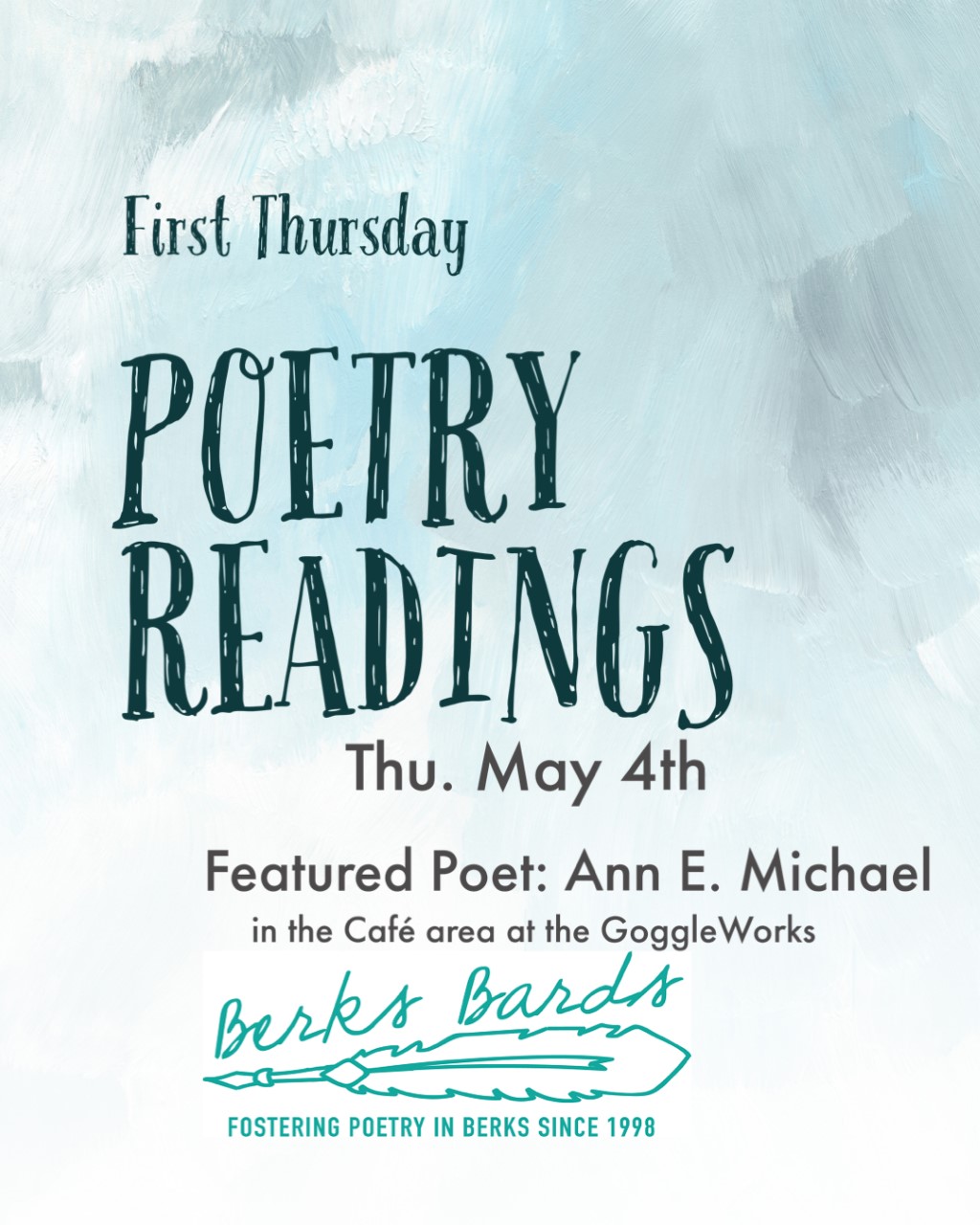
Coming up in May, I’ll be featured once again at GoggleWorks in Reading PA, 6 pm on May 4th…it has been awhile since I was there (2012), and I look forward to it!

Astronomy

As a freshman in college, seeking to expand my limited science knowledge, I enrolled in a Physical Astronomy course, an introductory seminar class that taught students how physicists study the cosmos. At any rate, it introduced us to how that was done in the early 1970s. Thanks to computer tech and so many rapid changes in the field (we were using slide rules!!), the discipline has changed in some respects. I was terrible at the math, never having gotten beyond Algebra II in high school, but I had a terrific professor and loved the material. As may be obvious to readers of this blog, the cosmos and all that is in it provides me with endless opportunities for learning, speculation, and reflection.

Rebecca Elson, whose book A Responsibility to Awe I just finished reading, keenly reminds me of how fascinating the study of the universe can be and how little we know of it. Each decade the science and the theories take immense leaps in measurement and exploration, and each leap reveals how many more questions we have yet to ask, let alone answer. Not just inquiries into the galaxies, but also biological and ecological worlds to explore: salmon, eels, oceans, mountains, our own histories and our own mortality. Elson’s area of study centered on galaxy formation–the chemical evolution of stars, and globular clusters. But she started out collecting rocks with her geologist father who was doing fieldwork in Canada, then studied biology. It wasn’t easy to be a young woman studying the sciences in the 1970s, and she felt she was drifting a bit; writing, however, she felt more sure of. In the essay that ends this collection, she states that the atmosphere at Princeton during her post-doctoral study was “a stronghold not just of men, but of theoreticians” who looked down on work which involved “mere” observation, which is what she had painstakingly been doing in her research in Australia and Cambridge. At Princeton, though, she met a group of poets who encouraged her work and who made her stay at the university more comfortable. Good observation skills make a terrific foundation for poets.

~

If the ocean is like the universe
Then waves are stars.

If space is like the ocean
Then matter is the waves
Dictating the rise and fall
of floating things...
  --from "Some Thoughts about the Ocean and the Universe"

She was diagnosed with non-Hodgkins lymphoma when she was 29, died ten years later, and this book is the only example I’ve been able to find of her poetry. But it is revelatory what Elson does with simple language and deep, theoretical concepts as metaphor, topic, or theme. Some of the poems are so brief, yet I find myself thinking about them again and again. Like good haiku, they are not aphoristic–but they linger. Her sense of awe is palpable in these poems; I think that’s what I like most about her poetry.

Evolution

We are survivors of immeasurable events,
Flung upon some reach of land,
Small, wet miracles without instructions,
Only the imperative of change.

~
Salmon Running

Who isn't driven
Up the estuaries
Of another's flesh,
Up rivers of blood,
To spawn close to the heart?

~

A poem titled “OncoMouse, Kitchen Mouse” thanks the laboratory mice whose lives led to the cancer treatments that, for a time, prolonged her life; “Antidotes to Fear of Death” finds her eating the stars, or stirring herself into a young universe. While one late poem is bleak (“There is no poetry to cancer/To the body betraying itself”), another–the last entry in her notebook–observes the flourishing of spring. Much to learn here. Enough admiration that I wish, selfishly, she’d had more time on earth so I could enjoy more of her poems.

~

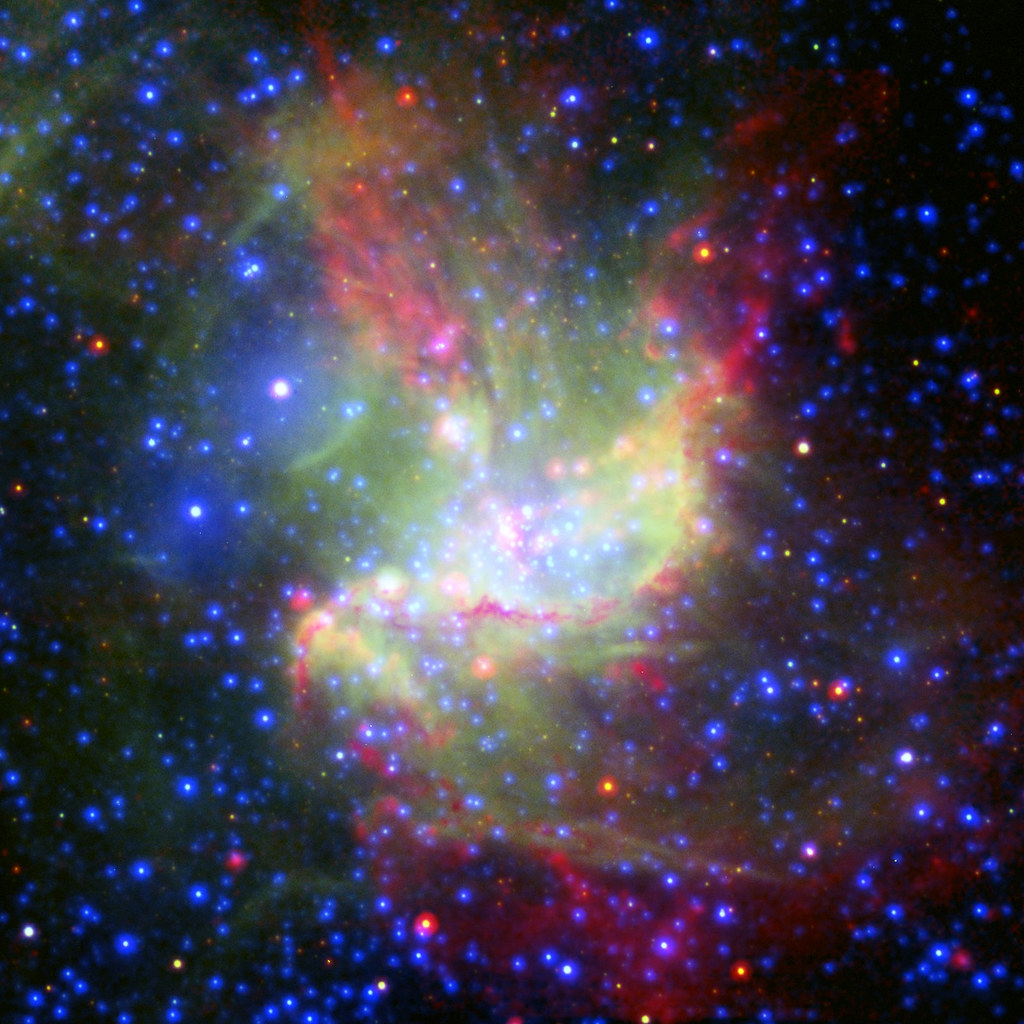
Fledgling Stars in Stellar Nursery by NASA Goddard Photo and Video is licensed under CC-BY 2.0

Wandering

My mind’s been wandering a great deal lately. This at a time when focus would be quite useful, and yet–I don’t mind a little mental meandering. I think that, akin to daydreaming, a lack of focus can lead to creative thinking. Of course, the downside is that it may also lead to lollygagging and a lack of ambition.

I’ve been thinking about the way contemporary Americans use the word “engagement.” Not as in marriage proposals–that definition hasn’t changed–but in statistics, marketing, self-help, and education. My department at the university has been directed to “foster student engagement.” Our administration wants us to find ways to engage students, but it seems what’s meant by that is simply to attract their attention amid the myriad distractions and attractions of modern life. In my area of the college, where students go to get a little extra assistance in their coursework or their educational plans, we have long been aware that we can’t reach everyone who needs help and that we cannot create enthusiasm or involvement. Apparently, engagement is supposed to lead to motivation. That would be a miracle. Like many young people when I was a young person, today’s young people are often rather undirected. Wandering.

I wonder whether gap years or a required year of community or civil service would benefit people before they march off to college to “become a physical therapist” or whatever it is they think of as a career. Many of them would save on tuition fees, because maybe they are not that keen on academic coursework after all, or because they can go to college with a better idea of what they want to learn (rather than end up attending for 6 years because they changed majors). US society has evolved to push its citizens through large, unwieldy systems that supposedly create clear-thinking individualists who can fit into whatever job market the nation happens to foresee itself needing in future, but there is so much wrong both with that methodology and with that picture in the first place.

I’m with Walt Whitman and the loafing approach to observation and creative thinking, but that probably won’t be sufficient for a nation with a population of 336 million people.

This is not my problem to solve, and I would not be the person elected to solve it. But I ponder this sort of thing.

~

This poem appeared in Schuylkill Valley Journal Online. It’s a persona poem in which I imagine being Walt Whitman as a young child. May we encourage our young people to wonder and wander (and, yes, loaf a little).

Little Walt

When Mother sends me with a bucket to the pump
and it is a rainy day, droplets landing on my face, I open my eyes
trying to see where the rain starts but cannot
because I blink—and why is it that I blink without ever
meaning to?

My Baby Brother wails so loud
I hear him out of doors although the rain is also noisy
splashing the leaves. I can tell the wagons’ wheels are spewing mud
as they clobber past hitched to wet horses who snort at the weather.
The pump handle feels slick and water spurts into my
bucket so that I think of a waterfall in a gully or tumblers
at the sea’s shore where the little fishes get caught in the seining nets.

When the bucket’s full I set it down beside me
and watch water’s surface going plip plip and my own face
under the rain and how it is that I can keep my eyes open looking
into the bucket: behind me in the reflection is the cloud
that is raining all upon the Town.

Mother calls me to the house, You have been loafing.
The bucket, full now and heavy, becomes my chief burden
although a hen scurries beside me, and the ice man hollers
at his little brown donkey and the world around me
is so full of everything!
~
Walt Whitman in mid-life

Life-shifts

This week marks one of those “big birthdays”–my mother turns 90. The birthday feels bittersweet; for, in many ways, I have been in the process of “losing” my mother since her diagnosis of vascular dementia in 2017.

Or is it that she is losing? Losing cognition, a sense of time, the words to say…anything at all. She has not yet lost a sense of emotional self, though I know that if her body doesn’t give out first, that will eventually occur. I’ve been through this before, with my mother-in-law. Helping people navigate dementia is a challenging task.

Therefore, as I celebrate her birthday, I also celebrate the goodness of the people (nurses, CNAs) who assist her daily at her skilled-nursing apartment, the social worker who visits with her and brings her mail, the acquaintances who smile and greet her even though they know there cannot be conversation (of any meaningful sort). The doctors and nurse practitioners who find ways to communicate with her about how she feels physically. It cannot be easy, even with someone as even-tempered and pleasant as my mother continues to be.

A funny thing about my mom. When she was my age, we used to tease her and my dad about “getting old.” She’d toss our teasing aside by insisting, “You’re not old ’til you’re 90!” Even with a few health issues, she and my father continued to be curious about the world and the people in it, traveling, going to parties, trying new things (cross-country skiing, Thai cuisine, activities with grandchildren). About 8 years ago, when my dad was ill with cancer and meningitis and going in and out of the ICU, Mom said she felt old. We retorted, “But Mom! You’re not old ’til you’re 90!”

Now she really is 90. Bless her good kind heart. <3

~

February 26th is just another day, another year–and at this point, my mother has very little sense of time. It is likely that my mother’s life-shifts are in the past, and the next shift (there’s no escaping it) will be death; but who can tell? My mother’s ninetieth feels like a huge shift in my life as her daughter, as an adult, as a mother to grown people, and as a writer in the world. Why this is so, I can’t say. It’s certainly something I’ll be reflecting on often in the coming years, and the reflections emerge in my writing. As I work on revising the poems I’ve drafted in the past 5 years, the topics of aging, mortality, aphasia, and memory keep showing up. Things I can consider myself fortunate, perhaps, to be preoccupied with, rather than being forced into confronting a natural disaster (Pakistan, Turkey, Syria, and others) or war (Ukraine, Syria, and other regions).

Here’s part of a poem I’ve been wrestling with lately.

                       ... --I would untangle
my mother's mind if I could be let access to its
recesses, but those stay hidden like the life in hedge
and meadow, in the woody undergrowth,
unknowns twisted together, impenetrable.
...

How fortunate for me that my mother is not far away, is well-housed and safely cared-for, and has had a long, creative, fruitful life to celebrate this weekend. Nonetheless, the grief inheres. The hardest shift? I miss the person she has been all my life until recently. And yet: here she is. Herself, more impenetrable than ever. And loved.

~

Mom at about my current age–ca. 1998 or ’99.

Reading poetry

I find I’m drafting poems again, though most of them fall on the melancholy side of tonality. It’s odd because I’m not feeling exceptionally melancholy myself. Granted, the news cycle’s enough to make anyone feel a bit low; but my internal weather isn’t so bad, and the end of February has arrived with peculiar mildness this year. Last year, we were still covered in snow at Valentine’s Day. Could still happen–but the snowdrops and the crocuses are open, as are the iris reticulata.

~

Spending time reading contemporary poetry books may be a contributing factor to my flurry of new drafts. In the past two weeks or so, I’ve enjoyed perusals of books by Ocean Vuong, Lynn Levin, Jaan Kaplinski, Cleveland Wall, Kim Addonizio. I’m also reading Ian Haight’s newer (unpublished) translations of some Nansorhon poems, a process accompanied by research into the precepts of Taoism and its heavenly denizens and hierarchies. I need some context if I’m going to get as much out of her Taoist poems as I’d like. Thanks to Ian’s research and translations, I did some study of this poet and her work ten years ago; but I focused more on her family situation and constraints and did not examine the most religiously-influenced poems.

One Taoist goddess whose realms and attributes intrigue me is the Queen of the West, also called Queen Mother of the West, or Xiwangmu 西王母. She’s the mythical source of the peach of immortality and was likely important to Nansorhon as a powerful, much-worshiped female deity. Indeed, she’s invoked in several of the Nansorhon poems.

“Rubbing of a brick relief from the Han period, showing the Queen Mother sitting on her throne. To her right hand, a nine-tailed fox (jiuwei hu 九尾狐) and a dragon are facing each other, and to her left, a three-legged crow (sanzu wu 三足烏) and a tiger are facing each other. Just in front of the Queen Mother, a toad is dancing.” See http://www.chinaknowledge.de/Literature/Religion/personsxiwangmu.html (caption text by Ulrich Theobald, 2010).

~

Other translations I’m reading are from Ukrainian. One of my husband’s colleagues is working in exile on Vogue Ukraine, and the magazine plans to publish a print anthology of contemporary Ukrainian writers–as early as next month!–marking the one-year anniversary of the start of the Russian hostilities aimed at Kyiv. She sent me a few selections of the poems and prose that will appear in the book, and I’m impressed by the writing and the breadth and depth of the literature. And also heartbroken.

Vogue UA had been planning its 10-year anniversary celebration when Russia invaded. The magazine rapidly pivoted to online-only, and its editorial team decided to publish a commemorative print book titled, rather significantly, 9 1/2 Years of Vogue Ukraine (and if you are curious, you can purchase it here). Yes, it’s a high-end fashion magazine–not my usual jam. Proceeds support various Ukrainian cultural organizations (museums, libraries) and female veterans.

The forthcoming book, featuring contemporary Ukrainian prose and poetry, will appear on the Vogue UA site in March or April. I’ll keep my readers apprised…from what I have seen so far, the anthology will be well worth reading.