Poet’s truth

Hilary Mantel writes her protagonist’s view of 16th-C. poet Thomas Wyatt in Bring Up the Bodies:

~

…you trap him and say, Wyatt, did you really do what you describe in this verse? He smiles and tells you, it is the story of some imaginary gentleman, no one we know; or he will say, it is not my story I write, it is yours, though you do not know it. He will say, this woman I describe here, the brunette, she is really a woman with fair hair, in disguise. He will declare, you must believe everything and nothing of what you read… You tax him, what about this line, is this true? He says, it is poet’s truth.

When Wyatt writes, his lines fledge feathers, and unfolding this plumage they dive below their meaning and skim above it. They tell us the rules of power and the rules of war are the same, the art is to deceive; and you will deceive, and be deceived in your turn, whether you are an ambassador or a suitor. Now, if a man’s subject is deception, you are deceived if you think you grasp his meaning. You close your hand as it flies away. A statute is written to entrap meaning, a poem to escape it. A quill, sharpened, can stir and rustle like the pinions of angels.

~

There’s inspiration for you. Now to locate my sharpened quill.

Ignore more?

One of my brothers-in-law has been visiting from Berlin during the holidays. His young adult children all live in the U.K., and it is enjoyable to hear what they are doing and how they navigate the world as they grow–having children of their own, pursuing academic degrees or careers in the arts–and finding parallels between their lives and their American cousins’ lives. My brother-in-law (Lee, a jazz musician, listen here on YouTube) told me he recently asked his older son what the most valuable skill for the next couple of decades was likely to be. The answer surprised him:

“The skill of learning what to ignore,” his son said.

When Lee pressed a bit further for clarification, his son explained that “information overload” and real-time social and other media, along with television and Google Glass and smart phones and whatever next gets developed, overwhelm the human brain to such an extent that people tend to lose the ability to sort or to prioritize. When we get distracted, we become less efficient; several recent studies suggest that there are costs to trying to do everything at once.

So, according to my nephew (who is studying neurology at Oxford), those of us who learn to shut out unnecessary information are likely to be more successful in a highly-communicative, highly-technological social landscape. The difficulty is knowing what kind of information is unimportant. Another difficulty is that our brains are wired to sense everything. In fact, our brains are already highly developed to screen out “useless” information. Managing an even more intentional focus will not necessarily be as automatic. It may be something we have to learn: i.e., a skill.

I think I need to re-develop my ability to ignore things. It seems likely that a lack of intentional focus and time away from technology would get me working on my poetry more than I have been. One way to regain this skill might be to recharge my mindfulness/meditation practice. The intentionality of the practice, and its conscious use of both awareness and screening or letting go, seems valuable enough over all that it would be well worth the time away from multitasking.

One possible “New Year’s Resolution,” then?

Ignore more.

QAL

Studio. Space.

Contemporary artist and blogger Deborah Barlow writes: “A studio, like a womb, is a vesseled space, a geolocation from which one’s work, intentionally free of its context, can emerge.” http://www.slowmuse.com/2013/11/25/up-stairs-in-sight/

In another recent post, she talks about artists’ decisions about whether or not to offer studio tours, and art critics’ decisions about whether or not to visit studios. The critics she mentions (Saltz and Smith) prefer not to see the studios of artists whose work they are reviewing. The sense I get is that the critic needs more objectivity–a disinterestedness–and that a working artist’s studio is a personal space, one through which perhaps the critic might learn too much (context? biography? vulnerability? …one wonders).

I wrote my graduate thesis on how time works in poems, and for a long time I considered writing a followup on space in the poem, particularly the kind of vesseled, nested, interior space to which Barlow alludes (and Bachelard, in The Poetics of Space).

What spaces are conducive to the creative process? Such variety! I have friends who love to write in diner booths or cafes, and others who need complete silence, no distraction (Annie Dillard wrote in a closet; Robert Frost in a shed). One writer I know must be in bed to write. Another must be outdoors. The place matters to many people–but not to all of them.

Writing’s different from painting, sculpting–arts that require at least a few tools at hand.

But some of my writing friends need a computer, or a candle; a pencil and a legal pad, or a fountain pen and a spiral notebook; a bookshelf; darkness; classical music, or the blues.

I don’t really have a studio these days. Maybe it is time I lent my mind to carving out a creative space? –Somewhere nestled, vesseled, interior: (A Room of Her Own).

Below: A location…space, intentionally free of context.  :)

IMG_0252

Depression & the creative process

I was recently chatting with a psychiatrist about the creative process, specifically among poets. He admitted that he doesn’t know much about poetry, but I was nevertheless surprised to learn that he believed the stereotype of the poet who works most creatively when depressed.

“You deal with depressed people all the time,” I said. “Do they strike you as particularly motivated to do anything creative?”

He admitted that one hallmark of depression is loss of motivation–to do anything, let alone create expressive art of any kind. So it would follow, I suggested, that a period in which a person is seriously working at what he or she loves would be unlikely to coincide with a full-blown depressive episode.

“What about those poets who write about, say, staring out a window and sadness,” he asked, “They seem to write about being depressed, to express the feelings of depression.”

True, some poets experience depression (some commit suicide, too); and some express those feelings in verse. Yet none of the working writers I know who struggle with forms of depression write while in the midst of the “black mood.” They can only write well when the mood has not seized them fully; and while they may try to convey those feelings of the ‘inexpressible,’ they write and especially, revise, the work during more productive hours when melancholia has tapered a bit.

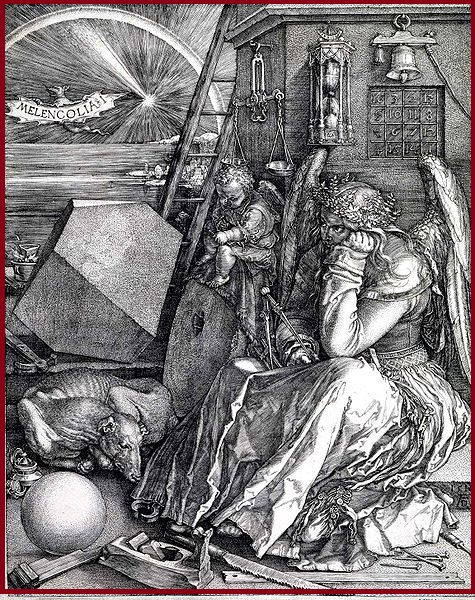
Melencolia_I_(Durero)

Drurer’s Melencolia I (wiki images)

It takes concentration, creativity, and analysis to craft a poem that adequately means what depression feels like. You cannot access such things when you are truly depressed. Some writers want to portray the experience; others want to explain it; still others prefer to write about the desire to escape, or even to embrace, the melancholy; others simply relate what they observe. Trying to pigeonhole all writers who address despair defies reason and suggests that all writers undergo the same feelings and experiences. Excuse me, we are individuals–diversely, wildly, enthusiastically unique.

That said, I cannot make the claim that no one has ever created a great work of art or poem while in the midst of a clinical depression; I merely posit that it’s likely that poetry composed while the author is gripped by existential melancholy will not meet the poet’s own standards.

Lewis Wolpert, a biologist and author, says, “I claim that if you can truly describe what it is like, then you have not had a true depression. It’s an illusion, and completely unlike anything else. When you are immersed in it, you enter a world without reference points, so once you recover it is very hard to relate how you felt.”

A world without reference points–that is the attraction depression might hold for a writer: the creative summons to relate an experience that is essentially beyond description. But most writers are not able to answer that summons while in the depths themselves.

And many writers are not troubled by depression at all. [See this 2012 article from the UK’s Mental Health Foundation for essential insight and clarification of an earlier study–that abstract is here.] The studies do suggest that writers are more likely than the general population to have bipolar disorder, which makes a kind of sense to me: after the sinkhole of a depressive period, the active “manic” phase might permit a writer to accomplish a great deal, including possibly a description of the void. Or it might not.

At any rate, I hope that people–psychiatrists, for example!–eventually recognize that we should not stereotype artists and poets any more than we should stereotype people who have mental illnesses, different accents, or skin color that is dissimilar to our own. What makes artists “different from other people” remains a mystery despite years of research and speculation, and my gut feeling is that the difference has more to do with other aspects of the creative process than it does with depression of any stripe.

Story of an object

In a previous post, I quoted Edmund de Waal about the stories that objects can “tell” us. In his book, those objects were things made by human beings; the story of the netsuke was not separate from the stories of the people who acquired them. His book did not examine the stories of the people who sculpted the netsuke, as there was no way to trace them that would not have required years of research. A fiction writer or poet might speculate on the possibilities of the lives of the ‘makers,’ however. That is part of what creative writers do.

There are also those “natural” objects that surround us and which can tell stories–or inspire human beings to imagine and tell their stories. For example, every origin myth contains some aspect of telling the story of the earth or sun, stars or mountains, seas, skies, moon.

After some online discussion with artist and writer Deborah Barlow, I considered the story of an object as having tactile and temporal aspects in some cases, and the object as “residue” of an event–or life. Ephemera, correspondence, tokens…many potential stories.

And, of course, works of art. If you follow this blog at all regularly, or check the archives or the Art[s] tab/page, you can tell I think often about art, its stories, artists, and their stories.

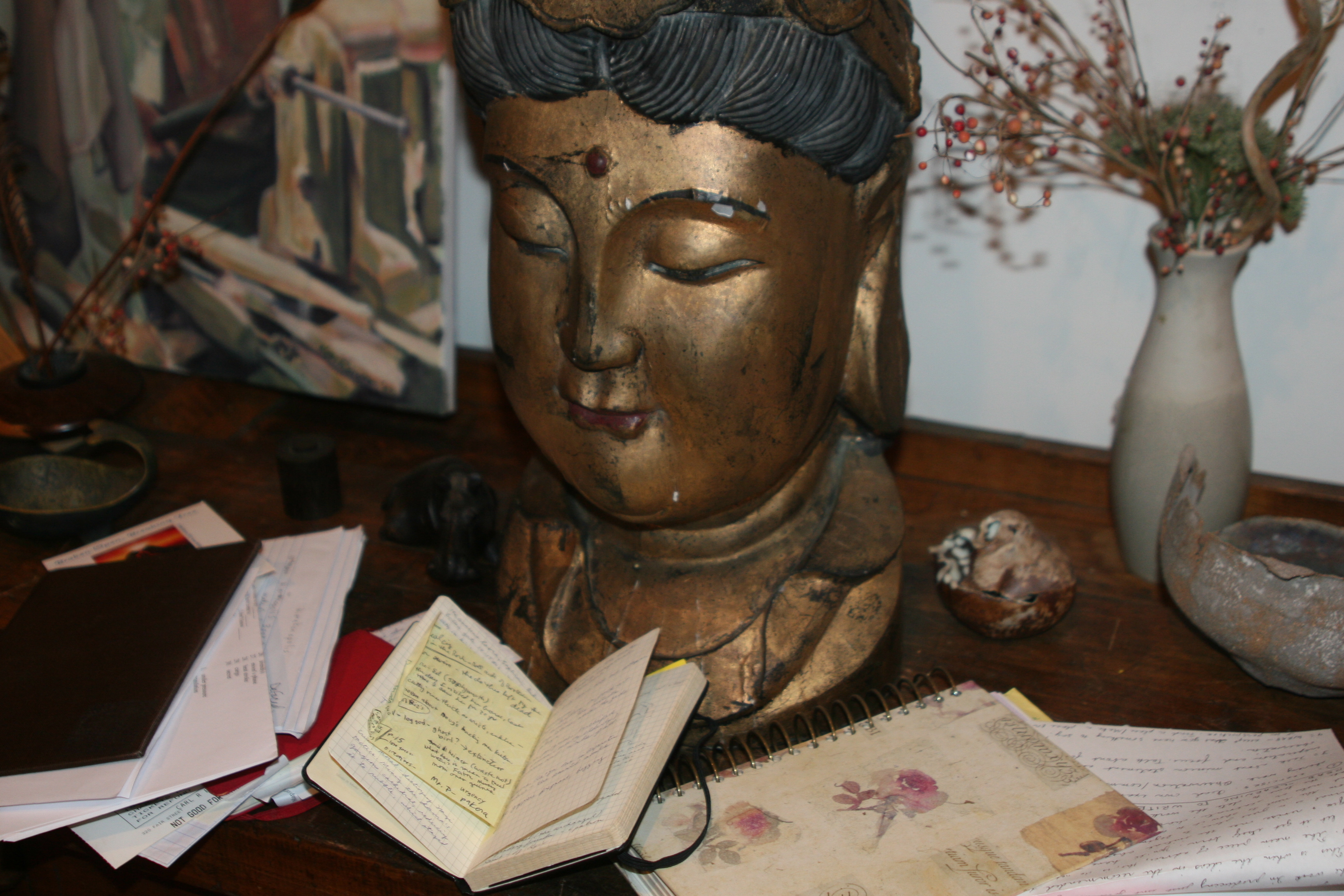
For example, a journal or notebook that an artist or writer uses can be a tool, repository, memory-jogger, inspiration-minder, sketchbook, Rolodex

It occurred to me that my poetry journals, which I’ve been keeping for decades, contain potential stories/poems but are also objects with their own stories to tell–which may or may not be “my” stories, though they necessarily intersect with whatever my story is.

objects, stories

objects, stories

~
Some examples. Tactile, visual, textual.
Inspiration, possibly.

Images captured in several ways.

Necessary–yes. For me.

~

Where do your stories reside? What object or objects seem to require the act of story-making? By which I mean, which objects fire that urge in you?

Sublime beauty

In his book Survival of the Beautiful, David Rothenberg says perhaps it was the evolution of an abstract aesthetics in art (abstract work as beautiful) that enabled human beings to begin to see natural things as beautiful in themselves–as opposed to the Romantic view that human yearning and elevated sensibility could best be encountered while experiencing Nature or Classicist ideas that found natural things corrupt and irregular, in need of perfection into better-proportioned objectification. In History of Beauty, Eco allows the Romantics their view of the sublime but says that in the late 17th c “the Sublime established itself in an entirely original way, because it concerns the way we feel about nature, and not art.” His text offers the paintings of Caspar David Friedrich as an excellent example, paintings that depict people as observers of the Sublime:

The people are portrayed from behind, in such a way that we must not look at them, but through them, putting ourselves in their place, seeing what they see and sharing their feeling of being negligible elements in the great spectacle of nature…more than portraying nature in a moment of sublimity, the painter has tried to portray (with our collaboration) what we feel on experiencing the Sublime.

I love the idea Eco parenthetically notes here: with the viewer’s collaboration. These paintings permit us to enter into the experience as the great preponderance of the artistic canon did not. Some critics suggest the environmental “movement” (in the USA, at least) owes its lineage to Leopold via Thoreau through Darwin, Wordsworth, and the German Romantics.

Friedrich’s work tends a bit over the top for my personal tastes, but I do think some of his best work (notably The Wanderer above the Mists, Woman on the Beach of Rugen, Moonrise by the Sea) does exemplify a sense I have experienced myself in natural surroundings when I feel myself a “negligible element” amid the remarkable scope of the cosmos and the world.

In the USA, at about the same time as the German Romantics, the paintings of the Hudson River school evoke some of the same sense of nature-as-sublime. (Frankly, I prefer Thomas Cole to Friedrich.)

~

This, too:

“The sense of the Sublime is a mixed emotion. It is composed of a sense of sorrow whose extreme expression is manifested as a shudder, and a feeling of joy that can mount to rapturous enthusiasm…while it is not actually pleasure…”   Friedrich von Schiller, On the Sublime (tr. Alastair McEwen)

~

“Poetry might be defined as the clear expression of mixed feelings.” I am pretty sure W.H. Auden said that. Which, by the way, gets us into the territory of the Sublime as described by Schiller.

~

In Japan, in the 17th century, Matsuo Basho composed haiku, some of which demonstrate the sense of the Sublime (without being Romantic at all)–i.e. that sense of rapture tinged with the shudder of grief or the feeling of awareness of one’s negligibility:

A wild sea-
in the distance over Sado
the Milky Way.

~

paintdaub
I stand on my back porch; I am small and negligible, the sky is large and Sublime.

The poet & the Good

I have recently finished reading Robert Archambeau‘s collection of essays The Poet Resigns and am mulling over the idea of resigning with him.

It’s not that I necessarily want to give up writing poetry but that, in my reflections about where I can do the most good among the community of sentient beings, my work as tutor and teacher almost certainly has an effect both deeper and broader than my work as poet. This “good” hearkens to the ancient Good of Socrates, Plato, and their ilk but also to the sense of mindful “middle way” of the Tao: a practical path between two values that may be incompatible in many ways.

~
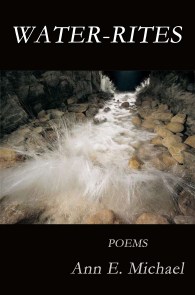
water-rites_coverThe readership for contemporary poetry is small, and my readers number only in the hundreds; among those readers, resonance of any kind–aesthetic, emotional, lyrical–is likely to be limited to a small number of poems. A poem of mine that effects some measure of The Good upon readers represents a minuscule good moving into the world. The net effect, I imagine, hardly registers…not that net effect matters so much. I suppose if a poem of mine moves just one person enough to evince even a small transformation, something has been achieved beyond my individual abilities in the composition of that particular piece.

As a teacher and tutor for the past ten years, my role expands not merely to number of people encountered (few of whom will remember me as an individual) but to the concepts I present to them, most of which will be significant in their lives one way or another–although not immediately, and probably unconsciously. Lately I have been devoting more of my limited energies to this aspect of my life work. Such focus does impede my ability to do creative work of other sorts.

~

This bust resides in the Louvre, and was found here: http://www.humanjourney.us/greece3.html

This bust resides in the Louvre, and was found here: http://www.humanjourney.us/greece3.html

Example: I am reading a little book on philosophy for beginners by Thomas Nagel. The Nagel book is on my table because I have been trying to find simpler ways to talk with students about their philosophy essays. While my main enterprise as writing tutor is to help students to clarify and correct their mechanical weaknesses (sentence and paper structures), it is not always possible to ignore content weaknesses; a student can write correctly about nothing of value–and receive a D or, in the case of Philosophy classes especially, an F.

But understanding philosophy is important.

Now, it is often extremely difficult for beginning writers to express their understanding of philosophical concepts in writing. They are just learning rhetoric and fall into fallacy errors through grammar as often as through thinking. Since I am not supposed to be a content tutor, I have to find ways to tease out what the student understands (or does not understand) and make that idea come through clearly on the page.

Kind of like mind-reading.

[Aside: I have to admit this can take a lot out of me by the end of the day.]

The Nagel book is one of several philosophy primers I have been reviewing to try to find a text to which I can refer my more confused students, the ones who cannot infer the basics from their professors’ lectures or assigned readings. There are academics who might suggest such students do not belong in college in the first place; but I believe in the ideal of an educated populace, and whether or not these students stay in the university through graduation, they can benefit from the discipline of thinking about thinking.

It feels rewarding when, after half an hour of discussion and writing coaching, a young person leaves my office slightly more enlightened. So they tell me, anyway. I know from experience that writing about something helps a person to understand not only the subject but, more importantly, what the writer thinks about the subject.

~

So perhaps my creative energy is better served in the direction of others through tutoring than through poetry; perhaps the former leans more toward the Good. Perhaps I am a better tutor than poet; this is indeed likely, although I have been poet-ing longer than I have been teaching. Then again, not to knock the art of teaching, but writing poetry is much more difficult than the teaching I do. And I get paid to enlighten people through my tutoring.

Not so through poetry. Indeed, Mr. Archambeau–you have gotten me seriously to think about tendering my resignation as a poet, though not without considerably more reflection on the possibility. Writing about the idea has helped me to understand where the Good fits into all of this, and what the middle way might be.

Now, I suppose I could write a poem about the subject…

~

Autodidact as adult student: Goddard & me

In a previous post, I mentioned my peculiar undergraduate experiences at alternative institutes of higher education (The New School) and how being a book-loving autodidact influenced, perhaps even configured, my approach to education. My favored learning strategies led me to a non-traditional graduate school program, as well. Reflecting upon my higher education, I realize that every institution I attended chose alternatives to standard pedagogy–and I am grateful that such colleges exist. The world needs outliers.

A kind of heaven.

The New School’s pedagogy for the “Freshman Year Program” was seminar-based. That worked very well for me. Classes were small, discussion-centered, predicated on the reading of significant original texts–no textbooks. The professor was not a lecturer but a participant-coach and mentor.

The program was only a year long, however, so I had to transfer. There were a number of experimental college programs in the 1960s and 1970s; without the miracle of internet searching, however, they were not easy to locate. I did not find out about St. John’s College, Reed, or Evergreen, for example. I stumbled instead upon Thomas Jefferson College (now defunct) in Michigan.

I completed my undergraduate studies without ever seeing a syllabus. Yet I read more books than the majority of my standard-pedagogy-educated peers and discussed classic and contemporary texts, science and history and literature, in depth with my peers and with scholars. I wrote a lot and did hands-on projects, independent studies, experiments and interviews. TJC drew criticism for its ‘flakiness’ and ‘lack of oversight,’ (some of which, I can attest, was deserved); however, the former college president “described TJC as perhaps too far from the mainstream, but attracting excellent students, noting that ‘Thomas Jefferson College…was sending a larger percentage to graduate school than the College of Arts and Sciences.'” Yes, but in my case it took awhile to get there.

Much water under the proverbial bridge: suffice it to say that in 2000, I returned to college to pursue a masters degree…and I wanted to learn in the kind of environment that suited my style. There were other factors then, as well: two children, for example, and responsibilities I had not encountered as an undergrad. On the other hand, by 2000 I was an adult and more motivated and disciplined than I could ever have been at age 19.

I chose Goddard College for a number of reasons, foremost its small seminar-style instruction, its mix of workshops and instruction, its focus on readings, annotations, mentoring, and community-building among students and faculty–reaching outward into the world at large. The low-residency format only works if the student is independent and self-directed, which–as a returning, “adult” student–I certainly was. I appreciated the school’s more interdisciplinary approach to the creative writing program. We didn’t have to face off, pegging ourselves as poets or fiction writers. And creative non-fiction was taken seriously as a genre to develop voice, style, and depth…it could be studied and parsed. That endeavor of interdisciplinary arts education is true of a few institutions now but was rather new among MFA programs in the late 1990s.

Another college without core requirements, without syllabi, without standard formats. But, like New School and TJC, Goddard offers excellent professors dedicated to students’ intellectual enrichment and personal transformation, small-group discussions, and narrative evaluations. I knew how to balance life’s responsibilities when I enrolled, and I knew what kind of teaching I’d respond best to. How did I learn that? See above. Suits my philosophical, bookwormish, autodidactic approach to–well, practically everything!

Irritation, explanation, interpretation

I had another testy conversation about poetry analysis recently. Hence, this brief explanation, rationale, and license to interpret.

Feeling a mild irritation...

Feeling a mild irritation…

I truly sympathize with people who prefer to avoid any sort of literary analysis; so many times, it is such a badly-taught subject. Nevertheless, it is never a good idea to refuse to learn about something thanks to one or two negative experiences. If that were the case, no one would ever learn to walk (we fell down, we cried, we refused ever to rise up and take another step).

First, let go of the idea that the purpose of literary analysis is to understand exactly what the writer meant. Second, let go of the idea that poetry contains a symbolic hidden meaning.

Instead, recognize the following fairly obvious observations:

1] the poet wrote what he or she meant; the reader can interpret on the reader’s terms.

2] the meaning is in the poem itself.

Poetry is a form of communication, and it is not a detective story. The poet said what he or she said because the poet determined that was the best way to communicate the experience.

Problem: You, the reader, fail to understand the poem. All that means is that you and the poet may be speaking in different terms and that, to you, the poet’s determination of the best way to say what he or she meant does not convey much. Welcome to the world of human interactions.

The reader has choices: turn the page, for example, and ignore the poem. Or read the poem and find its sound or rhythm entertaining. Or read the poem for its summary–the top-line story, if there is one. Or relish the poem’s mood or use of language. Or its images.

Or throw the poem across the room in frustration or anger. Poetry is powerful enough to evoke such responses.

You could also try to examine the poem, look at how the poet uses rhythm or sound or language or image or metaphor or rhyme…you might learn something about how a writer puts a poem together; and even if you do not manage to shoo the “real meaning” out from under a chair, you may be able to come to terms with the poem in your own way.

You are permitted to interpret what the poem means for you.*

~

*CAVEAT: This approach may not get you an A on your analysis paper (though it might), but it will serve to enhance your lifelong appreciation of the poetic art.

Art, story, story, art

Yesterday, I attended a reading by former US Poet Laureate Kay Ryan in a more intimate setting (a luncheon) than I’ve ever been privileged to hear her at in the past. An audience member asked her how she would define art. Alas that I don’t write quickly enough to have taken her words down verbatim, but she offered a lovely answer.

She said that if a person cannot really be happy without doing it, and cannot keep from needing to do it, and if it nourishes or gives back to that person in ways nothing else can–then that “it” is art, in her opinion.

~

I suppose art also ought to speak to others, but I am not sure that is as necessary as art critics think it is.

~

Speaking of critics, and of art, I was impressed with Hilary Mantel’s 1998 novel The Giant, O’Brien for reasons that made a few critics rather lukewarm about it. The author is best known for her amazing historical works, well-researched and full of believably human perspective. O’Brien is a departure in several respects although still historical fiction. I read this book as an ambiguous moral tale, a myth, a story about stories (and art) and a depiction of ways the Enlightenment created significant losses in the midst of its gains. So I was less bothered by the exaggeration of certain personalities or minor plot gaps. O’Brien, a storyteller of the most shamanistic/primitive sort, also possesses a modern (Enlightenment) intellect and an artist’s “intuition.” But he never achieves fame, or the goal of restoring a beloved pub–the place he learned his craft–and dies painfully and slowly, impoverished and nearly abandoned.

As O’Brien nears death, Mantel writes that there comes “a point in fatigue or pain when logic slowly crumbles from the world, where reason’s bricks sieve to crumb. Where content flits from language…and departs.” And her character, the giant–who embodies in his hugeness the epitome of mythical narrative, the kind that sustains us even in dire poverty–eventually comes to the conclusion that the poor among us lose all. Of the poor man, he muses:

Stories cannot save him. When human memory runs out, there is the memory of animals; behind that, the memory of the plants, and behind that the memory of rocks. But the wind and the sea wear the rocks away; and the cell-line runs to its limit, where meaning falls away from it, and it loses knowledge of its own nature. Unless we plead on our knees with history, we are done for, we are lost. We must step sideways, into that country where space plaits and knots, where time folds and twists: where the years pass in a day.

What within us plaits and knots and folds and twists but the brain itself? We pass along our knowledge and, more importantly, our stories. That is done from brain to brain through language and music and art, even as the individual brain comes to the end of its viability and vitality. We step sideways into another person’s brain, just as O’Brien’s listeners memorize his tales, his cadence, his figurative speech. So, in the end, O’Brien is wrong.

~

I attended a funeral today at which the officiant encouraged us to keep the departed alive in our hearts and for the future by telling stories he had told or by relating stories about him to anyone who might listen. I know I have previously written about this idea in conjunction with readings and philosophers and art and literature. The more I encounter it, the truer it seems to me.

The bereaved spouse at this funeral is a person who is losing her own story through senile dementia, though she has some occasional awareness of her memory loss. Her ability to carry on her husband’s narrative is already deeply diminished or perhaps completely gone.

These are among our risks.

~

These words brought to mind my long-time friends, the craft-artists David Ellsworth (turned and other wooden forms) and Wendy Ellsworth (beaded forms). This month, for the first time in their many years together, they have a joint exhibit in the gallery space at Jenkins Arboretum (Devon, PA). The photos below are snapshots Wendy took, and their individual work is best viewed in person or on their studio website. [Contact the artists for permissions, photos, information about workshops and talks.]

Wendy Ellsworth's seaforms, and a necklace

Wendy Ellsworth’s seaforms, and a necklace

Wendy's "Sunset" (with David's turned-wood frame/container)

Wendy’s “Sunset” (with David’s turned-wood frame/container)

David Ellsworth's "Emergence" series

David Ellsworth’s “Emergence” series

I have known Wendy and David for over 25 years, and I can testify that the work each of them does fits Kay Ryan’s description of art. They are artists, and their work nourishes both of them–and nourishes us, the beneficiaries, as well.

~

For today, these are my stories.

www.ellworthstudios.com