Curation

Recently, I spent awhile browsing the Walter Kerr collection of books in the library of the college that employs me. Kerr and his wife Jean were writers in New York in the 1950s, 60s, and 70s; he was best known as a theater critic and she as a playwright and essayist. His family donated his books to the school, and it occurred to me during my perusal that this section of the stacks seems more personal than the collection as a whole. Here are Kerr’s quirky book choices, his favored influences, his academic interests with a place among the trendier tomes on movies and Broadway.

A personal library acts as a unit, books that are kept together rather than disbursed upon the death (or before-death donation) of the book collector. It therefore parallels–and predates, of course–the social media concept of the curated self:

Through the ongoing process of organizing content and media elements which create personal profiles for specific audiences, social media users inadvertently curate versions of themselves. Social media turns users into curators as they create distinct incarnations that are separate, yet become the objectified digital presentation of one’s physical self. [definition from socialcurators at weebly]

“Curating” seems to be a trending concept these days, so I naturally checked the etymology:

derives from cure: c. 1300, “care, heed,” from Latin cura “care, concern, trouble,” with many figurative extensions, such as “study; administration; a mistress,” and also “means of healing, remedy,” from Old Latin coira, a noun of unknown origin. Meaning “medical care” is late 14c. (https://www.etymonline.com)

Among those “many figurative extensions” is the curator in the sense of library science or museum administration. Now we can add social media users to the extension metaphors.

Perhaps curating oneself is more natural than I initially thought. My library probably offers a means of knowing who I am, or at any rate what I choose to value given what I have learned in my past; what we leave behind–as in Mr. Kerr’s library collection–becomes who we may be to others.

If they study, if they speculate, if they care.

While I was at the library, I borrowed a few books (of course). I will write about Arthur Frank’s classic book The Wounded Storyteller soon, I hope, in conjunction with some poems I’ve been working on. I also borrowed poetry collections by Matthea Harvey, Rachel Hadas, and Larry Levis.

Am I curating my life?

~~

~~
 

Poetry on chilly days

The region in which I live has been experiencing a lengthy spate of below-freezing weather, many a chilly day. When I do not feel like concentrating too much, I browse seed catalogues. But I am also reading poetry.

Today, I’ve begun reading a 2011 collection of poems by Rachel Hadas, The Golden Road, poems that are dense and beautiful and often elegiac in tone. I took a workshop with Hadas quite a few years ago and had enjoyed her work since long before the class; it was a pleasure to have her as a reader/instructor. And it is, so far, an excellent book. I’ve been keeping her poem “The Study” in my mind for hours now.

Good news, though–I have commenced the year with new poems of my own. I have three drafts as of January 7, which is a good start.

But for today–yet another chilly day–I’m posting this little verse by William Carlos Williams.

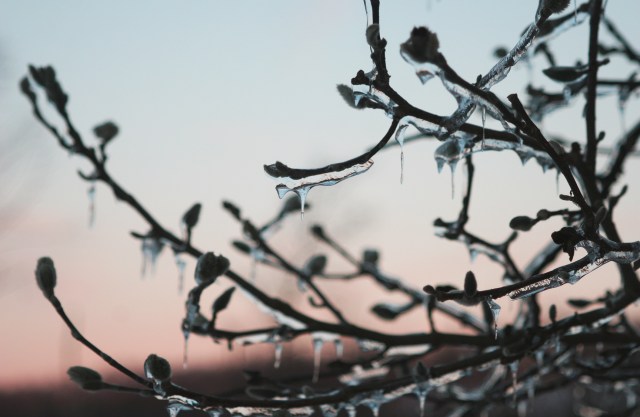
Winter Trees

All the complicated details
of the attiring and
the disattiring are completed!
A liquid moon
moves gently among
the long branches.
Thus having prepared their buds
against a sure winter
the wise trees
stand sleeping in the cold.
                              –William Carlos Williams
~
IMG_0516
~~
~~

Poetry & paradox

~
“Language is a profoundly mysterious technology, so constitutive of the human mind that we can only get glimpses, from inside the fishbowl of consciousness, of how it works.”
sea inside Charnine

 The Sea Inside. Charnine.com features information on surrealist artist Charnine and Surrealism – copyright © 1994 – 2011 Samy Charnine – All rights reserved

~
How do we get from language to poetry? However we do that, consciously or not, it must be as fluid and natural as it is damned difficult! I sometimes wonder whether paradox may be the basis of art. At least, if there exists a “something” that inspires me to compose a poem, paradox–and the way it requires effort to explore contradictions and ambiguities–could stand in as my motivating flame.
~

Paradox, randomness, juxtapositions and contradictions evoke imagery, dream, the realms beyond the rational consciousness we humans claim to possess. Poet and fellow poetry blogger Susan Rich recently posted about the surrealist painter Remedios Varo, an artist whose name and art I had never before encountered; and I felt an urgent pull to introduce her work to my friend David Dunn–he loved surrealism and appreciated it more than I ever have, and such paintings (particularly early de Chirico) exerted a large influence on his poems.

David, however, died in 1999. I share my memory of him here, by writing it on a blog, the same as I share the names of Varo and de Chirico and of the many poets and philosophers I have mentioned during my years of posting to this forum. It’s a form of immortality, if only a temporary immortality (another paradox…)
~
Here is Menand again, who wrote poetry in his youth but moved into journalism and critical reviews in prose later on: “… I got the same painful pleasure out of writing prose that I did out of writing poetry—the pleasure of trying to put the right words in the right order.” Painful pleasure. That mysterious technology, language, rises to the occasion of inherent contradiction.


“And I took away from my experience with poetry something else. I understood that the reason people write poems is the reason people write. They have something to say.”
~
Do you know what you have to say before you write a poem? Or does what you have to say appear in the process of writing? Or after the poem seems complete? Or once someone else has read it and decided what it is you had to say?

About time

It is the last day of the calendar year, and tomorrow evening a full moon will shine over our snow-dressed meadow. End-of-year events have left me thoughtful about time, memory, fear, love, and other such. Which brought to mind this poem I wrote quite a few years back. It’s part of The Red Queen Hypothesis manuscript.

Let 2018 be a time to press against the dam and swell into your next adventure.

~


Counsel

Wait for that wisest of all counselors, Time. —Pericles, Plutarch’s Lives

Always, you have hated the wait,
fidgeting at the desk, the queue, your bed.
You suffer the malaise of the young
whose imaginations collide
with the world’s dull and repetitive ways,

for whom responsibility is a petty bureaucrat
in a cheap gray suit
watching the clock you punch, counting
irretrievable minutes you spend
doing work you cannot love.

Do not despair.
After you’ve done some time
in the slow slog of nickel and dime
your passions, silvery as fishes,
will gather in schools that swell and press
against the dam—

that damn ordinariness
dulling your heart—
and spill themselves brilliant into
the crooked creek of your next adventure,
each carrying in its small body
the germ of an idea, yours
to pursue.

~

waterfall

Poetry as a value

If individual consciousness exists among human beings, and I believe it does, it is however the collective consciousness that has the longest-ranging impact. We are social mammals. We crave some object or objective with which we can connect and form relationships around in order to create community. Humans cannot survive without communities.

Those communities can be centered around almost anything as long as the focus keeps social members busy with the process of group-forming, skill-sharing, skill-teaching, communication and, ultimately, the development of a shared history. Hence family, tribe, language, or religion–among many other social magnets–keep us cohesive. Until we bicker and subdivide. Society works in ways analogous to the brain and body: through complex systems and nearly-random relationships and long, twisty networks.

I’ve been thinking about the things we “worship”–things we value and therefore believe are inherent among good human beings–and how such perspectives affect the consciousness of entire civilizations. Simon A. May, in Love: A History, suggests that in the early 21st century, “Western” societies have been elevating the idea of love to that socializing focus. An interesting premise, and I suppose there are worse rallying concepts than love, though May points out ways in which even love can be transformed into an ideology rather than an emotion.ann e. michael

In a large society are many sub-societies, each with its own locus of organizing a human collective; these may often overlap or coexist with the vast variety of human interests. Reflecting on this, I consider myself as part of the society of educators, and of book-readers and book-learners, and of art lovers; and also a member of those people who feel that poetry assists in the lifelong endeavor to engage meaningfully and attentively to life.

Here is a list of people like me who subscribe to the necessity of poetry and who write about it on their blogs. Donna Vorreyer has compiled a listing of poetry-related blogs to follow. I will be following some of them, too.

https://djvorreyer.wordpress.com/2017/12/26/it-feels-just-like-starting-over/

Jargon & rhetoric

This is a kind of continuation of my last post, in which I alluded to euphemism and jargon and the weightiness of words. Herein, I take the unpopular stance and argue that the Centers for Disease Control‘s suggestion that proposals avoid certain words is not entirely about censorship but about rhetoric and persuasion and in this case–given the makeup of the current Congress–was actually appropriate. This is a situation in which jargon–wording–makes all the difference in the persuasiveness of an argument.

The CDC needs to send its annual proposals for research, for agency budgeting, and more to Congress; and each set of documents requires Congressional Justification. If the Congress does not agree to certain proposals, those which have justification withheld will not be funded. (It is possible that many citizens, myself included, are not fully informed as to how these government-funded agencies operate.) Therefore, the possibly-skeptical audience must be convinced of the value of these proposals.

~ ~

letter I


f this were an essay for my students, I would prompt them to think about the audience for their arguments. A writer can employ jargon effectively to help persuade a skeptical audience. Use the terms of the discipline, I tell them. That usage may seem superficial, but it actually works to prove to the audience that you know what they are seeking; you are a member of that community, you know the lingo, you’re on that side and your research will advance that cause.

It may be that your research is something well beyond the audience’s understanding, but you know how to sound like one of them; so, chances are, they’ll get on board with whatever you are conducting.

Even if they have no idea, really, what it is you’re proposing. Even if what you are proposing in fact runs counter to the audience’s ideology, effective proposal writing can hide the fact.

The CDC, from what I have been reading, has not banned those seven words nor the research or public policies concerning them; instead, the agency is cautioning its researchers and policy proposal writers to avoid language that would ring the wrong bells in the ears of this particular Congress’s majority ideology. I see nothing wrong with that. In fact, as a person who guides others in writing arguments based upon research, I encourage it.

Gotta know your audience, or your proposal will fail no matter how excellent its logic, science, and methodology may be. I hope the resourceful writers at the CDC will find ways to convince our Congress to keep the agency and its research funded. A future Congress may be less sensitive to evidence-based information. In the meantime, use the jargon in proposals–whatever works! But use the best words, and the most clear and accurate words, in other forms of discourse.

#7words

7wds


Fully human

A student who grew up in Viet Nam and arrived in the USA just two years ago scheduled an appointment with me for assistance in revising her final paper for Philosophy.

My job is to help her with her articles, subject-verb agreement, verb tense, and plural forms and uses, and when to use a capital letter for proper nouns. I also assist students like her with claims, thesis statements, and rhetorical structure–but I am not a “content tutor.” Of course, I often understand the content and find it interesting to observe how young people interpret, say, literature or philosophy.

In this case, Western philosophy, in English, as interpreted by a person raised in a culture quite different from the Western university system norm.

Philosophy 109 challenges many native-born and US-educated freshman students; taking this course as an English-learner with very little “Western” experience must be ridiculously difficult. So I first assessed how the course had been going for her, and she said, “So-so.” What had been most difficult? Note-taking, she said. With the texts she could take her time, translate, and eventually tease out the ideas; but class lectures were really hard. In addition, she struggled with the concept of opposition and rebuttal as structured in the philosophical argument.


Her assigned argument for the term paper was: “The arts, sciences, and philosophy are valuable because they help us to become fully human.”

The paper began with her assertion that the arts make us more fully human because they are beautiful to behold and inspire in us joy and appreciation.

“Is the best art beautiful?” I asked. She said yes, and I asked her, “Is it only art’s beauty that makes us human and good?”

“Not only,” she said, after a moment of hesitation. “Sometimes–sad is beauty. Sad is not good, but sad also makes us human.” She hesitated again and then went on: “I think good art, and good science, has both sides. I think this but it isn’t in my paper. Should I put it in my argument?” We agreed to work on a sentence or two that might express her interpretation more completely while heeding the general conventions of Introduction to Western Philosophy.

Sometimes, syntax is content.*

Without exception (well, almost), I learn so much from student interpretations of ancient concepts. Rather than rolling my eyes and scoffing at how little they know, I’m searching their perspectives for what it is I ought to know about them and their experiences. The stance of most older authorities is that young people must integrate themselves into our norms and conventions; but we will age out of our power base, at which point we’d be better off recognizing their norms and points of view and exercising our neurons by learning how to adapt to the next set of conventions.

Philosophy and the arts will stay around. I have no doubts about that. The ways in which human beings interpret them may change; all to the good–stasis would destroy philosophy and art, thus keeping us from our potential to be fully human.

~


*[You might want to read Sister Miriam Joseph’s classic text, The Trivium, for a deeper explanation of how to approach ‘mastery’ of the liberal arts and learning.]


The beloveds

In my last post, which featured a draft of a new poem, I should have mentioned my indebtedness to Gregory Orr and to the King James version of the Bible, as well as to Rudyard Kipling for the affectionate phrase “O Best Belovéd.” *

It’s fascinating, the inflections of English–and the way some of our archaic forms of speech still show up, such as the extra syllable pronunciation option for a word like beloved. I appreciate, too, the connotation of one whose emotional being feels connected to another person. We nurture those connections when our children are young, when we fall in love, when we feel intense compassion for another person–sometimes, even, when the person has died and the feeling of being a beloved and having that beloved near linger.

My own best-beloveds fall into all of those categories. I believe I can say I have a full heart.

~

As my last two posts featured poems of sadness, I wish to change things up. This one’s a love poem and a food poem, a cozy piece for the approaching darker weeks.

stewcook


Says the Stew Cook to Her Belovéd

Cat’s leaped on the kitchen counter, pawed a walnut from the bowl.
Liter of red wine waits for dinnertime—can’t say I’m not tempted, though.

Low sun highlights the bottle’s deep maroon while I make stew:
turnips, potatoes, garlic’s liquor, bay-leaf—needs only you.

Cool weather calls for firelight and whatever cooks long.
This cook longs to influence your taste, your tongue.

Since night’s expanded its acreage, taking over December,
we can build upon the dark, fill nooks with aromatic hours.

Come taste soup, share coriander scent, sip from this spoon.
Lick clean the bowl, my love, cover pots, come to bed soon.


~


~~  * I recognize, however, that for many many readers, the word Beloved will most closely be associated with Toni Morrison’s daring, beautiful, wrenching novel by that title–a work I highly recommend.

Lacunae

With some encouragement from friends and colleagues, and with some trepidation, I am posting for the next few weeks some unfinished poem drafts and some poems from my Red Queen Hypothesis manuscript. That’s the plan, anyway. Plans, especially creative writing plans, seem often to go awry.

Given that my last two posts concern how we tell stories and what interrupts us from our narratives, I present herewith a draft of a poem concerning just that. I experiment here with gaps in form; I think of erasure poems (see Dave Bonta’s erasure poems on Via Negativa or Tracy K. Smith’s “Declaration”) though this is not one–the “erasure” here is internal, a series of neurological gaps and stutters.

I don’t know if the poem works as is, could use more tweaking and re-arrangement, or is so confusing as to be far off-base. Perhaps that depends upon the reader.

~


Lacunae

Writing self

Among the students I have tutored over the years was a young woman recovering from a traumatic brain injury. Writing was difficult for her on several levels. Reading on the screen or page tired her eyes and made it hard to focus; while using voice-activated software helped for that part of the writing issue, it did not resolve her larger cognitive loss: she found she could no longer tell a story. The ability to tie together research, concepts, and chronological moments to compose a logical narrative evaded her.

As we worked together, I learned how writing can restore the self. She began to reflect, through writing, on her process and her memories and to tether things together on the page so that they “made sense” to me–her sounding board. When something made sense to me, she would re-read it and decide if it reflected what it was she had been trying to say. Gradually, she felt more restored to herself, a slightly altered-by-trauma self, but a cohesive self who could tell a story again.

~

When I tutor students who are multilingual, particularly if they are fairly new immigrants here, I find that writing plays a similar role in reflecting or re-creating a self. These students learn to work and write using American English as their mode of persuasive communication, and in the process they develop as people who live in the United States and who consciously employ those terms, phrases, writing techniques, and concepts. They are much more conscious than “native” speakers about the fact that they are using Americanisms and writing in an American style; what they end up with is a self that they can deploy when necessary in American society.

~

Brain diseases, strokes, and dementia dismantle the story-telling ability. Whether we use the metaphor of braiding, warp & weft, or nuts & bolts, we mean that story has structure–and in dementia, structure comes undone. With that structural demise all too often comes the unraveling of the self. Each gap weakens the links that give us our own story-made self and leaves the human bereft of that consciousness we rely upon for being. The person whose brain has stopped constructing self stories is no less human, physically; but the self–that sentient, much-valued ego–disappears.

When I am with a hospice patient whose mind has stopped composing narratives, I see that the narrative of pain and envy and sorrow seems to depart. Is there a story that contains only peace? Could that even be a human story?

I don’t know what to make of all of this.

IMG_5015

Sometimes, I wish I had the peace and confidence of a house cat.