How it’s done

The annual Goschenhoppen Folk Life Festival happens this week–Friday and Saturday–and for the first time ever, neither of our now-grown children can participate. Nonetheless, my husband and I will be at our respective craft demonstrations, showing visitors how people a century or two ago solved the requirements of living in the region before there were highways, diesel shipping lanes, power grids, electric appliances, and cars–but after Europeans displaced indigenous people and started sawing down the forests. We had a taste of pre-power grid life ourselves early this week when a fast-moving storm made us lose electricity for 24 hours.

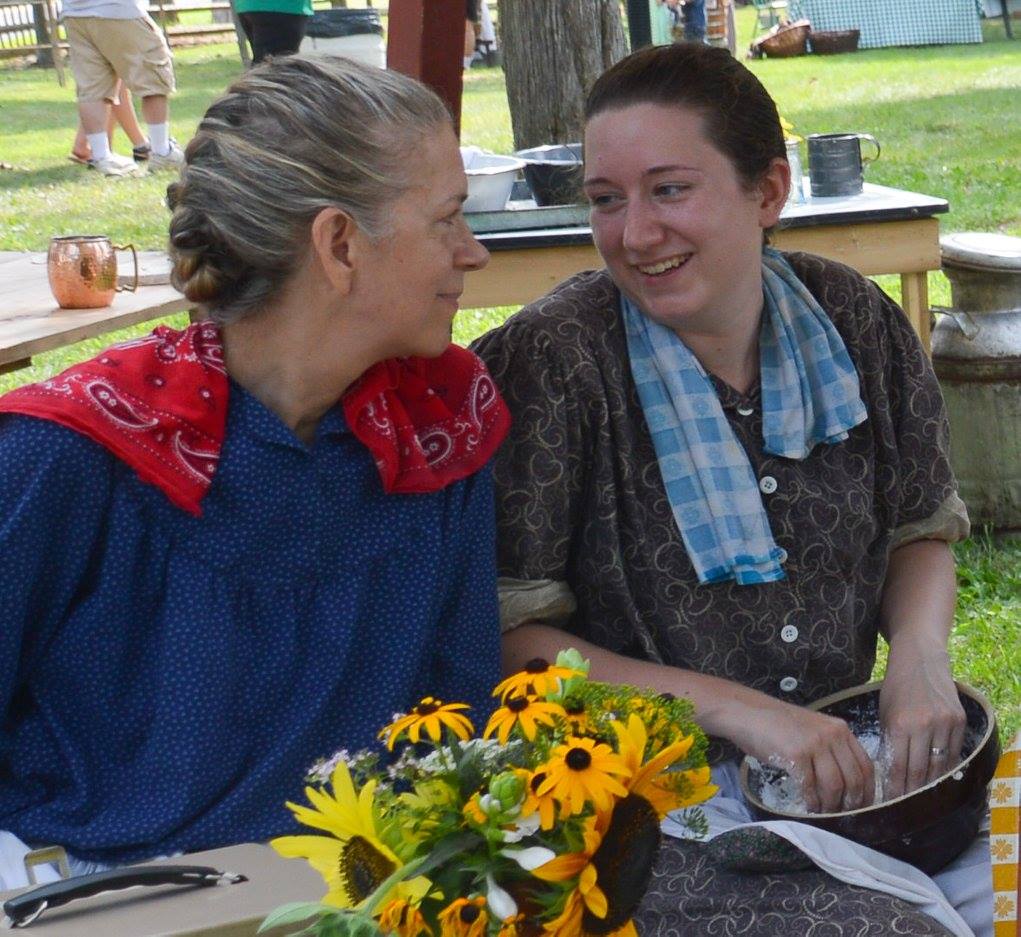
Visitors to the festival often marvel that they “never knew that’s how it was done.” They buy pickles or jam in a jar in the supermarket and figure it’s all made in a factory somewhere (which is true, today); meat comes packaged, and who thinks about how rope is made, or flour, or candles? One part of the festival demonstration includes butchering. I won’t post a photo (though there is one here), since some people get uncomfortable about it, but if you eat meat it might be worth remembering where it originated. In the late 1990s, I wrote the following poem about it. I may as well post it today! But the image I am adding is instead a nostalgic one of my daughter and me at the potato candy stand in 2016.

~

Hog Butchering Demonstration, or Deconstructing Breakfast
 
Cleaving bone and muscle 
beneath tough hide,
the man with the knife starts his
slow disassembly,
describes cuts of meat,
holds out intestines, uncoiled:
“used for sausage casings”—
removes the bladder
to rinse and inflate—
children’s game, an old-time balloon.
 
The carcass resembles nothing
the audience usually sees
whose meat arrives in cellophane
processed—slices, nuggets.
The children, especially,
have never watched the studious
and useful taking-apart 
of a body, never witnessed
anything dead
but the flattened,
nearly unrecognizable bodies 
of road-killed opossums.
 
No comparison, this 600-pound hog, 
hooked and dangling, its interior 
opened with jigsaw precision.
The man with the knife 
is a revelation.
They stare fascinated
at the butcher’s truth
carving an exact history of
their breakfast bacon.
 
~

Wandering

My mind’s been wandering a great deal lately. This at a time when focus would be quite useful, and yet–I don’t mind a little mental meandering. I think that, akin to daydreaming, a lack of focus can lead to creative thinking. Of course, the downside is that it may also lead to lollygagging and a lack of ambition.

I’ve been thinking about the way contemporary Americans use the word “engagement.” Not as in marriage proposals–that definition hasn’t changed–but in statistics, marketing, self-help, and education. My department at the university has been directed to “foster student engagement.” Our administration wants us to find ways to engage students, but it seems what’s meant by that is simply to attract their attention amid the myriad distractions and attractions of modern life. In my area of the college, where students go to get a little extra assistance in their coursework or their educational plans, we have long been aware that we can’t reach everyone who needs help and that we cannot create enthusiasm or involvement. Apparently, engagement is supposed to lead to motivation. That would be a miracle. Like many young people when I was a young person, today’s young people are often rather undirected. Wandering.

I wonder whether gap years or a required year of community or civil service would benefit people before they march off to college to “become a physical therapist” or whatever it is they think of as a career. Many of them would save on tuition fees, because maybe they are not that keen on academic coursework after all, or because they can go to college with a better idea of what they want to learn (rather than end up attending for 6 years because they changed majors). US society has evolved to push its citizens through large, unwieldy systems that supposedly create clear-thinking individualists who can fit into whatever job market the nation happens to foresee itself needing in future, but there is so much wrong both with that methodology and with that picture in the first place.

I’m with Walt Whitman and the loafing approach to observation and creative thinking, but that probably won’t be sufficient for a nation with a population of 336 million people.

This is not my problem to solve, and I would not be the person elected to solve it. But I ponder this sort of thing.

~

This poem appeared in Schuylkill Valley Journal Online. It’s a persona poem in which I imagine being Walt Whitman as a young child. May we encourage our young people to wonder and wander (and, yes, loaf a little).

Little Walt

When Mother sends me with a bucket to the pump
and it is a rainy day, droplets landing on my face, I open my eyes
trying to see where the rain starts but cannot
because I blink—and why is it that I blink without ever
meaning to?

My Baby Brother wails so loud
I hear him out of doors although the rain is also noisy
splashing the leaves. I can tell the wagons’ wheels are spewing mud
as they clobber past hitched to wet horses who snort at the weather.
The pump handle feels slick and water spurts into my
bucket so that I think of a waterfall in a gully or tumblers
at the sea’s shore where the little fishes get caught in the seining nets.

When the bucket’s full I set it down beside me
and watch water’s surface going plip plip and my own face
under the rain and how it is that I can keep my eyes open looking
into the bucket: behind me in the reflection is the cloud
that is raining all upon the Town.

Mother calls me to the house, You have been loafing.
The bucket, full now and heavy, becomes my chief burden
although a hen scurries beside me, and the ice man hollers
at his little brown donkey and the world around me
is so full of everything!
~
Walt Whitman in mid-life

Home is where?

Yesterday morning, I went to a local library to attend a writing workshop on the theme of ‘home.’ In my own work, when I stop to consider themes that recur, some form of dwelling appears in image and topic. Frequently. Nests, burrows, houses, cities, places. Love, death, kinship, the natural environment, and home. My first book* used the process of housebuilding as its motivating metaphor for perfectly natural reasons (we were indeed building a house), but both before and after that group of poems, the theme of home has been a common one I have felt drawn to describe.

Even, now I think of it, the body as home: this structure of flesh and bones and blood and synapses that houses my consciousness.

My parents left their homes and families, and when I was a child we moved three or four times–not enough to feel any loss of stability but enough not to feel particularly rooted to any one place. I suppose I can say that I carry home with me, in my sense of being a conscious body in a space surrounded by an environment about which I am curious. I do not, however, feel rooted to a culture, community, or extended family who live in one region; I have no region, city, state, place, house that I claim as mine and refer to when I refer to myself. Among the ten people in the workshop yesterday, I was a bit of an outlier in that respect. Some of the participants felt split between two homes/places, others felt rooted, and still others had felt rooted but were feeling the connections break.

I found it hard to say where my home is. Maybe it’s imaginary? Portable? I used to daydream about living in an Airstream trailer. Though I’d need a second one just for books…

Airstream Corp.

~

Which brings to mind something one of the workshop attendees said about feeling at home in a library. Several of us nodded in agreement, and he added that the library–the public library–functions as a kind of matrix. I would add that’s true for one’s private library, as well, books providing a kind of collage of interests and influences and teachings that can be seen as a kind of matrix to the book-collector’s consciousness, loves, and interests. Speaking strictly for me, in this case.

The house I have inhabited for nearly 25 years now, the house my Beloved and I designed, helped to build, inhabited, raised our children in: this is as close to a ‘true home’ as I have ever had. And yet: is it my home, my rooted place, my last place, the dwelling-in I must have to feel stable and secure and surrounded by love and nature? I’m not so certain about that.

It’s beautiful here, especially in springtime. Yet as I consider friends and students and strangers who have had to pick up and leave on short notice, possibly never to return–it would be hard, but I could leave home. And, for now at least, I still have a choice to go or stay.

~~

*If you are interested in reading that first poetry collection, it is called More Than Shelter. It’s out of print, but you can contact me and I’ll send you one for $8.00 including postage. Many thanks.

Synthesis

“The current moment” has a way of inserting itself into poetry I write, not just these past weeks but always. I look at my poems written in the wake of the 9/11/01 attacks and can see reflected in their pacing, tension, or imagery some aspects of the anxiety of those days. Not that I wrote much poetry that employed that current moment as a topic or narrative…just that the numb dread, surprise, and confusion managed to enter in. Poetry can contain and convey those hard-to-describe emotional tensions. Ambiguities. Conflicted feelings. Multitudes.

Poetry, by its nature, requires synthesis. For example, metaphor is one type of synthesis. In Carl Sandburg’s poem “Good Morning America,” he famously says that “Poetry is the achievement of the synthesis of hyacinths and biscuits.” (But then, he also says “Poetry is a pack-sack of invisible keepsakes./ Poetry is a sky dark with a wild-duck migration./ Poetry is the opening and closing of a door,/ leaving those who look through to guess about what is seen/ during a moment.”) Make of it what you will.

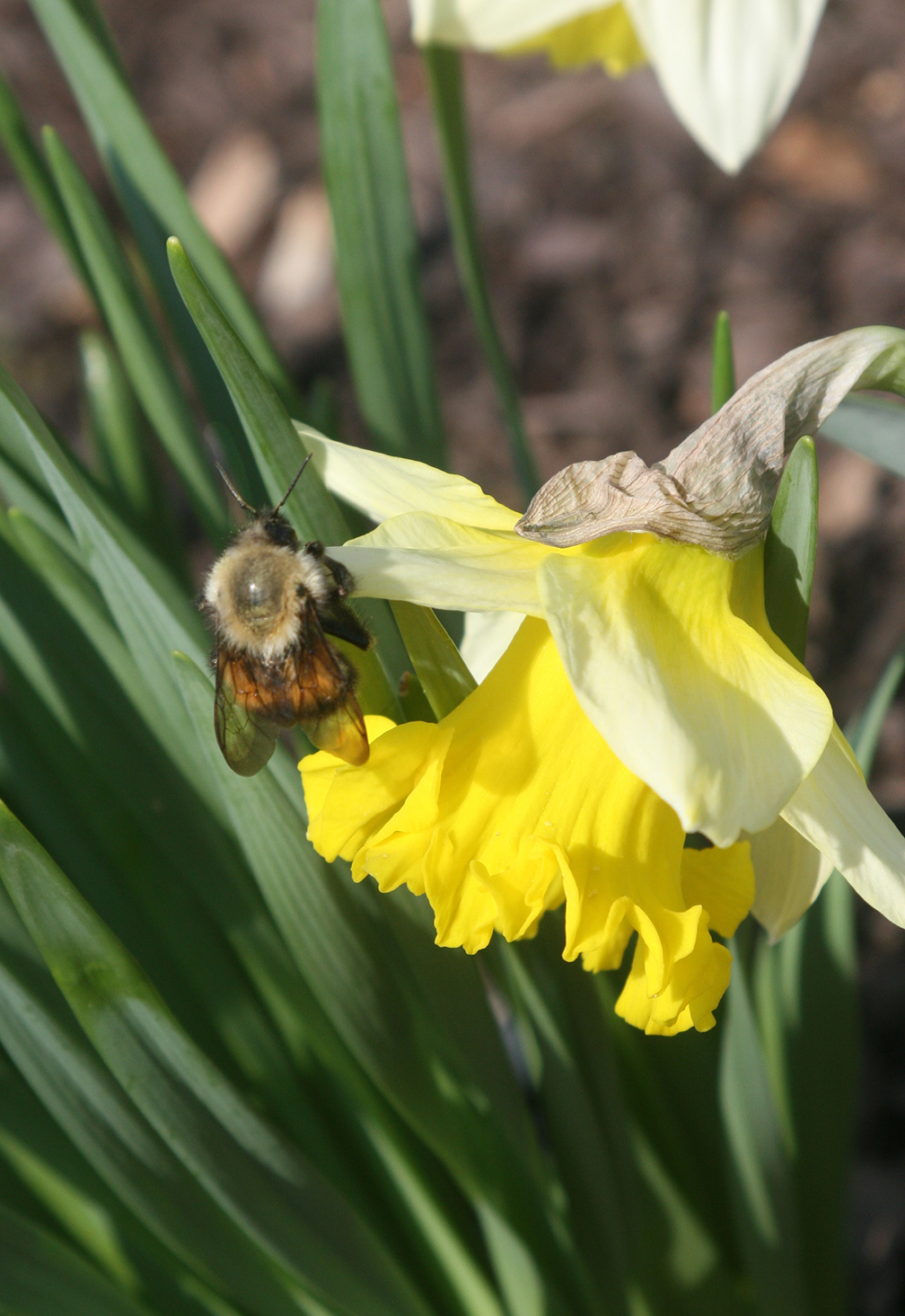
A few posts back, I mentioned my dad has been showing up in my poems recently. That’s still occurring. This one doesn’t have a title yet, as I’m still mulling it over and will probably revise the whole poem down the road. The initial impulse for the poem had nothing to do with my father or the war in Europe, and we do not have any daffodils in bloom right now. But there they are.

~

[Verge]

On the road’s verge, geese stand looking unctuous,
	vaguely irritable as I pass them
going 50 on the route I’ve taken for decades
and this time I recall two years back, when my dad
	was failing, how eagerly I sought any sign
of seasonal change—
	early-flowering witch hazel, or crocuses, quince,
swells in daffodils’ green emergence 
while inside myself the slow emergency of his dying
	began to open from probable to imminent.
I drove south idly; through the windshield I 
	looked forward to nothing, as my mother
talked of nothing when he floated in his haze of pain
and Dilaudid while holding one hand over his head
	as though he could, with his fingertips, pull
the ache from his left ear over his head and into the room
	where it might exit.
Now, the exodus occurs elsewhere, in refugee waves
of people whose minds and bodies lug their different pains
	across other kinds of borders.
My father’s experience of earth has ended,
	his baptism complete. His birthday was in April.
	See there, along the roadside? Daffodils.


~~

Relevant, possibly

~~

Of note: I’m happy to have a poem in Scoundrel Time, a journal I enjoy reading for work that’s relevant to the contemporary moment. Here it is; please read it, and read the other wonderful poems in Scoundrel Time: “A Brief History of Kyiv.”

~~

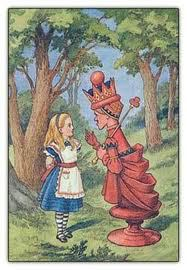
This poem also came to mind, for different though possibly related reasons. It will appear in The Red Queen Hypothesis when that book (my second full-length collection) gets into print. I was writing many poems in various forms at the time. The poem’s story is second-hand, the we a personified plural community of human beings, one repeated line taken from, you’ll recognize, A Tale of Two Cities–there’s a reason for the allusion as well.

Somehow, may all be well. Somehow, may each of us find some happiness.

~~

Variations on a Line of Dickens
			(Belarus, 1985)

It was the best of times, it was the worst
of times, when nothing seemed to go our way,
though happiness is what we wanted. First

we stood in endless queues, outside, and cursed
the lack of cheese or bread; our pals would say
it wasn’t the best of times, it was the worst.

We’d swill cheap vodka, harshening our thirst,
highlighting deprivations of each day,
when happiness was all we wanted. First

we’d press our bodies close enough to burst
the paper bag of lack. Kisses could not stay
our own best times, but it was the worst

thing to let go. Our lips still pursed,
the tastes of sex would linger and relay
that happiness is what we’d wanted; first

times were the best, solid, immersed
in flesh and heat—forget the fray—
those were the best of times, and yes, the worst.
Happiness was what we wanted first.

~~


Sir John Tenniel, of course.

What poetry says

My dad was a newshound. Always had the radio on and newspapers: New York Times, Philadelphia Inquirer, Camden’s Courier-Post. I grew up watching the Viet Nam War on the 6 o’clock nightly news. I am fortunate enough not to have lived through war in my own country, but I read a good deal of fiction–and wars supply natural conflict for plots, either as background or foreground. I found it a little too easy to put myself in the situations of the characters in novels.

Also, I was of a Cold War generation. The threat of nuclear warfare loomed, and we drilled for that eventuality in our school hallways the way children today drill for active shooters.

Dread. I get it.

Many friends and colleagues have been posting poems on social media the past week, as poems about the useless pain of war can be recycled generation after generation without becoming irrelevant. Really, that fact alone ought to teach us that armed conflict offers nothing but suffering; but when have governments ever listened well to what poetry has to say?

What follows is a work of the imagination, a poem I drafted in 1990, if my records are correct, and revised last in 2008, after which it was published online in a now-defunct literary magazine. Reading it, I realize that with a few changes, it could become a poem about a pandemic as easily as about a war.

~~

DURING WARTIME

First we lose
our certainties
and some of our trust.
The rest depends on events,
our nearness to the front.

Cities feel it earliest,
a dry panic, rations,
the irrational becoming
stuck, continually,
in our throats.
We practice
not being hysterical,
learn to live without
bacon, or oranges.
On worship days,
silence and weeping.

Life in hills and farms goes on
more quietly than before,
difficult situations held
as they usually are
like a straw between teeth.

The last things lost
are nonetheless changed:
a bounty of curls
on the pillow of a once-shared bed
turns grey. 
Linen closets, kitchen cabinets,
the child’s pale room
have altered, become simpler,
more desperate.

When infrastructures fail—
rails, roads, electricity— 
we are merely afraid;
it’s when simple things leave us
we have lost all our wars.


(1990/2008) Ann E. Michael

What war does

Shocks us. Even when we expect it.

Rattles the cages of the ordinary.

We made friends with several Ukrainian folks when my husband worked there years ago. We keep in touch; ever since the seizure of Crimea in 2014, we have been worried despite our friends’ apparent unconcern. But life was normal. On Monday, Y. called to discuss a recent job offer; should she take the position with a big corporation? On Thursday, she called at 9 pm (pre-dawn in Kyiv) to say she could hear bombing over the city and was thinking of hiding in the woods near her suburban house.

Now, she’s trying to get to Poland.

What rattles me is the way this reminds me of September 11, 2001, when things were initially so mundane and typical and then…not.

Here’s a poem from a visit we made to Lavra-Kiev in more peaceful, warmer, sunnier times. May such times return to all of us, and soon:

https://aboutplacejournal.org/issues/the-future-of-water/praise/ann-michael/

Reflective spaces

Many years back, I spent awhile researching and pondering the ways time can play out in a poem. I fully intended to spend another couple of years developing theory on space in poetry, but that essay never came about. Life diverted me from literary scholarship and criticism, and that’s alright. I never was very good at scholarship.

The idea, however, returned to me recently in one of those by-the-by moments; I had been writing to a friend about revisions and was re-reading Plath’s Ariel (the version with the facsimile pages and also drafts of the title poem and of “The Swarm”). I noticed that, from her earliest hand-written drafts, Plath chose to write “Ariel” in three-line stanzas–and that was something she did not revise or alter in any of her subsequent drafts.

Interesting. Stanza length happens to be one of the aspects of a draft I am most likely to change when revising. Stanzas being the little rooms of the poem, it seems the spaces between stanzas play, usually, a more than visual role in the best poems…well, that got me thinking about space in the poem and somehow led to thinking what poems offer. Why we read and write them, even in the 21st century.

Explicitly: The poem is a space for reflection. In the space of the poem, a reader can expand perspective or feel resonance, as in a concert hall; or find a mirroring of the reader’s self (reflection); or, in a critical sense, the reader can reflect upon the poem’s topic, context, argument, content, imagery, craft, language, or beauty. The space of the poem urges response and responsiveness. Poems are not rooms built solely by and for the writer but built of the circumstances and for the reader, too.

What poetry means, in terms of reflection, is that the response can be reflective of the reader’s space, as well as the writer’s. I know that I have had different responses/readings of the same poem depending upon the place I was in while reading it (emotional, physical, contextual “place”). Different kinds of mirrors reflect different visual images. The lighting matters. The time of day. The mood. All of those are spaces, metaphorically or actually. Different stanzaic rooms, different poetic rooms–ready for a reader’s exploration.

Photo by Jenna Hamra on Pexels.com

The berries

It is my custom to pick blackberries in the heat of the day. Perhaps I relish discomfort: the heat, the muggy late-June or early July weather, the thorny canes interspersed with other thorny canes and exuberant vines, poison ivy among these. I always end up scratched, sweaty, sunburned, and itchy; but I end up with blackberries.

Picking at midday means I encounter fewer mosquitoes, for one thing. And in midday I am likely to be the only berry-gatherer in the thickets. Everyone seems to love blackberries and mulberries—which ripen about a week earlier, so these berry seasons overlap. Everyone! Birds, squirrels, deer, foxes, groundhogs, raccoons, possums, bears…

Blackberry fruiting gives way to blueberries, and blueberries to wineberries and elderberries, so that bellies get filled and seeds get dispersed all over the place. I hear rustlings in the hedgerows and at the edge of the woods at night, so yes, I would rather loot my fruit when only “mad dogs and Englishmen” are outside.

Tonight, we’ll have berry cobbler.

I’m still not writing very much new work, but blackberry picking brought to mind this poem from quite some time ago. The poem’s speaker is hiking, not berrying, but I thought of it just the same.

~

Bear & Cloudburst


Blue Ridge, 4200 feet:
we start our ascent, sweet
cicely going fast to seed

trailside goldenrod in bloom.
Bees hover and hum,
we walk one by one by one by one

summer-heat left behind
smothered in pipe vine.
Track and blaze. Trail climbs

through laurel—twisted, dry
from two years’ drought, sky
overcast, color of thin whey

but the ranger doubts rain,
has hoped too long, in vain.
As we file by, he waves.

Further up. Dense shrubs
thickets of berries slubbed
like raw silk, leaves daubed

with stippled insect eggs
or lichen, fungus, swags
of spider webbing, sacs and bags

and butterflies, brute gnats
undeterred by repellent. We swat
stobs, are scratched. The scat

along trailside I recognize as bear
but say nothing, though a fear
threads my ribs tightly where

instinct thumps. Our feet tramp
soil, each step sounds the tamp
of soles ascending; camp’s

four hundred meters’ altitude
below. Skeletal crane-fly skewed
dry in a web. We walk through                       

woods, a clearing up ahead
when a pungency attests
to recent presence, and Alice says

“There’s a funny smell.”
Her voice seems oddly small.
We summon our collective will,

engage in loud conversation.
Bears aren’t known for discussion,
are likely to flee in disgust. Then,

thunder. Air, though thin,
grows humid. Under the din
the tree-line begins

to go, our path exposed
as a blade of lightning explodes
ahead, just to the north.

Pick up the pace. Slouch
back to the undergrowth, the touch
of brambles like a scutch

on skin. We scuff the leaves
in the musky, bracing odor, pleased
to be off-summit, our speed

faster than before and louder
as we plunge downhill and wonder
where the bear has wandered

and if it’s found shelter.
We’ve half a mile to weather
in the rain. I slip. I’d rather

climb into some outcropped sweep
hidden beneath a sweetgum tree,
nuzzle the berry-breathed bear, and sleep.


Evolution

Evolution

The chickens mill and scratch;
what do they know of their theropod ancestry,
how many millennia it took
to evolve a brain, without neocortex,
capable of amodal completion
immediately upon hatching, a brain
that supplies all they need for survival
until the hatchet, predatory snag, parasite, virus?
Hens in the garden stride through scythed weeds,
make an unhurried ambit of the dead
and dying remainders—
Stumps of stalks, twisted beige grasses
the color of birds’ tail and breast feathers,
brown-speckled hens, rumps dun, red combs.
They cluster in a fence corner,
step on each other’s heads,
snap up bees and beetles during autumn’s
short-limbed days. The clawed foot
extends, grasps, clings to roost.
A Jurassic hinge, rusting, its vitality immured
in the muttered musing of hens.
Dry leaves, blooms gone to seed.
How the mighty have fallen.

~

This is an older poem, going back at least ten years. It seemed suitable for the end of autumn and the looming solstice today. I love that I could use the terms amodal and neocortex in a poem. That kind of poetic vocabulary isn’t everybody’s “jam,” but the thwarted scientist in me enjoys playing around with this sort of fact-meets-art interdisciplinary terminology. And yes, there’s an opportunity for metaphor here, in the virus and in the chances evolution randomly develops as to who’s on top or who thinks they are on top. A lesson for us all.